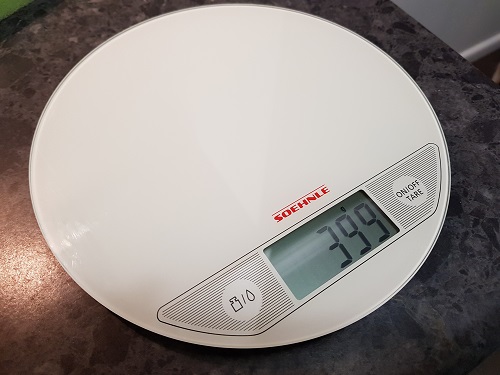
Food scales

Lighten Up to Limber Up

Many people with chronic health conditions are told by their doctor to “lose weight”. Having a chronic condition can mean the weight creeps on, often prior to diagnosis when we don’t know what is wrong, just that we aren’t well. This may continue after we are diagnosed, while we wait for treatment decisions to be made or for treatment to kick in. We may be on a steroid for a while (as I was) which despite the best intentions in the world can result in patients gaining unwanted kilos. Lots of stuff going on that disrupts our normal patterns, can effect our ability to see we are gaining a kilo or two.

How many times do any of us get home from work too tired to cook a proper meal, so we have a toasted cheese sandwich? With Vegemite, of course! Or grab take-away on the way home? Maybe even Vita-wheat, Vegemite and cheese. That’s 232 calories, but not really nutritionally balanced. Doesn’t look too appealing either, to be honest.

Vita-Wheat Vegemite Cheese

In addition, because we don’t feel well, we aren’t exercising enough to compensate for our often less than optimal food choices. We are defeating ourselves from both aspects: too much in, not enough out. We are NOT necessarily able to just ramp up our weights or cardio and burn that cheese sandwich right off. In fact, walking from the car to the lift at work may be as much as we can manage some days. Adjusting to our new activity levels means adjusting to new fuel levels as well.

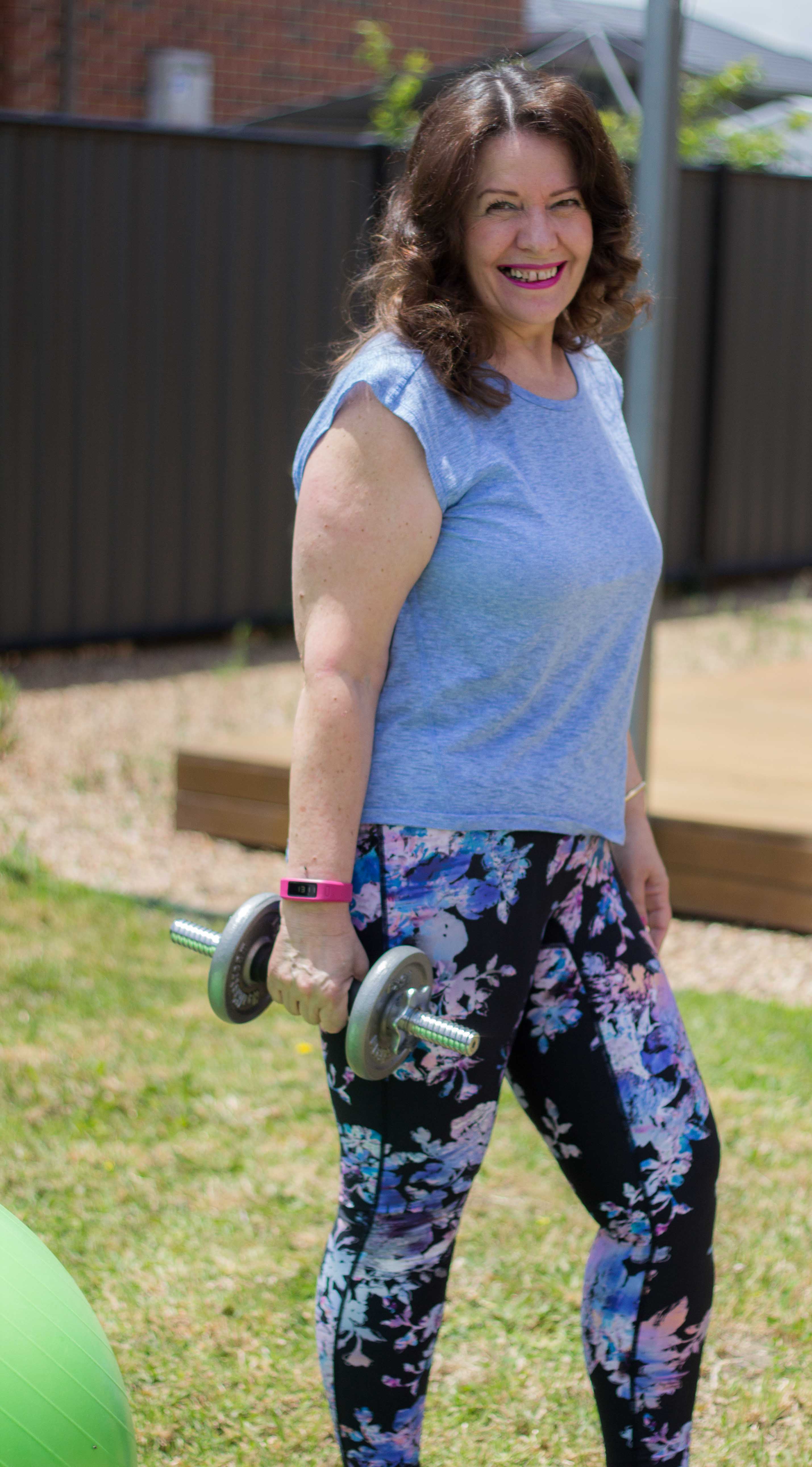
I can see some readers rolling their eyes already: “I knew she’d get to the weight loss eventually, but I want a coach who isn’t all about the scales“.  Hear me out. Let me assure you I am not all about the scales (actually, I am all about food scales), but I mostly certainly AM about helping my clients attain and maintain a weight that supports their efforts to manage their condition – or conditions. Take a good honest look at my picture below – do I really look like Vogue are going to invite me to appear on their cover next month? Of course not – I am no Australian size 6 – nor do I aspire to be. That photo is 12 months old – taken shortly after my medication change but before I was able to ramp up my own weights, but I have used it deliberately to illustrate the challenge we face.limberation-small-15

What I aspire to is being pain free and in control of my conditions. I’ve achieved that as far as my autoimmune conditions are concerned, but I can still improve my back support (detail later in this article). I am not going to complain if I lose a few more kilograms, but neither am I going to obsess about it. While the lighter I am the less stress there is on my joints, where I am right now I’m more interested in building strength (to support my joints and increase my metabolism (in turn encouraging those kilos to drop off as a nice side benefit).

Make no mistake, when it comes to your health, the risk of developing a range of conditions is dramatically increased if you are overweight or obese (comorbidities associated with obesity are conditions such as diabetes, heart disease and cancer to name just three) . The risk of negative long term health outcomes are higher if you remain overweight or obese. The medical and scientific evidence is overwhelming.

Being overweight increases the load on joints for conditions such as the arthritis family. The heart has to work harder to pump blood around. If you find doing stuff an effort, imagine how hard your internal organs are working. My lumbar spine is not a lumbar spine I would recommend either – as we get older, lots of bits and pieces tend to show wear and tear, irrespective of any conditions we may have. In my case my lumbar spine is a bit unhappy. So core and glute strength is important for me.

At L3/L4 I have “marked facet joint hypertrophy” and a disc bulge. At L4/L5 I have a broad-based disc herniation and facet joint arthropathy. The complete findings run a full page, that’s just a sample. I don’t need or want to place any more stress on my back by making it carry around extra kilograms or not supporting it with good muscle tone. I still have some intermittent pain we suspect may be the result of this wear and tear, but it is improving.

To give your body the best chance of serving you well for the next 20, 30 or 40 years, you need to take care of it. Especially now a medical condition/(s) is making a darn fine effort at undermining your plans. Reduce the strain on the joints, give your heart and lungs a lighter workload, give your body the right fuel in the right amounts.

Speaking of fuel, when you take your car to fill up the tank with petrol or diesel, the fuel tank has a finite capacity. My car has a 60 litre tank. I can’t put 70 litres in the car. Our bodies are a little more flexible. My body will use an estimated 1,388 calories a day to stay alive: breath, pump blood around, blink (refer BMR Calculator below this article). I’m 62, so my metabolism is already slowed just by the fact I’m not longer 20. If I eat more than 1,388 plus whatever my activity calorie burn is but don’t use it, I’ll just expand. Unlike the car’s fuel tank, my body has no capacity limitations. Nor does yours.

Example: 1,388 + 100 for steps for day + 380 for a strength workout = Total 1,868

If I eat 2,200 calories, guess where the excess over 1,868 is going? Fat stores. That puts more stress on my joints, internal organs have to work harder.

Many of the learned articles on overweight/obesity talk in financial terms of the costs to the community and the country. I’m concerned about the personal non-financial costs to YOU, the individual.

I won’t lie to you. Getting into the groove of eating less calories BECAUSE you are burning less calories is a bit tough initially. As I mentioned in my opening paragraph, it may be a while before you even realise your activity levels have dropped or your metabolism may have slowed as a result of your new friend, your condition. We have to adjust to not burning as much as we used to: it requires us to develop new habits, change behaviours: that is hard. But only for the first few weeks. What bothers you more? A difficult few weeks –  or a tough (possibly shortened) rest of your life? The sooner you take positive action, the shorter the road will be.

Am I saying I never have a Murray River Salted Caramel with Macadamia ice cream (my nemesis)?

Connoisseur Murray River Salted Caramel

No, I’m not saying that. I like to have the things I really enjoy every now and then. I am also well aware that “little” indulgence is worth 339 calories. In other words, worth a whole meal (for my calorie levels, you may be able to have more). If I’ve burnt off 400 calories through activity that day, I can indulge and still hit my calorie deficit target. If I’m having a day where for whatever reason I’ve done very little activity, I make sure I am strict with myself. Keep on top of it, because we no longer have the luxury of going for a 40 kilometre bike ride to pull back a couple of naughty days.

All that discussion was without even looking at ensuring we are getting balanced nutrition. Our body is fighting an internal battle for us now – we need to give it the right nutrients (micro and macro) to put up the best fight it can. That’s a whole different topic for another day!

This article should be read as an introduction and conversation starter only. The concepts discussed are general and not tailored for any individual circumstances. Limberation can provide healthy eating support and guidance.

Additional resources:

PwC report, Weighing the Cost of Obesity

BMR Calculator mydr.com.au

BMI Calculator mydr.com.au

Australian Guide to Healthy Eating

Also check the references on the Science Stuff page.


Beat the Boom Bust Cycle

BOOM! You feel great! You do all the things you’ve had to put off. What a sense of achievement!

BUST…… Can’t move, feel totally wiped out, no energy……

And so the cycle goes.

While the boom/bust cycle is certainly applicable to pain, today I am looking at another symptom of many chronic conditions, fatigue. Lethargy can be a better description.

If you google “fatigue and rheumatoid arthritis” you will get about 579,000 results. Similar with other conditions. “Fatigue and lupus” will find about 705,000 results.

While fatigue can be, often is, linked to pain levels, I have found it can also not be: I can be fatigued without pain. Thankfully, not nearly as much now because I’ve adopted strategies to manage the fatigue much better than I did in the early days. As will be the case with many people, there may be more than one condition involved. In my particular case, hyperthyroid, a condition that may cause sleep disruption/lack of sleep quality – not something that helps a person suffering fatigue.

I still remember one particular day early in my journey. I woke up feeling FANTASTIC! Off to the gym I went, did a great workout, did the grocery shopping on the way home, changed the linen on the bed: and then collapsed. I had no energy for three days. Not how I want to live my life.

In an earlier article on removing stress from our lives, I spoke of certain practical changes I made. Not all were for stress alone.

The following should be read as ideas. This is some of the things I’ve done: all, some or none may work for any other individual, or may simply prompt thoughts about what might be applicable in your own situation.

Depending on how aggressive your condition or conditions are you may not need to be this drastic. Lifestyle changes such as exercise, eating well, ensuring adequate hydration and good sleep hygiene may be sufficient. The Arthritis Foundation has a short introductory article on beating fatigue with lifestyle changes. I certainly incorporate all those (especially the exercise, of course) in my life!

Don’t Overdo It!

Rule Number 1 is the same as Rule Number 1 for pain management. On the “BOOM! I feel so good today” days DO NOT rush around madly doing a list of things a mile long (shopping, go to the gym, vacuum etc etc). Especially in the early days (battling the guilt of not getting things done) we can go completely overboard on the BOOM days. Guess what? The next few days are awful. BUSTed. Then we feel awful again because we aren’t doing what we feel we should be doing…… around and around it goes.

Even now, I never do my grocery shopping the same day as I do a strength workout. I don’t do a strength workout the days I go to my day job. I do not check my work emails on the days I am not in the office (that took discipline, developing and sticking to that rule). I plan ahead and I PACE myself carefully.

RELOCATION

When I was appointed to my current role, I lived a considerable distance from my new work location. I love driving, but spending an hour in peak-hour traffic in the morning and up to two and a half hours getting home after eight hours in the office was NOT a happening thing. Not only did I find driving on the freeway in second gear extremely stressful, an eleven and a half hour day was just way too much. The best solution for me was to relocate closer to work.

I can now drive door to door in ten minutes, or I can take a tram and be there in twenty minutes. No stressful driving conditions and a much shorter day.

Reduce Working Hours

This is a tough one. Again this is an aspect of life that can relate to both stress and fatigue. If you are fatigued, you are less likely to perform as well at work and that creates stress (and in some cases, guilt). If your work is being a mother and a wife, the same feelings can apply.

In either situation, reducing working hours can be difficult. There are financial implications of reducing paid hours of employment. For a mother, who is going to do the work?

I have been extremely fortunate and am extremely grateful for my situation. The reduced hours I work allow me to feel I am professional and effective when I am in the office, yet I get enough time to ensure my exercise regime is followed, I can prep meals on a day off for the days I work and I get adequate rest. I can also schedule medical appointments on my days off without feeling guilty for taking time off work.

No, financially it is not as beneficial as working full-time. But I am a lot healthier.

Exercise

Yes, well, it goes without saying that would be high on my list of recommendations! Limberation would not exist if I did not believe so strongly in the benefits of exercise. I won’t repeat my How Tough is it to Get Moving article here, I’ll just repeat, when I say exercise, I’m not suggesting you rush out and start running 10 km a day!

The days I do strength workouts I ALWAYS sleep well that night. Exercise has definitely helped alleviate my fatigue.

Healthy Eating & Hydration

Particularly, I have found, a problem if you live alone. When you are so tired you can hardly keep your eyes open (but of course you can’t sleep either), perhaps also in pain, maybe also stressed because you missed that important deadline at work or missing the school concert: guess what, taking the TIME to eat properly, or even enough, just seems to fall by the wayside.

Once I started making sure I ate enough protein and stopped depending on “easy” solutions such as toasted cheese sandwiches, I did indeed feel a lot better. The meal prep mentioned above is not just about time, it is also about ensuring I have nutritionally balanced meals right there when I am too tired to cook.

Drinking enough is also crucial. I find I am good on the intake when I am at work or the gym. I am slack when I am home – the water bottle always seems to be where I am not and I forget. I certainly know about not drinking enough later on though.

Don’t Worry About the Ironing

Or the vacuuming. Or polishing the furniture (a quick dust will do). Yes, you must feed the cat, dog, fish or bird if you have one. Vacuum one room a day. If you are in a family environment, delegate the ironing if possible: if living alone a) buy clothes that don’t need ironing or, b) iron one thing the night before. Hide the ironing basket in a cupboard out of sight, not only of visitors, but out of sight of yourself so you won’t be tempted to overdo it!

Sleep Hygiene

There are lots of different sleep hygiene strategies/techniques you can try, from breathing techniques to relaxation music, yes, even counting sheep will work for some. Temperature of the bedroom is important, put the screens (iPad, phone, TV) away well before bed-time. Talk to a professional about strategies that might work for you.

This one is an ongoing challenge for me, so I have no brilliant suggestions of my own to share. I know it is important and I’m working on it!

Why the Cat?

Why is my cat the photo? Because Cleo is doing what we must all do. Learn new things, within our restrictions. I don’t have an area I can let her experience the great outdoors freely. Learning to adjust to a harness and lead allows her experiences she would otherwise not be able to have.

Our harness is learning to PACE ourselves, so we can still have adventures.

Additional Resources:

A very interesting media release from 2007 by Arthritis Australia is worth reading, Women’s Insights into Rheumatoid Arthritis.

Get the Stress Out of Your Life

Being diagnosed with a chronic condition or conditions is stressful. You will notice part of my coping mechanism is I don’t use the word disease. I talk about conditions. I’ve learnt to accept I have a condition, I’m not ready to use the word disease. I’m in my third year post-diagnosis and I’m still adjusting.

Finding out you are not well is a difficult time. So many questions:

  • What does my future hold?
  • How bad might it get?
  • Will I become a burden on my family?
  • Will I be able to do my job?
  • How fast does this condition progress?
  • Will this shorten my life expectancy?

These are just a few of the many, many questions that will run through your mind. Worrying about the answers is, yes, you guessed it, stressful. The answers will ultimately be different for different people. I met a fellow patient in the gym one day. Diagnosed with rheumatoid arthritis in his late thirties, he was forced to give up work in his early forties. He is now in his early sixties. He is still doing everything he can to stay as well as possible – I met him as we worked on adjacent rowing machines. He told me he has had several operations over the years and lack of energy/fatigue is one of his major health issues.

I was diagnosed in late 2014, I am still working, swimming, walking, lifting weights: I am careful about how much I do, but my life has not, yet at least, been affected as dramatically as his life has been. I’m in a much better state of health now than I was in 2014: hopefully I can continue to improve or at least stay as healthy as I am.

I compare the two cases to illustrate in those early days there are no immediate answers. Any of us can be at either extreme or anywhere in between. I worked with a young woman who was having her first baby. She told me in her very early twenties, shortly after she was diagnosed, she could not hold a toothbrush or do up her bra. Yet here she was some years later working full-time and about to have her first child. Try not to worry about the unknown: easier said than done, I know. It took me quite some time to stop worrying about what I could not control.

Your doctor may well have said to you something along the lines of “Get the stress out of your life”. Great – you just gave me more stress and you are telling me to get stress out of my life? Terrific!

We all live with a degree of stress in our lives. Making sure we get to work on time, pick the kids up from school, stretch the budget until next pay day, find the money to fix the water heater than just blew up a week out of warranty, dealing with the daily commute, an upsetting disagreement with a partner, difficult challenges at work. In modern life we have so much packed into 24 hours, many of us don’t get enough sleep which in turn doesn’t help our health or our ability to deal with stress.

There are major stressors: the death of a loved one, changing jobs, moving house, divorce. The Holmes-Rahe Stress Inventory allocates points to many life events. They also developed a statistical predictive model, predicting the probability of a subsequent adverse health event based on a person’s stress score.

In 2012 the Carnegie Mellon University released study findings: How stress influences disease: Study reveals inflammation as the culprit. Then there is Stress as a trigger of autoimmune disease, a study looking at the relationship between stress and autoimmune conditions. This is just three of the many, many studies that have been done.

Stress may also lead to condition flares: all of a sudden the condition will go crazy bad for no apparent reason. As an example, one day I woke up unable to use my right arm, the pain in my wrist and hand was excruciating. I spent the day with my hand in the comfort position (think of an arm in a sling, hand higher than elbow). By 3 pm in the afternoon that flare had faded. Luckily. It may not have been stress that caused that particular flare, I will never know for certain, but I suspect it may well have. We are well advised to minimise stress.

What can we, as patients, do to reduce stress? Re-evaluating what is important to us is a good place to start. If we have a big home with a massive garden, we need to consider do we really need that. Is hiring a gardener and a housekeeper feasible? Can we delegate tasks to other family members? While every person is different, I can spend an hour in the gym lifting weights with no pain at all, yet I end up in pain every time I change the linen on the bed. If I spent an hour in a garden on my knees pulling weeds I’d be in serious trouble afterwards. If we hold onto that garden or the house, we then stress over the things we can’t, or shouldn’t, be doing. By the way, there is nothing wrong with vacuuming one room a day if that is what we need to do – it can be as simple as ensuring we pace ourselves. I discuss pacing in “Pacing for Beginners“. Consider downsizing (not possible for everyone, of course). Adjust how you do things – I leave some thoughts at the end of this article.

Work may be another challenge. Depending on the hours worked, the type of job and the specific symptoms any individual experiences it may be worth reconsidering how we earn our daily bread. Making that decision can be stressful in itself: there are possibly financial implications and certainly psychological implications. We may have to fight feelings of inadequacy or incompetence because we can’t work the hours we used to or do the tasks we used to do.

Fatigue is one symptom that isn’t always given a lot of attention, yet can be extremely disruptive to our lives. It is also a symptom I have struggled with during the last four years. The feeling of uselessness was at times overwhelming. I went from being a person who did everything at “100 miles an hour” (according to a girlfriend, that is) to someone who has learnt if I go at 100 miles an hour today, I’ll be useless tomorrow. Adjusting to this new way of living and working can be stressful. We want to be just the way we were before. We can slip into old ways of being and then pay the price the next day – or for two or more days. Be kind to yourself: easier said than done for many of us.

We may also feel physically inadequate or incompetent (there it is again) compared to our past selves. The first time I tried to do a leg press again I found I had to start at 20% of what I had been able to do in my heyday. To me that was devastating. I felt like I was a shadow of my former self. Who was I now?

Brain fog. Yes, folks, brain fog is real. Very real. That also leads to feelings of inadequacy/incompetence until strategies to manage it are developed. Even then, nothing is fool proof. I’ll share one little recent example. My real estate agent called. Why was she calling, I enquired. In response, apparently, to my call the previous Tuesday. Me? I called? No, I’d thought about it, but didn’t have time. I was adamant I had not called, maybe one of my neighbours had. Given the topic was a garage door frequently mysteriously opening of it’s own accord, it could have been a neighbour. Well, no. When I checked my phone log, I had indeed called. Brain fog.

I recommend talking to your GP about a referral to a psychologist. Adjusting to being sick is not easy. Having a professional help you work through that emotional adjustment can help ease the stress. Plus, to be frank, you can vent about the whole situation without feeling as if you are driving your family nuts: that alone can be helpful. Ask if you qualify for a Mental Health Care Plan (in Australia) if appropriate.

Exercise is a great way to help manage stress, depending on your current capacity to exercise.

Some things I have done:

  • Downsized – I live in a small apartment. Less vacuuming, dusting, floor washing;
  • Developed a career change so I can stop sitting;
  • Dropped my working hours (although with a new career based around movement I hope I will be able to do more hours, we shall see);
  • In my current part-time accounting role, I have a sit-stand desk, which helps immensely;
  • Learnt to accept I have a chronic condition – that is perhaps the hardest part, accepting;
  • Bought an upright vacuum cleaner so I don’t bend when vacuuming;
  • I don’t do all the ironing at once (in truth I do as little ironing as possible at any time);
  • I cook a week’s worth of meals on a Sunday so I don’t need to cook after a day at work (slow cookers are great for this in winter). Freeze and build up a variety;
  • I plan my activities a week ahead – I never do the grocery shopping and a gym workout on the same day, although I will swim and grocery shop on the same day;
  • Make time to look after my body: swim, strength workouts, Pilates, physiotherapy;
  • Make sure I get enough good sleep;
  • I eat well (most of the time – I’m no saint);
  • Resist the ever-present temptation to work when I shouldn’t.

There are some stresses in life we can’t avoid or control. Those we can control, we should.

For our health.

If you have tips and tricks, please share in the comments.

Lifeline Australia can be contacted on 13 11 14 and is a confidential telephone crisis support service available 24/7 from a landline, payphone or mobile. 

Disclaimer: The author is not a mental health professional. The concepts discussed above are based in part on personal experience and of a general nature, not tailored for any individual circumstances. Readers should consult their medical practitioner or allied health professional for personalised advice.

Launching Limberation!

Welcome! Limberation is now live!

Stay tuned for weekly articles of interest to people trying to manage the competing demands of a job, family, pets, medical conditions and their own physical maintenance.

Managing the demands of life is difficult enough for most people. Then one day you come out of a doctor’s consultant with a diagnosis and referrals to specialists. Your life just got a bit more complicated – or a whole lot more complicated.  Now you have to fit in taking care of yourself.

You know how sometimes you used to skip breakfast because the mornings were just so hectic and you have to catch THAT particular train or you’ll be late for work? Not so fast. NOW you have to find time for breakfast because you have to take medication and that medication must be taken with food. No scoffing down those pills on an empty stomach – that’s just asking for more trouble.

You’ve been busy the last few years and your exercise regime has fallen by the wayside. Suddenly finding time for exercise is mandatory. But you feel tired all the time now, hitting the gym or even just walking around the block is more challenging that you thought it would be.

I’ve experienced days where just getting off the bed was so painful I didn’t know how I’d actually get on my feet. I also knew once I did get on my feet, once I got moving, my pain improved dramatically. This will NOT be the case for every person immediately: those suffering chronic pain, for example, may need to work slowly to desenitise their nervous system. Just because something works for one person does not mean it work for another. We are all different.

Years ago I spent a lot of time working out – then I got too busy and I let it go. After all, I rationalised, I can get back to it when things settle down. This can be a psychological challenge post-diagnosis: for a competitive person, finding I could only leg press about 30% of what I used to be able to do was demoralising and demotivating. I had to fight that feeling of uselessness. I felt completely incompetent in a gym setting, yet I knew strength training was important for me.

The challenges those of us with chronic conditions face are not just medical. There are social, family, financial and psychological challenges. We have to examine our values and goals and reset some if not all of them.

Learning to pace ourselves can be the biggest challenge. Maybe working full-time is no longer the best thing for us, despite the financial ramifications. Maybe our current career is not helpful to us physically. In my case, sitting for long periods, being stationary, is not pleasant (and that is putting it mildly). A sit-stand desk helps greatly: changing careers to one with greater movement helps much more.

We need to prevent the de-conditioning of our bodies.

Deconditioning

None of this is likely to help us manage our conditions long term.

If your doctor hasn’t already told you to “get exercise” (as mine did), ask if exercise will be beneficial for you.

Then let’s Limber Up to Live Life.