Are Your Shoes Contributing to Your Pain?

I’m not just talking about six inch stilettos. Our shoes affect how we walk, how we stand and consequently our posture. If we are already facing joint issues, postural imbalances aren’t going to help. In simple terms, we can end up favouring (guarding or protecting) some aspect of our body which can place more strain on another part. It can become a case of the chicken or the egg, trying to work out where it all started.

Part of the solution may be changing your footwear. My rheumatologist gave me a stern lecture about heels. OK, his tone wasn’t stern, but I could tell his intent was! We know high heels aren’t good for us, but we keep wearing them anyway – until we get to the point that it is JUST TOO PAINFUL to persevere. We have to find more suitable footwear.

My Shoe Adjustments

About six months ago I bit the bullet and went on a “low heels” shopping spree for the office and social wear. In my down time I was living in runners, but that’s not such a good look in the office. Socially? I was warned, in no uncertain terms, by a girlfriend NOT to wear runners on a night out. Even with these lowest of low heels I was still experiencing pain in my right buttock and lumbar spine at various times, usually towards the end of the day.

I’ve found a great help for me – and for a neighbour, a friend and the friend’s husband. This may not work for you, but I’m sharing in the hope others may also benefit.

In sheer desperation one day I dragged my old MBT shoes out of the closet and wore them for two days. NO PAIN! However, they were so old (I’d forgotten I had them) that wearing them triggered end of life (theirs, not mine). Not surprising really – nothing lasts forever. I tried to buy replacements. Very, very hard to get in Australia these days.

kyboot by kybun

Doing my “can I buy them somewhere else” research I stumbled across kyBoot by kybun. I discovered the brains behind the original MBTs, Karl Müller, had moved on to developing his next generation shoes. There are only four stockists in Australia: one in Melbourne, two in New South Wales (Sydney and Mona Vale) and one in Brisbane. kyboot don’t have a very high profile in Australia – yet.

What makes them different? This is an American video, but illustrates the technology.

I visited a then Melbourne stockist in early July with NO intention of buying, just seeing what they had and trying them on. Yes, I walked out with my first pair. As soon as you walk around in them you can feel yourself standing differently. A co-worker who sees me at work every day told me I was walking as if I was twenty years younger – and without dobbing that person in, they are qualified to make that assessment.

I walk around a lot in my other job so my first priority was something I could wear to work that looked professional (i.e. did not look like runners). As you can see from the video below, they are fine for an office environment.

My Contacts’ Reactions

I posted about them on my personal Facebook page and spoke to a neighbour in my apartment building. It isn’t just me. My neighbour bought two pair: one for work and one for social. Her comment to me, “I don’t even take them off when I get home, they are too comfortable”.

The Facebook contact’s experience is best shown by her posts to me (I have redacted her name to protect her privacy).
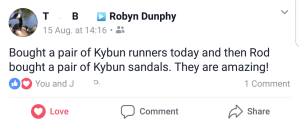
After a while this was her follow-up note to me.

She sent me a picture of her choice.

Kyboot

A Second Pair

So now I had solved my office problem, but I wanted some that I could wear working in Limberation. Something that would go with my gym gear. On the kybun website I had spotted the very colourful style featured at the top of this article. Sadly, this style is not stocked in Australia. Yet, anyway! The then Melbourne stockists, Peter Sheppard, very kindly ordered them in for me specially. I was very excited when they arrived. I was able to determine the size required by trying on another similar shape style prior to ordering.

Pros and Cons

These are not cheap. Up to $500 a pair depending on the style. As a friend said to me, “You can’t put a price on pain reduction”. Yes, my budget has been very tight this month, but I’m set for a while now.

The heel can also look a little odd when walking. Ignore the cat hair, she was all over me when I got home! In this photo I am landing on my heel to show the “squishiness”. The runners I have bought are not as squishy.

Kyboot

You really must try them on and be correctly fitted. My two pairs are two different sizes – the runners I wear with socks are slightly bigger than the ones I wear with stockings or bare feet. Take a typical pair of your socks with you to ensure the correct fit. I was really interested in getting a pair of sandals for summer, but I have very flat feet and in an open shoe my toes don’t stay where they should, so I think I’ll have to stick to closed styles.

The benefits, if these shoes suit you, are worth every cent. Everything we do – controlling our weight, increasing our movement & exercise (re-conditioning our bodies), reducing stress in our lives – all contribute to us managing our conditions and improving our quality of life. If a shoe helps us experience less pain or be able to move for longer before we experience the change (onset of pain), then we are going to be better off. Not only will we experience less pain, but we will re-condition faster than we might otherwise have done which in turn will help us manage our pain.

Summary

Before you ask, no, I don’t get any payments or discounts for writing about the kyBoot. I’m sharing because I’ve been so amazed and so have two contacts of mine. I have worn mine every single day since I got them (nearly two months ago). One of the Peter Sheppard staff told me that is what she had done the day I bought my first pair and frankly I didn’t believe her. Now I do.

The styles available in Australia are not the full range, however styles will change over time and if you are travelling overseas you may find different styles available in different overseas outlets. Just make sure you are getting the genuine article by checking the kybun stockists page.

Research. Read the kybun site to familiarise yourself with the product. The English version of the site probably doesn’t read quite the same as the Swiss version, but the basics are covered. There is even a section on “Initial Reactions” as depending on how you are standing/walking now you body may need to adjust. I didn’t have that experience, nor did the people quoted above, but be aware it is a possibility.

These may not be suitable for you. Even if these aren’t, it won’t hurt to evaluate your shoe wardrobe. Ask yourself whether you suffer less pain, or last longer before pain starts, in one shoe compared to another. Get rid of the ones you know are not doing you any favours. I hated giving up my heels – but now I just don’t care! I’m happily walking around everywhere! Yes, I kept my low heeled fashion shoes – there will be social occasions when I want to wear a dress shoe.

If you were a MBT wearer, these are much easier to walk in. There is a MBT v kyBoot comparison page on the KyBun site.

If you already have some kyboot shoes, please share your experience in the comments.

Update November 19, 2017

Above I stated I received nothing from kybun for writing this article. That is correct. I am disclosing that as a result of this article I have since been engaged to write for kybun for a period of twelve months.

Update October 21, 2022

As there is no longer a Melbourne stockist, I buy my kybun from Future Footwear in Sydney:

sales@futurefootwear.com.au

Future Footwear Pty Ltd
Shop 4 / 12-14 Waratah Street
Mona Vale NSW 2103

Tel:   02 9979 1713

How tough is it to get moving?

You may be asking yourself “How tough is it really, to get moving?” This may be moving again or starting from scratch. I’ll be honest, it may be tough-ish. How tough (or easy) will depend on many aspects: your specific condition, were you diagnosed early and therefore received appropriate medical care early, your pre-diagnosis level of activity, the medications you are on, the symptoms you specifically experience, do you have a chronic condition or are you in recovery from treatments such as chemotherapy.

The aim  of moving is to prevent de-conditioning, which I spoke about in Launching Limberation. Specifically here I am referring to pain management, but the benefits extend beyond this.

My Journey

I’ll share some of my own journey but as you read please be aware your situation may be entirely different. I do use time, distance and weight in this article to provide a sense of progress. Different people, different situations, different numbers, different timelines. What applies to me may not apply to anyone else at all.

Thankfully, I wasn’t completely starting from scratch – while I’d had an activity hiatus for roughly four years, I did have a gym junkie background to leverage. Or so I thought. In the beginning it certainly didn’t feel like I was leveraging anything!

Because I was diagnosed with two different autoimmune conditions at once, my medical team advised we stabilise one condition (hyperthyroid) before attempting to treat the other (autoimmune arthritis). Fatigue was a major problem for me in the beginning. Coping with getting to and from work, work itself and home life was draining what energy I did have. There was basically nothing left in the tank in the early days.

At the Starting Line

When I did start, I started very slowly. I did five minute walks four times a day. It didn’t take me long to realise I felt better when I moved. Pain and stiffness receded very quickly once I was actually MOVING. I increased to ten minute walks, three times a day. Finally I got to twenty minute walks, twice a day. I also moved as much as I could during the working day: sitting was hell. Even now, writing this in my home office where I do not have a sit-stand desk, I will not sit for long. No amount of activity is too small to start.

I didn’t do any strength (resistance) work at all in the beginning. I added some swimming: gone were my 2.5 km sessions: my physio was advising I swim 250 metres. I mumbled and grumbled that 10 laps wasn’t worth getting in the pool for, but I did stick to her advice the first time. The inflammation was also in my shoulders, meaning I had to strengthen my shoulders: be able to do 20 prone shoulder rotations (each side) daily with a 2 kg weight before I was allowed back in the pool.

Resistance Work

I wasn’t until late 2015/early 2016 I got back on the weights. I’d always liked the leg press, but had no idea what I should try to start with. Prior to the autoimmune arthritis and the hyperthyroid diagnosis, I’d been diagnosed (by MRI) with meniscus tears in my left knee, not a lot of cartilage to speak of and I’d had a Synvisc shot. I was understandably cautious, but knew I was continuing to lose muscle strength which wasn’t going to help me long term at all. I needed strength to support my joints, especially the damaged ones.

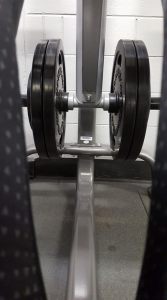
I loaded 10 kg weights on either side of the leg press and felt SO frail. I was in my school gym – most (not all) fellow fitness students were athletic and I felt like I didn’t deserve to be there. 20 kg was perhaps overly cautious. I upped the weight to a total of 60 kg quite quickly. From 60 kg to 100 kg took quite a bit longer. If I recall correctly, I got stuck around the 80/90 kg mark for quite some time. One of the issues was not actually physical by then – it was not knowing what was safe for me to aim for and no-one I asked was quite sure either. Will I ever get back to 200 kg? Right now, I doubt it – and you what? I’m OK with that. I know I have achieved what I set out to do – stay off pain medication. I’ll let the healthy people worry about 200 kg leg presses.

Climbing back up

Ultimately I asked my rheumatologist, who is very supportive of what I am doing, “How far is it safe for me to go? I don’t want to damage anything”. He is well aware I am using my own body as a research subject. He smiled and said “You’ll be fine. You’re sensible. Back off if it hurts.” After that I was more confident to push myself. I am careful. I don’t subscribe to the “no pain, no gain” philosophy – after all, pain is what I am working to manage, I don’t need to have more of it. Pace, incremental gains, no lifting to failure. My definition of “push myself” is not the general fitness industry definition – for very good reason.

I have just, this month, August 2017, managed to do a dumbbell bench press with 12.5 kg dumbbells (25 kg). I started back at 5 kg (10 kg total): it has taken me over 12 months to get to this far.

Other Considerations

Sometimes progress stalls. I find I lose gains very quickly if I miss a strength workout. Whether this is due to medications, the conditions themselves, my age (yes, I do have to consider that these days) or a combination of all three, I’m not sure. I’ve searched for research around such questions but have yet to find anything specific.

In late July 2016 I had a change of medication. I found this helped dramatically with the fatigue and therefore it has helped all the other aspects of my re-conditioning.

I don’t run. My knees are pain free and I want to keep them that way so I just don’t risk putting them through jogging or running. I walk a lot. I walk to my Pilates classes, I walk to or home from the gym, I walk to the next tram stop. While I’d love to get back to 10,000 steps a day, I’ll settle for 8,000 plus my other activities. I do indoor rowing, great whole body exercise.

In 2014 I could swim a 2.5 km session. In 2016 I was finally allowed by the physiotherapist to swim 250 metres. Now I’m back to 1.2 km sessions. Sometimes I only swim 800 – it depends on how I feel and how my shoulders feel. The message here is listen to your body at all times. Don’t use that as excuse to not do anything – but listen to your body. On Saturday I did my usual strength workout: I had every intention of increasing that leg press again, hopefully by 10 kg – I was aiming for 140 kg. As soon as I did my warm-up set I knew for whatever reason today was not the day. My strength was just not there. I suspect it was lack of dietary protein the day before – I’m currently monitoring how I feel against my dietary protein levels as mentioned on the Science Stuff page. So I simply did not try any increase. Next week will do, there is no rush, I’m not competing with anyone. I didn’t go backwards and that is my focus.

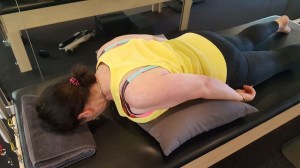
I’ve added Pilates to the mix at the suggestion of my physiotherapist. While this may look easy (looks like I’m doing absolutely nothing, doesn’t it?), trust me, after ten of these retracting the scapulae and opening the chest, I don’t want to do any more until the next day!

Objective Achieved!

As you can see, it isn’t achieved overnight. I’ve worked at it. Slowly, but surely, I’ve achieved my original goal: to stay off pain medications. Now on to the next goal, which is to help others in similar situations.

Will you give movement a try? Contact me for a preliminary chat. Limber Up to Live Life.

Disclaimer: This article is based in part on personal experience and is of a general nature, not tailored for any individual circumstances. Where appropriate, readers should seek medical clearance before embarking on an exercise program. 

Launching Limberation!

Welcome! Limberation is now live!

Stay tuned for weekly articles of interest to people trying to manage the competing demands of a job, family, pets, medical conditions and their own physical maintenance.

Managing the demands of life is difficult enough for most people. Then one day you come out of a doctor’s consultant with a diagnosis and referrals to specialists. Your life just got a bit more complicated – or a whole lot more complicated.  Now you have to fit in taking care of yourself.

You know how sometimes you used to skip breakfast because the mornings were just so hectic and you have to catch THAT particular train or you’ll be late for work? Not so fast. NOW you have to find time for breakfast because you have to take medication and that medication must be taken with food. No scoffing down those pills on an empty stomach – that’s just asking for more trouble.

You’ve been busy the last few years and your exercise regime has fallen by the wayside. Suddenly finding time for exercise is mandatory. But you feel tired all the time now, hitting the gym or even just walking around the block is more challenging that you thought it would be.

I’ve experienced days where just getting off the bed was so painful I didn’t know how I’d actually get on my feet. I also knew once I did get on my feet, once I got moving, my pain improved dramatically. This will NOT be the case for every person immediately: those suffering chronic pain, for example, may need to work slowly to desenitise their nervous system. Just because something works for one person does not mean it work for another. We are all different.

Years ago I spent a lot of time working out – then I got too busy and I let it go. After all, I rationalised, I can get back to it when things settle down. This can be a psychological challenge post-diagnosis: for a competitive person, finding I could only leg press about 30% of what I used to be able to do was demoralising and demotivating. I had to fight that feeling of uselessness. I felt completely incompetent in a gym setting, yet I knew strength training was important for me.

The challenges those of us with chronic conditions face are not just medical. There are social, family, financial and psychological challenges. We have to examine our values and goals and reset some if not all of them.

Learning to pace ourselves can be the biggest challenge. Maybe working full-time is no longer the best thing for us, despite the financial ramifications. Maybe our current career is not helpful to us physically. In my case, sitting for long periods, being stationary, is not pleasant (and that is putting it mildly). A sit-stand desk helps greatly: changing careers to one with greater movement helps much more.

We need to prevent the de-conditioning of our bodies.

Deconditioning

None of this is likely to help us manage our conditions long term.

If your doctor hasn’t already told you to “get exercise” (as mine did), ask if exercise will be beneficial for you.

Then let’s Limber Up to Live Life.