Strength Training – Getting Started (Part II)

If you have not done so already, read Part I before reading this article. Also pay close attention to the caveat therein.

Please bear in mind it is impossible for me to cover everything in one or two articles. My aim is to give you ideas and tips about how to get started.

Choosing Your Trainer

If you have an exercise physiologist – problem solved! They can develop a program for you and will know all the stuff I’m (hopefully) putting in laymen’s terms in this article! But not all of us do have exercise physiologists. Like any profession, you have to find the right one for you. I’m very happy with mine, but I have pointed out to one (in a hospital environment) that what I was being asked to do was not suitable given my overall situation at the time. Communication is, as with so many things, key. Recently I met a personal trainer who has become a osteopath as he wanted to increase his knowledge. This would be another ideal situation, of course!

From here on, I am writing as if you do not have an exercise physiologist.

As I described in Part I, different trainers have different areas of expertise, the same as doctors. No doctor graduates from medical school as a rheumatologist. Fitness coaches/personal trainers don’t finish their certification with a specialist knowledge of chronic illness patients. We need to find a trainer with either further education in this field or considerable experience – or willing/wanting to learn.

What questions should we ask? That is going to vary from person to person, depending on your particular condition/(s) AND the stage of progression of your condition/(s). I can give you some ideas, but you will need to think about your own specific situation and what might be the best questions to ask in your situation. What you are looking for is the trainer’s willingness to and hopefully knowledge about adapting exercises to suit your situation.

One question I would ask is do they recommend the chest press be done with free weights on a bench, or on a chest press machine. Yes, we already know I’d MUCH prefer to be doing the chest press with free weights – but I don’t for safety reasons as explained in Part I. I’d be looking for a trainer who was aware of the risk mitigation.

Another may be simply asking what do they know about your medical condition/(s). Hopefully you know enough to know if their answer is correct! If they don’t, are they willing to research. Effectively, your trainer becomes part of your “treatment team” and while you don’t need another doctor, you need them to understand the basics of things like flares and inflammation.

Side arm raises are an exercise where the angle can be changed from the standard lateral raise. Or the elbow can be bent slightly. These modifications depend on individual circumstances – I adjust my technique, you may not need to. This is a classic example of why the questions you ask need to be tailored to your situation.

The big one is the old “no pain, no gain” mantra. For a healthy person there is some truth to this – you might feel like you’ve lifted weights a day or two after you’ve lifted weights especially if you are lifting to failure. None of us will be doing that! If we feel discomfort doing an exercise it could be for a number of reasons:

  • Could be because we haven’t used that muscle or muscle group for a while
  • Could be because there is currently some inflammation there
  • Could be because over time we have “protected” that area and it has become weaker than it should be

The list is rather endless but we must stick to the pacing principles of Chronic Pain Management – feel a change, stop! NO “pushing through”. As I pointed out above, it may be a solution to change the angle, or drop the kilograms you are lifting, or do less repetitions (or drop kilograms and increase reps – the possibilities are many). The bottom line is you need a trainer who is well aware of these adjustments and who will NOT encourage you to continue at ANY level of discomfort.

Program Options

What sort of program you do will depend on your condition(/s), your background with strength training (if any), your level of overall fitness and your energy levels. While yes, you want to improve, you also have other things to do in your life such as cooking, laundry, driving and you need to ensure you don’t use all your energy on any one activity. Some chronic illnesses impact our energy levels quite severely, others not so much.

Be guided by the trainer – that’s why you are paying them after all – but be guided by yourself. If you feel the program design is too much for you when first starting out (e.g. do you feel wiped out the next day) then cut it back, add exercises back in slowly.

You may start with something like (I just plucked these out of the air for illustrative purposes):

  • Warmup
  • Leg press
  • Chest press
  • Seated row
  • Leg extension
  • Bicep curls

That’s not a heavy load BUT it is enough to see how your body reacts. If you feel fine, add a couple more exercises in.

Remember, the more exercises you do per session, the more careful you may have to be about increasing the weights because more exercises means using more energy. Increasing kilograms means using more energy. You don’t want to use too much energy all in one go. Avoid the Boom/Bust cycle!

Also, see the “How Often” section. You can split the workload!

Starting Kilograms

Recently I took a much younger friend, Tanya, to the gym with me. Tanya had expressed an interest in building her strength but was a bit wary of hitting a gym full of body building champions (my words, not hers). My gym is nothing like that so I invited Tanya along. Essentially she is healthy, not a chronic illness patient. She had recently noticed that physical work had resolved some shoulder pain she had been experiencing and that had driven her to think more strength training would be a good idea.

We did a warmup on the treadmills then headed for the leg press. I am mortified by my own (now) measly (by my expectations of myself) 125 kg leg press, and innocent me assumed given Tanya’s relative youth and health status, she’d easily lift that. I was wrong. We needed to drop the kilos. I have lifted weights most of my adult life, I have a history. Tanya doesn’t. So even though I’m sad I can’t lift what I once did, Tanya’s legs had no such experience! On one machine I had to set the weight to no weight at all. I will say Tanya is now more inspired than she already was to build her strength!

And she posted a lovely compliment: “Can this woman lift some serious weight, yes she can! Put me to shame!” I didn’t put her to shame at all really. I suspect it was a simple case of my friend underestimating my abilities due to my age (compared to her age) and medical conditions! Tanya is 16 years younger than I am. I probably overestimated her abilities due to her youth and recent physical work.

The lesson here is your starting weights could be anything. DO NOT STRUGGLE. Yes, you will see healthy people lifting to failure (keep increasing the weight until they literally fail to lift that weight). WE are NOT going to EVER do that, unless you are lucky enough to go into remission!

Start with a weight that feels comfortable for you for that exercise. You might start by doing 8 reps a set instead of 10. Increase the reps each session, then increase the weight and drop back the reps at the new weight. As I mentioned in Part I, I tend to build up to 12 reps a set before I increase the weight. At the new weight I’ll do 8 or 10 reps depending on the exercise.

If your trainer says, “That looks too easy for you, let’s increase”, that’s fine to TRY, but if you feel any discomfort or you struggle, drop back. Pacing rules rule!

How Often

When I started back I did strength training twice a week. I then increased to every third day. Now I’m doing three times a week and I very much doubt I’ll go beyond that, simply because I want to ensure I don’t overdo it. It also depends on what else you are doing. I walk and swim. You might cycle or run. Some readers will still be working, may have families you are caring for: any number of other aspects of life that require energy. And let’s not forget those darn medical appointments you still have to fit in – they take energy too.

Initially, I dropped my step goal on the days I did weights. I no longer do that, but it is an approach that works in the early days. It is all about balancing your energy use while you build more energy reserves.

Now I’m going to paint a general picture. I’m not saying this next idea is what you should do, I’m saying this is an example of what you MAY do. The trainer and you decide on a program. Be aware it doesn’t have to be done all on the same day. You can split the exercises. Spread the exercises over two days. You may do upper body one day, lower body the next. Or you may find a bit of both is better. For example, my wrists have been problematic from time to time. Most upper body strength training exercises involve use of the wrists in one way or another. Consequently, at those times, I do not do all my upper body on one day. That may aggravate my wrists, not something I’m keen on.

We have to be a bit more flexible (no pun intended) on how we approach strength training, especially in the early stages.

Other Adjustments

I’ve seen stroke survivors in the gym exercising one side of their body. I’ve been there in a moon boot doing upper body only. Other times I’ve done lower body only because my shoulders were flaring. I’ve walked in on crutches and only done upper body. We need to be prepared to be flexible in our approach. Sure, I’m working on increasing my weights, but there’s been days when my body just says, “no, not today” and I have to drop my weight (on whatever exercise) for that specific day.

Don’t get hung up about increasing constantly. That’s not what this is about, we aren’t aiming to compete at the Olympics, we just want to maintain our independence (see the articles at the bottom of Part I).

Don’t feel defeated if today you can’t lift what you lifted three days ago. We have chronic illnesses that often seem to have minds of their own and while we are in charge of managing those conditions, part of managing them is listening to our bodies.

I wear a mask. Yes, I’ve been asked, “Are you going to lift weights in a mask?” Yes, I am. I am immunosuppressed and have underlying inflammatory conditions. I DO NOT need Covid! I am not lifting the sort of kilos that would have me gasping for breath. I will say I can only manage about 500 to 700 metres on the treadmill with a mask, but that’s all I need for warmup.

Protein

Check how much dietary protein you are consuming. Many of us don’t eat enough protein and if we add strength training to our “To Do” list we need to ensure we are getting enough. I am not a nutritionist so I suggest you talk to your GP or a nutritionist. I have cited this article before, specifically related to inflammatory diseases (and inactivity).

Effects of inflammation and/or inactivity on the need for dietary protein – PubMed

I found this interesting as I realised at one point my protein intake was not reaching even the recommended levels for a healthy person AND my pain had increased. I asked a physiotherapist was he aware of any research re pain and lack of protein. He wasn’t. I discovered I felt better when I upped my protein intake. I then went searching for any research on the topic of inflammatory conditions and dietary protein. The above article is one of several I found and the one I cite.

Remember, if you eat a 180 gram steak, you are not eating a 180 grams of protein! A beef eye fillet is about 22% protein, per CalorieKing.

Note for Older Australians

If you have a My Aged Care Plan you MAY be eligible to have your gym membership paid for through your plan. Your program would need to be developed by an exercise physiologist (verification requires paperwork!) or similar allied health professional.

In Closing

I hope this has been helpful. If you have any questions, drop them in the comments and I will respond.

If there is a topic you would like me to address, let me know!

Build that strength!
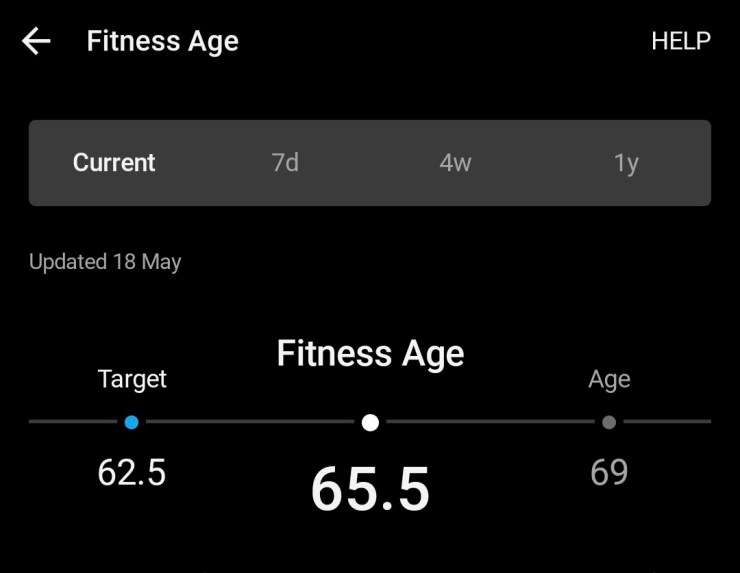
Garmin Fitness Age of 65.5

Accept the Project

I’ll start this article with clarification. This article will not apply to every person (remember we are all different) or every chronic illness or disease. But it does apply to many of us in the chronic illness population demographic. Remember, at least 47% of the population have at least one of just ten nominated chronic illnesses, so there are a few of us.

Please note as you read, I am using the word “accept” as per this Thesaurus definition: to accept or continue in a situation that is difficult or unpleasant: accept can be used when you want to say that you know a difficult situation will not change and you have decided to stop trying to change it.

But you CAN manage it in many cases. With, of course, the expertise of your doctors and allied health practitioners (physiotherapy, osteopathy, myotherapy, exercise physiologists particularly). Manage it to the point it is far less unpleasant.

The very first thing we have to do is truly accept the new us. Like you accept a new project in the work environment. Now, you may not like that project, you may not want to undertake that project: but you need to feed and clothe yourself, so you accept the project. You take it on board. You embrace it and do it to the best of your ability.

Discovering you have a chronic illness is a shock, no doubt about it. Many of us initially do some or all of the following:

  • Hope it will go away
  • Hope the medicine will do all the hard work
  • Deny the reality of the illness
  • Try to keep living “normally”, ignoring the illness
  • Think if they change aspects of their life to accommodate the illness they are “giving up”

The last one is the big one here. Let’s go back to the project at work analogy. To take on that project you may have to delegate some of your current role to other staff. You may need to relocate your office. You may have to hire new staff. Any number of aspects of your current work may have to change. You will have to set project milestones and goals.

With a chronic illness, same deal. YOU are the Project Manager of your life. To all intents and purposes, your doctors are your new employees (sorry, doctors, don’t read that the wrong way!).

It takes time to accept this new role. I estimate it took me four years. Oh, I started the Movement As Medicine immediately: it was the other things that took longer. Like cutting my work hours to part-time. Eventually I retired earlier than I would have liked. I’ve spoken to other patients who cite times from one and a half years to eight years. The risk of not accepting this new Project is that your illness may progress faster (or quite simply drain you) than it otherwise would have.

As I have written in the past, the energy depletion with many chronic illnesses can be astounding. If, for example, we continue to work full-time, at the end of the day we are exhausted. No Movement As Medicine happens. Weekends are spent recovering some energy for the next week. Or if we see getting My Aged Care as “giving in”, we are using our energy reserves to do housework rather than care for our bodies.

I have a damaged lumbar spine (result of a car accident about 44 years ago). In 2016 surgery was considered, as the pain was consistent and rather debilitating. That surgery would not have been permanent. Instead, I elected to try strengthening my posterior chain. It is now 2025 and that has been successful – no radiofrequency denervation of the lumbar spine for me! While not directly part of my illness, my illness (as do many illnesses) does love to exacerbate weak spots – a 44 year-old injury is a weak spot.

Clearly, to work on my posterior chain strength I need both time AND energy. Project Management priorities! Should I have continued working full-time and hoped my back would right itself? We all know that would have been unlikely. Or dropped my working hours and used that energy and time to work on my body?

If you are diagnosed with a chronic illness, you cannot ignore it in the hope it will go away. This IS the new you. The faster you take on that Project Manager role, the better your chances of maintaining your independence, mobility and freedom for as long as possible will be.

Stavros is another patient who took on the Project Manager role. You can read his Type 2 Diabetes story here: https://dodona777.com/2025/05/16/why-dont-people-choose-to-heal/ Stavros took charge of his project: control his Type 2 Diabetes.

Yes, I know I’ve been quiet for months! You see, I’ve been so wrapped up in enjoying my much improved body since the new diagnosis, and getting my own Movement As Medicine back on track, that’s been my primary focus (evidenced by the feature photo). I’ve increased my weight lifting/training from every third day to three times a week. For any readers raising their eyebrows about strength training, in closing I refer you to recent research findings:

The residents’ average age was 88, and three-quarters of them were women. Every resident had multiple medical conditions. Almost half required help to engage in the essential activities of daily life: getting out of bed, going to the bathroom, bathing, walking, eating.

One simple exercise proved older adults can build and retain muscle – and caused a paradigm shift in science

Source: The Guardian The ninetysomethings who revolutionized how we think about strength training

Are You In The Running For A Gold Medal?

No, I don’t have one, at least not yet. What IS she on about, I see you wondering. Let me recap. Back in May 2023 I wrote about Crossing My Fingers – Again. As it turns out, I was counting my chickens before they hatched. I saw my rheumatologist a week before my (latest, second) knee surgery and the decision was made no, the medication I was on was not working. HOWEVER, because my knee surgery was looming, I couldn’t start the next, the eighth medication, until ten days after my surgery due to infection risks, it being an immunosuppressant. This new medication can take twelve weeks, roughly three months to work – or more. Here we go again, I thought.

I started the new med in the second week of August. About three weeks ago I mentioned to my GP that if anyone were to ask, I would say the new medication was working about 50%. I qualified that statement by saying, “But the question is really, 50% of what? 50% of the maximum efficacy of the medication, or 50% of what I expect?” Hey, I’m an accountant – percentages make sense to me!

At my rheumatologist appointment this week, I relayed that conversation to him. I then added, for example, what percentage of normal can I expect to feel? 100% normal? 80%? Do we have a ballpark number? He sat back in his chair and said that was a very interesting question, he’d never heard it expressed like that. He told me, “We always aim for 100%, but don’t always make it”.

It is interesting to note that in cited clinical trials, on my new medication at the one year mark 68% of patients in the trial experienced “less joint pain and swelling”. Only 68% of patients? Only “less”, not “it had all gone away”? I’m not linking to the study results as I don’t name the medications I take simply because what doesn’t work for me might work perfectly well for other people and I don’t want to make any other patients hesitant to try medications. After all, we already know from my pharmacogenomics testing (click the link for great information) I have metabolisation issues with many medications (some too fast, some not at all, etc) – best not to use my personal experiences as an example of the efficacy of anything!

I actually don’t expect to achieve 100% of normal. My disease, psoriatic arthritis (PsA), like a lot of other chronic diseases, is A) not (yet) curable, and B) progressive. My patient understanding is that we hope to slow progression, not necessarily be able to stop it completely.

My rheumatologist (let’s call him Dr R) suggested I think about it like the Olympics – not everyone gets a gold medal, some people get silver. At the time, this sounded reasonable.

As I was walking the next day and thinking, always dangerous, I thought to myself, “Hang on a minute, in every race someone comes last!” And all the positions in between. Yes, every person who stands at the starting line hopes to get a gold medal, I know this, but only one does. I’m not sure this is the best analogy for Dr R to use. In fairness to Dr R, I think he came up with the Olympics on the fly, knowing my exercise strategy and thinking it fitted with the patient in question (me).

The initial three months have passed and yes, in the last two weeks I have started to feel much better. I have more energy, I found myself singing to the radio in the car (always a good sign) and my strength is slowly returning. At one stage I couldn’t lift my four litre saucepan if it was full, let alone do a six kilogram bicep curl. This was not just about strength – my hands and wrists were really sore if subjected to any load (saucepans or dumbbells), so although the biceps were quite happy, the wrists were not – we now have some improvement. I was waking every morning with my hands in a lot of pain and had difficulty bending my fingers (a complete reversal from when one hand had to be splinted to stop it locking into a fist). My hands are still a bit “grumpy” in the mornings, but at least they are usable!

The above photo was taken on October 22 – I wanted to wear an old bangle on a night out. As you can see, that wasn’t happening. My hands are still too swollen and the joint at the base of the thumb is bigger than it was in my pre-PsA days. So while I feel better overall than I did three months ago, am I “normal”? No. I think I might be at about 70% of normal taking into account my age which brings it’s own issues, irrespective of my PsA!

How could I measure it? Good question, I’m not sure. If I took the leg press as one measure, I am currently only doing 65 kg because I’m coming back from total knee replacement. My personal best since I was diagnosed is 160 kg. 65 is 40% of 160. But using that as a measure would be being unfair to the medication, as I am restricted in how much I can lift at the moment, being post-operative. I feel if it wasn’t for needing to be careful of my new knee, I could lift much more.

I’m not taking any pain medication other than Panadol Osteo, that’s a good measure, but I am supplementing with a low dose of NSAID as needed. I’m certainly doing more Movement As Medicine than I was before starting this medication: that is a very good sign. I’m writing (today at least).

Will I get the gold medal? I’m very wary of that as an analogy for treatment “success”. Too few people get gold medals in the sporting arena. How many of us come last? I know Dr R’s heart was in the right place, but I think expectations is something we perhaps need to look at more closely. What is a realistic expectation of improvement on any particular medication? Or, for that matter, with any particular condition?

As I stated above, this is my eighth medication since I was originally diagnosed in 2014 (with rheumatoid arthritis, later rediagnosed). That’s not counting the ever-present “extras” like NSAIDs and corticosteroids. But where am I in the race?

I think I know the answer: we don’t know! Personalised medicine is a rapidly developing field, but doesn’t cover everything yet. So I’ll keep running this race and hope I don’t end up last. Meanwhile, I’ll try to think of a better analogy. Maybe trying to hit sales targets? Not really my scene, but at least we’d stand an equal chance!

19/11/2023 Edited to clarify: by the phrase “So I’ll keep running this race and hope I don’t end up last” I mean I’m staying on this medication and hope improvements continue in the coming months. It occurred to me overnight that I may not have been very clear! My inflammatory markers were very nicely reduced too, which was good.

Related: Changing Medications – What Can You Expect?

Gardiners Creek

Crossing My Fingers – Again

My apologies for my silence over the last six weeks or so. I counted my chickens before they hatched.

On March 12 I published Changing Medications – What Can You Expect?. At that point it was roughly ten weeks since I had changed my medication for psoriatic arthritis (PsA) and I was finally feeling as if the new medication was starting to kick in. I was a little overly optimistic, as it turns out.

Also, although not mentioned in that article, the whole situation became more complicated when I slipped/tripped and fell in the shopping centre car park on March 8. What I initially thought was a simple trip ended up with me back in my orthopaedic surgeon’s office. To cut a long story short, it was decided the time had come to replace my right knee. If you are new to my story, I had the left knee replaced in 2020.

The problem was the slight improvement I’d got overly hopeful about in March did not continue. I was quite quickly back to waking in considerable pain and struggling with malaise and energy levels.

At the time I saw my perioperative physician I was still on 400 mg of Celebrex and 15 mg of Prednisolone a day. In order to undergo surgery on May 10 (the scheduled date) I needed to reduce the Celebrex to zero by May 1 and the Prednisolone to 2.5 mg per day by a week before the surgery. Was this going to be a challenge, I wondered to myself. I certainly didn’t want to just stop the Celebrex cold turkey on May 1 as clearly I was still in need of it to function on a daily basis. I’d needed friends to drive me to a myotherapy appointment and my pre-op Visionaire scans. Essentially, I wasn’t too chipper.

I discovered I had another infected tooth – maybe THAT was the problem? Had that tooth removed. It was a rather complicated event as the tooth was part of a double crown. I spent over an hour in the dentist’s chair, most of that time was spent removing the crown and temporarily recrowning the uninfected tooth. The actual extraction was a minor part of the visit. However, removing the tooth did nothing to improve my overall inflammation.

On April 17 I could see May 1 looming and decided I’d see if reducing the Celebrex was at all possible. Celebrex comes in capsule form – you either take a capsule or you don’t, there’s no pill splitting here! So I dropped from 400 mg to 200 mg on that Monday. Deliberate timing, as I had a GP appointment on the Tuesday. If anything went wrong, I already had an appointment! I also had accepted another kind offer from a friend to drive me to that appointment.

I woke up on the Tuesday in a very unwell state. While I managed to sit up in bed and get my feet to the floor, I could not actually stand up. This was a bit of a worry, to say the least. As gross as this sounds, I’m sharing for transparency: I was very worried about actually getting to the toilet in time. I tried using my walking stick to give myself some leverage, but doing so hurt both my hands and my shoulders due to the angle. Eventually I managed to stand upright and shuffle to the bathroom. While I was on my feet, I shuffled to the front door and unlocked it from the inside – if I had to call an ambulance, at least they could get in. Obviously I was in no position to start reducing my anti-inflammatories!

After various communications between my GP, rheumatologist and knee surgeon, the knee surgery was cancelled for the time being. My CRP and ESR inflammatory markers were rather high and THAT was while I was on all this medication. What would those markers have been reading if I was on no anti-inflammatories?

I did a damn good job on my rehab of my first knee and it is FANTASTIC! I want to be able to achieve the same result with the second knee replacement. At that point in April I was able to walk a mere 800 metres at a time because my ankles were so painful, the left one in particular. I knew that the extra loading of that ankle while recovering from surgery for the right knee could be very problematic. All things considered, cancelling the May 10 date was sensible, but very disappointing. I want the knee done, but there is no point in being a less that optimal patient if that can be avoided.

My next new medication injection was May 4 and I was getting closer to the 24 week mark – SURELY it would start working!

On May 4 (a Thursday) I gave myself the scheduled injection. Nothing much changed until Monday May 8. I did feel an improvement. I managed to walk 1.5 km in one walk. In total I walked 3 km for the day. I have slowly built up during the week and on Friday I walked a total of 4 km over three walks – I’d hit my old goal of 4 km for the day. Saturday I walked 2 km twice. The possibility of post-op rehab is now looking more achievable! I’ve even walked at my favourite walking spot, shown in the picture above.

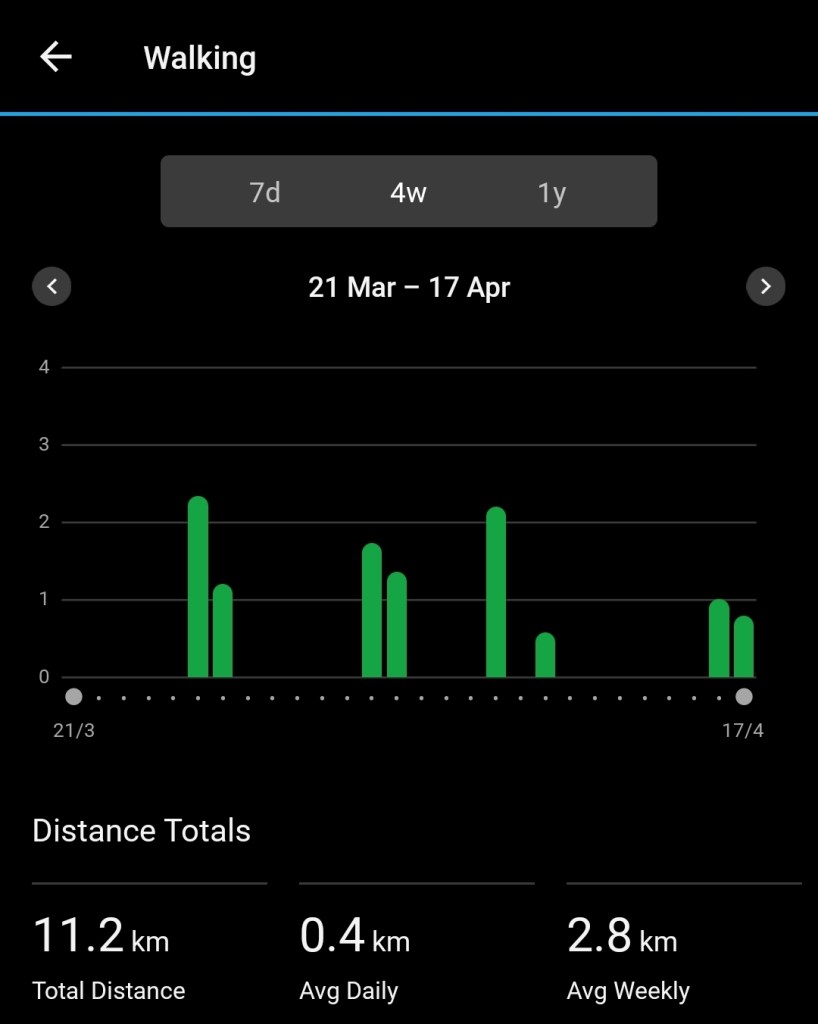
For those into graphic representation, here are the last 8 weeks. PLEASE NOTE Garmin changes the scale between the two periods, which makes the March/April bars look WAY higher than most of the April/May bars. And of course I haven’t finished today! Look at the total kilometres: 11.2 km versus 58.9 km

HOWEVER – I’m still on those same dosages of anti-inflammatories. I asked the GP about a possible test reduction and she was rather adamant that I give myself two weeks before we try to change anything. I haven’t even mentioned the pain medication I’m also taking or the Voltaren gel I am using on my hands and ankles.

While all this was happening, my rheumatologist scanned me for gout. The CT scan came back negative, which as the rheumatologist said is both a good and a bad thing. While it is good I don’t have gout, we are back to square one. Why is my inflammation so high? Is it merely that the new medication is taking its own sweet time to be effective? Or is my body being difficult?

Speaking of difficult bodies, I also did something rather adventurous. Click the image to go to the website.

While I am not going to go into detail about this test, it has been useful to me. My report was 29 pages long. To give you an indication, this is a summary of my genotype for the genes the test currently looks at.

We have changed two of my medications as a result. We also know to watch out for certain other medications in the future. This test does not yet cover every medication known to science, but it covers a lot. If you are interested, I suggest you speak to your GP about whether it may be useful in your situation. Yes, it is rather costly on a limited income but I see it as an investment in my health, given my situation.

Right now I am nervous that I am again counting my chickens before they hatch. Today is day eight of incremental improvement. I’ve managed to walk 4 km three days in a row, hopefully today as well. I have more energy. I’m writing. I haven’t ventured back to the gym yet, although I desperately want to.

In summary, as I said in my first article on the subject of changing medications, it is often not as simple as opening a different pill bottle. Even as I write, I do not yet know if this medication is going to be effective for me, but at least I have had eight straight days of improvement. I can exercise reasonably well again. This morning I woke with far less pain in my hands! So I’m crossing my fingers. The last blood test results showed a slight improvement in my inflammatory markers.

If you or someone in your life is changing medications, please be gentle. Be understanding. Be aware it may NOT be smooth sailing. 

In hospital again

Changing Medications – What Can You Expect?

This article is to illustrate the challenges any patient MAY experience when changing medications. I am describing my personal situation: please take into account while reading ALL situations are unique to the individual. My aim is to help patients be aware that changing medications MAY not be smooth sailing. I also ask friends, family and colleagues, especially those managing staff, to be aware changing medications is not as smooth as simply opening a new bottle of tablets. Be supportive and understanding of the patient.

2022 seemed to be a year of gradual deterioration. I ended up in the emergency department (ED) a few times and was hospitalised late January 2023, I had an infected tooth extracted, I just wasn’t feeling good at all. In late December I suddenly realised it was almost the holidays and I was likely to have doctors taking holidays. I felt bad enough that I decided I needed to talk to my rheumatologist before Christmas. My rheumatologist squeezed me in on his last consulting day prior to the holiday season, December 22, 2022. His assessment was that my old medication (let’s call this Med O) had ceased working for me. I stress the “for me” – this is one of the individual aspects – it may keep working very well for millions of other patients!

He started me on a new medication that day. We’ll call this Med N (“N” for New). I was advised it is not good to take Med O and Med N together, I was to stop Med O. I was to start (more like continue, as I had already started) Prednisolone and Celebrex to manage the pain. With hindsight, I think Med O may have still been partially working, guesstimate here, at 40% or 50% efficacy. Because once I stopped it, I got worse!

Med O was a daily tablet medication. The mean terminal elimination half-life ranges from 9 to 14 hours, so the web tells me. So once I stopped taking it, there was no longer any lingering protection from Med O.

Most fellow patients reading this will be aware many medications do NOT start working straight away. I talk about this in Movement As Medicine, written five days after I changed medications. By that stage I had read the documentation and worst case scenario was I could expect improvement in six months! Best case scenario was maybe “some” improvement in about four weeks. That’s a big difference in timeframes. Both “some” and “improvement” are very open to interpretation, too.

Between Christmas and New Year I had a case of De Quervain’s tenosynovitis in my left hand, requiring an ultrasound-guided steroid shot as soon as my rheumatologist was back in the consulting rooms! Not strictly PsA related, but I’m sure there is always a connection with these things, like the hole drilled in my big toe bone!

By that stage I had only had the initial Med N injection. This medication’s schedule is first injection at Week 0, second injection at Week 4, third injection at Week 12 and every eight weeks after that. I certainly wasn’t expecting it to be doing anything much at the three week mark.

On January 20th I yet again presented myself to ED because just about everything was hurting, I’d loss strength in my hands (could not even wring out the dishcloth). I was not a happy adventurer. I ended up having three infusions of methylprednisolone over three days to try to knock on its head the inflammation raging through my body. For a few days afterwards I did feel better, but then started to slide downhill again. Called rheumatologist. His advice was to increase the Prednisolone to 50 mg per day, then taper off at a 10 mg reduction per week down to 10 mg, then stay at 10 mg per day. I’d never been on such a dose! Especially after three infusions! I had noticed breathlessness was an issue after I’d been discharged from hospital and once I increased the Prednisolone dose I noticed sweating and (the worst bit) palpitations at night. Every night. It was like my heart was beating in my ears. Very unsettling experience.

I have a nocturnal AV block. This means my heart skips beats every now and then. Let me tell you, when you have palpitations the missed beats are accentuated. My heart was pounding then dead silence. While it is only a few seconds, I still found myself anxiously awaiting the next beat.

I woke up on March 1st feeling decidedly unwell. Doctor time! GP Clinic squeezed me in with a different than my usual doctor. She listened to my symptoms explanation then looked at my rather elevated blood pressure and heart rate.

Blood Pressure

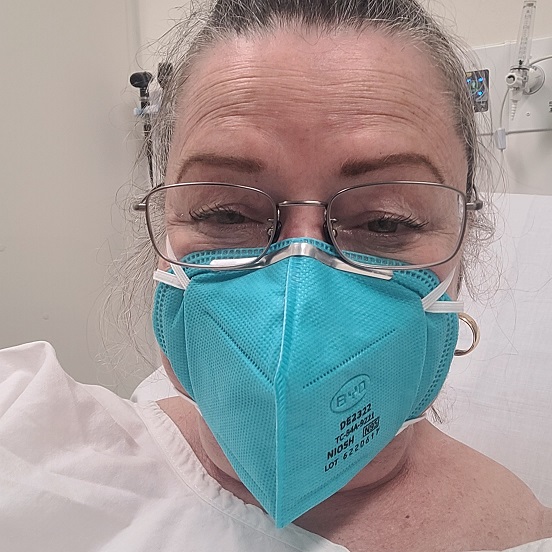
She wrote a letter to ED and told me to go home, pack a bag and head to ED. “Here we go again”, I thought. This was to be my sixth (I think, I may be missing one, I’ve lost track) trip to ED since October! While we both felt I was reacting to the Prednisolone, the obs were enough to need checking out. Bloods and a CT scan later I was sent home. I was not about to have a heart attack, so there was not much they could do. Yes, the picture above is me in ED on that day.

On February 28th I had reduced my Prednisolone to 20 mg a few days early because I was over the palpitations. While that had no effect (a bit early for the reduction to be reflected in my body’s behaviour) on the Tuesday night, Wednesday night I had no palpitations. I haven’t had any since that night either. Very happy about that!

Consider where I was at that point: Med N was still not being effective, and I was reducing the Prednisolone so the inflammation was increasing. Increased inflammation means higher pain levels. I was in a no-win situation at that point.

It isn’t all about the pain either. With my routines I can generally be pain-free by around 10:30 am, depending on when I get up, medication or no medication. It is the nature of the disease. The lack of energy and general feeling of unwellness was overpowering and that I can’t fix by 10:30 am. The effort required to do ANYTHING seemed too much. Having a shower? Tomorrow will do. Cooking? Toast was easier. Writing? The brain would not co-operate. I had to talk myself into walking, something I never have to do. Hydro pool? The effort required to get into bathers, drive there, get home and then shower just seemed all too much.

On March 9th I had my third Med N injection. Yes, technically a week early, but that is because somehow (do not ask) I stuffed up Week 4 timing. That’s OK, by the way, there is a window either side – I’d just confused myself. Cognitive impairment is worse at this time, naturally. I was still annoyed with myself.

FINALLY, March 11th (yesterday) I woke up and the malaise had lifted. All the sore bits weren’t sore. I could actually wring out the dishcloth – strength in my hands is returning. I am writing. I had been noticing gradual improvement over the preceding few days, but not wanting to count my chickens before they hatched, I’d been cautious. That cited six month timeframe was still floating before my eyes!

I still have swelling in various spots I can see and no doubt in spots I can’t see. I can’t see inside my shoulders, for example. I can see swelling in my hands still and there is fluid pooled under the skin on the top of my feet (like a bubble on both feet). The ankles are still swollen, but better than they were. I hope I’m safe to say we now have improvement: long may it continue!

So there you have it: just ONE example of how changing medications may not be as simple as just opening a new bottle of pills. If you or someone in your life is changing medications, please be gentle. Be understanding. Be aware it may NOT be smooth sailing. This has been an eleven week journey to just get SOME improvement from Med N. How fast improvement will continue, I cannot say.

Please note I have NOT addressed the question of adverse reactions to a new medication in this article, which is something to be aware of, of course. I’ve stuck to the topic of the process of change without adverse reactions. I have had an adverse event in the past, “When Medication Messes With Your Mind“.

* Med N was showing it was working on skin and nails though – so something was happening.

I Have Retired. Should You?

I’ve been very quiet on Limberation because I’ve been extremely busy. I’ve retired and moved. BIG life change it is too!

My plan was to keep working until I was 70. My body has been saying, “Maybe not”. Not that I am in constant pain, I’m not. And I want to stay that way. Regular readers will have noticed my articles about energy use and pacing. Two very important aspects to managing my condition and retaining my mobility, function and independence.

By April of this year I had reached the point where I was seriously considering how long I could keep working. It seemed I didn’t have enough energy to work AND exercise enough: #MovementIsMedicine. Of course, simply getting older plays a part in this as well and there is not a lot I can do about the passage of time.

When my name came up on the right list for retirement housing (yes, I had been planning ahead, I was on waiting lists) I made the decision. Retirement was the way to go. The decision involved a lot of work though – energy I really was struggling to find. Writing was definitely put on the backburner. Working through phasing me out of my position in a job I love. Organising the actual move – and the move date got moved twice, just to complicate matters. The move also meant downsizing and that was work. I am typing this on my dining table, not my very large corner desk with a return on each side that I used to have! Packing took more energy. To top it off I got a temperature that hung around for six weeks and towards the end of that six weeks, a tooth infection. The temperature involved a lot of blood tests, some CT scans and several doctors visits. More energy needed. We now think the temperature and the tooth were connected, but initially I didn’t have any tooth pain, therefore we didn’t realise.

It wasn’t just me either. My brother-in-law was diagnosed with an aggressive cancer, my nephew needed stents and my daughter and her husband got Covid-19. There was an attempted identity theft/fraud on an account of mine which had to be sorted as well – I caught it as it was happening, so no losses. Everything was happening at once.

Back to why I retired. I used to be able to walk before work, walk at lunch time and walk after work. I was struggling to find the energy to get dressed before work, let alone walk before work. This wasn’t good for the management of my psoriatic arthritis. I wasn’t being consistent in my exercise either. My weight training had dropped to once a week – I was not happy about that. As a result I was experiencing an increasing number of minor flares and I didn’t want any major flares! I had already cut my working hours from 30 hours per week to 24 hours per week, but the days I worked I was still struggling to do the movement I need, therefore I was losing the consistency.

It seemed if I did the exercise and physical therapy I need to do, I was too tired to work, and if I worked, I was too tired to maintain my exercise regime. Maintaining my health as best as I possibly can is critical to quality of life. I love working, but it reached the point where I could no longer have my cake and eat it too.

Should those of us with chronic conditions make this decision earlier if we can? It is a huge decision. There are the financial implications of course. There may be housing implications as well. The age pension age keeps getting further and further away……. The disability pension (for younger patients) is almost unattainable these days. Women around my age may not have a lot of super (if any) due to the particular decades we worked through, there was no paid maternity leave for many of us and so on.

Yet more and more of the population live with chronic conditions of some sort. We have to make hard decisions about how we manage our lives. I became eligible for the age pension the year before I finally bit the bullet and retired. I am still working as a casual for my employer but minimal hours.

I believe I have made the right decision for my health. Without health, other aspects of our life may suffer: relationships, work, mental health to name just three. Do we try to “keep going” too long, or longer than we should? I’m thinking not just of now, but in ten years time. I want to give myself the best chance of minimising deterioration NOW so I can maintain quality of life in my seventies and eighties. We need to look ahead, not just at tomorrow or next week. Our modern medications, as fantastic as they are, don’t solve everything.

What am I going to do with all this “spare” time? Naturally, I’ve set myself some physical goals: swimming, weight training, walking goals. I will pace up to those goals. Find more unusual flowers!

I will write more. I will get back to my parking permit project. I will finish unpacking, cull my shoe collection.

Paint my nails! Of course!

This first week of full retirement has been psychologically challenging. I hadn’t had time to really prepare myself for the change of lifestyle and then there it was, happening. My advice would be if you can plan ahead, do so.

So that is it. I am retired. A different phase of life.

Bring it on!

Personal Energy Use

Early in my chronic illness life, I wrote an introductory article, Pacing for Beginners. More recently, I wrote about Pacing THRU, Pacing UP, Pacing DOWN.

Pacing, balancing my life, has become even more critical since starting a full-time job. The earlier articles talk about the spoon theory and the battery analogy. Today I’m going to stick with the battery analogy as we all understand what happens when our mobile phone battery dies. That’s it. The screen is dead. You can’t make a call. The only option you have is to recharge the battery.

I find energy difficult to write about. I can’t quantify it like I can quantify calories or steps or weights. Energy seems elusive, hard to pin down. Even though I am using the battery analogy, I don’t have a charge meter on my arm. I can’t tell how much battery I have left at any given point in time. So if it seems like I’m pondering as I write, it is because I am pondering as I write.

Many of us with chronic conditions are a bit like a mobile phone. The battery has a limited capacity. I’ve written about fatigue/lethargy before too, in When was the Last Time You Yawned? Working full-time hours again, I have had to revisit my condition management plan to ensure I avoid the dreaded Boom/Bust Cycle. So far, I’ve managed, although my weight training has taken a bit of a back step, sadly.

The difference between me and my phone is if my phone goes flat, I can plug it into power, turn it on and make a call. If my battery goes flat, that is it. Coffee is not going to help. A sugar hit is not going to help. In fact, either might make the situation worse. Imagine if that phone battery could actually go negative and had to be charged back up to zero before use, even when connected to power. THAT is how we can be (not how we can feel, how we can BE) if we are not careful, if we break the rules.

While I was working part-time, I had everything worked out beautifully for me. I got the exercise I needed, the sleep I needed, I did my job well. I never let myself get a flat battery.

While I was not working in the early part of 2020 my plan was to pace up my exercise to build physical resilience in readiness for a new job. With the success of my new treatment, I could do this. There were some interruptions! A knee put me in hospital, then Covid-19 lockdowns followed by a total knee replacement meant things were a bit stop-start, but I was way ahead of where I had been at, say, the end of 2016.

Working full-time has changed how I can arrange my time and also shone a light on the fact the boom/bust cycle is still very much a risk. There have been times at the end of the work day where I quite simply feel my brain shut down. It goes from 90 miles an hour to a dead stop. Nothing I can do about it. The battery is dead. It isn’t just about physical activity, this battery also runs our brain.

It is challenging for people who have no prior experience of these sorts of conditions to understand what happens. After all, many of us, myself included, LOOK fine! It took my daughter some time to come to grips with it, but she now asks “Do you have enough spoons, Mum?” when suggesting something.

I’ve become better at declining social invitations – no, not on an evening before a work day, or no, not two events on one day.

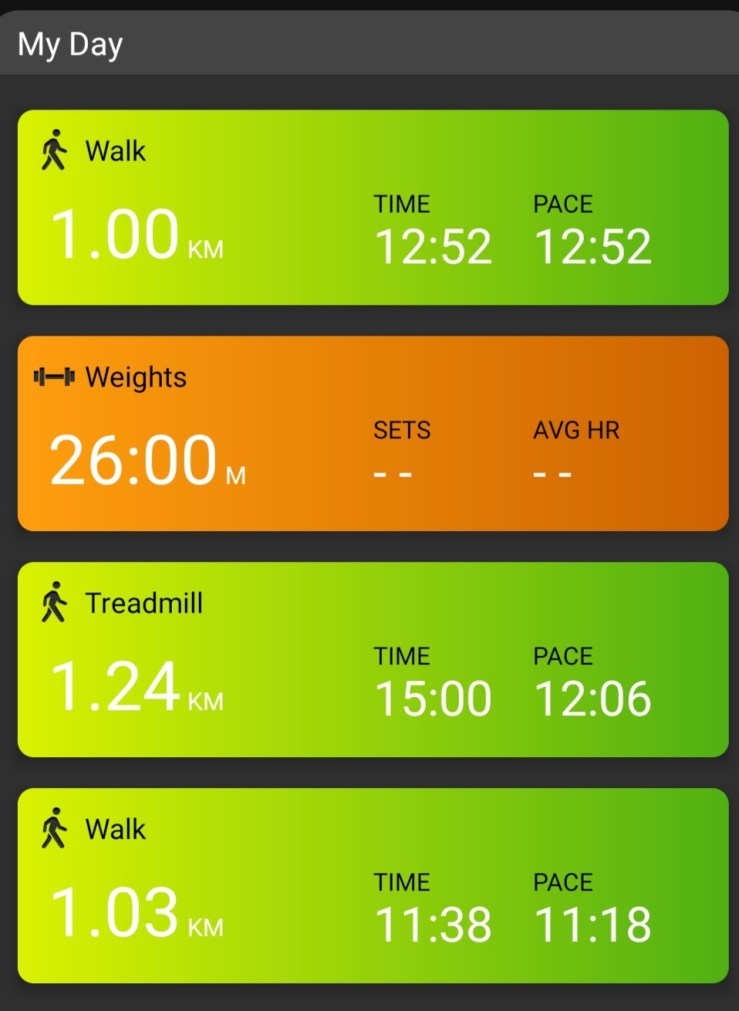
Every activity we do uses battery power. Showering, drying our hair, driving, working, exercising, cooking. In my experience some things use more battery power depending on the time of day: driving is a classic example. Driving for one hour in the morning is not nearly as tiring as driving for one hour in the evening after a day at work. It is almost as if once the battery gets low, it depletes faster. We have to be aware of all these things. I don’t want to cause a fatal car accident because I lose concentration because I haven’t paid heed to my battery level. Look at the pace column of my walks in the image above. the first walk of the day is the fastest, the last is the slowest. This is a constant pattern.

Early in my journey, I would have been unable to do a weight training session and grocery shopping on the same day. That would have used way too much of my battery. Even now, I shower in the evenings. Why? Because I can do it at a slower pace in the evenings and I am not using up vital battery life I need for the work day.

A good night’s sleep should recharge us, you say? We wish that were true. In many cases it is true – unless we have drained too much – then we end up in that negative charge scenario. Not good. However, disrupted sleep is often a symptom experienced by those with chronic conditions. Imagine trying to charge your flat phone, but the charger plug keeps falling out of the phone overnight. In the morning your phone battery is still at only 50%. That can be us.

Strength can fluctuate as well. I happily did 32 kilogram chest press sets one day with every intention of increasing next visit. Next visit I struggled with 25 kilograms. Why? No idea. By no idea, I mean no rational “healthy” explanation. Just that day my body said, “No, not today”.

Endurance is linked to our battery too. Some days I can walk two kilometres easily in one walk – other days I have to stick to three separate one kilometre walks. I’ll feel exactly the same at the start of any walk – then sometimes the body just says, “No, not today”. Part of this is linked to my not having the time available at the moment to consistently Pace UP. Between work and weather I have been limited to grabbing my walks in a somewhat patchy manner which breaks all the rules of pacing. Consistency is key. I’m not getting consistency. I suspect similar applies to the weights.

It is very hard to explain to people what this whole energy thing is like. How we constantly have to be aware of how much battery we’ve used. Healthy people would not, for example, think of having a shower as using energy, or should I say using any great amount of energy. I can assure you, many of the chronic illness community will attest to having to rest after a shower.

In my last article I raved, quite rightly, about the medication I am on. I also stated it hadn’t completely solved the energy/lethargy/fatigue aspect, or the “brain fog”. Despite my writing about energy today, these aspects are still much improved from where I was three years ago. To give some sense of measurement, three years ago I was working 24 hours a week and Saturday morning would always be a recovery morning – I’d do nothing until at least noon. Now I am working 38 or more hours a week and I’m actively doing something by 10 am on Saturdays. I might be at the gym, grocery shopping, doing laundry: I’m active. So a major improvement. And some quantification, which makes me happy!

However, I’ve had to cut my second weight session a week because the energy required to drive to the gym, do weights, drive back and then shower is more than I can manage at the end of a work day. I rarely write any more because usually by the end of the work day my brain has said, “No, not today”. I started this article on December 31, it is now January 16 and I still feel this is very scrappy writing. On the other hand it is a very scrappy topic: as I said I can’t quantify it very well. My thoughts about it come and go: after all, we learn, over time, to live with it. It becomes our new normal. At the same time we recognise that our healthy friends, family and co-workers can be baffled by something they have no experience of and it is not visible.

When I wake up in the morning, assuming I haven’t overdone it the day before, I feel perfectly “normal” just as I did before I became a chronic condition patient. The main difference is at the end of the day I will NOT feel as I did at the end of a day back then. Furthermore, depending how much “charge” I use during the day, I could hit that flat battery state earlier in the day. Other patients will not be as fortunate as I am, I am aware of that. So readers, just because I say I can do something, DO NOT, please do not, assume your mother, father, sibling, friend or co-worker can. They may be “better” or “worse” that I. I am simply n=1 – I’m not a study, I’m just one example trying to explain what it can be like!

As I write, at the beginning of 2021, I am very concerned for the long haul Covid-19 patients, many of whom cite fatigue as an ongoing issue. While the studies of this phenomenon may shed scientific light on ME/CFS, we will also have more chronic patients. My thoughts on society and chronic conditions are expressed in Society and Chronic Health Conditions. As communities, we have challenges ahead.

Make 2018 YOUR Year for SMART Goals

Seasons Greetings to all! Christmas is 30 or so hours away as I write (for those of us in the southern hemisphere). As the sun sets on 2017, we have an opportunity to re-evaluate our health progress and polish up our plans to get stronger, more active, more mobile and have less pain, less lethargy, better sleep: culminating in a better quality of life in 2018.

If you are still in “I’m thinking about it” mode, take stock over Christmas. What invitations did you turn down because you didn’t feel you could summon the energy required? Would you like to accept those invitations next year? Were you able to do the shopping you wanted to do without crashing in a heap for two days afterwards? Make 2018 the year you make the choice to include moving more into your treatment plans.

Talk to your doctors, get a clear understanding of what benefits you may expect from moving more.

SMART Goals

Now that my recent treatment change is behind me, I’m making more ambitious plans for myself and setting new goals for the new year. SMART goals. SMART goals are used in many walks of life: I’ve seen various wordings used depending on the context. For our purposes, I like the following definitions.

S = Specific. The goal needs to be something specific, not a nebulous idea.

M = Measurable. If we can’t measure our achievements against the goal, we won’t know if we are getting anywhere.

A = Achievable. It has to be achievable. If I set myself a goal of climbing Mt Everest, while both specific and measurable, for me it is not achievable. Swimming a two kilometre session – THAT is achievable.

R = Relevant. You will see realistic often used in this spot, but for our purposes I prefer relevant. We have limitations on our energy, our strength and our time. There is no point in setting goals that are not relevant to what we wish to achieve, which is better quality of life.

T = Timeboxed. There needs to be a time period within which you will achieve this goal. This helps to hold you to account and stay on target.

Let’s give it a try. “My goal is to swim two kilometres.” Is this a SMART goal?

No, it isn’t. While it is specific, measurable, relevant and (I hope) achievable, I have set no time target. “I want to walk more”, while relevant and achievable, is not a measurable goal – “more” could be anything. Walk longer distances or walk more often? Nor is it timeboxed. Walk more by when? 

Let’s have another go at this. “My goal is to swim a two kilometre session by 30 June 2018”. Now I have a SMART goal. I will need a progress plan to reach that goal, so I will need shorter term goals to get there: “My goal is to swim 1.2 kilometres once a week by 28 February 2018”.

That is one of my goals. Yours may well be something along the lines of “I will do my stretches every day for the month of January.” This is specific, measurable, achievable, relevant, timeboxed AND will set you up for the next step in establishing a movement as medicine strategy.

A walking more SMART goal could be very simple. “I will walk for three minutes, five times a day for one week”. At the end of the week a new SMART goal can be set. Remember when setting goals to pace yourself, always pace yourself.

Kyboot

For context, I was on crutches for much of 2014. I was diagnosed at the end of 2014. You can read how I started back to moving more on How tough is it to get moving?. My major goals for 2018 are:

  • Swim a two kilometre session by 30 June 2018.
  • Increase my daily step count to 10,000 steps a day by 30 September 2018.
  • Increase my leg press to 160 kilograms by 30 June 2018. (I was at 140 kg before my treatment change – I have to work back up after dropping back).

As I achieve those, I will set new goals during the year.

Of course, I have one other goal: help others get moving! I am back to normal availability after my recent hiatus, so reach out. It costs nothing to investigate the possibility.

Have a great time over the break! Stay safe!

Beat the Boom Bust Cycle

BOOM! You feel great! You do all the things you’ve had to put off. What a sense of achievement!

BUST…… Can’t move, feel totally wiped out, no energy……

And so the cycle goes.

While the boom/bust cycle is certainly applicable to pain, today I am looking at another symptom of many chronic conditions, fatigue. Lethargy can be a better description.

If you google “fatigue and rheumatoid arthritis” you will get about 579,000 results. Similar with other conditions. “Fatigue and lupus” will find about 705,000 results.

While fatigue can be, often is, linked to pain levels, I have found it can also not be: I can be fatigued without pain. Thankfully, not nearly as much now because I’ve adopted strategies to manage the fatigue much better than I did in the early days. As will be the case with many people, there may be more than one condition involved. In my particular case, hyperthyroid, a condition that may cause sleep disruption/lack of sleep quality – not something that helps a person suffering fatigue.

I still remember one particular day early in my journey. I woke up feeling FANTASTIC! Off to the gym I went, did a great workout, did the grocery shopping on the way home, changed the linen on the bed: and then collapsed. I had no energy for three days. Not how I want to live my life.

In an earlier article on removing stress from our lives, I spoke of certain practical changes I made. Not all were for stress alone.

The following should be read as ideas. This is some of the things I’ve done: all, some or none may work for any other individual, or may simply prompt thoughts about what might be applicable in your own situation.

Depending on how aggressive your condition or conditions are you may not need to be this drastic. Lifestyle changes such as exercise, eating well, ensuring adequate hydration and good sleep hygiene may be sufficient. The Arthritis Foundation has a short introductory article on beating fatigue with lifestyle changes. I certainly incorporate all those (especially the exercise, of course) in my life!

Don’t Overdo It!

Rule Number 1 is the same as Rule Number 1 for pain management. On the “BOOM! I feel so good today” days DO NOT rush around madly doing a list of things a mile long (shopping, go to the gym, vacuum etc etc). Especially in the early days (battling the guilt of not getting things done) we can go completely overboard on the BOOM days. Guess what? The next few days are awful. BUSTed. Then we feel awful again because we aren’t doing what we feel we should be doing…… around and around it goes.

Even now, I never do my grocery shopping the same day as I do a strength workout. I don’t do a strength workout the days I go to my day job. I do not check my work emails on the days I am not in the office (that took discipline, developing and sticking to that rule). I plan ahead and I PACE myself carefully.

RELOCATION

When I was appointed to my current role, I lived a considerable distance from my new work location. I love driving, but spending an hour in peak-hour traffic in the morning and up to two and a half hours getting home after eight hours in the office was NOT a happening thing. Not only did I find driving on the freeway in second gear extremely stressful, an eleven and a half hour day was just way too much. The best solution for me was to relocate closer to work.

I can now drive door to door in ten minutes, or I can take a tram and be there in twenty minutes. No stressful driving conditions and a much shorter day.

Reduce Working Hours

This is a tough one. Again this is an aspect of life that can relate to both stress and fatigue. If you are fatigued, you are less likely to perform as well at work and that creates stress (and in some cases, guilt). If your work is being a mother and a wife, the same feelings can apply.

In either situation, reducing working hours can be difficult. There are financial implications of reducing paid hours of employment. For a mother, who is going to do the work?

I have been extremely fortunate and am extremely grateful for my situation. The reduced hours I work allow me to feel I am professional and effective when I am in the office, yet I get enough time to ensure my exercise regime is followed, I can prep meals on a day off for the days I work and I get adequate rest. I can also schedule medical appointments on my days off without feeling guilty for taking time off work.

No, financially it is not as beneficial as working full-time. But I am a lot healthier.

Exercise

Yes, well, it goes without saying that would be high on my list of recommendations! Limberation would not exist if I did not believe so strongly in the benefits of exercise. I won’t repeat my How Tough is it to Get Moving article here, I’ll just repeat, when I say exercise, I’m not suggesting you rush out and start running 10 km a day!

The days I do strength workouts I ALWAYS sleep well that night. Exercise has definitely helped alleviate my fatigue.

Healthy Eating & Hydration

Particularly, I have found, a problem if you live alone. When you are so tired you can hardly keep your eyes open (but of course you can’t sleep either), perhaps also in pain, maybe also stressed because you missed that important deadline at work or missing the school concert: guess what, taking the TIME to eat properly, or even enough, just seems to fall by the wayside.

Once I started making sure I ate enough protein and stopped depending on “easy” solutions such as toasted cheese sandwiches, I did indeed feel a lot better. The meal prep mentioned above is not just about time, it is also about ensuring I have nutritionally balanced meals right there when I am too tired to cook.

Drinking enough is also crucial. I find I am good on the intake when I am at work or the gym. I am slack when I am home – the water bottle always seems to be where I am not and I forget. I certainly know about not drinking enough later on though.

Don’t Worry About the Ironing

Or the vacuuming. Or polishing the furniture (a quick dust will do). Yes, you must feed the cat, dog, fish or bird if you have one. Vacuum one room a day. If you are in a family environment, delegate the ironing if possible: if living alone a) buy clothes that don’t need ironing or, b) iron one thing the night before. Hide the ironing basket in a cupboard out of sight, not only of visitors, but out of sight of yourself so you won’t be tempted to overdo it!

Sleep Hygiene

There are lots of different sleep hygiene strategies/techniques you can try, from breathing techniques to relaxation music, yes, even counting sheep will work for some. Temperature of the bedroom is important, put the screens (iPad, phone, TV) away well before bed-time. Talk to a professional about strategies that might work for you.

This one is an ongoing challenge for me, so I have no brilliant suggestions of my own to share. I know it is important and I’m working on it!

Why the Cat?

Why is my cat the photo? Because Cleo is doing what we must all do. Learn new things, within our restrictions. I don’t have an area I can let her experience the great outdoors freely. Learning to adjust to a harness and lead allows her experiences she would otherwise not be able to have.

Our harness is learning to PACE ourselves, so we can still have adventures.

Additional Resources:

A very interesting media release from 2007 by Arthritis Australia is worth reading, Women’s Insights into Rheumatoid Arthritis.