Yippee! Finally, Second Knee Replaced!

That was a long journey! But I am all good, the second knee replacement is done and shows every indication of being as great as the first knee replacement. July 26 was New Knee Day!

I wrote comprehensive articles relating to my first knee replacement. This time I’m writing about the differences between the two experiences.

The 2020 articles:

I have NOW been told my 2020 recovery was “exceptional” while this recovery has been “typical”. They didn’t tell me that back in 2020, just that I was doing “so well”.

The Lead Up

As with the 2020 operation, this initial operation was also cancelled and rescheduled. In 2020 it was due to Covid-19 lockdowns. This time, in 2023, it was due to my psoriatic arthritis (PsA) being out of control. As well as medication for the PsA, I was also on NSAIDs and prednisolone as we (hopefully) waited for the medication to kick in. For surgery I had to reduce the NSAID dose from 400 mg p/d to ZERO. I had to get the prednisolone down to 2.5 mg p/d. I wrote about those requirements and what happened when I did a trial run in Crossing My Fingers – Again.

With the change to pain medication for me, my GP and I were confident we could handle the 10 days required with no NSAIDs, but yes, IT WAS DIFFICULT. By the time I was due to be admitted, I could barely use my hands at all before 11 am, as an example. The hospital admitted me the night before on medical grounds as there is no way I could have got myself there by 6:30 am the day of surgery.

I’ve talked about my teeth issues: yet another tooth (the third) played up just prior to surgery – in fact it split and half basically fell out in the dentist’s hand. My dentist advised it needs to be removed by an oral surgeon and did a temporary patch job. My GP had prescribed precautionary antibiotics which I arrived in hospital with. That caused quite a kerfuffle and there was talk of cancelling the surgery. Thankfully, that did not happen. My surgeon does not like surprises! Good thing too, but certainly was a bit traumatic at the time.

Last time neither my PsA or my teeth caused any complications!

Surgery

Pretty much the same as last time – I was out for it! However, surgeon came to me after surgery and said it was very “messy” once he got in there. The inflammation had caused damage to muscles that he could “stick his fingers into” (the holes). Will the muscles heal, I asked. He believed so. I forgot to ask which muscles! He last described it as “terrible”. I’m not sure if terrible is worse than messy!

Reading the letter the surgeon sent to my GP, it was again the popliteus muscle that was so badly damaged. This is the same muscle that was being dissected by a cyst in 2020, just this time it was worse.

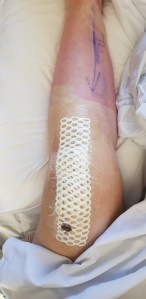
The scar looks pretty much a mirror image of the left leg! it is also the same length – 23 cm for those into scar dimensions.

Post-Surgery

One good difference, one not so good.

First, the good difference. In 2020 my glutes spasmed uncontrollably and very painfully 10 hours after surgery. In the end, Lyrica was used to solve the problem. On that basis, the peri-operative physician decided to start me on Lyrica immediately post surgery. It worked, no spasms. My glutes, ITB and piriformis were still painful and needed physio work, but there was no crazy spasms like last time. Yay! I was also on far less pain medication overall with the change my GP and I had made and which the surgical team adhered to.

The not so good difference was my veins kept collapsing and we had to find new cannula sites. This was not fun, especially at 2 am in the morning. Why were they causing issues? I don’t really know, although having been on prednisolone for so long pre-surgery was suggested as a possibility. I ended up with quite a few bruises. The machine would beep madly and display “Downstream Occlusion”. I’ve left out the bruise photos!

The darn catheter was not a relief. I’d been rather looking forward to not having to worry about toilet trips immediately post surgery, but I felt as if I wanted to “go” all the time. Very annoying!

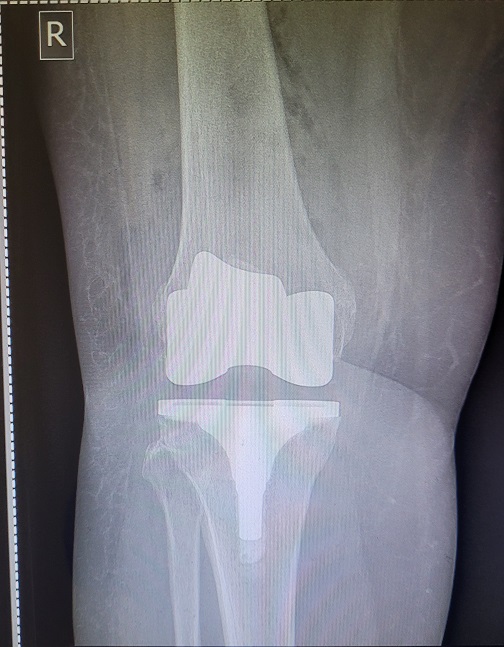
The x-rays look pretty much like last time! As does the dressing.

Of course I got makeup on and my nails done! The nails were done before the makeup and my hair is wet in the photo. But I was in hospital, so I’m allowed some leeway!


Rehab

Patient transport (to move me to the rehab hospital) was about 2.5 hours late and I nearly missed out on lunch!

Basically, rehab went pretty much like 2020. One difference was I left rehab still unable to do a straight leg raise. I managed to get those happening by four days later. It just took longer this time to get those quads really firing.

The other very sad difference was the wonderful massage therapist who had rooms at this hospital in 2020 is no longer there. Thankfully the physios treated my glutes and ITB!

The food was pretty good!

Home!

A hint. DO NOT accidentally hit your operated knee on anything. I did and I think I set myself back a week. Very grumpy with myself. I was a bit concerned and went to the surgeon’s office to have it checked on Monday (August 21). The nurse told me it looked fine, just to take it easy for a few days. So I did! Unusual for me, I know.

I’ve had ice packs on the knee and heat packs on my hands and glutes! Plus the spikey ball got a bit of use on the glutes too. Ice packs are good after the rehab exercises.

I am still taking pain medication, whereas in 2020 I had stopped by Day 20. As I write, this is Day 33 for this knee. I am older, the knee was messier and I accidentally hit it. Plus my PsA is still not under control (i.e. inflammation). My GP says to be realistic about the differences. I have reduced the pain meds considerably from when I first got home so that’s good.

I also have a theory about sleeping. My knee will be fine all day, but I’ll have pain or discomfort during the night. One night I woke up thrashing my leg around the bed, as if trying to shake off pain. Even this morning I woke up with the knee quite stiff. I think during our waking hours we are very careful and (usually) ensure we don’t do anything to hurt the knee. But when we sleep we toss and turn and can put the knee in positions it doesn’t actually like. We wake up as a result. Pain and/or stiffness can result. I wonder if bracing it at night might be a plan, but that only occurred to me today.

I am doing the rehab exercises religiously, as I did last time. On Friday (August 28) my flexion was measured at 128 and my extension was 100%! I never got to 100% extension with the left knee, I got to 98%. But I did get to 145 flexion at week 10, so that is again my aim. I may not get it, as I am heavier now than I was in 2020 due to the PsA and related meds this time around. It is still my target though.

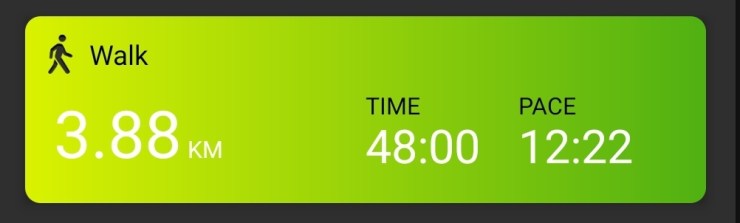
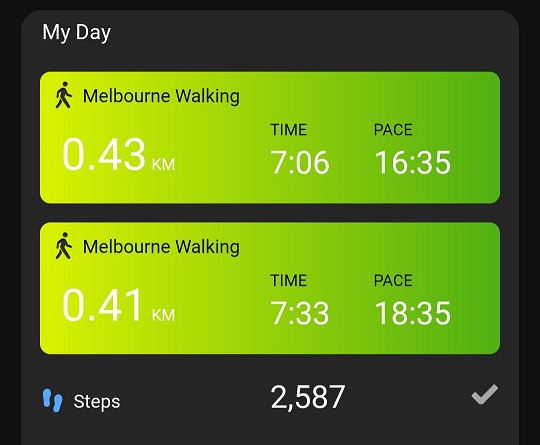
I am walking every day. Started with two little walks a day, gradually increased. Today I was back to my favourite walking spot!
Now, skip the next photo if you are squeamish. I think it looks great! Looks better now, this was a week ago. It is getting the Vit E treatment now. The scar from 2020 is barely visible any more.

So that about sums it up. As for the PsA, six days before surgery my rheumatologist changed my medication again, but I wasn’t allowed to start the new medication until 10 days after my surgery. It may take three months to know if this one works, so I am back on the NSAIDs and prednisolone while we wait. This is medication number 8. The hands are a little better now, but I am scared of counting my chickens before they hatch. The shoulders are also a little better. I do think I’ve been keeping Voltaren in business!

A Thank You!

Again, a very big THANK YOU to my surgical team. Same surgeon, same anaesthetist, same peri-operative physician as 2020. Absolutely fantastic. I am so happy to have matching knees!

Down with the Bad, Up with the Good

Thankfully, my second knee replacement surgery is back on the agenda! Woo hoo! I’m excited!

I suspect some people may wonder why I am getting a knee replaced if I can walk 7,500 to 8,000 steps a day and do “formal” walks totaling 4 kilometres a day. How can my knee be THAT bad if I can do that? Only due to great care and diligence, let me tell you. The aim of this article is to give some tips on how to manage walking leading up to surgery. If I don’t replace the knee, I am very limited in what I can do. I can’t spend my life walking in a straight line.

As described in Crossing my Fingers – Again, we felt my new biologic was finally kicking in. My GP wanted me to keep my medication dosages stable for a week or two, which we did. On May 30 I dropped my NSAID dose by half and have managed to maintain that. I saw my GP again on June 6. We felt if I got a surgery date, we’d make it. So I have a date! Next month! Now, we recognise that during the 10 days before surgery where I have to be at zero NSAIDs, I MAY have to increase my pain medication to compensate, but as this is only for 10 days, that’s acceptable. I did something similar for the last knee surgery too (there are links at the bottom of that article to the full knee replacement story). I also have to reduce my prednisolone, which I have starting doing this week. I’m NOT pain free, by any means, but I’m surviving!

I do have to be very careful to keep the bung knee in line, no twisting! I can’t fully extend it, although flexion is not quite as bad. Bending down to pick something up off the floor? OUCH! Having it bent while sitting at a dining table, for example, results in pain when I first get up from the chair.

I need to keep exercising to ensure I’m ready for rehab. Last time I was doing glute bridges on the dining table. Sadly, down I’ve downsized, my dining table is doubling as a desk, so I have to find other ways.

Here are my walking tips.

  • Make sure you have good, supportive shoes. This is an absolute must.
  • Choose a pleasant place to walk if you can. The photo above is where I love to walk. It is encouraging!
  • Keep an eye on the terrain. If I accidentally step into a small pothole with my bad leg, the pain is NOT GOOD.
  • Pay attention to your posture. If walking in a shopping strip, shop windows can be useful. In a park, check your shadow. Is your back straight? Shoulders back?
  • You may start limping because your body may decide to shorten your stride on the bad leg without you even thinking about it. Try to maintain the stride length if the pain is not too bad. This will depend on several things: what pain management program you have going, how bad the joint is, etc. You will need to “warm up” first, but I find I can control the limping without increasing the pain. Why is this important? Because you don’t want to shorten and/or tighten soft tissue like tendons prior to surgery if you can avoid it.
  • Down with the bad, up with the good. When negotiating steps, stairs or gutters on pavements etc, down with the bad leg, up with the good leg. Why? Less bending of the bad leg (especially bad knees). I stupidly walked down the stairs to the car park in a hospital the other day. Very bad decision, I should have waited for the lift! Even with this tip, stairs are hard to negotiate!
  • Inclines and declines. Where I walk there are very slight (well, very slight for MOST people) inclines and declines. Some on the actual path, but also bridges like this. While I have little problem with the incline, the decline is difficult. Depending on where the damage is in your knee (or other joint) you may find the reverse, or you may find both are a little challenging. Slow down, hold the rails if there are some, maybe decide that track is not for you in future.
Incline Decline
  • Don’t walk until you’ve “thawed out”. As we know, psoriatic arthritis is notoriously bad in the mornings. I take time in the morning to gently thaw myself out. The knee awaiting surgery will most likely also stiffen up overnight. While some mornings are better than others, I rarely do my first walk of the day before 10 am, sometimes not until 11 am. Even then, the first 200 metres or so are warming up.
  • Split the walking if at all possible. I’m retired, I can walk whenever I like, but obviously some patients are still employed. If you can break up the walking, do. At the moment it takes me about 15 minutes to walk a kilometre. You can fit a kilometre in here or there throughout the day. Take a slightly shorter lunch and a longer tea break, perhaps. Not possible in all jobs, I know. Winter means walking after work is not really appealing. Think about ways you can split the load.
  • As we all have different pain management regimes, I can only speak of mine. At the moment I am on a slow release (SR) twice a day and have some instant release (IR) for breakthrough pain. On a day where I’m not too bad, I may need no IR at all. If I am feeling the knee is a little too grumpy, I’ll time the taking of an IR (maybe only half) so that it kicks in before I start walking. This is all about listening to your body.
  • When you get home from a walk, I suggest elevating your feet for a while, but do not allow your legs to “freeze up”.
  • Remember to adjust your goals if you are doing other “stuff”, as I discuss in Why is There a Dip in My Stats?.

Once I have done the first walk of the day, I usually have very low pain levels for the rest of the day. We are all different, our joint damage is different and some, like me, have underlying conditions such as psoriatic which do complicate matters. So while that is my situation, I accept it may not be yours.

I also have two ankles requiring surgery. The left ankle is very problematic at the moment. When I was on my higher dose of NSAID I would know when I hit 500 metres on my first walk of the day as all of a sudden, the ankle would stop hurting as much. When I dropped the NSAID dose on May 30, from then it has taken about 800 metres before my ankle stops hurting. Hence it is important I time that IR dose properly if I feel it necessary. When I say “stop hurting” do I mean pain free? No, sadly, I don’t. Some days are better than others, but the level of pain is low enough that I can keep up the walking. And, once it is gone, it is pretty much gone for the rest of the day, thankfully.

We are all different. Please talk to your doctor and/or physio about what may be specifically appropriate for you.

Do not expect every day to be the same. For some weird reason this morning was awful for me. I even battled to pull my sheets out of the washing machine (nothing to do with my knee). I had a nanna nap after lunch (VERY unusual for me). Yet now, as I write, I am fine. I reduced my prednisolone yesterday morning, I think my body is adjusting to that reduction.

If you have any questions, I am always here to help if I can.

Addendum: The following is a good article from The Guardian about walking technique.

‘I’m not just faster, but taller’: how I learned to walk properly – and changed my pace, posture and perspective

Thirteen Weeks! (Knee Arthroplasty)

It seems like months ago, yet really it is no time at all! Thirteen weeks have flown by.

I kept up the rehab exercises every single day for twelve weeks. With the approval of my surgeon, I have now dropped to every second day but I have increased my walking. I was aiming for my first four kilometre walk today, but missed it by 120 metres – slight miscalculation on my part! It is important to keep up mobility work on your knee, so I do.

With the encouragement of my trusty physiotherapist, I’ve even managed to do single leg glute bridges. I was doing 30 glute bridges a day, now I’m doing 30 every second day. Unless I get super bored by Covid-19 lockdown and then I might still do sequential days.

What can I say? I. LOVE. MY. NEW. KNEE.

I think at thirteen weeks it is safe to say that! I’ve even knelt on it – not too often and not for too long as yes, kneeling on it does feel very odd. I don’t think I’d be out kneeling for long periods weeding a flower garden, for example. Plus the risk of kneeling on something sharp and not feeling it is always a possibility – to be avoided at all costs.

I can now walk down stairs normally, rather than the bringing the two feet together on one step method employed initially. My flexion was last measured (about week 10) at 145 degrees: I was very happy about that!

My right (the still natural knee) decided to be nasty almost a month ago. My physiotherapist said in her experience this is not unusual and should settle with some love and care. It seems to be settling down this week, possibly a load issue due to the operated knee not doing its fair share for a few weeks.

The only remaining issue I had at 12 weeks was a bit of pain around the kneecap getting on and off the toilet. However, even that seems to have resolved. I had adjusted one of the rehab exercises to strengthen the muscles used in that action and it seems to have worked. Plus the glute bridges, of course!

I recognise I’ve had a very successful knee operation. My surgeon is great, my physiotherapist is great and yes, I was dedicated to doing my rehab consistently and effectively. Between us we got a great result.

A word about rehab exercises. I used the word effectively in the paragraph above. From my experience, that is critical. It can be tempting to “back off” if an exercise causes a little discomfort (most don’t). Especially I found the stretches can really feel as if you are stretching! I’m not suggesting suffering pain, but at the same time don’t back off at the first twinge of discomfort either. Check with your physiotherapist if you are unsure.

One of the extra exercises my physio gave me was to lie prone (face-down) across the bed with a weight on my ankle and let my leg be stretched that way. Let me tell you, trying to take a photo of yourself lying face-down in this position is not easy, so I’ve drawn a little stick figure to give you the idea. CHECK WITH YOUR PHYSIO FIRST before trying this at home. Everyone is different!

I’m using this exercise to illustrate the discomfort factor. I started with one kilogram for 30 seconds. I can now do two kilograms for over a minute. Yes, it does hurt a bit this one. Not the actual knee, but the muscles. In my specific case we have been working on getting those muscles working properly again. I persevered. No, I didn’t let myself get into a really painful place (a martyr I am not), but I didn’t stop as soon as I felt a twinge either. The physio did warn me it would hurt a bit. The benefit is I have 145 degrees of flexion!!

We are all different, we all have different pain tolerances. Even so, we should feel as if our exercises are doing something.

The flip side of that coin, of course, is not to go to the other extreme and overdo things. When I was leaving rehab, I asked the physio how far was I allowed to walk, one kilometre, two? She looked at me and in a stern voice said, “I was thinking the end of the street”. One of her colleagues, who had worked with me on some days I was there, piped up from the other side of the rehab gym, “Just make sure she doesn’t live on Dandenong Road!” For those with no knowledge of Melbourne, Dandenong Road is very long, a major arterial road. I got the message.

I was splitting my walks, one in the morning, one in the afternoon. However with Melbourne in lockdown, where we are only allowed to leave the house once a day for exercise, I’m increasing the single walk.

I miss the gym, swimming and hydrotherapy pool. I was hoping to be back on the leg press by now! All in good time. EDIT: I was missing the gym and swimming etc because of Covid lockdowns, NOT because of my knee! It made sense when I wrote it, but realised now it sounds completely different!

Oh, did I mention? I. LOVE. MY. NEW. KNEE. 

Previous:

My Total Knee Replacement
Home: Now the Willpower Kicks In

Home: Now the Willpower Kicks In (Knee Arthroplasty)

While in hospital and/or rehab, others drive the recovery process. Essentially all I had to do was follow instructions. Food was provided, bed was made for me, physiotherapists ensured I did my rehab exercises, nurses delivered ice packs and heat packs as required at the press of a button. Medications were administered on schedule. If you are catching up, the hospitalisation part of this journey is found at My Total Knee Replacement.

Once home though, I’m the one in charge. I have to do all that stuff. While I write from the perspective of living alone, I am aware that partners are not always good at enforcing encouraging patients to do what needs to be done. While partners may cook and make the bed, when it comes to the exercises, these the partner cannot do for the patient!

There isn’t anything I’ve struggled with or been unable to do since arriving home. Having said that, remember I did spend time in rehab, I did not come straight home on Day 5. The physical action of getting out of bed is easier now that it was before surgery.

Full rehabilitation takes about six months according to the experts. I’m one month down the track today. It is my bionic knee one month anniversary!

Here’s a list of my tips topics, I speak about each in more detail below. Warning, there is a scar photo at the end – avoid if squeamish!

  1. DO. THE. EXERCISES. Every day. Just DO THEM!
  2. Continue seeing a physiotherapist or outpatient rehab.
  3. Sleeping, napping, coffee.
  4. Eat nutritious meals, you’re healing.
  5. Ice!
  6. Skin care.
  7. Establish a relatively normal routine, enables better rest and movement.
  8. Protect the knee (from falls, twists, etc). Get the shoe horn!
  9. Follow your medical team’s post-op instructions to the letter!
  10. Take a walking stick on public transport.
  11. Equipment.

Exercises

Whether you went to a rehab hospital as I did after the surgical hospital stay, or go to outpatient rehab, there are a set of exercises to do to get the best out of the new knee long term. I have a list of 10 exercises and some stretches. My physio keeps adding new stretches. My programme takes about 30 minutes, not a big chunk of the day.

In my experience it is easier to be inspired to do the exercises in the early days: the excitement levels are still high! By week three post-surgery I did find I had to push myself some days. Boredom: “Do I HAVE to do the SAME things AGAIN?”. Yes, I do. Tiredness: sleeping can be quite disrupted for a while – at one point I was exhausted from lack of decent sleep. Still DO THOSE EXERCISES.

While the rehab physio said I could do half in the morning and half in the afternoon if I wanted to, I have found doing them in the morning as part of a regular daily routine easier. I can’t guarantee I won’t feel tired later in the day, so best to do them when I’m fresh.

I started walking in rehab – I did laps of the ward. Small, regular walks are recommended by the experts and I’ve certainly followed that advice. I’ve increased in the same way I would for anything else, monitoring how I feel afterwards and the next day.

Here is my last week and you can see I dropped steps on June 16 – that was also the day I went to the physiotherapist, so a reasonable amount of activity already. I’m not pushing myself to get the 3,000 steps a day target I had set myself for this week, as I was warned (very strongly) not to overdo it!

The biggest issue I have found with the rehab exercises is not the actual joint itself, but the skin! The skin initially feels SO tight I was actually scared I might pop the wound open with one of the exercises (one where I lift my heel towards my bottom). When you are home alone and not allowed to drive, this is actually quite a scary feeling. Even now, one month post-surgery, the skin is still tight, but improving daily. Plus I’ve got used to the feeling.

Do any of the exercises cause pain? Everyone is different so there is no easy answer. In my case, one of the exercises causes muscular discomfort if I hold the position too long. This is an exercise to improve the straightening of my knee. I couldn’t straighten my knee properly before surgery, so I am undoing old issues, that’s why the discomfort. The only exercise that sometimes causes any pain is standing up from a dining chair. Some days I can do it without using my hands at all, other days I still need a little support from my hands. Essentially, the exercises are painless to do. Initially, of course, pain medications helped! I’ve not been on pain medications since June 9 and the only discomfort I have is as described above.

Continuing Physio

While I felt I was fine with the actual knee exercises on my own by the time I came home, those darn glutes were still giving me grief periodically. Six days after I came home I was off to see my physio for some glute help. In my case I was super lucky, as my physio also happens to do shifts at the rehab hospital I had been in, so she was already conversant with my case! I am seeing her weekly, although after this coming week we hope to reduce the frequency. This has been invaluable for me. Extra stretches to get the hamstrings and calf muscles (both very tight) back into good condition as well. Essentially these sessions are about working on the muscles involved with the knee to get them back into the condition they were before my knee troubles began.

As an added bonus she measures my flexion and extension so I can see I am progressing. I like to have those progress measurements as motivation to keep improving my flexibility.

Sleeping, Napping, Coffee

Sleep can be disrupted. According to the information provided pre-surgery, the length of time and the severity can vary considerably from person to person. I’ve had trouble getting a decent night’s sleep and I’m not even sure why. In the early days the knee did tend to ache at night – this wasn’t pain as such, just an annoying ache. If we sleep too much during the day, then it can be even harder to sleep properly at night. While a short nap maybe helpful, don’t sleep the day away!

For me, this is easy as I’ve never been able to sleep during the day at the best of times (unless I’ve got the ‘flu or similar).

If you do have a partner, my suggestion would be to plan a separate sleeping location for your partner before you leave to have the operation. I would not have wanted any poor person to try to get a decent night’s sleep with me of late!

I’ve made sure I don’t drink coffee after 3 pm. Like the napping, coffee can affect one’s sleep and that’s the last thing I need.

Nutrition

Have a good supply of eggs! If all else fails they are quick and easy to cook.

Easy Meal!

Have a supply of healthy frozen meals in the freezer. I also had long-life milk in the cupboard and preserved fruit, just in case.

There are times when cooking just doesn’t seem like something to be bothered about, but marmalade on toast is not really a nutritious meal, especially when the body is healing. Having a healthy frozen meal is a good option.

Hydration is very important. No-one wants a dehydration headache on top of a healing surgical site.

Ice

Continuing the hospital/rehab practice, I still ice daily at some point when I feel it necessary. After my exercises perhaps, or after walking. The knee swelling and heat hangs around for quite a while, so ice is my friend!

I ice the top of the knee first, then I later ice the underneath part of the knee.

This is my preferred ice-pack, but there are many on the market.

Skin Care

As mentioned above, the skin feels so tight and this is an area you bend! Bend constantly! Nothing much can be done re moisturising or Vitamin E oil/cream until the wound is healed and permission is granted, but once moisturising can happen – oh, the relief!

Quite a large area on the outer (lateral) side of the knee is numb. This is usual, but a bit disconcerting at first. The area reduces in size over time, I’m told – I am yet to experience that myself, but it will come!

Routine

Establish a routine. Get up at the normal time, eat at normal mealtimes, go to bed at a normal time. I hear stories of patients spending way too much time in bed. Not good. It was recommended to me to lie down for up to an hour, twice a day, to let the muscles stretch out. This I do.

A routine makes it easier to meet exercise needs, take any medications at the right times, eat appropriately and fit in rest breaks.

Healing is actually tiring. Add to that disturbed sleep. On June 12, which was Day 23 post-surgery, friends kindly took me to lunch. I was really quite tired after my outing and visitors. On top of the aforementioned lying flat on the bed, rests in an armchair/recliner after rehab exercises and walks are sensible. Each person recovers differently: listen to your body, don’t push it. If the vacuuming doesn’t get done today, it really doesn’t matter.

My routine is (flexible) as follows:

  • 6:30 – 7 am get up
  • Prepare/eat breakfast
  • Morning ablutions
  • 9 am “flat” rest
  • 10 am (thereabouts) rehab exercises (and COFFEE!)
  • 11 am walk
  • Noon – lunch
  • 2 pm walk
  • 3:30 pm second “flat” rest
  • 5:30 pm dinner
  • 10:30 pm SLEEP

In between I have little rests, ice the knee, do some laundry, the typical other living type stuff we have to do!

Walking to a local coffee shop and rewarding oneself with a coffee and a treat is highly recommended once that distance is achievable, plus that provides a little mid-walk rest!

A treat is allowed every now and then.

Protect the Knee

That may sound like an odd tip but I’ve learnt the (almost) hard way. The pavements in my area could do with some tender loving care in a few places and twice in my early first walks I almost tripped – that would not have been good. I keep my eye on the terrain now.

It is important not to twist the knee, yet it is surprising how much we twist the knee in normal day-to-day activity. Once my knee started to feel pretty normal, I found myself almost (caught myself in time) twisting the knee just doing simple things like getting stuff out of the fridge or a cupboard.

Don’t cross the legs. O. M. G. That is SO HARD for a veteran leg-crosser. I’m better now, but two weeks ago I’d have to uncross my legs every time I sat down.

Stairs. I live in a downstairs apartment (selected very deliberately because of Lennie, the bung old knee). I would not have liked to try to tackle stairs if I had come home on Day 5 after surgery. Stairs and crutches or walking stick are certainly workable, rehab teach patients the correct approach. I was already proficient from my time on mobility aids with Lennie. I would have been happier about the prospect of stairs, I think, if I did not live alone. The thought of possibly falling with crutches on Day 6 post surgery, alone, is not an appealing thought. I’m sure I’d have managed if I had needed to deal with stairs.

Now, one month after surgery I can climb stairs normally holding onto the handrail, but descending is still an “operated (left) leg down one step, right leg to same step” affair.

Follow the Medical Team’s Instructions

Do I really need to say that? I don’t, do I?

I haven’t detailed too many specifics because each surgeon and rehab team, although all quite similar, will have slight variations on the theme. Different surgeons use different components – there are lots of variations. Also again, each patient is different. The rehab physio crossed out one exercise on the sheet for me, saying, “Not yet, for you”.

They’ve done this hundreds of times, they are constantly updating themselves with research in the field. Follow the instructions for the best result. Even when that means not driving for six weeks.

If you are told to wear TED stockings, wear them! Yes, they are ugly, uncomfortable and annoying. Wear them.

Take a Walking Stick on Public Transport

I’m still taking a walking stick with me when I go on public transport. For two reasons.

First, many of our trams are not that easy to get on and off. Deep steps for one thing. The little extra support getting off and on the tram/train/bus is comforting.

Secondly, the walking stick is a badge. Without it, I look perfectly normal, yet I still need extra time and space to get on and off transport. I also don’t want to get pushed or knocked over. The walking stick encourages people to give me that bit of extra space, even on the pavement.

Equipment

The exercises prescribed for rehab do not require equipment, however it can be helpful to have some. I have foam rollers and they are easier than using two rolled up towels. I also have ankle weights which have proven very handy for one of the extra stretches I’ve been given. I rather wish I had a half foam roller.

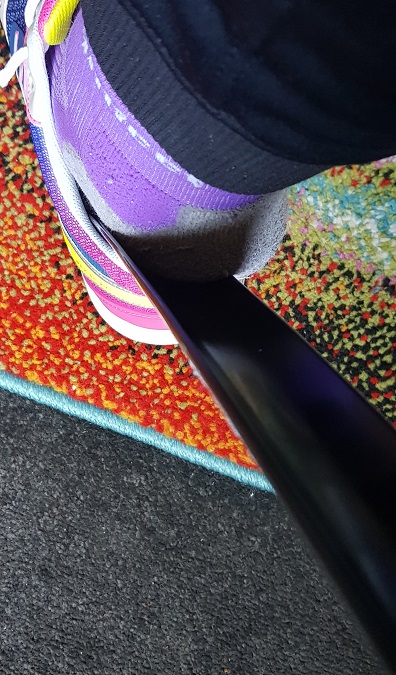
Get the long handled shoe horn. I cannot stress this enough. Most important piece of equipment ever! Absolutely fantastic! I still cannot get my runner on the foot of the operated leg without the shoe horn.

I haven’t needed rails in the shower, but the raised toilet seat is definitely needed (and can be used as a seat in the shower if needed). I was VERY careful getting in and out of the shower the first time! I did get a non-slip mat for the shower, then realised it already has non-slip tiles.

Status

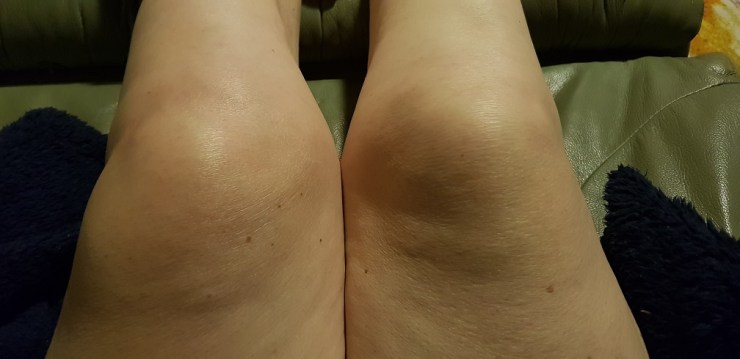
This was my knee a week ago. As you can see, the left leg is still swollen at this stage, but I’m walking around normally, just not as far as usual – yet!

You can see the shin bone on the right leg, not yet on the left. The knee is still larger. But it is much less swollen that the pre-surgery knee shown in the previous article!

The scar looks to be healing really well. I’m happy. Let’s see how I am feeling when the six months is up!

June 13

The worst part about being home is the boredom! Honestly, for me, that’s the hardest part. Not allowed to drive yet, so can’t go to the gym (for upper body), don’t have clearance to swim yet either. I hope the surgeon isn’t so strict the next time around!

One unexpected added bonus is my posture seems to have improved. I’m naturally standing straighter than before. I’ll see if that continues to be the case, but a positive plus.

My Total Knee Replacement (Knee Arthroplasty)

My early birthday present this year was a bionic knee. My surgeon will tell you very clearly it is NOT a bionic knee: the Australiam Orthopaedic Association clearly advises, “After knee replacement you cannot run, squat, kneel, crawl or play twisting, impact sports“. So not very bionic, but I like the idea.

Warnings re this article.

  1. It is long. Very long.
  2. Your experience may be very different. Each body is unique. That’s why the title includes “My”.
  3. I do try to inject some humour into the proceedings, otherwise it is a very dry topic.
  4. There are wound photos, but none of them are gory. I forgot to ask the team to take gory photos.
  5. This is written from the patient perspective (obviously) and no, not everyone gets praise (most do) – there are some bouquets and brickbats at the end.
  6. I do not name hospitals, doctors or medications.
  7. This article deals with the period of hospitalisation and rehab. I will write a second about being home (and continuing physio).

Background

We will call this knee Lennie (for left knee). Just to bring newer readers up to date with Lennie, back in 2014 it started being a little on the grumpy side. I had a Synvisc shot as an experiment and it worked well, but knee replacement was initially discussed back then. In October 2019 Lennie got really grumpy and I had fluid drained and a steroid shot. Temporary relief. By the end of January 2020, Lennie had me in hospital for five days. A cyst dissecting my popliteus muscle was discovered. At first it was thought that could be removed, but two eminently qualified orthopaedic surgeons said “No.” Mr T, the surgeon I went with, did explain a little more comprehensively. The view was the inflammation was so bad I’d simply develop more cysts. The time had come.

I was shocked. I had been expecting keyhole surgery to remove a cyst. NOW I was looking at rebuilding Lennie. Slightly more major event. Psychologically this was challenging for me – I WANTED to be able to manage the osteoarthritis (being careful here to distinguish from my psoriatic arthritis, different conditions) with exercise and strength and physiotherapy. Yet I had to admit this was not going to be a happening thing: Lennie was just a little too damaged. No matter what we did, Lennie would rage.

Once I made the decision, I was raring to go. Let’s get this show on the road. We had to time surgery around my drug trial injections. Surgery was booked for April 8, 2020.

Preparation

This is not surgery undertaken lightly, let me tell you! After the consult with Mr T to agree to let him cut out some of my bone and insert some metal and plastic bits and pieces I then had a schedule.

  • Consultation with a physician, Dr M
  • Blood and other tests
  • ECG
  • Visit with hospital staff re post-surgery planning
  • Another pre-op consultation with surgeon

Dr M’s job was to make sure I was healthy enough to survive surgery. He was also responsible for my post-operative welfare in hospital. I spent an hour with him, lovely guy, very thorough. Pulled prior medical tests from my various other specialists, including the cardiologist. More on THAT a little later – because I got a little surprise.

Dr M also ordered me to stop some medications I was on. This is very patient specific but I can tell any women of my age reading, it includes stopping (temporarily) HRT. Also verboten were anti-inflammatories. This is fun when you have a rather inflamed knee and are still trying to walk three kilometres a day and do exercises to keep your muscles “recovery ready”.

Then Covid happened and everything got cancelled. I did however still go and have the blood tests and ECG. The plus was I could go back on anti-inflammatories and HRT (temporarily)!

During this time my left ankle was becoming more and more painful until one morning I absolutely could not weight bear at all. I was convinced this was all tied in with Lennie’s misbehaviour, as from my January hospital excursion I had been unable to control that foot. Mr T was unconvinced, but I also did not explain to him (my patient oversight) the specific loss of foot control I was experiencing. The 4 second video below illustrates what I could NOT do with my left foot.

FINALLY and fortunately and I am forever grateful I GOT A NEW SURGERY DATE! May 20, 2020. Back off the anti-inflammatories and HRT. This however meant my knee was swollen and painful. My GP worked out a pain management regime so I could keep moving. As always, I was very nervous about this as I didn’t want to develop a tolerance to medications and have pain medications not be as effective as possible post-surgery. My GP assured me I wasn’t taking enough, or for long enough, for that to happen. By the last couple of days pre-surgery, I was in considerable pain and not a very happy person.

May 16 – not at the most swollen, but just a snap I sent to my daughter

Due to Covid, the hospital appointment mentioned earlier happened by phone. I also needed another (updated) lot of blood tests, which I had done at the hospital on May 8.

I had groceries delivered the day before surgery, changed the bed linen, did all the laundry and the dishes and cleaned the fridge. All I would need when arriving home was fresh milk and fresh fruit.

I was VERY happy to arrive at the hospital at 6 am on May 20, after starving myself from midnight.

Surgery Day

The very first thing I was required to do was have an antiseptic shower. I was first on the theatre list. The anaesthetist popped in to see me, the assistant surgeon dropped in, Mr T popped in to draw on my leg (the big black arrow from my ankle you will see in a later photo). I commented to him I’d love to watch the surgery. I think he was a bit surprised. His response was it was a worksite and I wouldn’t “want to hear all the swearing”. I figure I’d have talked too much anyway, asked too many questions: I’d have distracted them from the task at hand.

Dr M popped in at some stage, I forget exactly the sequence of events now, BUT he blithely informed me I was going to the HDU post-surgery. The conversation went a little like this.

Dr M: You’ll be going to the HDU post-surgery.
Me: What is the HDU?
Dr M: The High Dependency Unit
Me: WHY? I’m healthy as an ox, I just have a bung knee!
Dr. M: You have a nocturnal AV block.
Me: …………????????

I had no idea what a noctural AV block is, or that I actually had one. My recollection of my cardiological investigations was I was pretty damn good on the cardiovascular front, just every now and then my heart would miss a beat, nothing to worry about – I certainly don’t still see a cardiologist! Unless, it seems, you are having fairly major surgery. As I write I still do not know much about the mysterious nocturnal AV block, but I’ve been busy concentrating on my knee. I’ll find about the AV block later (that’s going to be delegated to my trusty GP).

By 7:30 am I’d seen four doctors, been drawn on and discovered I had something that was sending me to the HDU. I also mentioned to the surgeon and the anaesthetist that it had occurred to me I never research the anaesthetist, despite the number of surgeries I’ve had. Check out the surgeon, yes, but then just trust him/her to pick an anaesthetist that will keep me alive! I just found it interesting.

My daughter and I had agreed they would not visit on the day of surgery as I might be a bit “out of it”. As it turns out, the day of surgery I was fine, would have been a great day to visit! Day 1, when they did visit, I was “out of it”.

I woke up to be greeted by this.

Now when I say I could feel nothing, that’s exactly what I mean. Nothing! I could not move the leg at all, it was like a lead weight, seriously. It was also cocooned on a padded frame I did not take a photo of. Just holds the leg safely in position.

I thought if this is as bad as it gets, this is a walk in the park.

Mr T did pop in to see me and share with me the news that he had not been able to remove all the inflamed tissue as per his normal practice as that would have been just a bit too dangerous in my case. In my experience doctors use the word “dangerous” very sparingly so I’m guessing my knee was a little messy once it was opened up. Will find out more detail when I see him again in a couple of weeks.

Then My Glutes Went Crazy

At about 10 pm, so roughly ten to twelve hours post-surgery, I mentioned to the nurses that I was starting to feel pain and my glutes (the muscles in the buttocks) were spasming. This glute spasming thing had happened back in January too. Wasn’t fun in either January or May, let me tell you. I won’t go into all the detail of the next few hours, but those hours were not pleasant. The anaesthetist got a 4 am wake up call (although apparently he was already awake – do those guys ever sleep?). Dr M got in on the pain management act as well. I want to stress here, it really wasn’t the knee that was causing me the issues. It was everything else: the glutes and the ITB mainly (I’ll talk about the ITB later, at this point I didn’t separate the knee from the ITB pain, that dawned on me later in rehab).

The glute spasms came in waves, just as they had in January. Those wave peaks were intense. The great team did get it all under control fairly quickly, but the glutes continued to be an issue, reducing in severity over time, for nearly four weeks. In hospital the nurses would ask that great pain question “What is your pain on a scale of 1 to 10?” My answer would often be, “The knee is zero, the glutes are 6.”

I ended up with three drips in various locations on my right arm and I was on a cocktail of drugs Day 1 (surgery day is Day 0).

I’m an information technology person: we make ONE change at a time when troubleshooting. If that change doesn’t give the desired result, we roll it back, make another change, test. Rinse and repeat. When you have a patient in considerable pain, I can understand they don’t have the luxury of the time to try one drug, it doesn’t work, take it away, try another one, rinse and repeat. Hence the cocktail. To me, with my background, it was like “But which one worked/is working?” I’m a pain medication minimalist at the best of times, I make an exception for surgery, but I was staring at the IV pole in horror.

Yes, it was an unpleasant few hours but would not happen to every patient and was probably more specific to the state of my anatomy at the time. Nowhere in all the copious information are glute spasms mentioned as a possible post-surgery event! I’d got an extra five years out of the knee since surgery was first discussed, so I can’t complain too much if during that five years other tissues had suffered: shortened, tightened, etc due to coping with the damaged knee.

Preventing Blood Clots

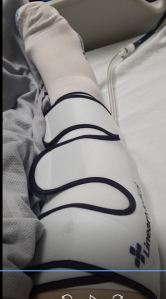
Blood clot prevention is big these days! Compression stockings, daily injections of a blood-thinning agent and these intermittent pneumatic compression (IPC) sleeves. Apparently some people hate them, but I loved them. I would have stolen them if possible. Like a constant leg massage. The only problem was I would count the compressions. One leg was doing 17 before the rest between sequences, the other leg was only doing 5 compressions. Was something wrong, I wondered? Did I have faulty sleeves? As a patient, I expected them to do the same thing to both legs. No-one seemed to know, which worried me even more. They rebooted the pump, unplugged and replugged the connectors, still the same. I can’t remember now who did know the answer, but apparently these sleeves don’t work in unison, but have a pre-programmed variation. It is likely many patients would not sit there counting the compressions to compare, but of course, I did!

I still find it amusing that I had to stop anti-inflammatories before surgery because they thin the blood (don’t want us bleeding too much in theatre, after all) then as soon as surgery is over, we get blood-thinners daily!  I understand the logic and am very grateful for the level of care, but it still amuses me.

Dr M also gave me deep breathing and coughing exercises to do.

Day 2 Onwards

Day 2 it was suggested I go to rehab. By Day 2 I was feeling much better, but thought I’d be guided by the experts, so I agreed. I do live alone and thought perhaps this may be a wise choice. Transfer was scheduled for the coming Monday. The remainder of my hospital stay was reasonably uneventful. The glutes were kept under control, I gradually lost IV connections and started to move about. Had my first shower sitting in a chair (first time ever!). That was the only chair shower I had, all others were standing. Another issue was sleeping on my back. I have never been a person that sleeps on my back, but all of a sudden I was expected to. That was hard. My back didn’t like it overly either. As soon as I was able to sleep on my side using a myriad of carefully positioned pillows, I did.

I learnt how to hook my right foot under my left ankle and swing my still as heavy as lead leg up onto the bed. The monkey bars above the bed were a great assistance! You will of course note by then I had painted my nails!

Day 2 I also had an x-ray. Mobile x-rays are wonderful things, plus the lovely staff took photos of the x-rays for me. I could finally see IN my knee! I could see Mr T’s handiwork, even though I missed out on seeing it happen.

X-ray without moving from my bed!

The bubble wrap looking stuff is the dressing. But there it was – Lennie was replaced, no more angry knee. Yes, my patella got some attention as part of the whole deal, so it lights up as well. Apparently, yes, I will set off the airport metal detectors.

The actual knee itself looked pretty good, if somewhat swollen (as is to be expected). And there is the aforementioned big arrow the surgeon drew on my leg before it all started.

BEST OF ALL? I discovered I had control of my foot again! I could move it as demonstrated in the little video above! The nurses were a bit mystified at my excitement, but I was ecstatic. I had control of my foot back!

I swapped between a walker and crutches for a couple of days as I have to say the walker was convenient for hanging clothes and towels on moving from bed to bathroom. Other times I would use the crutches. I had little exercises to do in bed to start stretching and bending the knee.

Day 4 I was feeling pretty chipper, but was still in a nightdress. Still no haircut either.

Off to Rehab

Day 5 was off to rehab day. I got dressed!!! All by myself! The last IV connection came out and off in the ambulance I went (very squishy ambulance, just as an observation).

Rehab is mostly about physiotherapy, moving, functionality. The monkey bars are gone, for a start, as was the walker (although I’d not used that for a few days by then). I ended up with the start of abrasions on my elbows from dragging myself up the bed, so we had to cover my elbows at one stage to protect the skin. I did learn to use my hands more than my elbows, which helped!

Unfortunately, the glutes decided to spasm badly again once I reached rehab. That was disappointing and frustrating. I missed a physio session due to the glutes. The whole pain management process started again, but this was about the glutes, not the knee.

They have a gym! First trip to the gym is in a wheelchair, but most after that on crutches (even if the physio followed me with a wheelchair “just in case”). Some physio sessions were in the room. For example, I’d go to the gym in the morning, then in the afternoon the physio would come to me.

It was in the gym I had my ITB epiphany. Refer back to the above section about the glutes going crazy. At that point, immediately post-op, I hadn’t differentiated between my knee (the operated bit) and the ITB. As a patient you are still a bit foggy from the anaesthesia, it is all in the same area, pain is pain at that point. But in the gym, six days later, your brain is working a lot better. I was doing one of the rehab exercises and realised it wasn’t the surgical site that was hurting, it was my ITB. It was painful and restricting my movement.

The physiotherapist and I had a chat about what we could do. The rehab hospital had a clinical massage therapist so we decided to give that a go. ONE treatment and the ITB pain was gone. I have no idea what he did, but it was fantastic! He also worked on the glutes a bit too. I had two treatments with him. My own physio, now four weeks later, is still working on those areas for me.

I’d have a heat pack on my glutes and an ice pack on my knee. The knee wasn’t necessarily painful, the ice was more preventative and to help with the swelling.

The goal for release from rehab is knee flexion (bend) of 90 degrees. I reached 93 degrees on Day 11 (post-surgery day count, that is). That was also the day I found myself in the bathroom with no crutches – I’d just got off the chair and wandered into the bathroom. Hmmm, I thought to myself, perhaps I’d better get Mr T’s OK, because I don’t think this is the first time I’ve done this in the last couple of days. Mr T’s office said that was fine, I was close enough to two weeks. I could “potter about” without crutches or walking stick. I promised not to go to the supermarket (just yet) without crutches.

By the very next day, my knee flexion was 105 degrees. Day 14 I finally came home! Now, almost a month after surgery, I am walking about 3,000 steps a day and my flexion is 125 degrees (as of Tuesday this week) – more on that in Episode II.

I had an appointment to see my surgeon on Day 13, but because I was in rehab we agreed the rehab doctors could review me and so that appointment was cancelled. In hindsight, I wish I’d gone to that appointment, just for information and post-op guidance.

Bouquets and Brickbats

Mostly I have bouquets. Just three small brickbats. Overall the care and staff were fantastic.

Surgeon – wonderful work. What more can I say? Fantastic.

Physician, anaesthetist, assistant surgeon – as far as I can tell, all did a great job! Sorry about the 4 am wake-up call.

Physiotherapists – terrific. They were really encouraging, understanding and supportive.

Nurses – all bar one night nurse were wonderful.

Food – some was great, some was not so great, but hey, it isn’t a restaurant. I was happy to get home to a higher protein diet though.

Pillows – terrible. Next time I am taking my own pillows into hospital IF that is allowed (it occurs to me maybe that would be considered an infection risk).

One rehab night nurse – I was not impressed. Towards the end of my stay I avoided calling her at all costs. HOWEVER, given the number of wonderful nurses over the 14 days, I think only one being not as helpful as I would have liked was not too bad really.

Release Process – oh, OK, discharge. I was sent home with various medications, two of them were pain medications. I was released just before a long weekend, so I was thankful for the coverage. It occurred to me over the weekend I had been given NO instructions how to get off these things. Remember I’m the pain medication minimalist – BUT I was also aware I’d had pretty invasive surgery, I didn’t want to change anything on a long weekend and cause a pain episode. Off to my GP I went to find out what I could stop taking and when. We stopped the slow release, kept some instant release up our sleeves IF necessary. I was happy. On reflection, I feel not enough information was given to me on discharge about the medications. Really, a small complaint very easily rectified by a visit to my GP.