Underlying Conditions

In 2017 I wrote Why Do Our Bodies Attack Us? Like many of us, I wondered WHY did I have a chronic condition (otherwise often known as an underlying condition). Most of my working life has been about root cause analysis – naturally I apply that to myself! It is a bad move, I don’t recommend it, you can drive yourself nuts!

More recently, December 2021, I wrote Will Society Adapt? When? How? looking at society’s lack of acceptance of chronically ill people. I specifically noted I wasn’t looking at environmental impacts in that article, but we can’t ignore the impacts we ourselves, as a species, have created in the same span of the last 100 years or so. In that article I proposed society has yet to adapt to this new chronic state of health, and I referred to my generation as being the first generation of chronic people in any great number. I essentially attributed our survival to improvements in medical science keeping us alive, but why do we fall sick in the first place, in ever increasing numbers?

Regular readers will know I am a big supporter of the work of Julian Cribb, an Australian author and fantastic science communicator. He has recently released Earth Detox – How and Why We Must Clean Up Our Planet.

Every person on our home planet is affected by a worldwide deluge of man-made chemicals and pollutants – most of which have never been tested for safety. Our chemical emissions are six times larger than our total greenhouse gas emissions. They are in our food, our water, the air we breathe, our homes and workplaces, the things we use each day. This universal poisoning affects our minds, our bodies, our genes, our grandkids, and all life on Earth. 

https://www.cambridge.org/us/academic/subjects/earth-and-environmental-science/environmental-science/earth-detox-how-and-why-we-must-clean-our-planet?format=PB

I did refer to chemicals in my 2017 article cited above. I’ve also looked at plastics in Packaging Our Pills in Plastic which includes some videos – visit that article if you are interested.

So while some science is keeping us alive, our tendency as a species to misuse other science for selfish reasons is potentially, at the same time, making us sick. Why did I choose selfish in that sentence? Let’s take plastic as a classic example. When I was a child plastic was not really a thing. Shopping bags weren’t plastic. You didn’t put your fruit and vegetables in plastic at the shops. Glad Wrap? I do remember plastic bags for freezing meat. Pills were still in glass bottles.

But plastic was convenient and we started using it for EVERYTHING! Our wild life has been paying the price for years, but it seems we have too. We just didn’t want to acknowledge that fact because that would be inconvenient and if there is one thing the human species hates, it is being inconvenienced.

Of course, all of this ties in with our population growth: if there were less of us, we’d use less of all the “stuff”. Less MIGHT be manageable. That is a big “might”.

I’m going to turn 67 this year. In my first ten years of life I lived on a farm in the middle of nowhere, BUT I was still exposed to many chemicals. Sheep dip. Top dressing. Weed killers. All before the many safety tests and regulations of today were in place.

Later I moved to the city: car fumes, plastics.

“It would be naïve to believe there is plastic everywhere but just not in us,” said Rolf Halden at Arizona State University. “We are now providing a research platform that will allow us and others to look for what is invisible – these particles too small for the naked eye to see. The risk [to health] really resides in the small particles.”

https://www.theguardian.com/environment/2020/aug/17/microplastic-particles-discovered-in-human-organs

Yes, I have psoriatic arthritis (PsA) and a wonky thyroid (plus a few other things) and yes, there is a genetic component to PsA. What triggered the expression of the condition? After all, genes or no genes, my disease hasn’t been active all my life. What triggers any number of the conditions now prevalent in the chronic illness community, even if there are genes playing a role (in many cases, not yet proven)?

We have to stop blaming our chronic illness patients for being chronically ill, when it is very likely it is the path humans have chosen that has created many of us in the first place.

In our current situation in 2022, chronic illness has suddenly risen to the surface as a “reason” people die of Covid-19, so more people are aware of our existence. I myself am in four Covid-19 risk categories, the most dangerous to me being that I have an underlying inflammatory condition (PsA). We know Covid-19 can cause lots of inflammation: I’ve already got that going on, so I have this image in my mind of Covid-19 entering my body, running into PsA and my PsA saying, “Mate! Great to see ya! Let’s party!”

According to Professor Jeremy Nicholson, there are only about 10% of people in Western society that are “really, genuinely healthy”. You can find that quotation at 31:40 in the second video on Better Health, Together: Living with COVID in 2022.

I’m not suggesting 90% of us are at high risk of imminent death from either our conditions alone or our conditions plus Covid-19. We DO need to know which underlying conditions place us at higher risk of severe Covid-19 in order to be able to adequately take whatever additional protections may be necessary. The fact we are at a higher risk cannot be ignored. I see many on social media particularly suggesting the underlying conditions are irrelevant. They are relevant. We can’t ignore reality because we find it unpalatable. I most certainly think the politicians could separate the sad news of deaths from the statistics relating to underlying conditions. This is where the 90% really comes in – as in, it is potentially most of us!

As I am known to do, I have digressed – or have I? Covid-19 is perhaps a wakeup call. As a species we have created a state of ill-health as “normal”. Because we want our pollution and our chemicals and our plastics – but as Julian writes, we are paying the price. We’ve been somewhat quietly paying the price for a while, now Covid-19 has highlighted our vulnerability.

I know I have a chronic illness – many people do not yet know they have one. Conditions can take a while to be evident enough for the person to seek medical help. I am quite sure my PsA was active at least two years before I was diagnosed. In other situations, many people struggle to get a diagnosis of various conditions for years.

I am NOT suggesting that had Covid-19 come along in 1819, or 1719 that we would have been in a overall healthier state as a species. There were other considerations back then. However, we have changed our world, our environment, our living conditions, massively in the last 100 years. We’ve solved old problems, but created new problems.

I am a massive fan of science generally and medical science in particular, however I am also very aware of the human tendency to misuse anything we can if we see a personal advantage in doing so. Covid-19 gave us a shock: we were the Gods brought to our knees by the invisible.

We are not just destroying the environment of the planet we inhabit. We are not just destroying other species. We are possibly also destroying ourselves.

Packaging Our Pills in Plastic

Plastic is the horror product of our times. A relatively recent innovation, plastic penetrates every aspect of our lives. Scientists have estimated 8,500,000,000 kilograms of plastic waste is ending up in our oceans every year (source “How Much Plastic Is In Our Oceans”, second video below).

That is a lot of plastic in anyone’s language. Plastic shopping bags, plastic drink bottles, product wrappings. Although there has been much furor recently in Australia over the banning of single use plastic shopping bags at supermarkets, I have been noticing other uses of plastic that we could surely rethink.

Product wrappings: I have been on a linen buying spree of late and the amount of plastic in which sheets sets and doona sets are packaged is quite amazing. Not really reusable either.

Fresh fruit and vegetables: this is one of my biggest gripes. If they are not prepackaged, then we use those silly little plastic bags in the fruit and vegetable section of the supermarket. We get home and into the rubbish they go. There are paper bags for the mushrooms – why can’t we use recycled paper bags for buying our vegetables?

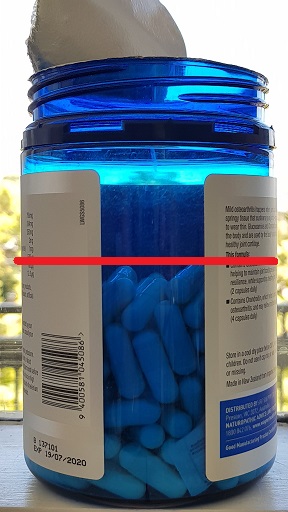
There are many examples. My focus today is medication packaging. Not just prescription medicines either. This first came to my notice when I bought a fish oil supplement.

Red line added to indicate the wasted space

That’s a lot of plastic serving no good purpose.

Then, a month or two later I picked up a prescription for some new medication. The bottle seemed rather large to me for 15 tablets – I was thinking these must be “horse tablets” and was not looking forward to the swallow challenge. Nothing could be further from the truth!

Itsy bitsy teenie weenie yellow tablets that did not even cover the bottom of the plastic bottle. OK, a one-off, I thought to myself. Then that medication got replaced in my regime by another one. These are a bit harder to see, being white in white. At least there are 30 tablets in this bottle, not quite as bad as the bottle above, but really?

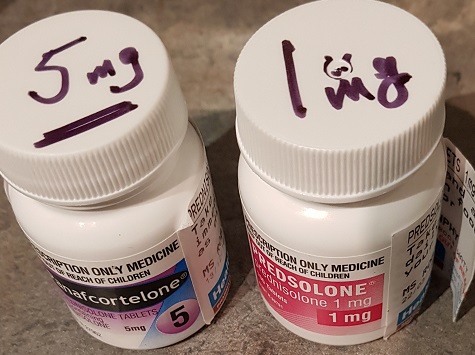
I have other medication. Predisolone. Let’s compare the pair.

The bottle on the left in the above picture has 100 – yes, that’s right ONE HUNDRED tablets in it. The bottle on the right has 30. Just 30.

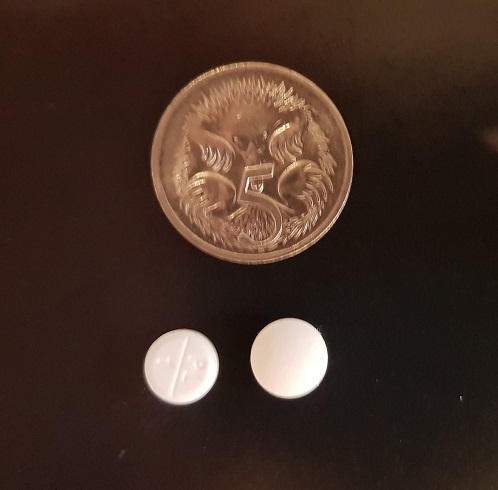
Just to tie up loose ends, let us compare the actual tablets from the above bottles.

Not much difference in size, is there? The tablet on the left is from the little bottle, the one on the right is from the big bottle. But you can’t tell how big the tablets actually are, you say? I thought of that. So here they are below with a five cent piece for scale.

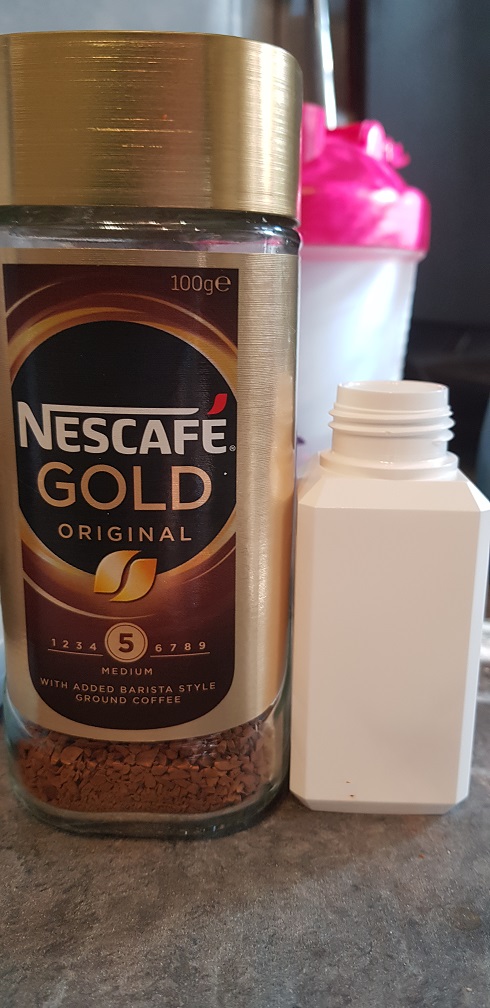
How big is the pill bottle compared with a standard household object? Here it is compared to a coffee jar.

Comparison with a common coffee jar.

I am just one person out of the 7.6 billion people on this planet and I have looked at only THREE pill bottles: two prescription and one a supplement. Extrapolate that out over the world. How much plastic waste is coming from our pharmaceutical industry? Worse, how much of it is superfluous? Containing nothing more than air.

How are these bottles disposed? It varies: the itsy bitsy teenie weenie yellow tablets had to be returned to the pharmacy for controlled destruction. What happened to the bottle itself I do not know, but I trust my pharmacist took the responsible recycling option. But what do most of us do with most of our empty pill bottles? All the bottles I have carry a recyclable symbol. Do we all recycle? Privacy concerns have been mentioned to me: the information on the dispensing label is personal. We can and should return them to the pharmacy, but how many of us do?

Not only are there a lot of them, surely if we have to use plastic we could at least use appropriately sized bottles, not these humongous monstrosities.

Other medications come in blister packaging. While I am focusing on plastic today, there are surely waste concerns around blister packaging as well. At least there doesn’t appear to be as much superfluous plastic involved.

Blister packaging

One suggested explanation for the size of the bottles was that the dispensing label needs to fit. Yet the pharmacy managed to adhere a dispensing label quite well to the smaller prednisolone bottle above. The larger bottle didn’t even get a dispensing label attached as the bottle came in a cardboard box and the label was affixed to the box, not the bottle.

Other patient-centred considerations driving size might be:

  • The need to have a child proof or child resistant cap. None of the examples cited here had child resistant or child proof caps.
  • Larger bottles for ease of use by the patient – yet all those bottles are for me and I have to say ease of use is about the same for all of them.
  • The need to print information on the bottles. Medications come with Consumer Medication Information leaflets. These contain far more information than could be fitted on any size bottle. There are minimum requirements for “on bottle” information.
  • Differentiation so patients don’t get medications confused.

That last one would seem logical if it wasn’t disproved by the following example. These two bottles are exactly the same, but contain different strengths. As you will see I’ve written the strength in large letters on the caps because yes, I have accidentally taken the wrong strength in the creeping morning light when in a hurry. The labels are different colours, but who notices that at 6:30 am?

There are of course cost and manufacturing considerations. The above example, using the same bottle, reduces production costs. Yet if I go look in my medicine cabinet those are the only two that are the same. BioCeuticals, a company producing a wide range of supplements, do use the same bottles for many products. It is cheaper to print and adhere different labels than it is to manufacture a wide range of bottle sizes.

We are concentrating on plastic shopping bags and single use drink bottles. Yet many of us would dispose of more medication and supplement plastic bottles than plastic drink bottles. I might buy a disposable bottle of water once or twice a year only. Yet I have a considerable number of health related bottles in my cupboard.

The other consideration is leachate. Leachate is discussed in the Ted Ed video below. Not all medication bottles are discarded empty. I mentioned above one medication that was required to be returned to the pharmacist for destruction because of the toxicity of the medication. We’ve heard of estrogen ending up in rivers and streams. Other drugs excreted by humans do too.


Medications such as antidepressants, painkillers, antibiotics and estrogen are excreted by humans, and they wind up in treated sewage that is released into the environment, where fish and aquatic animals, even humans, can be exposed.

Source: Scientific American

Over time, discarded, unused medications are going to become part of the leachate from landfill where they have been discarded into the general waste bin OR the recycle collection has ended up in landfill due to contamination, which is more frequent that we like to think about. How dangerous is that over time?

If a bottle still has medication in it, does that contaminate the recycling collection?

How can we encourage the pharmaceutical industry to rethink packaging so we don’t end up with five or six times the amount of plastic needed to dispense a few tablets? It may not be as big a problem as plastic shopping bags, but it is contributing to the global plastic problem.

REFERENCES:

Department of Health, Therapeutic Goods Administration medicine labelling and packaging review, 2012

The videos below discuss plastic pollution generally. Both have been referenced in the above article.

Here is a video with lots of facts and figures from November 2017 – and the situation is only getting worse.

If you are too young to recognise the “itsy bitsy teenie weenie yellow” reference, here it is, just for you.

R