Tough, But Worth It!

Yes, I’ve been very quiet. VERY quiet. I know, I’m sorry. Recovery from my November surgery took quite a lot of effort. On top of that, the mobility restrictions meant my psoriatic arthritis decided to complain, so I was fighting on two battle fronts.

My ankle surgery took place on November 28, 2023. My first completely pain/discomfort free walk was March 22, 2024. 16 weeks and 2 days.

I’m not repeating the details previously documented, so if you are catching up, read the surgery article linked above first! The moon boot was better than the cast and knee scooter for sure. I could shower without “bagging” my leg in plastic bags! I didn’t have to sleep in the moon boot! I was no longer doing three-point turns in my small apartment or constantly reversing in and out of spaces. I could drive! I was no longer so totally dependent on other people, I had a modicum of freedom.

I was allowed to go to the gym to do upper body work. ONLY upper body work, but at least it was something! The gym staff looked at me a little askance, but let me in.

I was to gradually increase the percentage of weight on that leg each week and could try proper shoes at week four of moon boot life. I will admit I snuck into shoes a couple of days early because the moon boot meant my legs weren’t the same length and my right piriformis muscle was not overly impressed with that situation. I was VERY careful though.

At my 12 week post-op my surgeon was very happy with how everything had knitted and I was finally allowed to go to the physiotherapist. It is amazing how weak your calf and ankle muscles can become after 12 weeks of no use. Surprisingly, this physiotherapist wasn’t as bossy as the knee physiotherapists: exercises every second day instead of every day.

On February 14 I started short walks – between 500 and 800 metres depending on how the ankle was feeling. I managed my first 1 km walk on February 20 and have slowly built up from there. March 21 I walked 2 km in one hit! I should add I was doing multiple walks a day by this stage, with the physio’s permission.

While the ankle/foot wasn’t really painful, it wasn’t 100% comfortable either until March 22. That was the day I felt free!

Funny conversation with surgeon at the 12 week post-op.

Me: “So I have no restrictions now?”
Surgeon: “No, you’re fine!”
M: “So I can do the leg press?”
S: “Sure!”
M: “So what weight can I start at?” (Thinking to myself 50 kgs seemed reasonable to start)
S: “Oh, just the plate, no weights!”
M: Thinking – that sounds like a restriction to me!

It always pays to clarify. I think maybe he didn’t consider his nearly 70 year-old patient was going to be doing things like the leg press. Have I got news for him!

I have interesting rehabilitation exercises, such as standing on one leg for 30 seconds and calf raises on one leg. Now, to be honest, I still cannot do the one-legged calf raise, but I’m getting there with a little help from the other leg. A little less help each day. Hoping I can do the single leg calf raise by my next physio visit!

So yes, it was well worth it, but man alive, am I glad I only have two ankles. I’ve learnt a lot of this experience and will plan the next one with the knowledge I now have about how VERY different this is from knee replacement surgery.

Of course not every ankle surgery will be exactly the same as mine. Other patients may spend less time in a cast for example. Or more time in a moon boot. It definitely isn’t as easy as knee replacement though.

Due to the lack of exercise during those weeks of recovery, my back is not happy. It is getting happier now I am back to a more normal routine, but some days have been quite tough. Moving is not as bad, most of the time, as being stationary, luckily. My back has been under control for some years, due to the work I keep doing on my posterior chain to support it, but at my age we decondition faster than in our twenties – I’m having to build up that strength again. The shoulders and wrists didn’t like the crutches either – the psoriatic arthritis complained. Both wrists and shoulders are now improving with increased exercise and no irritation from the load of crutches.

One thing I wasn’t happy about was once I could walk 1 km, I discovered I’d lost another point on my VO2 Max reading. I was devastated. While I don’t do high intensity exercise and therefore don’t expect a high VO2 Max reading, I do want something healthier than “poor”! Thankfully, I’ve worked hard enough this week (shown below) and last week to recover that measly one point. The lost of the one point had worried me because it was the continuation of a downward trend that started early 2023 and so desperately want to turn it around and get back to where I was.

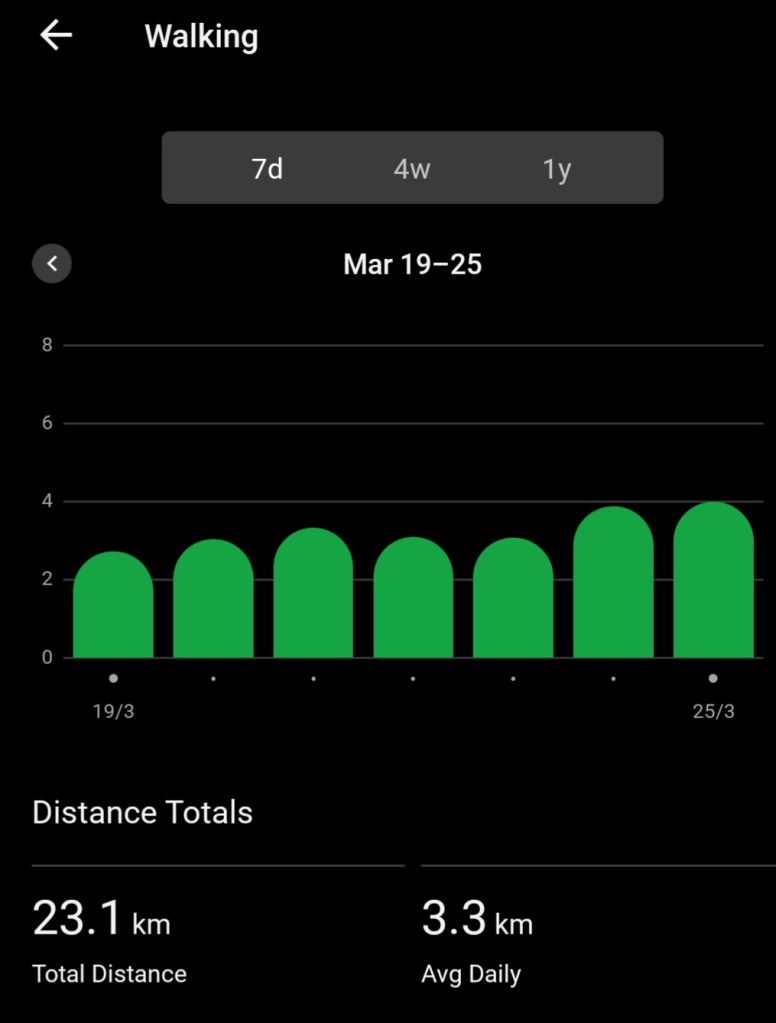
Steps per day March 19 - 25
Formal measured walks per day March 19 - 25

So that’s it for this ankle. When the next one will be done is debatable. Naturally the surgeon looks at risk mitigation from the perspective of the risks of surgery. I’m looking at it from the recovery perspective. It doesn’t matter how brilliant his surgery is if I am not well enough to manage the recovery properly and at this point in time I’m still not sure we will get my psoriatic arthritis under control. I needed my wrists, shoulders, piriformis and back to be better behaved. I managed, but it was tough.

Onwards and upwards! I need another 3,700 steps today to hit my daily goal, so off I go!

Fibreglass cast

Knees Breeze, Ankles Rankle

As regular readers know, I’ve become a bit of a patient expert in the field of orthopaedic surgery of recent years. Two total knee replacements and bilateral foot surgery. On November 28 I added a fourth: ankle surgery, fusion of the subtalar joint. There were apparently two options for my ankle situation. The surgeon, at my pre-op appointment, was thinking aloud in determining which approach to take. If he had “told” me I was 68 one more time….. My age was relevant to the decision. A little too relevant in my view!

If you are catching up, here are links to my very excited articles about the previous surgeries:

Then I was silly enough to go for a second lot of surgery in 2023 – the left ankle in November.

Sidenote: When I write I aim to give other patients a realistic picture of whatever I’m discussing in any article and this is no different in that respect. This article is different from my usual in that THIS surgery is more difficult to deal with and I am depicting that in my words deliberately. I am not sugar coating this.

Let me share something – ankles are not knees! With knees, you are up and about the next day. Yes, you are on crutches, but you are MOVING. Ankles? Not so much. OK, not at all. Yes, I was forewarned that the first two weeks were going to be in a half cast and I’d essentially be able to do very little. Rightly or wrongly, I was under the impression I’d most likely graduate to a moon boot at the two week mark. That is not what happened. As I write I am STILL using a knee scooter. I HOPE to graduate from that on January 8, 2024. To a moon boot and crutches. At that point after knee surgery I’d be back in the swimming pool and walking two or three kilometres a day.

Let’s go back to the beginning. I duly fasted as instructed on the day of surgery and arrived at the hospital at the appointed time. Usual pre-op stuff, then into the slicing and dicing bit. I woke up post-op and the nerve block hadn’t worked (not uncommon, I am told). Issue number 1. Fantastic anaesthetist, he did a second nerve block which worked fabulously. Issue number 1 solved.

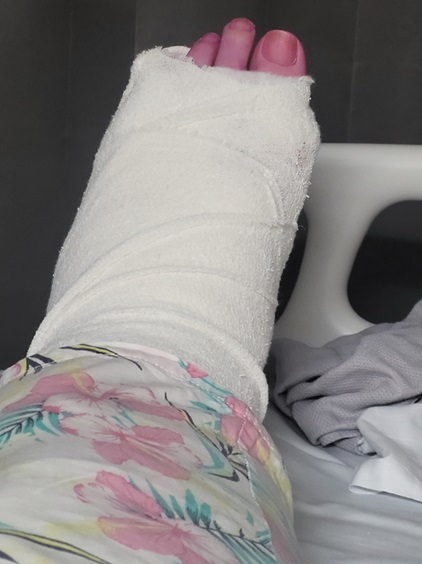
This is how my foot looked after surgery. Yes, I know – the same hospital PJs! That cast goes to just under the knee.

Half cast
Post-op half cast

Surgeon stopped by and told me everything went well. Good to know. Off I went to the ward. As I was only in for the one night, I was in a shared ward. Issue number 2 – the patient next to me did not turn her light off all night. I learnt later she can’t sleep in the dark. Well, I can’t sleep with the lights on. So I got no sleep.

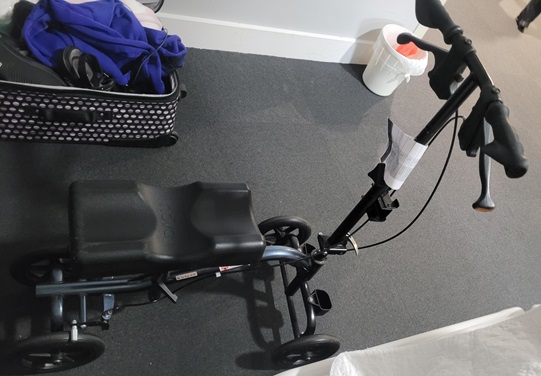
A nurse told me I could use crutches to go to the bathroom. Issue number 3. I say no, I am under very STRICT instructions to not weight bear on the operated leg. Not even a little bit. Nurse disagreed, but said physiotherapist would tell me that if I am worried. Physiotherapist agrees with me. Knee scooter arrived! Sorry about the lousy photo, but it is what it is.

Knee scooter

Worth noting at this point that the other option for getting around without putting weight on the operated joint is to hop with crutches. Or hop with a walker. Hop. At 68 with an inflammatory arthritis. That ain’t happening. I’m not a 20 year-old footballer with massive upper body strength. I actually asked that physiotherapist if anyone could hop with crutches. He said, “Just quietly, none I know of.” That made me feel marginally better.

Now, of course, and this is critical for later in the story, at this point I didn’t need any pain medication – I had a very effective nerve block.

The rehabilitation hospital called and I got “checked in”. An ambulance would transfer me to the rehab hospital. The ambulance ran late. I got to the rehab hospital too late to see a doctor for admission. One was at a funeral and one was on a day off. I had NO pain medications charted from the surgical hospital because I hadn’t needed any. Sooooooo… when the nerve block started to wear off, we had a problem. I should say I had a problem. That took some time to resolve, I have to say. Issue number 4.

I also learnt it is VERY difficult to advocate for yourself when you are in post-operative pain. It is not as if I was a “new” patient to this hospital – this was my fourth trip through this hospital, the last in July. Yet I struggled to get the required outcome. Finally, this too was resolved, but it took longer than I found appropriate.

I wasn’t a major fan of my room’s frosted window either. Very “enclosed” feeling, but not much could be done about that. It is due to the close proximity of the building next door.

Frosted window in hospital room
Frosted Window

Of course I painted my nails! Did you really doubt that would happen?

painted nails

Once we had the pain under control, I ended up with Issue number 5. I was constipated for seven days. Trust me when I say this was NOT fun. I was swallowing Coloxyl and Movicol like there was no tomorrow. Then they tried Microlax. Then Fleet enemas (twice), took abdominal x-rays and determined I was “loaded” so resorted to a colonoscopy prep. Not that I was having a colonoscopy, but something was needed. Took three days to clear – we know that because I had a follow-up x-ray a few days later and I STILL wasn’t completely clear. Issue number 5 was eventually resolved though. I did not have this problem with either of the knees, I think the lack of mobility was definitely a contributing factor. While pain meds are known to cause constipation, I was definitely on pain meds after the knee surgeries (I’m not a martyr), but I was WAY more mobile. I also wasn’t on pain meds very long with this surgery. I don’t remember which day I started reducing the dose, but it was quite quickly compared to knee surgery and I was off pain meds completely well before I was discharged.

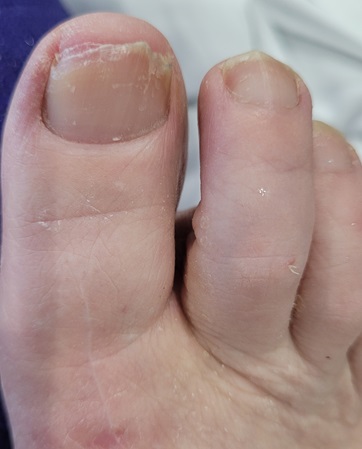
I also managed to damage myself – twice! We won’t talk about how I sliced a nipple (it bled) with a finger nail. We can talk about how I ran over my big toe with the knee scooter and ripped a toenail to pieces. The broken bits later ripped off completely. Yes, the psoriasis was having a bit of a field day in the left picture. Sorry – goes with the territory.

Issue number 6 was a clash of dates. With the knee surgeries, I was in the surgical hospital for four or five days, so my two week post-op appointment never clashed with my discharge from rehab date. In this case, because I was transferred to rehab the day after my surgery, the post-op and discharge were the same date. For overseas readers, the health insurance covers two weeks of rehab. Not good, as the physiotherapists in rehab like to wait until the patient knows what the next stage is so the patient can be taught how to manage while still in rehab. For example, had I gone into a moon boot, they’d teach me how to manage mobilising in a moon boot. So there was a lot of discussion about seeking two extra days of cover from the health fund. That happened. Thankfully. But it was another stressful complication.

This bit was a complete shock! I didn’t get a moon boot, I got a fibreglass full cast. From just under the knee to my toes. Still no weight bearing allowed. I burst into tears. I knew the knee scooter could not be maneuvered in my bathroom, so what was I going to do? The surgical Fellow (my surgeon was not available) suggested I just spend another two weeks in rehab. I’m not sure the surgical Fellow, here temporarily from overseas for experience, really understands our health system yet. One can’t just stay an extra two weeks, that’s not how it works. After considerable discussion it was decided to build up the bottom of the cast (under my foot) and I would be allowed to use crutches to hobble from my bed to the toilet (at home, this is). By hobble I mean place that foot on the floor for balance only, absolutely as little weight on that foot as possible – just so I didn’t have to hop.

Fibreglass cast
Fibreglass Cast

Issue number 7 (unresolvable) relates to the knee scooter and my leg length. The specifications of the scooter include that it can be adjusted for people from 157 cm tall. I am 164 cm, so it should be fine. It isn’t. I end up propelling the scooter on my tippy toes, not the safest maneuver ever. Also, instead of being able to keep the supported leg at a 45 degree bend at the knee, the back of my thigh presses down on the fibreglass cast which has an edge like a knife. I now have a dressing on the back of my thigh. When standing, all the weight is going through my right leg as in order to have my right foot flat, I am standing with no weight going onto the knee scooter. More load on that new knee.

I can also state I have done more three-point turns on this thing than I have done in 53 years of driving my car! Knee scooters could also do with rear view mirrors as a lot of reversing is involved if you live in a small apartment.

Issue number 8 is also, I think unresolvable. Use of crutches puts considerable load on my shoulders/upper arms and wrists. As regular readers know, I have had issues this last couple of years with controlling the psoriatic arthritis (PsA) inflammation. Yes, I could have waited until the PsA was under better control, but that might never happen. I did try a walker, but the load on the shoulders was greater, so we scratched that idea.

The Occupational Therapist visited my home with me the day prior to discharge and confirmed I would not be able to use the knee scooter in the bathroom. As I did not have official confirmation of the surgical Fellow’s strategy, rehab wouldn’t discharge me. They couldn’t get hold of the surgeon (he was in theatre that day) for confirmation. The surgeon rang me the next morning – I promised to be good and he confirmed I could go home. How good I’ve been will be determined on January 8 when I have an x-ray.

On reflection, knowing what I know now, I would have waited for a few more months after the knee surgery. The load on the newest knee is quite high, compounded by the inability (in my case) to be able to perfectly adjust the knee scooter. There is also a lot of pivoting on that leg required, getting on and off the scooter. Prosthetic knees, especially new ones, are not really a great fan of pivoting.

This is not surgery to be undertaken without very careful planning. If, like I do, you live alone, even more planning is required. If you can stay with a family member or friends, I highly recommend it. The feeling of uselessness and being almost totally dependent on other people is driving me to distraction. Not being able to walk, swim, be active is so frustrating. Showering is a major task: the leg has to be “bagged” in plastic bags. Getting into the shower recess without weight bearing AND without falling over is a challenge. I recommend using a raised toilet seat instead of a shower chair as it is easier to wash the private parts. Not sure who designed shower chairs, they need a rethink.

Even getting to the toilet is a challenge. Let’s say I am in the lounge room. I need to standup on one leg, mount the knee scooter, propel myself to the bedroom, transfer to crutches, push the knee scooter back out of the doorway, hobble to the toilet, do a 270 degree turn, sit down using the grip rail and one leg. It occurs to me men might have a slightly easier time of this (most trips, anyway)! The return journey requires a 360 degree turn at the bed in order to transfer back onto the scooter and I have to back out (reverse out) of the bedroom and do a three-point turn in the kitchen area to be able to head back to the lounge.

The friends who picked me up from hospital when I was finally discharged, who have done pharmacy trips for me, who hired a wheelchair to get me in and out of their home on Christmas Day, may never really understand how much their support and help has meant to me. I hope at some time in the future I can repay their wonderful kindness.

Was the surgery worth it? At this point, I don’t know! I must stress, I have every faith in the surgeon, he did a great job on my feet. But the reality is I won’t be able to “test” it for about another six weeks.

If you find you are going to have ankle surgery, my advice is make sure you completely understand what the “worst case” recovery period scenario is likely to be and plan accordingly. Often times (and with me every time so far) when they get the patient on the operating table they find more needs to be done than was perhaps anticipated – this happened this time too. I also had an osteotomy as part of the operation.

I certainly don’t want to turn anyone off having their ankles “repaired” if necessary. I do want to highlight ankle surgery recovery is nothing like knee surgery recovery from the patient perspective. I have hated every minute of the last six weeks. I’m not going to like the next six weeks either. At least it is only twelve weeks out of the year.

I constantly tell myself so many people are worse off. My son-in-law has another twelve months of leukemia treatment to go, for example. Even so, every day is a challenge. Every day is boring. Every day is inactivity. Knowing one’s situation could be worse isn’t much consolation on a day-to-day basis.

Technical note: the surgeons like to go down the leg. So ankles are typically done after knees. Having sound ankles is important, as wrecked ones, like mine, could lead to damaging my wonderful new knees. We don’t want that! Of course, if one doesn’t need new knees, then it isn’t an issue, but for those of us who do, there are rules.

March 24, 2024: Read Part II, now I have tested the ankle.

Edited Jan 8, 2024

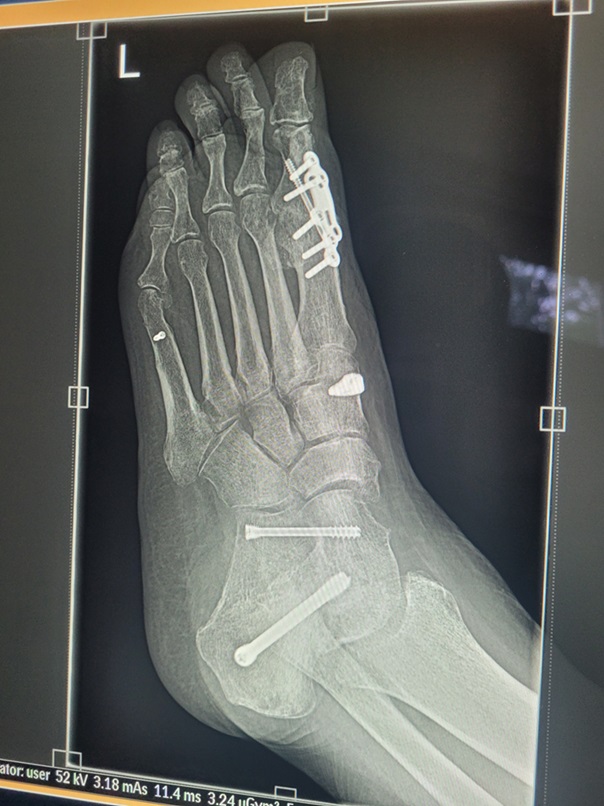
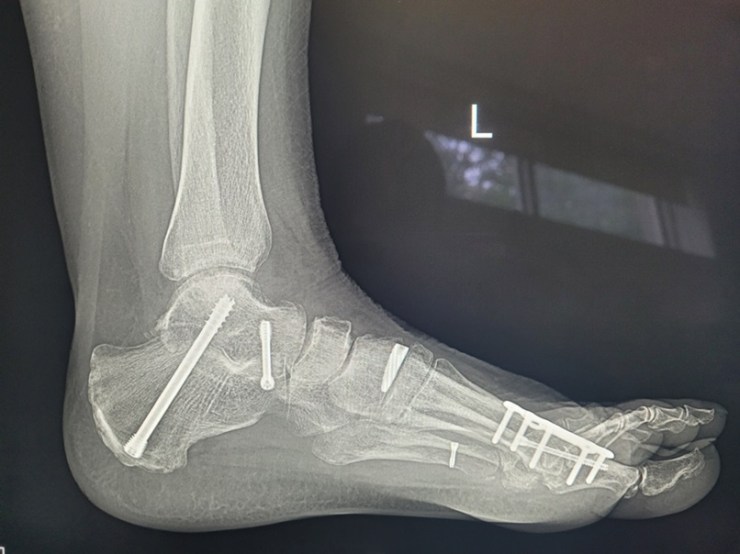
YES! Got rid of the cast! Now in a moon boot. Just editing to add the x-rays so you can see what I had done. I was expecting to see three screws, but apparently the triple arthrodesis description on the paperwork was a clerical error. I’ve got two screws and a bit of something to stabilise the front of the foot. The metal in the actual toes was all the bilateral foot surgery, not this surgery. Surgeon is very happy with healing so far.