Are You In The Running For A Gold Medal?

No, I don’t have one, at least not yet. What IS she on about, I see you wondering. Let me recap. Back in May 2023 I wrote about Crossing My Fingers – Again. As it turns out, I was counting my chickens before they hatched. I saw my rheumatologist a week before my (latest, second) knee surgery and the decision was made no, the medication I was on was not working. HOWEVER, because my knee surgery was looming, I couldn’t start the next, the eighth medication, until ten days after my surgery due to infection risks, it being an immunosuppressant. This new medication can take twelve weeks, roughly three months to work – or more. Here we go again, I thought.

I started the new med in the second week of August. About three weeks ago I mentioned to my GP that if anyone were to ask, I would say the new medication was working about 50%. I qualified that statement by saying, “But the question is really, 50% of what? 50% of the maximum efficacy of the medication, or 50% of what I expect?” Hey, I’m an accountant – percentages make sense to me!

At my rheumatologist appointment this week, I relayed that conversation to him. I then added, for example, what percentage of normal can I expect to feel? 100% normal? 80%? Do we have a ballpark number? He sat back in his chair and said that was a very interesting question, he’d never heard it expressed like that. He told me, “We always aim for 100%, but don’t always make it”.

It is interesting to note that in cited clinical trials, on my new medication at the one year mark 68% of patients in the trial experienced “less joint pain and swelling”. Only 68% of patients? Only “less”, not “it had all gone away”? I’m not linking to the study results as I don’t name the medications I take simply because what doesn’t work for me might work perfectly well for other people and I don’t want to make any other patients hesitant to try medications. After all, we already know from my pharmacogenomics testing (click the link for great information) I have metabolisation issues with many medications (some too fast, some not at all, etc) – best not to use my personal experiences as an example of the efficacy of anything!

I actually don’t expect to achieve 100% of normal. My disease, psoriatic arthritis (PsA), like a lot of other chronic diseases, is A) not (yet) curable, and B) progressive. My patient understanding is that we hope to slow progression, not necessarily be able to stop it completely.

My rheumatologist (let’s call him Dr R) suggested I think about it like the Olympics – not everyone gets a gold medal, some people get silver. At the time, this sounded reasonable.

As I was walking the next day and thinking, always dangerous, I thought to myself, “Hang on a minute, in every race someone comes last!” And all the positions in between. Yes, every person who stands at the starting line hopes to get a gold medal, I know this, but only one does. I’m not sure this is the best analogy for Dr R to use. In fairness to Dr R, I think he came up with the Olympics on the fly, knowing my exercise strategy and thinking it fitted with the patient in question (me).

The initial three months have passed and yes, in the last two weeks I have started to feel much better. I have more energy, I found myself singing to the radio in the car (always a good sign) and my strength is slowly returning. At one stage I couldn’t lift my four litre saucepan if it was full, let alone do a six kilogram bicep curl. This was not just about strength – my hands and wrists were really sore if subjected to any load (saucepans or dumbbells), so although the biceps were quite happy, the wrists were not – we now have some improvement. I was waking every morning with my hands in a lot of pain and had difficulty bending my fingers (a complete reversal from when one hand had to be splinted to stop it locking into a fist). My hands are still a bit “grumpy” in the mornings, but at least they are usable!

The above photo was taken on October 22 – I wanted to wear an old bangle on a night out. As you can see, that wasn’t happening. My hands are still too swollen and the joint at the base of the thumb is bigger than it was in my pre-PsA days. So while I feel better overall than I did three months ago, am I “normal”? No. I think I might be at about 70% of normal taking into account my age which brings it’s own issues, irrespective of my PsA!

How could I measure it? Good question, I’m not sure. If I took the leg press as one measure, I am currently only doing 65 kg because I’m coming back from total knee replacement. My personal best since I was diagnosed is 160 kg. 65 is 40% of 160. But using that as a measure would be being unfair to the medication, as I am restricted in how much I can lift at the moment, being post-operative. I feel if it wasn’t for needing to be careful of my new knee, I could lift much more.

I’m not taking any pain medication other than Panadol Osteo, that’s a good measure, but I am supplementing with a low dose of NSAID as needed. I’m certainly doing more Movement As Medicine than I was before starting this medication: that is a very good sign. I’m writing (today at least).

Will I get the gold medal? I’m very wary of that as an analogy for treatment “success”. Too few people get gold medals in the sporting arena. How many of us come last? I know Dr R’s heart was in the right place, but I think expectations is something we perhaps need to look at more closely. What is a realistic expectation of improvement on any particular medication? Or, for that matter, with any particular condition?

As I stated above, this is my eighth medication since I was originally diagnosed in 2014 (with rheumatoid arthritis, later rediagnosed). That’s not counting the ever-present “extras” like NSAIDs and corticosteroids. But where am I in the race?

I think I know the answer: we don’t know! Personalised medicine is a rapidly developing field, but doesn’t cover everything yet. So I’ll keep running this race and hope I don’t end up last. Meanwhile, I’ll try to think of a better analogy. Maybe trying to hit sales targets? Not really my scene, but at least we’d stand an equal chance!

19/11/2023 Edited to clarify: by the phrase “So I’ll keep running this race and hope I don’t end up last” I mean I’m staying on this medication and hope improvements continue in the coming months. It occurred to me overnight that I may not have been very clear! My inflammatory markers were very nicely reduced too, which was good.

Related: Changing Medications – What Can You Expect?

Rattle Ya Bones Day!

Rattle Ya Bones Day is coming! What is Rattle Ya Bones Day, you ask? I’m so glad you asked, because that’s what I want to tell you about!

Rattle Ya Bones Day is a National Day of Awareness for all muscle, bone and joint conditions. It’s held every year on October 31.

Let’s look at some statistics around musculoskeletal conditions.

  • 1 in 3 people have one or more musculoskeletal conditions (That’s about 7 million of us, give or take)
  • Musculoskeletal conditions aren’t just conditions of old age. Babies, children, and young adults are affected as well
  • 93% of people told us that their lives were negatively impacted by their condition
  • 58% of people are of prime working age (25-64)
  • Musculoskeletal conditions are the most common cause of early retirement (yes, that includes me!)
  • Musculoskeletal conditions cost the economy $55 billion each year.

Given 1 in 3 people have one or more musculoskeletal conditions it is highly likely even if YOU do not, a member of your family, a friend or co-worker has a musculoskeletal condition. Regular readers know I do: psoriatic arthritis. I also have a bit of osteoarthritis and minor scoliosis of the spine. Rattle Ya Bones Day is very relevant to me!

Remember, quite often our conditions are invisible: I’ve written about that particular challenge before, in “We Don’t All Look Sick! Invisible Illness“. This is a photo of me I used in that article – I don’t (I hope) LOOK sick, but yes, I am.

Me! Looking not sick, I hope!

This year’s message is “Get informed and Get supported”.

Learn more about conditions like arthritis, back pain and others, to help you and those you love live well.

On the evening of October 31, MSK will present the Koadlow Community Lecture, Back Up: Why back pain treatments aren’t working and the new science offering hope.

The 2023 Koadlow Community Lecture will be presented by Liam Mannix, a multi-award-winning national science reporter for the The Age and the Sydney Morning Herald. Liam is one of the many who live with back pain, and he takes his own experience as a starting point for his recently published and highly praised book of the same title.

If you are interested, click here to find out more!

Support Musculoskeletal Australia’s work: Please donate today. Your support plays a crucial role in enabling MSK to provide free resources aimed at improving the quality of life for people impacted by muscle, bone, and joint conditions. By donating, you become an agent of change, ensuring that those facing these challenges receive the support and resources they deserve. Together, we can make a lasting impact and create a brighter future for everyone affected by muscle, bone, and joint conditions.

Together, we can raise awareness, share information, and foster a more compassionate and informed society regarding muscle, bone, and joint conditions. Join us on Rattle Ya Bones Day 31 October as we strive to make a positive impact and create a place where everyone has access to the support and resources they need.

Musculoskeletal Australia also has an on-line shop where you can buy items that may make your life or the life of a friend, family member or colleague just that little bit easier. Highly recommend visiting! The kitchen page is particularly useful for me, with dodgy hands.

Need More Information?

Perhaps your organisation may be interested in supporting Musculoskeletal Australia and/or Rattle Ya Bones Day? Your organisation’s support will help create awareness around the wide variety of musculoskeletal conditions and the impact they have on people’s lives. Contact us (that link is to MSK, not me personally 😊) to learn more.

Get informed. Get Supported. Rattle Ya Bones Day

Disclosure: I am a member of the Consumer Advisory Committee of Musculoskeletal Australia.

Picture of two cars squeezed into a single disability parking space

Two Cars in One Disability Car Park?

Today the final report of the royal commission into violence, abuse, neglect and exploitation of people with disability was released. At the end of this article are links to information about the findings.

By sheer coincidence, on Wednesday this week I had an interesting encounter in a disability car space.

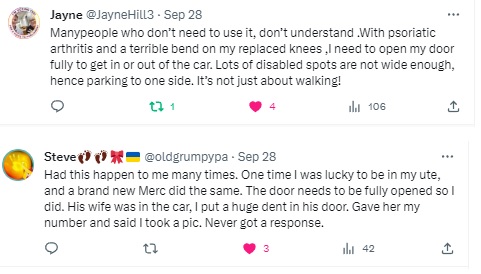
I shared the information on X (previously known as Twitter). Some of the responses blew me (and many other people) away. No wonder the royal commission was needed: just at this simple level of disabled life the responses were incredible. Many were very quick to blame me for the black car’s illegal parking!

Let me set the scene. I’d been for a skin scope late in the afternoon. I drove from there to my local shopping centre to collect a prescription from the pharmacy and grab four items from the supermarket (i.e., not a long visit to the shopping centre). I parked my car in the leftmost disability park beside a pillar – that is no-one would be parking to my left. Looking at the picture, you can see the pillar to my left, creating a gap between my park at the next bank of spaces.

Picture of two cars squeezed into a single disability parking space
This does not work!

When I came back from my quick errands, I discovered someone had decided to squeeze in beside me. The yellow line demarking my space can be clearly seen under the left side of the black car’s number plate. There was no way known I could get into my car, even if I’d been a perfectly healthy person back in my thirties!

The car was not displaying a disability parking permit. If the driver did have a disability permit, there is no way the car would be parked as it was. The permit in the window of that car is a residency parking permit – it allows street parking where the car owner lives. The purpose of those permits? An example is a friend of mine lives near a public hospital. The residents in surrounding streets all have these permits, otherwise they’d never get a park near their home.

I called the shopping centre management. They suggested I just wait, the driver would probably only be a few minutes. Probably? What if the driver had gone to dinner at a local restaurant? Gone to the gym upstairs? Centre management agreed to send a security guard. I waited. Several other customers stopped to lend me their emotional support, even though they couldn’t do anything. My plan at that point was to ask the security guard if he could get into my car and back it out for me.

Near the end of this adventure, I was turned away from the cars, watching the escalator to see if I could spot the security guard. I turned back to see the boot of the black car open. The driver then tried to sneak into his car unnoticed! I suspect as he returned to his car, he saw my bread and backpack on my hood and realised he’d stuffed up. Yes, it was a he. Not a young one either, I’d hazard a guess my generation, a tad younger than I am. He was hoping to escape unchallenged.

I’ll admit I was not happy and I did swear.

Me: “How the fuck could you do that?”

Him: “Easy!”

Lovely attitude. As he drove away he screamed at me something about photos, but photos was the only word I heard. I assume he didn’t like that I had taken evidentiary photos of him.

The security guard turned up just after the driver had left. We discussed the incident and I provided all necessary information, including the photos. Drove home and made a police report.

That is not the end of the story though. I posted the saga to X.

So I park in a disabled spot to go to pharmacy & buy bread. I come out to find someone has squeezed in beside me. Like what the actual f***? I can't open my door enough to get myself in my car (knee surgery, PsA, etc) And no, I'm not hiding his numberplate. 😡😡😡
Click image to see the full thread.

Well, all hell broke loose! I was told I should park in the middle. Umpteen times. Let me assure you this doesn’t always work. Different disabled people need different space to enter and exit vehicles. They may have any of a walking stick, crutches, a walker, a wheel chair or even a hoist involved. When I park my car, I don’t know what the next vehicle may need or whether they will park to the left, the right, or in the middle of the adjacent park (to my right). It will depend on their needs. By parking to the left as I have, I am allowing maximum flexibility for the next car and given I am next to a pillar, I am not restricting anyone who may park to my left. I also have the room I need. Well, at least I did when I parked my car. Yes, parking in the middle is standard and necessary in narrow, normal car parks. It doesn’t quite work that way in disability parking spaces.

Different parking spots are marked differently. Here are two disability spots at a local park. As you can see, one is delineated, the other not.

Disability parking at a local park. One delineated, one not

Then the issue of MY disability parking permit came up. Shock, horror, it was hidden by my backpack in the photo. Lots of responses telling me I was at fault as my permit wasn’t where it was supposed to be, according to them. I have NO idea how this excuses the illegal parking by the guy in the black car, but here we are.

According to VicRoads, I was fine. I can assure readers it WAS clearly visible on my dashboard, not just where other people thought it should be.

An Accessible Parking Permit: 

can only be displayed when the vehicle’s transporting the individual who the permit was issued to 
must be clearly displayed so that the permit number and expiry date are visible from outside the vehicle.
The Rules!

One reply even asked me what I’d do if all the disability spots were taken, as if to imply I really didn’t need one anyway – now what on earth that had to do with the guy illegally parking is beyond me.

Several seemed to think the only “disability” I had was my recent knee surgery, rather than see I had clearly stated PsA. No, I don’t expect people to know what PsA is – we are a mere 1% of the population – but if you don’t know, perhaps ask – do not assume it is “nothing”.

Many people were supportive, here are two examples:

Supportive replies

Others shared their own experiences.

However, the number of replies that effectively blamed me, the disabled person, for the OTHER person’s illegal parking was astounding! I had to wonder how many of them have snuck into disability car parks when they shouldn’t. Guilty consciences? There are other considerations too. In my case I needed to be home on time to take medication at a specific time. Another person may have been heading to a medical appointment. Being stuck there for any length of time could be really problematic for some people.

Edit 30/09/2023: After publishing this, I had an another thought. There was a lot of emphasis, in the replies to my original thread, on how I should prevent others doing the same thing. Why? Even one of my own friends said it! How has society got to point I (or anyone) can’t just depend on others to DO THE RIGHT THING? Why should we have to be on the defensive ALL the time, to our own detriment (in this case, less space)? Just do the right thing! It isn’t that hard.

Edit 05/10/2023: On the weekend following the above experience, I happened to be in the same car park and took some photos to demonstrate the practicalities we face. The experience that day just happened to be a good example of how parking in the middle doesn’t always work.

In above photo, I have parked in the first disability spot in this part of the car park. as can be seen, there is a pillar on my right (driver’s) side and a delineated clear space to my left. Quite obviously I am NOT parked in the middle of this space: I think it is obvious that had I parked in the middle I would NOT have been able to open my car door fully due to the shopping carts left in the space in front of the pillar. Also, even to open the door as I have, I am clearly NOT within the delineated space. So I moved to another space. Let’s see how that works in practice.

In this space I have parked in the middle. Again there is a pillar on the driver’s side, so a space between my car park and the next one over. However, see where that car (my driver’s side) is parked? Right on the edge of their space. So, if the pillar was not there, I would not have been able to park in the middle – as can be seen, my open door extends over the edge of my car space and would hit that vehicle. Or I could come back to my car and find that space full of shopping carts, like the previous photo. Again, I’d not be able to fully open my car door, therefore would be unable to get into my car. The car parked on my passenger side is parked in the middle of that space, but is a smaller vehicle, may not need to open the door fully, or there may be pillar space on the passenger side of that vehicle and perhaps it is the passenger, not the drive, that needs the space. Every case is different, which is something people forget!

End of edits

No wonder we needed a royal commission! This was, in comparison to some, a very minor issue. The social attitudes it highlighted were shocking.

New Disability Rights Act needed to end abuse and exploitation, royal commission finds – The Guardian

Australia’s Disability Representative Organisations call for healing – Inclusion Australia

Yippee! Finally, Second Knee Replaced!

That was a long journey! But I am all good, the second knee replacement is done and shows every indication of being as great as the first knee replacement. July 26 was New Knee Day!

I wrote comprehensive articles relating to my first knee replacement. This time I’m writing about the differences between the two experiences.

The 2020 articles:

I have NOW been told my 2020 recovery was “exceptional” while this recovery has been “typical”. They didn’t tell me that back in 2020, just that I was doing “so well”.

The Lead Up

As with the 2020 operation, this initial operation was also cancelled and rescheduled. In 2020 it was due to Covid-19 lockdowns. This time, in 2023, it was due to my psoriatic arthritis (PsA) being out of control. As well as medication for the PsA, I was also on NSAIDs and prednisolone as we (hopefully) waited for the medication to kick in. For surgery I had to reduce the NSAID dose from 400 mg p/d to ZERO. I had to get the prednisolone down to 2.5 mg p/d. I wrote about those requirements and what happened when I did a trial run in Crossing My Fingers – Again.

With the change to pain medication for me, my GP and I were confident we could handle the 10 days required with no NSAIDs, but yes, IT WAS DIFFICULT. By the time I was due to be admitted, I could barely use my hands at all before 11 am, as an example. The hospital admitted me the night before on medical grounds as there is no way I could have got myself there by 6:30 am the day of surgery.

I’ve talked about my teeth issues: yet another tooth (the third) played up just prior to surgery – in fact it split and half basically fell out in the dentist’s hand. My dentist advised it needs to be removed by an oral surgeon and did a temporary patch job. My GP had prescribed precautionary antibiotics which I arrived in hospital with. That caused quite a kerfuffle and there was talk of cancelling the surgery. Thankfully, that did not happen. My surgeon does not like surprises! Good thing too, but certainly was a bit traumatic at the time.

Last time neither my PsA or my teeth caused any complications!

Surgery

Pretty much the same as last time – I was out for it! However, surgeon came to me after surgery and said it was very “messy” once he got in there. The inflammation had caused damage to muscles that he could “stick his fingers into” (the holes). Will the muscles heal, I asked. He believed so. I forgot to ask which muscles! He last described it as “terrible”. I’m not sure if terrible is worse than messy!

Reading the letter the surgeon sent to my GP, it was again the popliteus muscle that was so badly damaged. This is the same muscle that was being dissected by a cyst in 2020, just this time it was worse.

The scar looks pretty much a mirror image of the left leg! it is also the same length – 23 cm for those into scar dimensions.

Post-Surgery

One good difference, one not so good.

First, the good difference. In 2020 my glutes spasmed uncontrollably and very painfully 10 hours after surgery. In the end, Lyrica was used to solve the problem. On that basis, the peri-operative physician decided to start me on Lyrica immediately post surgery. It worked, no spasms. My glutes, ITB and piriformis were still painful and needed physio work, but there was no crazy spasms like last time. Yay! I was also on far less pain medication overall with the change my GP and I had made and which the surgical team adhered to.

The not so good difference was my veins kept collapsing and we had to find new cannula sites. This was not fun, especially at 2 am in the morning. Why were they causing issues? I don’t really know, although having been on prednisolone for so long pre-surgery was suggested as a possibility. I ended up with quite a few bruises. The machine would beep madly and display “Downstream Occlusion”. I’ve left out the bruise photos!

The darn catheter was not a relief. I’d been rather looking forward to not having to worry about toilet trips immediately post surgery, but I felt as if I wanted to “go” all the time. Very annoying!

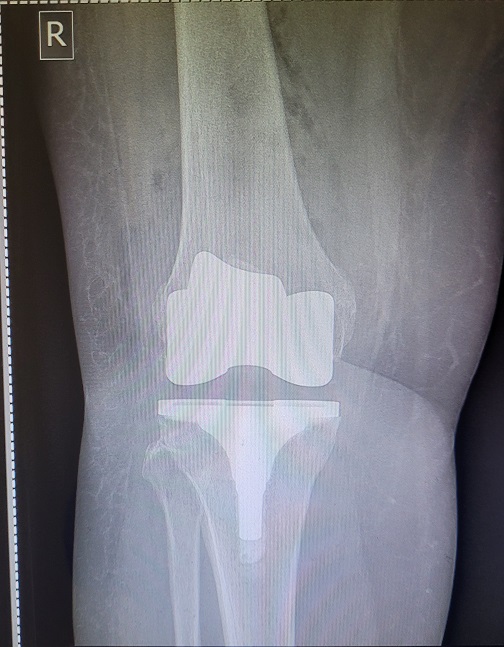
The x-rays look pretty much like last time! As does the dressing.

Of course I got makeup on and my nails done! The nails were done before the makeup and my hair is wet in the photo. But I was in hospital, so I’m allowed some leeway!

Rehab

Patient transport (to move me to the rehab hospital) was about 2.5 hours late and I nearly missed out on lunch!

Basically, rehab went pretty much like 2020. One difference was I left rehab still unable to do a straight leg raise. I managed to get those happening by four days later. It just took longer this time to get those quads really firing.

The other very sad difference was the wonderful massage therapist who had rooms at this hospital in 2020 is no longer there. Thankfully the physios treated my glutes and ITB!

The food was pretty good!

Home!

A hint. DO NOT accidentally hit your operated knee on anything. I did and I think I set myself back a week. Very grumpy with myself. I was a bit concerned and went to the surgeon’s office to have it checked on Monday (August 21). The nurse told me it looked fine, just to take it easy for a few days. So I did! Unusual for me, I know.

I’ve had ice packs on the knee and heat packs on my hands and glutes! Plus the spikey ball got a bit of use on the glutes too. Ice packs are good after the rehab exercises.

I am still taking pain medication, whereas in 2020 I had stopped by Day 20. As I write, this is Day 33 for this knee. I am older, the knee was messier and I accidentally hit it. Plus my PsA is still not under control (i.e. inflammation). My GP says to be realistic about the differences. I have reduced the pain meds considerably from when I first got home so that’s good.

I also have a theory about sleeping. My knee will be fine all day, but I’ll have pain or discomfort during the night. One night I woke up thrashing my leg around the bed, as if trying to shake off pain. Even this morning I woke up with the knee quite stiff. I think during our waking hours we are very careful and (usually) ensure we don’t do anything to hurt the knee. But when we sleep we toss and turn and can put the knee in positions it doesn’t actually like. We wake up as a result. Pain and/or stiffness can result. I wonder if bracing it at night might be a plan, but that only occurred to me today.

I am doing the rehab exercises religiously, as I did last time. On Friday (August 28) my flexion was measured at 128 and my extension was 100%! I never got to 100% extension with the left knee, I got to 98%. But I did get to 145 flexion at week 10, so that is again my aim. I may not get it, as I am heavier now than I was in 2020 due to the PsA and related meds this time around. It is still my target though.

I am walking every day. Started with two little walks a day, gradually increased. Today I was back to my favourite walking spot!

Now, skip the next photo if you are squeamish. I think it looks great! Looks better now, this was a week ago. It is getting the Vit E treatment now. The scar from 2020 is barely visible any more.

So that about sums it up. As for the PsA, six days before surgery my rheumatologist changed my medication again, but I wasn’t allowed to start the new medication until 10 days after my surgery. It may take three months to know if this one works, so I am back on the NSAIDs and prednisolone while we wait. This is medication number 8. The hands are a little better now, but I am scared of counting my chickens before they hatch. The shoulders are also a little better. I do think I’ve been keeping Voltaren in business!

A Thank You!

Again, a very big THANK YOU to my surgical team. Same surgeon, same anaesthetist, same peri-operative physician as 2020. Absolutely fantastic. I am so happy to have matching knees!

Down with the Bad, Up with the Good

Thankfully, my second knee replacement surgery is back on the agenda! Woo hoo! I’m excited!

I suspect some people may wonder why I am getting a knee replaced if I can walk 7,500 to 8,000 steps a day and do “formal” walks totaling 4 kilometres a day. How can my knee be THAT bad if I can do that? Only due to great care and diligence, let me tell you. The aim of this article is to give some tips on how to manage walking leading up to surgery. If I don’t replace the knee, I am very limited in what I can do. I can’t spend my life walking in a straight line.

As described in Crossing my Fingers – Again, we felt my new biologic was finally kicking in. My GP wanted me to keep my medication dosages stable for a week or two, which we did. On May 30 I dropped my NSAID dose by half and have managed to maintain that. I saw my GP again on June 6. We felt if I got a surgery date, we’d make it. So I have a date! Next month! Now, we recognise that during the 10 days before surgery where I have to be at zero NSAIDs, I MAY have to increase my pain medication to compensate, but as this is only for 10 days, that’s acceptable. I did something similar for the last knee surgery too (there are links at the bottom of that article to the full knee replacement story). I also have to reduce my prednisolone, which I have starting doing this week. I’m NOT pain free, by any means, but I’m surviving!

I do have to be very careful to keep the bung knee in line, no twisting! I can’t fully extend it, although flexion is not quite as bad. Bending down to pick something up off the floor? OUCH! Having it bent while sitting at a dining table, for example, results in pain when I first get up from the chair.

I need to keep exercising to ensure I’m ready for rehab. Last time I was doing glute bridges on the dining table. Sadly, down I’ve downsized, my dining table is doubling as a desk, so I have to find other ways.

Here are my walking tips.

  • Make sure you have good, supportive shoes. This is an absolute must.
  • Choose a pleasant place to walk if you can. The photo above is where I love to walk. It is encouraging!
  • Keep an eye on the terrain. If I accidentally step into a small pothole with my bad leg, the pain is NOT GOOD.
  • Pay attention to your posture. If walking in a shopping strip, shop windows can be useful. In a park, check your shadow. Is your back straight? Shoulders back?
  • You may start limping because your body may decide to shorten your stride on the bad leg without you even thinking about it. Try to maintain the stride length if the pain is not too bad. This will depend on several things: what pain management program you have going, how bad the joint is, etc. You will need to “warm up” first, but I find I can control the limping without increasing the pain. Why is this important? Because you don’t want to shorten and/or tighten soft tissue like tendons prior to surgery if you can avoid it.
  • Down with the bad, up with the good. When negotiating steps, stairs or gutters on pavements etc, down with the bad leg, up with the good leg. Why? Less bending of the bad leg (especially bad knees). I stupidly walked down the stairs to the car park in a hospital the other day. Very bad decision, I should have waited for the lift! Even with this tip, stairs are hard to negotiate!
  • Inclines and declines. Where I walk there are very slight (well, very slight for MOST people) inclines and declines. Some on the actual path, but also bridges like this. While I have little problem with the incline, the decline is difficult. Depending on where the damage is in your knee (or other joint) you may find the reverse, or you may find both are a little challenging. Slow down, hold the rails if there are some, maybe decide that track is not for you in future.
Incline Decline
  • Don’t walk until you’ve “thawed out”. As we know, psoriatic arthritis is notoriously bad in the mornings. I take time in the morning to gently thaw myself out. The knee awaiting surgery will most likely also stiffen up overnight. While some mornings are better than others, I rarely do my first walk of the day before 10 am, sometimes not until 11 am. Even then, the first 200 metres or so are warming up.
  • Split the walking if at all possible. I’m retired, I can walk whenever I like, but obviously some patients are still employed. If you can break up the walking, do. At the moment it takes me about 15 minutes to walk a kilometre. You can fit a kilometre in here or there throughout the day. Take a slightly shorter lunch and a longer tea break, perhaps. Not possible in all jobs, I know. Winter means walking after work is not really appealing. Think about ways you can split the load.
  • As we all have different pain management regimes, I can only speak of mine. At the moment I am on a slow release (SR) twice a day and have some instant release (IR) for breakthrough pain. On a day where I’m not too bad, I may need no IR at all. If I am feeling the knee is a little too grumpy, I’ll time the taking of an IR (maybe only half) so that it kicks in before I start walking. This is all about listening to your body.
  • When you get home from a walk, I suggest elevating your feet for a while, but do not allow your legs to “freeze up”.
  • Remember to adjust your goals if you are doing other “stuff”, as I discuss in Why is There a Dip in My Stats?.

Once I have done the first walk of the day, I usually have very low pain levels for the rest of the day. We are all different, our joint damage is different and some, like me, have underlying conditions such as psoriatic which do complicate matters. So while that is my situation, I accept it may not be yours.

I also have two ankles requiring surgery. The left ankle is very problematic at the moment. When I was on my higher dose of NSAID I would know when I hit 500 metres on my first walk of the day as all of a sudden, the ankle would stop hurting as much. When I dropped the NSAID dose on May 30, from then it has taken about 800 metres before my ankle stops hurting. Hence it is important I time that IR dose properly if I feel it necessary. When I say “stop hurting” do I mean pain free? No, sadly, I don’t. Some days are better than others, but the level of pain is low enough that I can keep up the walking. And, once it is gone, it is pretty much gone for the rest of the day, thankfully.

We are all different. Please talk to your doctor and/or physio about what may be specifically appropriate for you.

Do not expect every day to be the same. For some weird reason this morning was awful for me. I even battled to pull my sheets out of the washing machine (nothing to do with my knee). I had a nanna nap after lunch (VERY unusual for me). Yet now, as I write, I am fine. I reduced my prednisolone yesterday morning, I think my body is adjusting to that reduction.

If you have any questions, I am always here to help if I can.

Addendum: The following is a good article from The Guardian about walking technique.

‘I’m not just faster, but taller’: how I learned to walk properly – and changed my pace, posture and perspective

Walking Graph

Why Is There A Dip In My Stats?

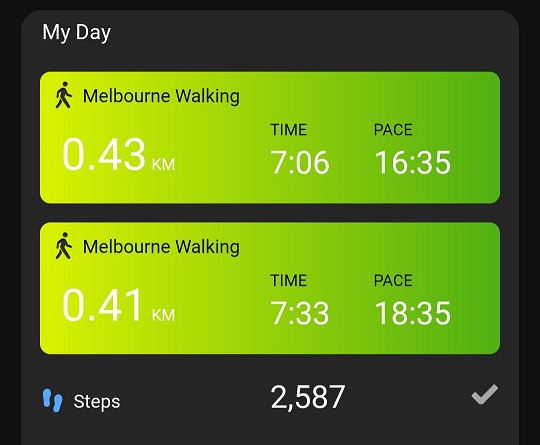
Above is a snapshot of my walks for the last four weeks. In my last article I wrote I was improving. Yet we see there was dip yesterday. Why is this so? You’ll be pleased to know it is a deliberate dip. A very deliberate dip, in fact. Recently I wrote Let’s Revisit Pacing. If you are new to my work I strongly suggest you click that link and read that first as this is, essentially, a sequel. A real life example.

Improvement has allowed me to get to the point I am walking 4 kilometres each day: but that was all I was doing! At least that was my primary use of energy over and above actually fueling the bodily functions that keep us alive: pumping blood, breathing, digesting food etc.

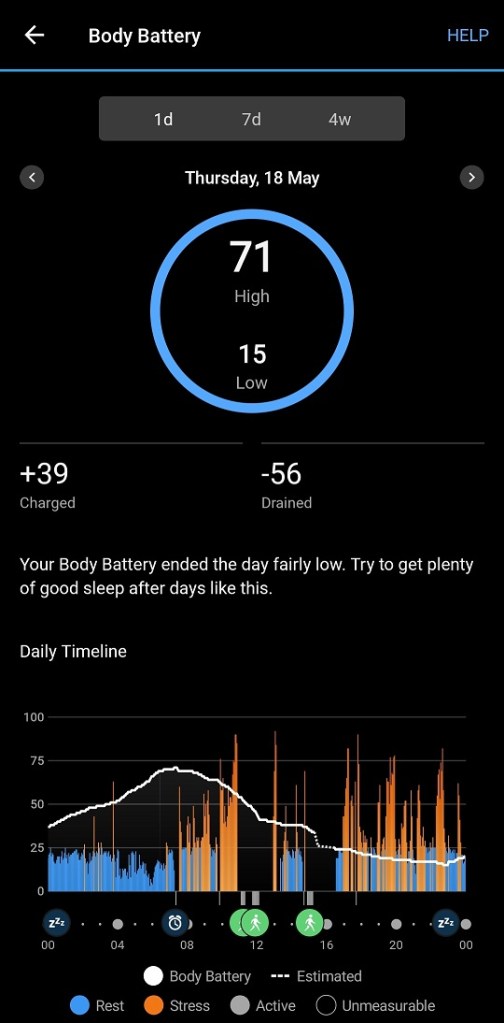
Yesterday I did two activities that require energy, that chew through our internal battery charge. I had a shower and I did grocery shopping. This wasn’t a “nip down to the shops and grab a pint of milk” trip, this was a monthly stock up. When I got back to my apartment it was four trips between my apartment and the car to bring everything inside. Then the effort of putting it all away.

When I initially wrote about what I call our internal battery, I stated I didn’t have a charge meter on my arm! I do now: my Garmin watch. Here it is for yesterday (Saturday) compared with Thursday. For whatever reason, I hadn’t charged my battery as well overnight Friday night, so I was already a little low on fuel Saturday morning. I will state I am not sure how accurate this is for chronically ill people – I’m working on watching it carefully – but it is certainly an indicator. Blue is charging your internal battery, orange is using it up.

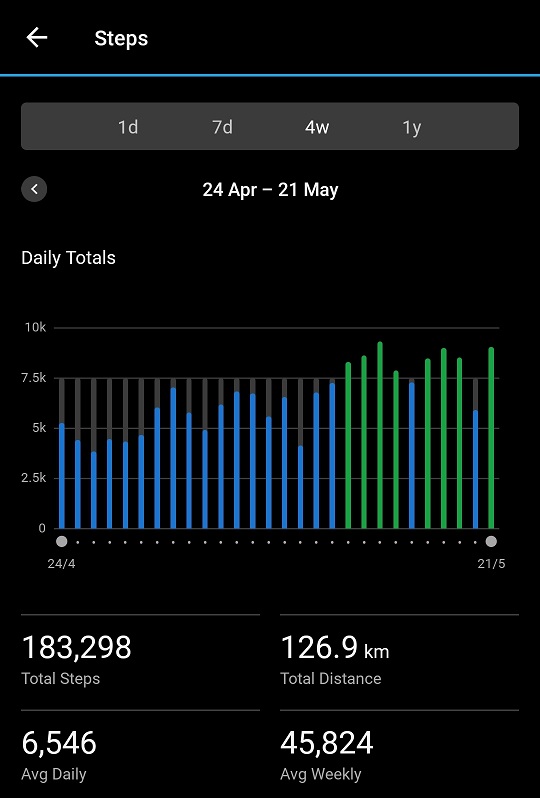
Another point to note is that most of the step counters will not register steps, or register steps accurately, if you are pushing a shopping trolley (or similar activity). Very annoying, as I think I walked about 1,000 steps just around the supermarket. Consequently there is also a dip in my steps for yesterday, even though I was moving. For those wondering the blue bars below are where I did not achieve my daily goal of 7,500 steps. Green bars are goal achieved!

Why not 10,000 steps you ask? Ahhh, well, yes, I have that covered too! Read We Need Personalised Numbers to understand the 10,000 figure is a myth.

Healthy people reading this will most likely understand shopping uses energy. They might raise an eyebrow over the shower taking energy. Trust me, for most of us chronically ill patients, a shower consumes energy. Many of us need a rest afterwards. I don’t usually, but I do at the moment.

What I did yesterday was adjusted my activities so that I did not Boom/Bust. I don’t need to burn through my internal battery one day then be wiped out for the following two or three days. Having a goal of 4 kilomtres a day is great, but at this stage of my “comeback” I am not risking any post exertional malaise (PEM). If I have to do something, like the grocery shopping, I will adjust my walking goal. Hopefully. in a few months I won’t need to: I’ll be back to my “normal”. Right at the moment, I’m not taking that risk. When I do head back to the gym for strength training, initially I will drop my walking goal for that day.

Using Movement As Medicine is not a simple “just get out there and walk”. It requires careful planning and monitoring. I hate “bust” days and monitor myself very carefully to avoid those days. Over time, following the pacing principles, I can do more. Pacing is the golden rule here! Today I walked 5 kilometres. I’ve been working up to it and I did nothing else that used energy today (other than writing this, of course).

Gardiners Creek

Crossing My Fingers – Again

My apologies for my silence over the last six weeks or so. I counted my chickens before they hatched.

On March 12 I published Changing Medications – What Can You Expect?. At that point it was roughly ten weeks since I had changed my medication for psoriatic arthritis (PsA) and I was finally feeling as if the new medication was starting to kick in. I was a little overly optimistic, as it turns out.

Also, although not mentioned in that article, the whole situation became more complicated when I slipped/tripped and fell in the shopping centre car park on March 8. What I initially thought was a simple trip ended up with me back in my orthopaedic surgeon’s office. To cut a long story short, it was decided the time had come to replace my right knee. If you are new to my story, I had the left knee replaced in 2020.

The problem was the slight improvement I’d got overly hopeful about in March did not continue. I was quite quickly back to waking in considerable pain and struggling with malaise and energy levels.

At the time I saw my perioperative physician I was still on 400 mg of Celebrex and 15 mg of Prednisolone a day. In order to undergo surgery on May 10 (the scheduled date) I needed to reduce the Celebrex to zero by May 1 and the Prednisolone to 2.5 mg per day by a week before the surgery. Was this going to be a challenge, I wondered to myself. I certainly didn’t want to just stop the Celebrex cold turkey on May 1 as clearly I was still in need of it to function on a daily basis. I’d needed friends to drive me to a myotherapy appointment and my pre-op Visionaire scans. Essentially, I wasn’t too chipper.

I discovered I had another infected tooth – maybe THAT was the problem? Had that tooth removed. It was a rather complicated event as the tooth was part of a double crown. I spent over an hour in the dentist’s chair, most of that time was spent removing the crown and temporarily recrowning the uninfected tooth. The actual extraction was a minor part of the visit. However, removing the tooth did nothing to improve my overall inflammation.

On April 17 I could see May 1 looming and decided I’d see if reducing the Celebrex was at all possible. Celebrex comes in capsule form – you either take a capsule or you don’t, there’s no pill splitting here! So I dropped from 400 mg to 200 mg on that Monday. Deliberate timing, as I had a GP appointment on the Tuesday. If anything went wrong, I already had an appointment! I also had accepted another kind offer from a friend to drive me to that appointment.

I woke up on the Tuesday in a very unwell state. While I managed to sit up in bed and get my feet to the floor, I could not actually stand up. This was a bit of a worry, to say the least. As gross as this sounds, I’m sharing for transparency: I was very worried about actually getting to the toilet in time. I tried using my walking stick to give myself some leverage, but doing so hurt both my hands and my shoulders due to the angle. Eventually I managed to stand upright and shuffle to the bathroom. While I was on my feet, I shuffled to the front door and unlocked it from the inside – if I had to call an ambulance, at least they could get in. Obviously I was in no position to start reducing my anti-inflammatories!

After various communications between my GP, rheumatologist and knee surgeon, the knee surgery was cancelled for the time being. My CRP and ESR inflammatory markers were rather high and THAT was while I was on all this medication. What would those markers have been reading if I was on no anti-inflammatories?

I did a damn good job on my rehab of my first knee and it is FANTASTIC! I want to be able to achieve the same result with the second knee replacement. At that point in April I was able to walk a mere 800 metres at a time because my ankles were so painful, the left one in particular. I knew that the extra loading of that ankle while recovering from surgery for the right knee could be very problematic. All things considered, cancelling the May 10 date was sensible, but very disappointing. I want the knee done, but there is no point in being a less that optimal patient if that can be avoided.

My next new medication injection was May 4 and I was getting closer to the 24 week mark – SURELY it would start working!

On May 4 (a Thursday) I gave myself the scheduled injection. Nothing much changed until Monday May 8. I did feel an improvement. I managed to walk 1.5 km in one walk. In total I walked 3 km for the day. I have slowly built up during the week and on Friday I walked a total of 4 km over three walks – I’d hit my old goal of 4 km for the day. Saturday I walked 2 km twice. The possibility of post-op rehab is now looking more achievable! I’ve even walked at my favourite walking spot, shown in the picture above.

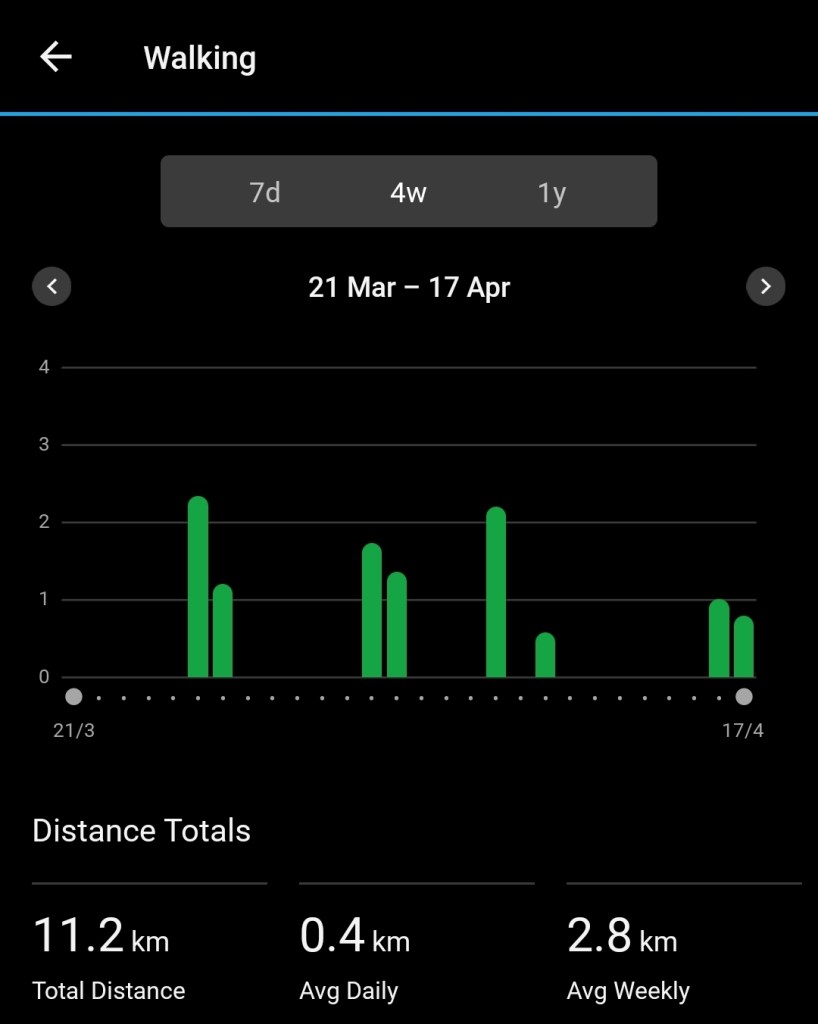
For those into graphic representation, here are the last 8 weeks. PLEASE NOTE Garmin changes the scale between the two periods, which makes the March/April bars look WAY higher than most of the April/May bars. And of course I haven’t finished today! Look at the total kilometres: 11.2 km versus 58.9 km

HOWEVER – I’m still on those same dosages of anti-inflammatories. I asked the GP about a possible test reduction and she was rather adamant that I give myself two weeks before we try to change anything. I haven’t even mentioned the pain medication I’m also taking or the Voltaren gel I am using on my hands and ankles.

While all this was happening, my rheumatologist scanned me for gout. The CT scan came back negative, which as the rheumatologist said is both a good and a bad thing. While it is good I don’t have gout, we are back to square one. Why is my inflammation so high? Is it merely that the new medication is taking its own sweet time to be effective? Or is my body being difficult?

Speaking of difficult bodies, I also did something rather adventurous. Click the image to go to the website.

While I am not going to go into detail about this test, it has been useful to me. My report was 29 pages long. To give you an indication, this is a summary of my genotype for the genes the test currently looks at.

We have changed two of my medications as a result. We also know to watch out for certain other medications in the future. This test does not yet cover every medication known to science, but it covers a lot. If you are interested, I suggest you speak to your GP about whether it may be useful in your situation. Yes, it is rather costly on a limited income but I see it as an investment in my health, given my situation.

Right now I am nervous that I am again counting my chickens before they hatch. Today is day eight of incremental improvement. I’ve managed to walk 4 km three days in a row, hopefully today as well. I have more energy. I’m writing. I haven’t ventured back to the gym yet, although I desperately want to.

In summary, as I said in my first article on the subject of changing medications, it is often not as simple as opening a different pill bottle. Even as I write, I do not yet know if this medication is going to be effective for me, but at least I have had eight straight days of improvement. I can exercise reasonably well again. This morning I woke with far less pain in my hands! So I’m crossing my fingers. The last blood test results showed a slight improvement in my inflammatory markers.

If you or someone in your life is changing medications, please be gentle. Be understanding. Be aware it may NOT be smooth sailing. 

Medicare, bulk-bill, gap, rebate

Watch for Ambiguous Billing Terminology

I learnt a valuable lesson during the month of March, 2023. Words we think mean one thing, can mean something completely different to other people – I think in general life we are all used to this. When it comes to money, especially money involved in the costs of medical treatment, different interpretations can result in an unexpected and unwelcome hit to the bank balance and the budget.

I share these small examples to encourage ALL patients to double and triple check what their provider actually means when they refer to some of these terms. I also encourage the medical profession to be consistent and use clear terminology, removing all risk of ambiguity.

The terms I am looking at today are:

  • Bulk-bill
  • Out-of-pocket
  • Gap
  • Rebate
  • Non-rebateable

“They do not bulk-bill” does not technically mean the same as “there is no rebate” for a service. Many providers do not bulk-bill, but the patient still gets a rebate. Happens every time I go to my GP. I pay $260.00 and I receive the Medicare rebate of $223.40 overnight into my bank account. Please note that rebate is after having reached the Safety Net Threshold for the year. The fee is also for a long appointment.

The $36.60 is the gap and, to me, my out-of-pocket. A quick unofficial survey on Twitter showed 34% of respondents believe the same as I do. A service that has no rebate and is paid for totally by the patient is, in my simple view of the world, a private service. Like prescriptions for off-label use not being covered by the PBS subsidy – a private prescription.

So, when I was recently told an imaging provider did not bulk-bill, that is what I expected. That is not what happened.

When I arrived I filled out the MRI information and permission forms, including agreeing to $345 “out-of-pocket” expenses. Now, my pain medication befuddled thought process went like this. “That is the standard gap, but they don’t know I’ve hit the threshold, therefore my out-of-pocket will be much less.” The term out-of-pocket does NOT scream to me that there is NO rebate for what you are about to have done. Yet, in this case, that is exactly what it meant.

I knew that in order to receive a Medicare rebate for a knee MRI at my age, I now (Liberal govt changes to Medicare) needed a specialist referral rather than a GP referral. I had the specialist referral. So I thought I was OK here.

Turns out, Medicare “license” only certain specific MRI machines to be allowed to do rebateable knee MRIs for older patients. Other MRIs I have no idea about, but I will ask if I need any! The machine I had been in? No rebate. It isn’t that they don’t bulk-bill, it is that they CANNOT lodge a Medicare claim for my situation at all. Big difference!

The other incident was similar, but different. I rang to book an appointment to have an ultrasound guided steroid shot in a finger. The staff member taking the booking told me the cost was $285. I explained my having reached the safety net threshold to the staff member. Even then I was NOT informed that the $285 included a non-rebateable item number at a cost of $115. My having reached the Safety Net Threshold was not going to have any affect at all on that component of the bill. Why was I not informed? I have no idea.

When did I find out? After the service was provided, as I paid the bill.

In checking numbers for this article, I have just realised I am currently seeing a provider and paying a bill that is NOT being submitted to Medicare at all. At this point I have no idea why, but I will be enquiring. It maybe there is no Medicare item number for this visit type – is this another Liberal govt change to our Medicare system? When I was working, these sorts of things didn’t bother me and probably if they had happened would have slipped under the radar. Now, being on a fixed income, I pay much more attention to the dollars and cents involved in my medical care, given that is where most of my dollars and cents go these days!

Please note, in the grander scheme of things, these are minor expenses. One contact of mine details thousands involved in a chemo treatment that is not on the PBS for the particular cancer being treated. However, minor expenses, especially for those on fixed or low incomes, mount up. I had visions of a single parent being unable to do the grocery shopping this week because of such a situation. I’m also not an inexperienced patient – I’ve been walking this road for a while now. Yet even I got caught out by the ambiguity.

Be careful.

Medications

The Costs of Medications

In 2018 I wrote “The Costs of Chronic Conditions” highlighting how many of our condition management costs are not recognised by “the system”.

Today, I’m going to look at medication costs in more specific detail, to paint a realistic picture of what happens. Similarly to my article yesterday, I hope family and friends may find this useful in building their understanding of the financial situation the patient in their lives is perhaps dealing with. The details I provide here are simply to paint the landscape. Every patient will be different, but the overall picture is one of many dollars on medications, not all covered by the Concession Card (IF the patient has one). Most of us don’t just take one medication for one condition: as you will see here, we end up taking medications to counteract the actions of other medications. It gets messy. And costly.

I am very concerned that a number of Long Covid patients are going to find themselves in exactly this situation, without a Concession Card.

For ease of calculation and summarisation, in this article the medication prices I quote are rounded up to the nearest whole dollar. E.g. Panadol Osteo is $9.49 where I buy it, in this article I’m citing $10. Prices vary between brands and retailers, I’m using the pricing of the brands I buy.

“But you have a Concession Card, your prescriptions are only $7.30!” I hear people cry. SOME of our prescriptions are only $7.30. Some, by no means all. On top of that many of us need over-the-counter medications. Prime example is the Panadol Osteo mentioned above. Not a prescription medication. $9.49 for 96 tablets. Six tablets a day usually, so that will last 16 days.

While on the topic of pain management, here is a strange anomaly for you. Palexia is a good pain medication that comes in both instant release and slow release. Guess what? The slow release is covered under the Concession Card (CC), the instant release is not. $20 for 20 tablets. I have needed both formulations during my recent “difficulties“. How long does 20 tablets last? Depends on the situation.

Here’s were it starts to get complicated. Pain medications have a well earned reputation for causing constipation. So now, per my gastroenterologist, I need to counteract that by buying Coloxyl and Movicol, both over-the-counter medications. Movicol is $20 for 30 sachets. Coloxyl is $14 for 100 tablets. Pain medications can also cause nausea, hence the Ondansetron (prescription, not covered by CC), although I do suffer nausea from time to time even without pain medication.

If I am taking NSAIDs (non-steroid anti-inflammatory drugs e.g. Celebrex) I have to double my Somac (pantoprazole). So while Somac is covered by the CC, now I need to fill the prescription more often resulting in increased cost.

Of the 16 items (a mix of OTC and prescription) listed below, only seven are covered under the CC. Less than half.

MedicationCost
Panadol Osteo$10
Movicol$20
Coloxyl$14
Palexia SR$7
Palexia IR$20
Somac$7
Prednisolone$7
Celebrex$7
The magic biologic$7
Thyroxine$7
HRT$7
Enstilar Foam$7
Dymista (nasal spray)$49
Saxenda$387
Zyrtec (for hayfever)$30
Ondansetron$17

There are other things not listed above. The Fess Saline Nasal & Sinus Wash kit was $13. Because of my psoriasis I don’t use soap or typical shampoo. T/Gel shampoo is $15 and Ego Pinetarsol solution is $22.

If I were starting from scratch to get all my “stuff” I would need $653 to buy all the above.

Then there are the unexpected events, such as needing an ultrasound guided steroid shot in a finger recently. When booking, I was told the cost would be $285. I said that’s fine, I’ve reached the Medicare Safety Net Threshold. The staff member did not tell me $115 of that charge was NOT rebateable!

Why am I tacking Saxenda? Because both Prednisolone and Thyroxine can make the patient hungry. Diabetes is a common comorbidity with PsA, so this is preventative, we do not need me developing diabetes. I should clinically be on Ozempic (MUCH cheaper) but there is a shortage as we know.

If a patient is still working and not on a CC, then the prescriptions will be dearer. Yes, there is a PBS Safety Net, but not all medications count towards it – talk to your pharmacist about your specific medications. Non-prescription items like Movicol and Coloxyl do not count towards the Safety Net either.

You or your family member may be on completely different medications and OTC products, but the overall picture is likely to be very similar. Lots of dollars for lots of items.

The picture above does not have everything in it, I just grabbed enough packets to populate a photo! In my forties, had you asked me for a Panadol, I probably would not have had any in the house. How times change.

I only have me to worry about. What of a young mother with my conditions? Finding those dollars could be very difficult. That patient may skip medications in order to feed her children. We need to improve our support of chronically ill patients, as I discuss in “Will Society Adapt? When? How?

Footnote: In this article I have NOT addressed the issue of very expensive medications that are not subsidied under the PBS at all. Years ago a girlfriend of mine was spending $3,000 every six weeks for an infusion. She campaigned to get that medication onto the PBS, but by the time that happened, her savings were virtually non-existent.

In hospital again

Changing Medications – What Can You Expect?

This article is to illustrate the challenges any patient MAY experience when changing medications. I am describing my personal situation: please take into account while reading ALL situations are unique to the individual. My aim is to help patients be aware that changing medications MAY not be smooth sailing. I also ask friends, family and colleagues, especially those managing staff, to be aware changing medications is not as smooth as simply opening a new bottle of tablets. Be supportive and understanding of the patient.

2022 seemed to be a year of gradual deterioration. I ended up in the emergency department (ED) a few times and was hospitalised late January 2023, I had an infected tooth extracted, I just wasn’t feeling good at all. In late December I suddenly realised it was almost the holidays and I was likely to have doctors taking holidays. I felt bad enough that I decided I needed to talk to my rheumatologist before Christmas. My rheumatologist squeezed me in on his last consulting day prior to the holiday season, December 22, 2022. His assessment was that my old medication (let’s call this Med O) had ceased working for me. I stress the “for me” – this is one of the individual aspects – it may keep working very well for millions of other patients!

He started me on a new medication that day. We’ll call this Med N (“N” for New). I was advised it is not good to take Med O and Med N together, I was to stop Med O. I was to start (more like continue, as I had already started) Prednisolone and Celebrex to manage the pain. With hindsight, I think Med O may have still been partially working, guesstimate here, at 40% or 50% efficacy. Because once I stopped it, I got worse!

Med O was a daily tablet medication. The mean terminal elimination half-life ranges from 9 to 14 hours, so the web tells me. So once I stopped taking it, there was no longer any lingering protection from Med O.

Most fellow patients reading this will be aware many medications do NOT start working straight away. I talk about this in Movement As Medicine, written five days after I changed medications. By that stage I had read the documentation and worst case scenario was I could expect improvement in six months! Best case scenario was maybe “some” improvement in about four weeks. That’s a big difference in timeframes. Both “some” and “improvement” are very open to interpretation, too.

Between Christmas and New Year I had a case of De Quervain’s tenosynovitis in my left hand, requiring an ultrasound-guided steroid shot as soon as my rheumatologist was back in the consulting rooms! Not strictly PsA related, but I’m sure there is always a connection with these things, like the hole drilled in my big toe bone!

By that stage I had only had the initial Med N injection. This medication’s schedule is first injection at Week 0, second injection at Week 4, third injection at Week 12 and every eight weeks after that. I certainly wasn’t expecting it to be doing anything much at the three week mark.

On January 20th I yet again presented myself to ED because just about everything was hurting, I’d loss strength in my hands (could not even wring out the dishcloth). I was not a happy adventurer. I ended up having three infusions of methylprednisolone over three days to try to knock on its head the inflammation raging through my body. For a few days afterwards I did feel better, but then started to slide downhill again. Called rheumatologist. His advice was to increase the Prednisolone to 50 mg per day, then taper off at a 10 mg reduction per week down to 10 mg, then stay at 10 mg per day. I’d never been on such a dose! Especially after three infusions! I had noticed breathlessness was an issue after I’d been discharged from hospital and once I increased the Prednisolone dose I noticed sweating and (the worst bit) palpitations at night. Every night. It was like my heart was beating in my ears. Very unsettling experience.

I have a nocturnal AV block. This means my heart skips beats every now and then. Let me tell you, when you have palpitations the missed beats are accentuated. My heart was pounding then dead silence. While it is only a few seconds, I still found myself anxiously awaiting the next beat.

I woke up on March 1st feeling decidedly unwell. Doctor time! GP Clinic squeezed me in with a different than my usual doctor. She listened to my symptoms explanation then looked at my rather elevated blood pressure and heart rate.

Blood Pressure

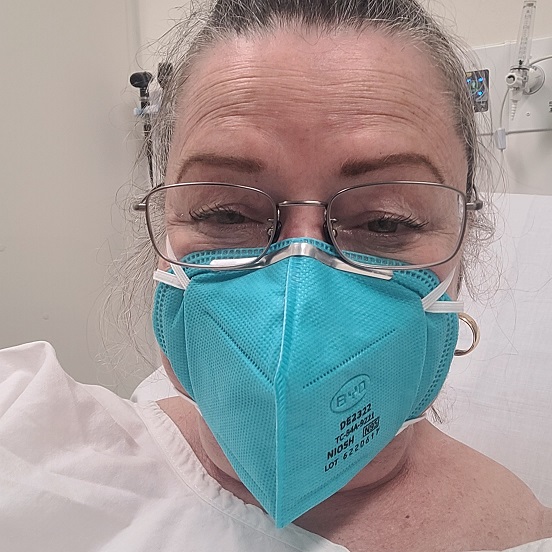
She wrote a letter to ED and told me to go home, pack a bag and head to ED. “Here we go again”, I thought. This was to be my sixth (I think, I may be missing one, I’ve lost track) trip to ED since October! While we both felt I was reacting to the Prednisolone, the obs were enough to need checking out. Bloods and a CT scan later I was sent home. I was not about to have a heart attack, so there was not much they could do. Yes, the picture above is me in ED on that day.

On February 28th I had reduced my Prednisolone to 20 mg a few days early because I was over the palpitations. While that had no effect (a bit early for the reduction to be reflected in my body’s behaviour) on the Tuesday night, Wednesday night I had no palpitations. I haven’t had any since that night either. Very happy about that!

Consider where I was at that point: Med N was still not being effective, and I was reducing the Prednisolone so the inflammation was increasing. Increased inflammation means higher pain levels. I was in a no-win situation at that point.

It isn’t all about the pain either. With my routines I can generally be pain-free by around 10:30 am, depending on when I get up, medication or no medication. It is the nature of the disease. The lack of energy and general feeling of unwellness was overpowering and that I can’t fix by 10:30 am. The effort required to do ANYTHING seemed too much. Having a shower? Tomorrow will do. Cooking? Toast was easier. Writing? The brain would not co-operate. I had to talk myself into walking, something I never have to do. Hydro pool? The effort required to get into bathers, drive there, get home and then shower just seemed all too much.

On March 9th I had my third Med N injection. Yes, technically a week early, but that is because somehow (do not ask) I stuffed up Week 4 timing. That’s OK, by the way, there is a window either side – I’d just confused myself. Cognitive impairment is worse at this time, naturally. I was still annoyed with myself.

FINALLY, March 11th (yesterday) I woke up and the malaise had lifted. All the sore bits weren’t sore. I could actually wring out the dishcloth – strength in my hands is returning. I am writing. I had been noticing gradual improvement over the preceding few days, but not wanting to count my chickens before they hatched, I’d been cautious. That cited six month timeframe was still floating before my eyes!

I still have swelling in various spots I can see and no doubt in spots I can’t see. I can’t see inside my shoulders, for example. I can see swelling in my hands still and there is fluid pooled under the skin on the top of my feet (like a bubble on both feet). The ankles are still swollen, but better than they were. I hope I’m safe to say we now have improvement: long may it continue!

So there you have it: just ONE example of how changing medications may not be as simple as just opening a new bottle of pills. If you or someone in your life is changing medications, please be gentle. Be understanding. Be aware it may NOT be smooth sailing. This has been an eleven week journey to just get SOME improvement from Med N. How fast improvement will continue, I cannot say.

Please note I have NOT addressed the question of adverse reactions to a new medication in this article, which is something to be aware of, of course. I’ve stuck to the topic of the process of change without adverse reactions. I have had an adverse event in the past, “When Medication Messes With Your Mind“.

* Med N was showing it was working on skin and nails though – so something was happening.