The Gods Brought to Their Knees by the Invisible

Humans are Earth’s chronic condition. We destroy at will. We see our species as the pre-eminent beings on the planet. Although many believe in a God or Gods in the heavens, here on Earth the human species is all-powerful.

This year the God-like species has been brought to its knees by something it cannot see. A tiny, minuscule, virus. So insignificant, it is not considered to be living. Yet this unalive molecule coated in protein has shut businesses, grounded air traffic, overloaded the health systems of several cities and killed nearly 700,000 people (at the time of writing). We wear masks, socially distance and in Melbourne we are now under a curfew. Many work from home, many are not working at all. The human worship of the great God Economy has been called into question most dramatically by the state of our aged care homes.

Despite great advances in science and technology, humans are losing the battle. The front-line defence, healthcare workers, are dying.

Some leaders are performing brilliantly trying to save and protect their constituents. Local leaders Dan Andrews of Victoria and Mark McGowan of Western Australia spring to mind. The New Zealand Prime Minister has achieved what many deemed impossible. Others are intent on using the virus as an excuse to denigrate these leaders and undermine their efforts. Tim Smith and Tim Wilson are two examples in Australia.

I am the beneficiary of advances in medical science. I have a prosthetic knee and I’m on a clinical trial. If I was living 200 years ago it is possible I’d be severely immobile, yet in 2020 I am lucky enough not to be. While I recognise the wonderful things we, as a species, are capable of, I also recognise how damn stupid we can be.

I don’t need to provide links, nor do I want to, highlighting the ridiculous conspiracy theories and “my rights” people. The inability of some to accept the existence of something they can’t see is one problem. The selfishness of the “it is my right to go maskless” brigade is another. The lack of numerical literacy, where people cannot comprehend growth rates and infection rates, is a problem.

At the moment there is much talk of vaccines. I hope as much as anyone that a vaccine is developed: I am also aware it will be the first coronavirus vaccine. To date we have not developed one, partly because coronaviruses have not previously been so contagious and deadly/damaging. Then there is the question of availability. Will only the rich be able to afford any vaccine, or will a vaccine be made available to all? The great economy, you see, would not like a free vaccine.

The human species has been brought to its knees. Not by aliens, not by flood or fire (yet, that’s coming) but by an unseen molecule. Humans are reminded despite our belief in our own pre-eminence, that we are vulnerable. Humans can, indeed, be on the receiving end of the same brutality humans dish out to other creatures on this planet. We steal and destroy their habitats, we shoot them for sport, we really don’t care if other species become extinct through our actions. Now we know how it feels. We’ve lost the freedoms we took for granted: the freedom to crowd supermarkets, to fly to the other side of the world on a whim, to get a haircut when we feel like it.

The fragility of nature

We ignored the beauty and fragility of our world because we did not feel fragile. We redefined beauty to be tall skyscrapers, fast cars and electric lights.

Human’s biggest enemy has always been other humans. Wars. Killing each other. Now humans have a new enemy. It isn’t the first and according to science, this will not be the last.

I wonder if this is the wake-up call we need. Time to re-evaluate our way of life. Re-evaluate our disrespect for the flora and fauna with which we share this planet. Re-evaluate our worship of the God Economy.

Managing the economic and social costs of the survivors suffering chronic illness is going to be a challenge. As I have written before, as a society we do not cope well with chronic conditions, I worry that many are going to suffer greatly in the years ahead.

How we cope with the aftermath of this pandemic is going to be a major test of the humanity of the human species.
 

Telehealth – Let Us Keep This Innovation!

The Covid-19 pandemic has brought sadness and pain globally: job loses, businesses closing, the high death toll in many parts of the world. The loss of family members, colleagues and friends is devastating for those affected, irrespective of the death toll of any given country.

One positive that has emerged is telehealth. In Australia telehealth was already available in certain regional areas: during the pandemic it has become widespread. The Guardian published a very good article from the perspective of the medical profession, “The genie is out of the bottle: telehealth points way for Australia post pandemic“.  Here I present my perspective as a patient.

Telehealth is fantastic! Especially for me and I suspect for many other chronic illness patients who see a collection of doctors. Apart from the obvious Covid-19 related benefits of limiting unnecessary contact and thereby maintaining isolation, there are other benefits.

  • Many chronic illnesses have a tendency to flare, meaning even without Covid-19 travel to and from a medical clinic can be an unpredictable physical challenge.
  • In situations like my current one, awaiting total knee replacement surgery, the main focus has been pain management (I’m pretty healthy other than the knee). My GP has been wonderful, keeping in touch, ensuring I’m managing, reviewing the pain management plan, faxing prescriptions to the pharmacy when necessary.
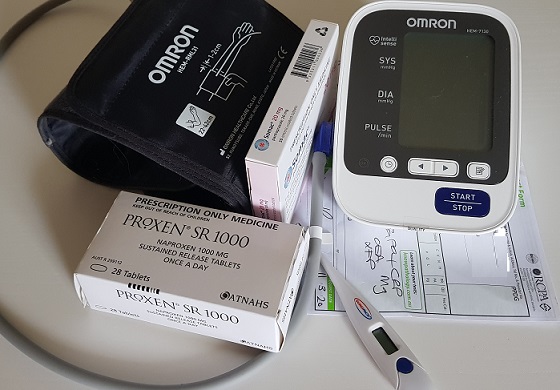
  • My endocrinologist really doesn’t do much with me physically during my visits – observations such as weight, blood pressure and temperature I can provide (although she didn’t ask – this may be an area where some practitioners have to develop a bit of patient trust!). Aside from my description of my health, in my case at this point, it is mostly blood test results that drive decision making, plus an annual ultrasound of my thyroid. Telehealth worked perfectly and saved my travel time, fuel and parking costs. She emailed me a pathology request for my next appointment in July.
  • My psychologist used Zoom, which worked really well. Again, saved travel time, fuel and parking (although that parking location is free in my case). For me it was clinically no different to sitting in her rooms, yet I was in my slippers and had a coffee on hand!
  • Hospital pre-admission appointment for surgery. Yes, my surgery is actually happening, next week! While I was to have a face-to-face appointment at the hospital to go through pre and post surgery planning and preparation when my surgery was originally booked for April 8 (then all surgeries were cancelled due to Covid-19), I had that appointment by phone yesterday. It worked well, everything was achieved as it would have been in a face-to-face appointment, including my being able to confirm I can take nail polish in with me to apply post-surgery.
  • I can see benefits for working people too. A 15 minute phone consultation is a lot easier for a working person than taking several hours off work to go to the doctor. Let’s face it, it does take several hours: travel to the clinic can easily take 30 minutes or more, wait time (minimal if your doctor runs on time), consultation time, maybe a stop at a pharmacy, travel back to work depending on the time of day. I suggest most of us would not return to work after a 4 pm appointment, for example, or go to work before a 9 am appointment.

I have long-standing relationships with my doctors: I’m not sure I’d like to have an initial consultation with a new doctor by phone, although video conference may be fine. I’d prefer my GP and specialists used video and I think that will come in time.

Clearly telehealth doesn’t work for everything: my surgeon is not about to slice and dice me over the internet. The physician couldn’t do his pre-operative physical examination over the phone. I couldn’t get the ‘flu shot remotely.

For on-going management of existing conditions it works beautifully from this patient’s perspective.

There may be opportunities for people such as myself to assist patients with technology in their homes. I notice the article linked above mentions this:

Dr Chris Bollen, a GP in Adelaide who cares for many elderly people living in their own homes, has spent much time recently teaching patients to use FaceTime and other digital platforms. He is excited by the potential for telehealth to help support older people to live independently…

The article also points out that the current arrangements are planned to be temporary.

These temporary arrangements are due to end on 30 September, and the health minister Greg Hunt has flagged his support for their continuation, although many questions are yet to be answered about the rollout and impact of these services.

I hope teleheath stays. It also has environmental benefits which are discussed in the above article. It works for many situations, it is now proven. Let’s keep it.

A Clinical Trial – Patient Journey – Part V

Catching up?

Apart from draining trial participants of blood every visit, as I have mentioned before joints and entheses are assessed for improvement – or not.

For my first 26 weeks of the trial, the period we now suspect I was on placebo, there was no real change in my hands or feet. Other areas are assessed but for illustrative purposes, I am only going to talk about hands and feet. Many of the joints subject to assessment, such as hips and temporomandibular joints (TMJ), I have not had problems with, so not much point in talking about them!

Now if you don’t know how many joints are in your fingers and toes, let me tell you – quite a few! They test 28 total in the fingers and 20 total in the toes on my trial.

While my finger joints were never my major trouble spot, my feet were a different story. Every single joint would light up with pain when assessed. In some cases, big red siren type lights.

Four weeks ago there was certainly a reduction in the number of joints that lit up and most of the ones that did react to assessment, were as if the dimmer switch had been activated.

Today? Today only TWO toe joints lit up and even those were a faint glow. That is two out of 20!

The hands? Not one of the assessed joints lit up. NOT ONE! Yes, I am still splinting those two trigger fingers at night, but that is not a finger joint issue and they are also improving.

One of the other aspects I am very pleased about, given my past medication experiences, is NO SIDE EFFECTS! Obviously there can be clinical side effects from medications that I, as the patient, would not necessarily recognise, which is one of the reasons they take all that blood. Are my kidneys OK? Is my liver still happy? But from my day to day living experience I’m not having any side effects like I had with the four previous treatments I have been on.

From here on in, I only visit the research clinic once every twelve weeks. The hard part is over. I don’t expect to have any really news to share for the remainder of the trial, providing everything continues to go well. Yes, there is a possibility I could stop responding at some stage in the future, but I’ll cross that bridge if and when it happens.

That just leaves me with the problem knee, but there have been announcements this week surgery will be commencing again and joints are on the list so I am hopeful that will also be resolved ….. shortly. I’ve already been on the phone to my surgeon’s office, so I’m waiting for a date!

I am very happy with the results. I love the team at Emeritus Research, it really is like dropping in to see good friends. Very professional good friends: as a trial participant I feel very well cared for and valued. Great atmosphere. Just watch the coffee machine if you like flat whites, it can overflow!

Glute Bridges on the Dining Table

Finding new ways to do things in our #StayAtHome world is a must!

Situation

  • Bung knee (click for details)
  • Due to above, can’t get up off the floor!
  • Gyms are all closed
  • Live in an apartment (no space for gym benches)
  • Need to keep glutes activated (part of good knee support)

When I was able to go to the gym, I would ask one of the trainers to haul me up off the floor after my floor exercises. Now that is not possible.

Solution

While I probably could use a strategically placed chair to help myself get up off the floor, I have found a much easier solution. Use my dining table as a gym bench. The bed isn’t firm enough. Also works for sit-ups.

I can get on the dining table quite easily using a chair as a step up. Much easier to get down off the table than up off the floor!

Glute Bridges

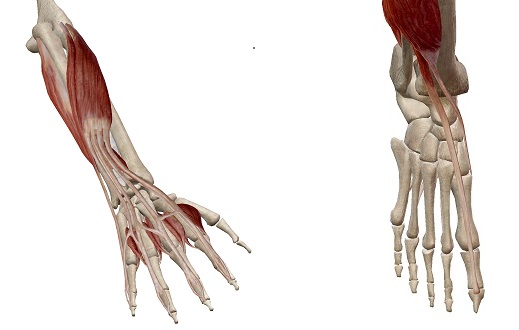
As the name suggests, this exercise is to activate, tone, strengthen your glutes. Glutes are the muscles in your posterior. Maximus, medius, minimus. The minimus is under the medius.

Image Credit: Visible Body

Once you are safely perched on your dining table, place your legs as shown and lift your butt by squeezing your glutes. Keep your spine neutral. Hold for a count of 5, lower. Repeat.

Due to both my knee and the fact I was trying to take a photo at the same time as execution, my butt isn’t as far off the table as it could be!

Progressions (making it harder):

  • Move one leg further away from the body
  • Lift one leg off the surface altogether (this is not me at this time!)
Move one leg further away from the body

Getting On and Off the Table

  • Place a dining chair roughly where you would before sitting
  • Lean butt against/on edge of table, hold onto the back of the chair
  • Lift one foot onto chair, followed by other foot
  • Wiggle back on table.
  • To get off, reverse the above.

I’d film it if I could, but that’s a bit difficult to do by myself.

Of course, if you can do these on the floor, GO YOU!

My Personal Weight Management Under #StayAtHome

Yesterday I tweeted:

I did not expect the reaction! I promised to write in more detail what I am doing to achieve this, so here it is. I want to stress this is what works for me, given my current circumstances. It is really intended for people of similar age and in similarly physically challenging circumstances. While the #StayAtHome situation is common to most of us, of course the knee issue is an added complication. Unlike my recent short videos, this will be a long read, so buckle in folks!

Situation Summary

I have been in self-isolation since March 1. The gyms closed, the pools closed. I am a weight training person: suddenly I couldn’t even do upper body or hydrotherapy. The knee is preventing any lower body weights work or walking. I am also nearly 65. We all know as we get older it becomes harder to manage our weight than when we were 25.

I was terrified of gaining weight and making my knee pain worse. Due to several changes of medications and predisolone off and on over the period in question, I had gained a few kilos during late 2018/early 2019. I have been very successful in reversing that trend, especially once my clinical drug trial got underway, with the suggestion and support of my endocrinologist to adopt the philosophies of Dr Michael Mosley. I’d never known it was considered safe to eat 800 calories a day. I do now! Before you stop reading in horror, I’m not eating 800 calories a day now! But it is a damn good kick start to get you going and I do still apply the macro principles espoused by Dr Mosley.

Comfort Eating

Several responses to the above tweet raised the issue of comfort eating. This is an issue that is exacerbated by isolation, anxiety (e.g. about the current health crisis of Covid19) and boredom among other drivers. A chronic illness patient I know once said to me she stopped comfort eating when she realised she was “eating her pain” – and she didn’t just mean physical pain, she meant emotional pain as well. Once she had that epiphany she was able to stop. She looked for and found other ways to deal with her pain.

I find boredom can be an issue for me, especially when I can’t go to the gym or swim and I am locked away. For me, the recording (discussed below) helps immensely. I can see what I’m eating instantly.

I have no great solution for comfort eating, I am sorry, as it is a bit out of my field of expertise. I would suggest perhaps consulting a psychologist if it is impacting your weight management efforts. Mental health is a critical factor and if you have a chronic illness, in Australia you are entitled to a Mental Health Care Plan. Use it.

Understand Your BMR

Before we even look at food, my recommendation to anyone on a weight management journey is to understand your Basal Metabolic Rate (BMR). This is the number of calories your body burns being alive. Nothing else, just being alive. Our BMR drops as we age. This calculator at MyDr.com.au is the one I use: http://tools.mydr.com.au/tools/basal-energy-calculator

Pop in your details at various ages and you will see the BMR drop. Of course this is a average. If, like me, you are an avid weights person you will have more lean muscle mass and your BMR will be higher. Conversely, you may be on medications that actually reduce your BMR as a side effect. Even so, as a place to start, it is a good indication.

If you do no exercise and you eat more than your BMR, you will gain weight. There is more to it than that if we want to delve into the science, but for our purposes, it is that simple, really. Note well: exercise in this context includes NEAT!

Be very aware though, your current weight may drive your BMR reading up. If your BMR says 2,000 calories a day, you don’t want to be eating that if weight loss is your goal. Try putting your target weight into the calculator – work from that.

Net Calories

If I am exercising in my normal manner, I live by net calories. My calorie target for the day plus what I “earn” exercising less what I eat. When I cannot exercise “properly” as is the current case, I aim for less than my BMR. At the moment I aim for 1,200 calories a day or less, with the odd 800 calorie day thrown in for good measure.

When I fill up my car the fuel tank capacity limits how much I can put in. Unless the car burns the fuel, no more will fit. Humans are not limited in the same way – if we don’t burn it, we just expand to make room (store the fuel).

Record, Record, Record

I cannot stress strongly enough to record your food intake. If you are anything like me, you forget that snack you had at 10 am. Or you don’t realise that SMALL muffin you grabbed en route home from the pharmacy was actually 530 calories! I use My Fitness Pal, there is Cronometer and various other apps out there. Find one that you like.

Recording means measuring. Get food scales. Measure.

Dietary Protein

My next tip is to look at your dietary protein. Are you eating enough protein? From talking to people I suggest many, especially older people living alone, are not eating enough protein. Without enough protein we can feel hungry and snack (usually on carb heavy stuff) unnecessarily.

My interest in dietary protein came about from my own experience. I noticed my protein levels had dropped when I reviewed my My Fitness Pal recording at one stage back in 2017. I was also in more pain from my psoriatic arthritis, although I wasn’t thinking of a causal link. I upped my protein for general health reasons and suddenly my pain levels dropped. Hmmmm, I thought. At the physiotherapist, I picked his brains, “Are you aware of any research around dietary protein and pain levels?”. No, he wasn’t aware of any so I came home and researched. This is one of the articles I found, which I rather like as it is succinct in stating the findings.

Effects of inflammation and/or inactivity on the need for dietary protein

Remember too that a 100 gram steak is NOT 100 grams of protein. It is about (depending on cut, quality, etc) 23 grams of protein. Know your protein sources.

Serving Sizes

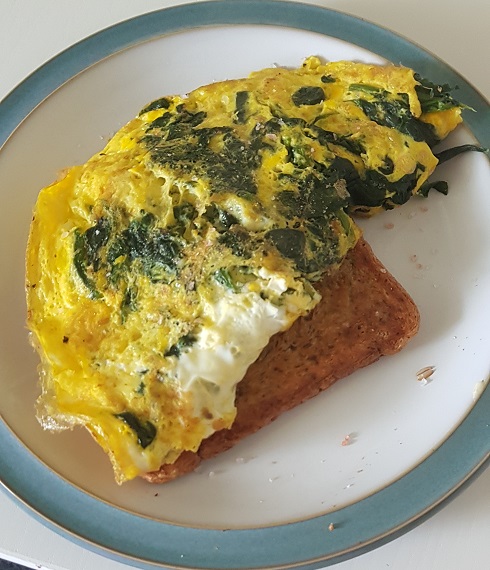
All food packets have a recommended serving size. These are guidelines, not mandatory rules. Most bread packets have a serving size of two slices. I do not need two slices of bread under my omelette (see main photo above), I won’t burn that extra fuel.

My favourite high fibre muesli has a serving size of 45 grams. I have 35 grams with 160 grams of high protein yoghurt. I don’t miss the 10 grams, but over a week it adds up to less calories.

Adjust serving sizes to suit your circumstances. When I’m able to lift weights again, I’ll go back to 45 grams of muesli!

Ease of Preparation

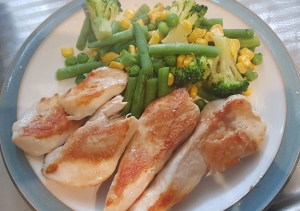
Some people love cooking, others do not. Other people have physical challenges around standing chopping up vegetables, for example. Some of us have days where our medical conditions flare. Living alone can result in wastage as fresh vegetables go off before we use them. How I deal with this is frozen vegetables. No, I don’t find them particularly wonderfully cordon bleu – but they serve a purpose. Prepped, pre-measured, 2.5 minutes in the microwave. Here is one instance where I double the serve – as each bag contains two standard serves.

Another variety with chicken.

I’ve found this frozen spinach great for omelettes!

Two blocks of this (about 50 grams) with two eggs. I microwave it per the first half of the instructions, drain and pop in my non-stick pan for a minute or so, pour beaten eggs over. Cook. Greens and protein in one simple meal.

I stick to fresh salad vegetables such as lettuce, cucumber, mushrooms and tomato. They are easier to buy in “as needed” quantities. Of course, as I am in isolation and receiving grocery deliveries, that is more difficult. Another benefit to frozen vegetables at the moment as I’m not dependent on deliveries to have vegetables.

Meal Replacement

Eating the increased amount of protein as discussed above and keeping calories down can be a challenge. I was also told by a friend (I have NOT substantiated this) that in some cultures older people eat very little late in the day, but it makes sense, especially when there are reduced levels of activity.

I have been replacing most evening meals with a protein shake. This brand was recommended to me by a work colleague who is a amateur marathon runner. I chose this product.

I’ve tried various meal replacement shakes and work out protein shakes over the years, but I really do like this one as it is virtually all protein and suits my particular needs well at this time. Once I’m back in the gym, I’ll change to one of their “work out” formulated products and probably not use it as a meal replacement but as a work out supplement.

The cost is $2.13 a serve, which is cheaper than a steak! I buy the large container because it is cheaper per kilo and is delivery free.

Carbohydrates

You will notice not one photo of potatoes or rice. I am a very low carb, healthy fats, high protein eater. I do eat fresh fruit: bananas, peaches, apricots, apples, grapefruit, plums, mandarins. While sugar is the bane of my existence, as it is in everything, fruit has other health benefits. I do limit my intake to two pieces of fruit maximum a day.

Did you know there is 11 grams of sugar in a cup of milk? Anything low fat is often high/added sugar. I tend to triple check the sugar content of anything that is labelled “low fat”. The version that isn’t low fat may actually be better for you.

I found a great low carb, high protein bread that is really nice, highly recommend!

Watch out for “hidden” carbohydrates. This label is a classic example.

Knowing the calorie value of each macro (fats X 9, carbs and protein X 4) my mental arithmetic could not see where the 337 calories was coming from. See the red arrow? Yes, glycerol. 4.32 calories per gram. A whopping 14.3 grams! In the USA it is required it be included in the total carbohydrates. Not in Australia, it seems. Read labels, be aware of possible hidden stuff you don’t want.

Emergencies

Have healthy food you can prepare with no effort if necessary. This prevents grabbing something carb/sugar heavy. I keep four of these in the freezer for flare days. I like these ones, but everyone’s tastes are different. Find ones you like that you can have on hand for emergencies. These two are usually on special for $4.00 each, other varieties may be dearer.

I also have tinned salmon which requires no preparation or cooking. Never run out of eggs!

Treats

Yes, treats. Gotta have treats! At nearly 65 and not aiming to appear on the cover of Vogue anytime soon, I’m not going to be a martyr.

At the moment I am alternating between two treats I allow myself, ONE treat a day.

20 grams of this:

or 67 grams of this:

The 20 grams of chocolate is basically 50% sugar – not really a good choice, I’m eating 2 teaspoons of sugar. But we have to cut ourselves a little slack!

The ice cream (comes in chocolate too) is a much healthier choice as you can see from the label. This is a serving (on a bread and butter plate).

If I am out going to the doctor or the pharmacy I may well indulge in a skinny flat white and a sweet treat – but that would be once a week at the most. More likely once a month under our current #StayAtHome rules and doctors doing telehealth!

One-liners

  • Drink plenty of water – helps you feel full
  • Watch how many coffees you have – can be 50 calories an instant coffee (4 grams raw sugar)
  • Get enough sleep (lack of sleep affects cortisol levels)
  • Eat breakfast
  • Eat slowly (mindful eating is a thing)
  • Eat ice cream with a teaspoon
  • Use smaller plates, the meals I have pictured here are on my entree plates
  • No or at least very minimal alcohol – empty calories
  • No soft drinks (unless used as a small treat)

In Conclusion

I’m reiterating: this current regime of mine is for a particular set of circumstances: minimal activity, isolation, age, pending replacement knee surgery (so very important I not gain weight), pain management requires weight management.

This is certainly not how I eat when I am weight training three or four times a week and swimming two or three times a week. It would not be how I would eat if I was 25.

Some of my weight loss this last month will have been muscle, which concerns me, but there is little I can do about that at the moment.

ALWAYS check with your health care professional for your specific circumstances!

Please ask questions in the comments, as anything you are wondering about may be a question other readers have as well.


Keeping Your Quads in Tune at Home

Please note these little videos are meant as ideas and suggestions while we are all in isolation or quarantine at home.

Bear in mind I have not assessed you personally for the appropriateness of these exercises for you. Only attempt these if safe to do so.

#Stay the F*** at Home!

Looking After Your Shoulders While We #StayHomeStaySafe

My apologies for the colour quality! With all this self isolation, I am equipment restricted! I also apologise for confusing forearm and upper arm, but you get the drift!

Please note these little videos are meant as ideas and suggestions while we are all in isolation or quarantine at home.

Bear in mind I have not assessed you personally for the appropriateness of these exercises for you. Only attempt these if safe to do so.

A Clinical Trial – Patient Journey – Part IV

Catching up?

I last wrote in September about my clinical drug trial. So much has happened since! I did reach the conclusion, despite how good I felt by September, that I was on the placebo for the first 24 weeks. So why did I feel so good in September? To work that out we have to look at my specific treatment history. I’d failed three DMARDs when I started the drug trial and had just started a fourth DMARD. The rules of the trial were we could stay on up to two DMARDs during the trial.

Having adverse reactions to medications is not fun and while in each case I typically cite one prime adverse reaction, in reality there are probably other issues going on with the body as well.

Timing is the other factor in my case. Due to the adverse reactions to the DMARDs, by the time I started the trial my treatment regime had been a bit stop-start. To recap, November 2018 I stopped DMARD #2, did three month washout. Tried DMARD #3 in February 2019, but only lasted five weeks due to adverse reaction. Another small washout period, started DMARD #4, on a low introductory dose, in April 2019. By the time I started the drug trial in July 2019 I was really recovering from a lot of adverse reaction events and had not had continuous, effective treatment for almost eight months. It is therefore, to my mind, not surprising that I felt better in many ways! I was, if nothing else, recovering from the medications my body had not looked upon too favourably! When I wrote Part III (link above), I was also still on that low dose of DMARD #4 which may well have been having a positive effect on the psoriatic arthritis.

However, DMARD #4, like the previous three treatments, also resulted in an adverse event for me. My, shall we say, gastrointestinal activity started to go through the roof. I won’t go into details, I think you get the picture! It was not at all pleasant and worsened over time. After discussions with my gastroenterologist, rheumatologist and the research team we recorded yet another adverse event and I went off DMARD #4.

Around the same time the left knee, the topic of my last article, was starting to make its presence felt. I also developed trigger finger in late December and started splinting my fingers at night. I got different colours so I’d know which one was for which finger! These splints are from an great occupational therapist. So I had a few things going on.

While I could still fit my runners on, my feet were still slightly swollen. I developed a few clearly visible small nodules here and there: one on a pinky finger, one on a second toe and one on a big toe. These were new, small, and bothersome. The feature photo shows the finger one, completely gone now. The toe one below would now not be noticed by anyone else, I can just see where it was.

The joint assessment at my October trial visit still lit up all my toe joints and some finger joints. There really wasn’t any improvement in that joint assessment at all, even though I still felt better in many other ways as noted in my prior articles.

But what about the skin? Yes, it remained 100% clear. If I was on placebo AND off all DMARDs, wouldn’t my skin possibly flare? No, I don’t think so for the very simple reason my skin had never been a problem in the past, it came to the fore in a big way as a result of DMARD #2. Off that specific medication, my skin ultimately returned to normal. The timing just happened to coincide with the clinical trial. It was easy to look at my skin improvement and think, YAY, I got the good juice!

The bottom line is, by November/December 2019 I was saying to my doctors I think I’m on the placebo. If that was the case, then January 2, 2020 was to be my first active intervention injection. I certainly didn’t have long to wait!

After the January 2 injection, on the morning of January 16 I was vastly improved. I specifically noted the date in my symptom diary as I woke up feeling a switch had been flicked. I actually had to considerably tighten the laces on my runners! My feet had really shrunk! The trigger fingers had improved dramatically during the day. My shoulders, which had been grumpy, were also feeling better. Both knees were very good (bearing in mind the left one had had the rescue steroid shot in mid-November). I was very pleased. I was, if you like, now doubly improved!

Then we reached the end of January and the osteoarthritis in that left knee went haywire and I ended up in hospital (detailed in my immediately previous article).

I was therefore a week late getting my loading dose because my rheumatologist wouldn’t let me out of hospital to go and get it, even though I promised to come straight back! Also, due to the hospitalisation, the clinical trial medical monitor had to give clearance for me to continue on the drug trial. Clearance was granted, much to my relief!

I am due for my next injection in late April (injection every 12 weeks after the loading dose).

Aside from my osteoarthritic knee, my psoriatic arthritis is definitely improving. I am still splinting those two fingers at night but the hands are fine during the day. In fact the right hand is fine all the time now, just the one finger on the left hand is still an issue, but definitely improved. The small nodules I referred to above have almost disappeared and at the last two joint assessments, each time less joints have lit up. In fact, at this month’s assessment, I think from memory only two finger joints lit up (very slightly) and only about half my toe joints and even then they were much less painful than before. Shoulders are fine. Of course, my CRP was back up in early February (don’t have March results yet) but we’ve attributed that to the knee inflammation, which was pretty gross at the time.

Comorbidity makes things challenging. Like my CRP rising due to my osteoarthritic knee, even though my psoriatic arthritis is coming along nicely. Then there is the theoretical question of how much do osteo and psoriatic play together? I have this image of little psoriatic soldiers being sent on reconnaissance missions around my joints. They find the osteo damaged knees and the Sergeant-in-Charge decides it is a great place to attack where the defences are down! Not too sure what my doctors think of my visualisation but it amuses me! Obviously my knee didn’t get that bad or the cyst develop overnight – the aforementioned eight months of stop-start medications probably was a contributing factor and if I had been on placebo, the two conditions really had free range to play together.

One thing I am noticing is with the self-isolation required by Covid-19 AND the fact I can’t get out and walk due to the knee, I am missing my usual swimming and weight training. I’m doing remedial type exercises at home, but it is not the same as being in the gym. Medications don’t do everything, exercise is still a major part of condition management.

Oh, and STAY HOME: Social Distancing is critical!

Where Have I Been? I’m Glad You Asked!

I’ve been everywhere, man, as the song goes. In hospital, in MRI machines: all sorts of fun things.

I wrote last year about my right knee sending to me to the emergency department just before I started my clinical drug trial. It is important to emphasise here, I have two different forms of arthritis: psoriatic arthritis (for which I am on the drug trial) and osteoarthritis.

In 2014 my left knee got very grumpy. Total knee replacement was mentioned way back then, but we tried a Synvisc-One shot as a less invasive treatment. With that and the proper exercises, I got another five years out of that knee. However, it seems time is up. In October last year, after my right knee had recovered, the left knee went out in sympathy. Badly.

At Week 16 of the drug trial I was allowed an intervention: a steroid shot in the very cranky knee. I also had an MRI. This was November last year. Sitting in my GP’s office later, the conversation went like this.

GP (reading MRI report): “Hmmmm, Grade 4 osteo.”

Me: “How many grades are there?”

GP: “Four”

Me: “Oh”

Not exactly the best news, but we hypothesised that the flare in my right knee had increased the load on the left knee, so now it was reminding me to look after it – in no uncertain terms. The steroid shot, some exercise, I’d be fine. That was my thinking. All was progressing positively for about ten weeks after the steroid injection. I was thinking I could start activating Limberation again.

Then came Australia Day weekend (end of January for overseas readers). Friday I woke up, the knee was a little swollen and stiff. I went and did some hydrotherapy. Saturday it wasn’t any better so I went for a walk around the block to see if that would help. No. On Sunday, I had lunch, looked at the dishes and thought “I’ll just go the bathroom first.” As I stood up from the toilet, something at the back of my knee snapped or popped or did something. So painful I fell back onto the toilet. Sat there for a minute, thought, “OK, I can’t sit here forever, got to get up somehow.” So I very gingerly managed to get off the toilet. The excruciating pain of the pop had gone, but this was one very unhappy knee. And it got unhappier as time progressed. I took some panadol osteo – I may as well have taken jelly beans. By an hour later I decided hospital was the place to go.

The poor taxi driver was quite distressed, I think, because by the time we got to the hospital, I was in….. a lot of pain. The hospital staff got me out of the taxi, into a wheelchair and into triage. To cut a very long story short, I was admitted. Finally got the pain under control at 1 am Monday morning. I don’t think the nurses believed me, but I was adamant the pain was worse than when I woke from my hysterectomy. It wasn’t just the knee, but now my foot was excruciating and my glutes were spasming. Because it was a public holiday weekend I didn’t get my MRI (yes, another one, I am now dating the MRI machine) until the Wednesday morning.

You know that look doctors get when one of their patients has something interesting, unique? I recognised that look! My rheumatologist came into the ward, holding the results, with excited stars in his eyes. “I’ve never actually seen one of these myself”, he said. I don’t mind when they get all super excited because it means you are medically interesting!

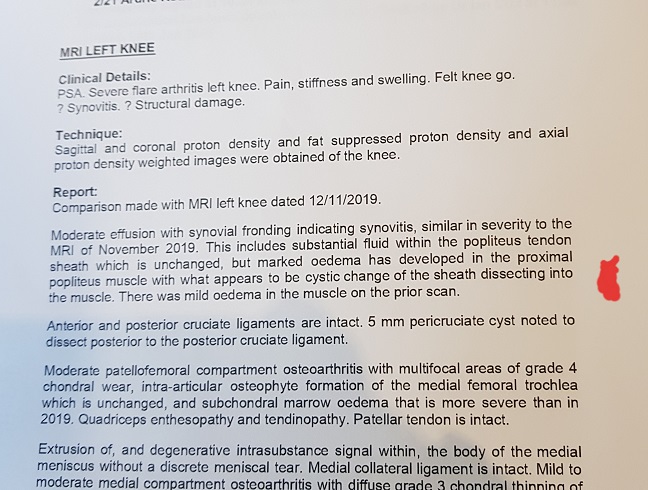
The MRI showed, amongst other things, a cyst dissecting my popliteus muscle. Not a Bakers Cyst, I must emphasise. This is different. The idea at that point was we could perhaps remove the cyst with keyhole surgery. This was good news, as I didn’t (and don’t) want to get kicked off the drug trial for the other arthritis! Minimal is best, I was thinking. Here is an extract of the report if you are medically minded.

So off to see a surgeon. Surgeon was not happy that my quads weren’t working, I couldn’t flex my toes and my left foot was just one big blob of pins and needles. He also quickly killed the keyhole surgery idea. I needed a total knee replacement. This was a shock, not really something I was planning on. Surgeon sends me off for another MRI, this time of my lumbar spine to ensure my muscle weakness wasn’t coming from my spine. I was wheeled down to the MRI department to make an appointment and they very kindly fitted me in on the spot. Wonderful.

Next day the surgeon rang me. They found a cyst on my spine too, so now I needed to have electrophysiology testing. Off to see a neurosurgeon. Now, dear reader, over the years I’ve had a lot of medical poking, prodding, needles, tests, monitors – but electrophysiology testing would have to be my least favourite. Interesting to be sure, but not so pleasant. You know that old saying, there’s a fine line between pleasure and pain? No, just no. Honestly, it isn’t terribly painful, but it certainly is not pleasant. The second part, where they stick needles in the muscles is not nearly as bad as the first part (but then again, needles never worry me). However, all good, the cyst in my back is not a concern, too small and not in the usually problematic location, not causing any issues. Mind you, he hadn’t seen a cyst in that spot before. Why was I not surprised?

I was still a bit stunned about the whole total knee replacement thing though. So I sought a second opinion. Same advice, total knee replacement required. This surgeon did explain the situation in a way I was better able to understand the problem. In his opinion, the inflammation from the osteoarthritis, with maybe some assistance from dear friend psoriatic arthritis, was causing the cyst. The cyst isn’t in a particularly good position to try removal safely and in his opinion unless we fixed the knee, even if they did remove the cyst, I’d just get more cysts. Great. Not.

Then I had to decide which surgeon to go with. In the meantime, what else was going on? We were, by that stage, in early March. Covid-19 was ramping up around the world. I decided to go with the second surgeon, Mr T, and surgery was duly booked for April 8. I needed a pre-operative health assessment by a physician, the knee components had to be ordered, then another pre-op with Mr T and a rehabilitation prep session with the hospital. All were booked, I was good to go. I had the pre-op health assessment and was sent off from that for a raft of tests (blood, ECG etc).

Then on Sunday, March 22 I got a call from Mr T (my pre-op with him was for the following day). Please don’t come in. Shortly thereafter, of course, all surgery was cancelled.

Consequently, I am now in limbo. A bung knee that has somewhat settled since the end of January hospitalisation, but only if I am careful. I’ve worked out I should do about 2,500 steps a day, in small time blocks, evenly spread throughout the day. Too much activity, knee swells. Too little, knee seizes. I can get around the house now without the walking stick, but for excursions to the supermarket I need the stick.

On top of that, I am self-isolating because I am on an immunosupressive medication.

When surgery will start up again is an unknown at this point: all depends on our containment/management of Covid-19. The surgeon will call as soon as they know. So I wait.

My next article will be about my clinical trial progress, which is going very well (although there is a twist to the story). It was a toss up whether to write about the knee or the clinical trial first!

Oh, and STAY HOME: Social Distancing is critical!