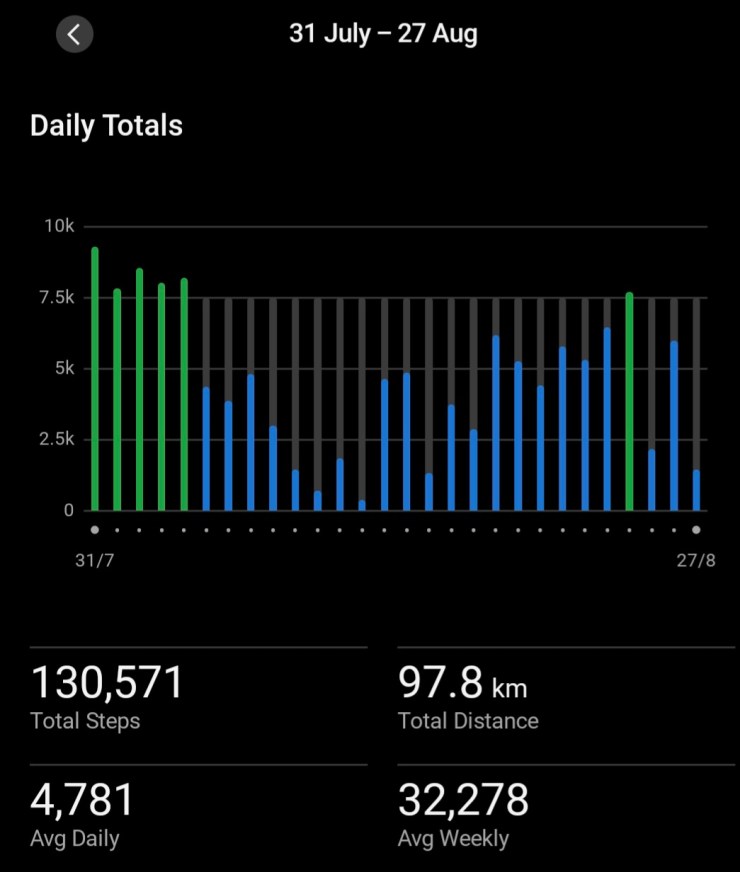
Garmin graph of my steps this last four weeks

When a Spanner Gets Thrown in the Works

When those of us with chronic conditions get something else, as I recently did, our situation can become a little more complicated. The journey back to where we were before this something else disrupted our routine can be challenging. Moreso the less young we are, sadly. Par for the course for many in the over 50 demographic, not just the chronic illness community. We decondition faster the less young we are.

So what happened? I started getting a slight temperature, then it became a fever. It would go up and down. Given my clinical status as a “complex comorbid chronically ill person”, I thought it would be wise to alert my GP (general practitioner) to the situation. My GP was fully booked but organised for a colleague to see me. The colleague ran a host of tests, including blood cultures! I’d never had blood cultures before. Funny story – as the phlebotomist was drawing blood, I noticed the expiry date on two of the four blood culture bottles was past. So I had to give an extra one! Spotted before the second expired one was taken.

By the Friday August 8 my temp was higher. Messaged GP clinic. Advised to go to hospital. So I did. Was not expecting to be admitted, so hadn’t even taken a toothbrush with me! Consequently I begged them to allow me to go home and come back the next day. Properly equipped for being an inpatient.

After more MRIs, CTs, x-rays, blood tests and blood cultures that you can poke a stick at, I was finally discharged on August 13. If you’ve never seen a blood culture bottle, they look like this! And seem to come in pairs.

Blood culture bottles

My diagnosis? Atypical pneumonia. Hard to diagnose, but the antibiotics prescribed did the job. One lung lobe looked “flat” on imaging and they could hear a rattle in the other lobe. But a fluctuating fever and chills were the only real symptoms I had: no coughing or headaches. I had been experiencing intermittent pain under my left rib (mostly in the evenings) for a few weeks. Related? I don’t know, but it seems to have stopped since the antibiotics.

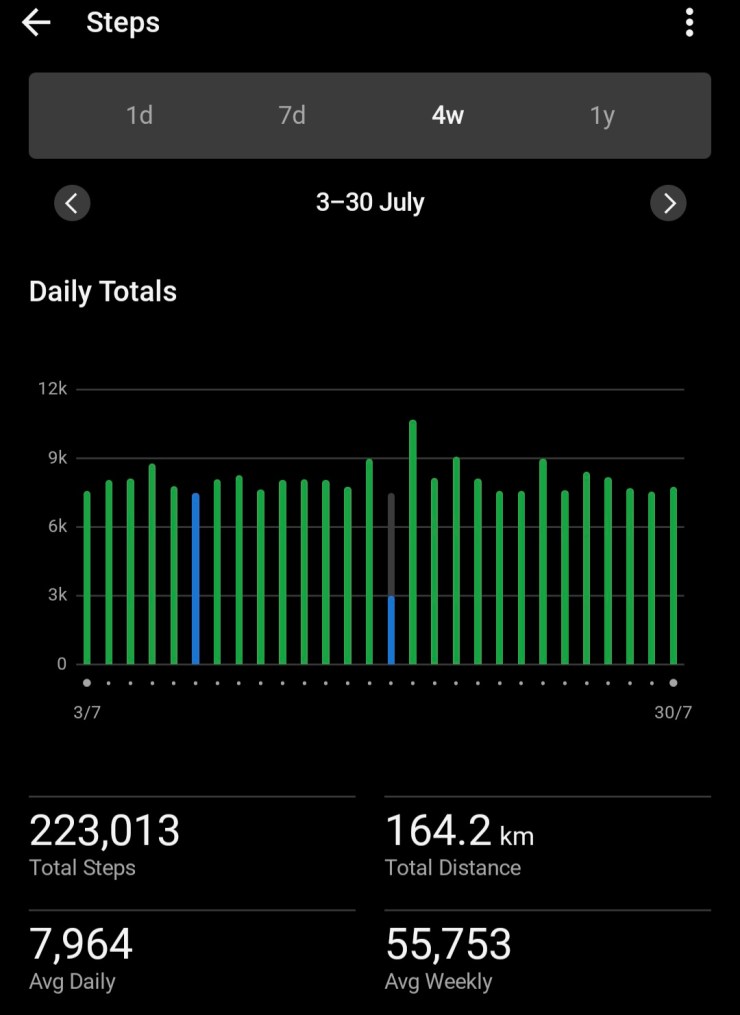
Due to this event, my exercise regime had just stopped. I’d last been to the gym on August 2, finally got back on August 18. So a 16 day break, not just in strength training but also walking/step goal. Above is the graph of steps I have achieved this last four weeks. July is shown below for comparison. Big difference.

Garmin graph of steps in 4 weeks of July

My lumbar spine is still complaining as I’ve lost muscle tone in my posterior chain, but I am seeing gradual improvement. HOWEVER many of my metrics are still showing a loss of fitness and strength:

  • My resting heart rate has increased by 8 points
  • My walking speed has dropped
  • My vigorous intensity minutes per day goal is not attainable at the moment
  • I’ve had to drop my weights for several exercises

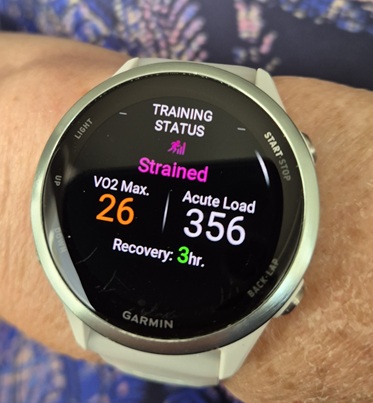
For example, I was at the gym yesterday. My usual practice is to walk 500 metres on the treadmill as a warm-up. I was breathing quite hard at 4.8 kms per hour. NOT my usual by any means. Garmin told me it would take me seven hours to recover. Normally Garmin tells me 0 hours (yes, zero, that’s not a typo) for 500 metres at a speed of 5.5 kms per hour. I’d had to drop my chest press from from 59 kg to 39 kg – got back to 52 kg yesterday.

Even lifting weights yesterday caused me to breath harder than I usually do. I’m seeing my GP next week to confirm, but have read it can take six weeks to fully recover lung capacity. I’m pretty sure I don’t need any pulmonary rehabilitation, I just need to build back up at a sensible rate. I must not overdo it!

Of course, me being me, not rushing things is not easy. I want to be back where I was before all this happened. The hospital experience was a little confusing too. One doctor told me I couldn’t take Panadol Osteo, just Panadol for my back. Another told me to stop one of my arthritis medications, the next day another doctor told me I could take that medication. All of this was because they weren’t quite sure what was wrong with me. At one stage I wasn’t allowed out of my room and there was a big sign on my door that staff entering had to take precautions.

Given my experience since I’ve been home, that is what I can only describe as reduced lung capacity, I’m pretty sure the doctor diagnosing me got it right. Even so, I had to agree to try the antibiotics as the diagnosis wasn’t one of those ones where you have a blood test and there is a clear positive or negative result!

Getting back to where I was before all this will take time and I must not rush it. So that is my advice to anyone else who finds themselves in my position – where we suddenly get something else and that throws a spanner in the works. Be careful. Don’t not do anything (unless there is medical advice due to your specific condition) because that will lead to other aspects (like my back) deteriorating. On the other hand, we can’t go overboard and try to rush things either.

I’m not sure how long it will take me to get back to where I was in July, I’m hoping just a few weeks. I think I was relatively fortunate as I didn’t end up with a severe case of pneumonia. Maybe partly because I got onto it quickly and my GP took action. If anything seems amiss, see your doctor!

Strength Training – Getting Started (Part II)

If you have not done so already, read Part I before reading this article. Also pay close attention to the caveat therein.

Please bear in mind it is impossible for me to cover everything in one or two articles. My aim is to give you ideas and tips about how to get started.

Choosing Your Trainer

If you have an exercise physiologist – problem solved! They can develop a program for you and will know all the stuff I’m (hopefully) putting in laymen’s terms in this article! But not all of us do have exercise physiologists. Like any profession, you have to find the right one for you. I’m very happy with mine, but I have pointed out to one (in a hospital environment) that what I was being asked to do was not suitable given my overall situation at the time. Communication is, as with so many things, key. Recently I met a personal trainer who has become a osteopath as he wanted to increase his knowledge. This would be another ideal situation, of course!

From here on, I am writing as if you do not have an exercise physiologist.

As I described in Part I, different trainers have different areas of expertise, the same as doctors. No doctor graduates from medical school as a rheumatologist. Fitness coaches/personal trainers don’t finish their certification with a specialist knowledge of chronic illness patients. We need to find a trainer with either further education in this field or considerable experience – or willing/wanting to learn.

What questions should we ask? That is going to vary from person to person, depending on your particular condition/(s) AND the stage of progression of your condition/(s). I can give you some ideas, but you will need to think about your own specific situation and what might be the best questions to ask in your situation. What you are looking for is the trainer’s willingness to and hopefully knowledge about adapting exercises to suit your situation.

One question I would ask is do they recommend the chest press be done with free weights on a bench, or on a chest press machine. Yes, we already know I’d MUCH prefer to be doing the chest press with free weights – but I don’t for safety reasons as explained in Part I. I’d be looking for a trainer who was aware of the risk mitigation.

Another may be simply asking what do they know about your medical condition/(s). Hopefully you know enough to know if their answer is correct! If they don’t, are they willing to research. Effectively, your trainer becomes part of your “treatment team” and while you don’t need another doctor, you need them to understand the basics of things like flares and inflammation.

Side arm raises are an exercise where the angle can be changed from the standard lateral raise. Or the elbow can be bent slightly. These modifications depend on individual circumstances – I adjust my technique, you may not need to. This is a classic example of why the questions you ask need to be tailored to your situation.

The big one is the old “no pain, no gain” mantra. For a healthy person there is some truth to this – you might feel like you’ve lifted weights a day or two after you’ve lifted weights especially if you are lifting to failure. None of us will be doing that! If we feel discomfort doing an exercise it could be for a number of reasons:

  • Could be because we haven’t used that muscle or muscle group for a while
  • Could be because there is currently some inflammation there
  • Could be because over time we have “protected” that area and it has become weaker than it should be

The list is rather endless but we must stick to the pacing principles of Chronic Pain Management – feel a change, stop! NO “pushing through”. As I pointed out above, it may be a solution to change the angle, or drop the kilograms you are lifting, or do less repetitions (or drop kilograms and increase reps – the possibilities are many). The bottom line is you need a trainer who is well aware of these adjustments and who will NOT encourage you to continue at ANY level of discomfort.

Program Options

What sort of program you do will depend on your condition(/s), your background with strength training (if any), your level of overall fitness and your energy levels. While yes, you want to improve, you also have other things to do in your life such as cooking, laundry, driving and you need to ensure you don’t use all your energy on any one activity. Some chronic illnesses impact our energy levels quite severely, others not so much.

Be guided by the trainer – that’s why you are paying them after all – but be guided by yourself. If you feel the program design is too much for you when first starting out (e.g. do you feel wiped out the next day) then cut it back, add exercises back in slowly.

You may start with something like (I just plucked these out of the air for illustrative purposes):

  • Warmup
  • Leg press
  • Chest press
  • Seated row
  • Leg extension
  • Bicep curls

That’s not a heavy load BUT it is enough to see how your body reacts. If you feel fine, add a couple more exercises in.

Remember, the more exercises you do per session, the more careful you may have to be about increasing the weights because more exercises means using more energy. Increasing kilograms means using more energy. You don’t want to use too much energy all in one go. Avoid the Boom/Bust cycle!

Also, see the “How Often” section. You can split the workload!

Starting Kilograms

Recently I took a much younger friend, Tanya, to the gym with me. Tanya had expressed an interest in building her strength but was a bit wary of hitting a gym full of body building champions (my words, not hers). My gym is nothing like that so I invited Tanya along. Essentially she is healthy, not a chronic illness patient. She had recently noticed that physical work had resolved some shoulder pain she had been experiencing and that had driven her to think more strength training would be a good idea.

We did a warmup on the treadmills then headed for the leg press. I am mortified by my own (now) measly (by my expectations of myself) 125 kg leg press, and innocent me assumed given Tanya’s relative youth and health status, she’d easily lift that. I was wrong. We needed to drop the kilos. I have lifted weights most of my adult life, I have a history. Tanya doesn’t. So even though I’m sad I can’t lift what I once did, Tanya’s legs had no such experience! On one machine I had to set the weight to no weight at all. I will say Tanya is now more inspired than she already was to build her strength!

And she posted a lovely compliment: “Can this woman lift some serious weight, yes she can! Put me to shame!” I didn’t put her to shame at all really. I suspect it was a simple case of my friend underestimating my abilities due to my age (compared to her age) and medical conditions! Tanya is 16 years younger than I am. I probably overestimated her abilities due to her youth and recent physical work.

The lesson here is your starting weights could be anything. DO NOT STRUGGLE. Yes, you will see healthy people lifting to failure (keep increasing the weight until they literally fail to lift that weight). WE are NOT going to EVER do that, unless you are lucky enough to go into remission!

Start with a weight that feels comfortable for you for that exercise. You might start by doing 8 reps a set instead of 10. Increase the reps each session, then increase the weight and drop back the reps at the new weight. As I mentioned in Part I, I tend to build up to 12 reps a set before I increase the weight. At the new weight I’ll do 8 or 10 reps depending on the exercise.

If your trainer says, “That looks too easy for you, let’s increase”, that’s fine to TRY, but if you feel any discomfort or you struggle, drop back. Pacing rules rule!

How Often

When I started back I did strength training twice a week. I then increased to every third day. Now I’m doing three times a week and I very much doubt I’ll go beyond that, simply because I want to ensure I don’t overdo it. It also depends on what else you are doing. I walk and swim. You might cycle or run. Some readers will still be working, may have families you are caring for: any number of other aspects of life that require energy. And let’s not forget those darn medical appointments you still have to fit in – they take energy too.

Initially, I dropped my step goal on the days I did weights. I no longer do that, but it is an approach that works in the early days. It is all about balancing your energy use while you build more energy reserves.

Now I’m going to paint a general picture. I’m not saying this next idea is what you should do, I’m saying this is an example of what you MAY do. The trainer and you decide on a program. Be aware it doesn’t have to be done all on the same day. You can split the exercises. Spread the exercises over two days. You may do upper body one day, lower body the next. Or you may find a bit of both is better. For example, my wrists have been problematic from time to time. Most upper body strength training exercises involve use of the wrists in one way or another. Consequently, at those times, I do not do all my upper body on one day. That may aggravate my wrists, not something I’m keen on.

We have to be a bit more flexible (no pun intended) on how we approach strength training, especially in the early stages.

Other Adjustments

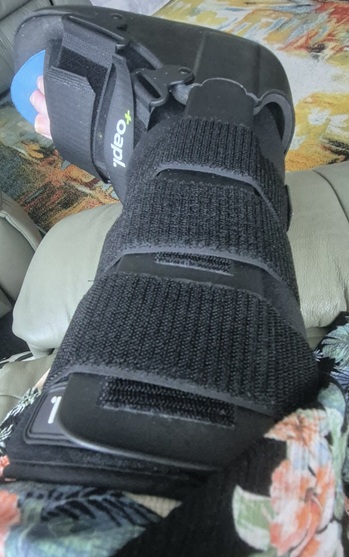
I’ve seen stroke survivors in the gym exercising one side of their body. I’ve been there in a moon boot doing upper body only. Other times I’ve done lower body only because my shoulders were flaring. I’ve walked in on crutches and only done upper body. We need to be prepared to be flexible in our approach. Sure, I’m working on increasing my weights, but there’s been days when my body just says, “no, not today” and I have to drop my weight (on whatever exercise) for that specific day.

Don’t get hung up about increasing constantly. That’s not what this is about, we aren’t aiming to compete at the Olympics, we just want to maintain our independence (see the articles at the bottom of Part I).

Don’t feel defeated if today you can’t lift what you lifted three days ago. We have chronic illnesses that often seem to have minds of their own and while we are in charge of managing those conditions, part of managing them is listening to our bodies.

I wear a mask. Yes, I’ve been asked, “Are you going to lift weights in a mask?” Yes, I am. I am immunosuppressed and have underlying inflammatory conditions. I DO NOT need Covid! I am not lifting the sort of kilos that would have me gasping for breath. I will say I can only manage about 500 to 700 metres on the treadmill with a mask, but that’s all I need for warmup.

Protein

Check how much dietary protein you are consuming. Many of us don’t eat enough protein and if we add strength training to our “To Do” list we need to ensure we are getting enough. I am not a nutritionist so I suggest you talk to your GP or a nutritionist. I have cited this article before, specifically related to inflammatory diseases (and inactivity).

Effects of inflammation and/or inactivity on the need for dietary protein – PubMed

I found this interesting as I realised at one point my protein intake was not reaching even the recommended levels for a healthy person AND my pain had increased. I asked a physiotherapist was he aware of any research re pain and lack of protein. He wasn’t. I discovered I felt better when I upped my protein intake. I then went searching for any research on the topic of inflammatory conditions and dietary protein. The above article is one of several I found and the one I cite.

Remember, if you eat a 180 gram steak, you are not eating a 180 grams of protein! A beef eye fillet is about 22% protein, per CalorieKing.

Note for Older Australians

If you have a My Aged Care Plan you MAY be eligible to have your gym membership paid for through your plan. Your program would need to be developed by an exercise physiologist (verification requires paperwork!) or similar allied health professional.

In Closing

I hope this has been helpful. If you have any questions, drop them in the comments and I will respond.

If there is a topic you would like me to address, let me know!

Build that strength!

Strength Training – Getting Started! (Part I)

This will be a series of articles! Too much information to cover in one.

Don’t worry, I am not trying to turn you all into Olympic Weight Lifters. I am definitely not an Olympic weight lifter, by any means! More and more studies are confirming that strength training is beneficial. And, believe it or not surprisingly good for people in their 90s. Both my general practitioner and my rheumatologist wholeheartedly support my efforts. To quote my general practitioner, “Strength training is so important”.

CAVEAT: This article assumes you have medical clearance to exercise. If you do not, please get clearance from your doctor. This article focuses on musculoskeletal chronic conditions but the underlying logic can be applied to many conditions.

I will admit to being biased. My fitness regime has always included weight lifting. That is not including lifting bales of hay and sheep on the farm! When I first became unwell, I had to take a break, but when I slowly started back, I wasn’t starting from scratch. I knew how to lift weights from past experience and I did a Fitness Coaching course specifically to learn more so I could keep myself as close to “healthy” as I could.

Practical experience taught me more aspects specific to having chronic conditions, musculoskeletal conditions in particular. When I did my qualifications, the course didn’t cover much about chronically ill clients. We did learn a bit about diabetic and asthmatic clients, but that was about it. From talking to other trainers who have qualified more recently than I, not a lot has changed in that respect. So bear in mind my advice in this article is based on my practical experience, building on what I learnt on the course. Think of your medical specialists – your rheumatologist did not graduate from medical school as a rheumatologist: a lot more study and experience and training was required. Personal trainers/fitness coaches are really no different. After they’ve completed their basic training they may go on to specialise in different aspects of training. Many will have such information about themselves publicly available on a web page. They may be like me, have medical conditions themselves and therefore have lived experience. They may have a family member or friend with a medical condition or just simply have an interest in the field and have undertaken additional training. Be prepared to interview your prospective trainers to ensure they have the appropriate experience to guide you. I will suggest some questions in Part II.

In my recent article, Accept the Project, I talked about the challenges we face when we initially find out we are now different. Generally our doctors will tell us to “get exercise” or “keep exercising” but it is not their role to give us specific instructions. As a result, many people will try to do what they did before. THAT IS NOT GOING TO WORK (unless you are extremely lucky). If you try to do that, the most likely outcome is you will end up in the Boom/Bust Cycle or, even worse, you may injure yourself.

My advice is start as if you’ve never picked up a dumbbell in your life before. If you have a history of weight training and are confident your technique is good, maybe you don’t need to consult a trainer. For complete novices, definitely consult a trainer. If you’ve had a considerable time away from lifting, I recommend consulting a trainer to ensure your technique is still correct. Technique (how you lift) is critical for healthy people, even more important for us.

Let me illustrate. If I am not in the perfect position when doing the shoulder press, my right shoulder will click. It doesn’t hurt, but I can feel it and hear it. It may not hurt now, but if I did that often enough, I’d very likely end up with an inflamed shoulder. My guess is my underlying conditions result in me not holding my shoulders in the correct position all the time, so I have to correct my posture before continuing with the set. But if we have no idea what correct technique for an exercise is, we could be doing it in a way that may exacerbate our situation rather than help us. I got caught the other day. I switched from tricep pushdowns to tricep kickbacks because my wrists didn’t like the pushdowns. One of the trainers pointed out my back was not in the correct position. Sometimes even when we KNOW how we should do something, because we can’t see ourselves, we don’t realise our technique needs correcting.

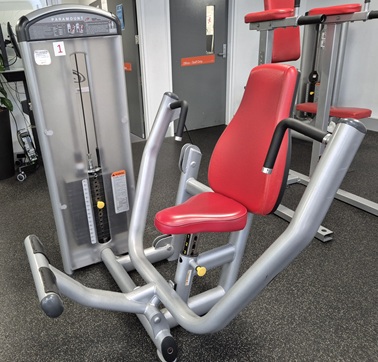
This next bit will be harder for some of us than for others. Sorry in advance! I used to do mostly free weights, not the machines. After I developed my condition(s), I realised quite quickly it is much safer to use the machines. Do I like using the machines instead of free weights? No. But I also know I need to be safe. Think of the chest press. If I am lying on a bench with a dumbbell in each hand and my body suddenly says, “No, sorry, not today” for whatever reason, I could lose control of those dumbbells and hurt myself in the process. On the chest press machine, at least the machine I use, I can transfer the load from my arms/hands to my feet very quickly (remember, I have bionic legs, so they cope!). In the picture below the foot rest can be seen. This moves as the handles move. Applying pressure to the footrest takes the load from the handles.

A chest press machine at the gym
Chest Press Machine

This way my chances of hurting myself are virtually zero. The machines can also be easier to adjust. Although we do aim to increase the weights over time just like any healthy person does, there will be days when for some unknown reason the body is just a bit “off”. I’ll put the pin in the plate I lifted two days prior and won’t be able to budge it. Very quick and easy to shift the pin to a lower weight without having to return dumbbells to the rack and get lighter ones. Usually dropping back by one plate is enough and I can keep going.

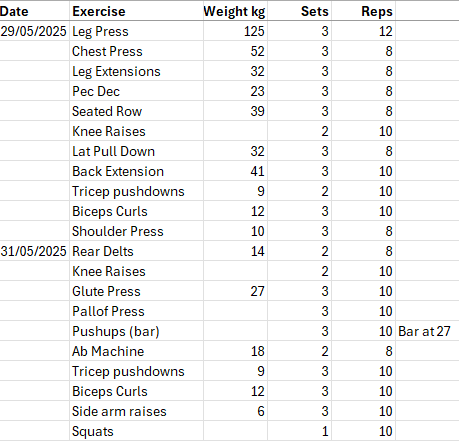
Having got those preparation aspects out of the way, what weights and exercises should you start with? You know what my answer is before I even type it, don’t you? IT DEPENDS! On so many things. Below is an example of what I am currently doing. This will be way too much for some people and others will scoff at my (to them) meagre weights. Yes, this is also an issue for those with a past history of lifting. I used to leg press over 200 kgs. My personal best since developing chronic conditions is 160 kg. At the moment I am sitting on 125 kg. If you are a competitive person it can be VERY, VERY hard to accept you are very unlikely to lift your previous weights again. My bicep curls are currently 12 kg – 2 x 6 kg dumbbells. Nothing wrong with my biceps, but prior to my recent new diagnosis my wrists couldn’t cope with anything heavier than about 4 kg. In my forties I was using much heavier weights. This is something we have to accept. We are now different, we have to have different goals.

THIS IS NOT WHERE YOU START! I’m merely illustrating what is possible over time.

The above shows two days. I go to the gym three days a week: Thursday, Saturday and Monday. The Thursday and Monday are fairly similar, but the Saturday is a lighter day and I do different exercises than the other two days. At the moment: I can change things around at any time.

Why are some sets only 8 reps and other 12? Usually 8 will indicate I’ve just increased the weight, 12 will indicate I am about to increase the weight. On the other hand, a 12 may indicate I have dropped a weight because that body part is not as happy as usual and I’m waiting for it to settle, so I’ve dropped the weight and increased the reps.

No, there isn’t a lot of core in that list. A lot of core exercises are on the floor and those I do at home. I also have a swiss ball at home. I don’t usually do squats at the gym, but that particular day I was short on total time so threw a set in to reach my time target.

In Part II of this series I discuss how you determine where to start on this journey. What questions might you ask a prospective trainer? What might be a good program? How many times a week? What kilograms might you start with?

Further Reading:

Not everything in the articles below is applicable to those with chronic conditions, but clearly the benefits of strength training are being recognised.

The ninetysomethings who revolutionized how we think about strength training – The Guardian
From strength training in your 20s to yoga in your 80s: how to reach peak fitness at any age – The Guardian
‘Never think you’re too old’: meet the world’s fastest 75-year-old woman – The Guardian

My favorite walking spot

Active Rest Days

Movement As Medicine is a balancing act. Sometimes we have to adjust our weights, our speed, our range of motion or other aspects of our exercise regime due to our conditions misbehaving unexpectedly. In this article, I’m not looking at those situations: this is about when our conditions are behaving! It is important to keep moving every day: it is also sensible to have active rest days. Active rest days are not specifically a chronic illness tool, it is a standard fitness coaching recommendation. It can be useful for us too!

I am using my stats to illustrate. I don’t run or cycle, but the concept is the same, just apply the underlying logic to whatever your exercise preference is.

If I’m moving, how am I resting, you ask? Funny you should ask, that’s just what I am about to explain.

I have several personal objectives at the moment:

  • Improve my VO2 Max
  • Increase my walking speed
  • Maintain my daily step goal streak (sitting at 72 days as I type)
  • Increase my weights

Doing the above every day relentlessly would NOT be practical. Pacing is critical at the best of times! While pacing is about improving (if possible), it is also about making sure we don’t boom/bust. Active rest day are days we do keep moving, but we are not trying to break any records. When just starting out, of course, no-one is breaking records, pacing rules everything we do (not just exercise). However, once we reach a more stable state with our conditions and providing we take due care and do not overdo things, we can have some objectives we could not have managed in previous years.

I don’t lift weights on an active rest day. I don’t try to increase my walking speed. I will still hit my step goal for the day. I’ll just do it slower and possibly in smaller chunks.

My daily step goal is 7,500 steps. I also have a goal of formally walking 4 kilometres a day. Why both? I’m retired (so not working) and I live in a very small apartment so I don’t get many incidental steps. I can walk 4 kilometres in less than 7,500 steps (5,600 steps to be precise). Other days I might be running errands and clock up some of the 7,500 steps pottering around the pharmacy etc, but not have achieved 4 kilometres in formal walks. On weight lifting days, I’ll clock up steps at the gym. Those days, because I’ve used energy to weight lift, I am happy to not achieve 4 kilometres as long as I still get 7,500 steps. None of that explains active rest days, but it paints the picture of where I am at.

Over time I’ve improved my walking pace from around 13 minutes a kilometre to somewhere between 10:30 to 11:30 minutes, depending on the day – I walk faster in cooler weather!

On an active rest day I’ll drop that speed back to around 12:00 to 12:30 minutes per kilometre.

I’ll also take shorter walks. On a “workout” walking day, I’ll aim for a distance between 2.5 to 3 km in my main walk (depending on where I am actually walking). I will take a shorter walk later. On an active rest day I’ll walk three or four times, about two hours apart. So I’m slower and have lowered the intensity. I’m still moving so nothing seizes up, but I’m doing it more gently. I’m actively resting.

I recently increased my weight lifting sessions from every third day to three times a week. I lift weights Monday, Thursday and Saturday, keeping Tuesday and Wednesday free for other commitments like medical appointments, walks or lunch with friends and other normal things. Even with my weights sessions, I make Saturday a lighter workout than Thursday and Monday, simply because I don’t want to risk overdoing the heavier weights such as leg press and chest press, especially as I’ve recently upped the overall regime. There is flexibility here too. In six months time I may decide to make Saturday a little more intense, but I’m seeing how my body holds up first!

In case readers are wondering, “If she is pacing UP, why is she not trying to increase her step count per day or the 4 kilometres?” Fair question. We can’t increase everything at once. At one point, when I first reintroduced weights into my exercise plans, I used to drop my step count goal on weights days. Gradually I’m got to the point I no longer need to do that. Also, studies have shown that 7,500 steps a day is fine – for healthy people. So I’m in no hurry to try to hit 10,000 (it was a marketing thing) steps. As for the 4 kilometres – some days I do walk more, but 4 kilometres is my target. If I exceed it, great, but I don’t make exceeding it a goal at this time. Increasing my speed is my current goal.

The featured photo is of my favourite walking spot, taken from one of the bridges that crosses the creek. This is where I do walks of 3 kilometres or more. Listening to the birds.

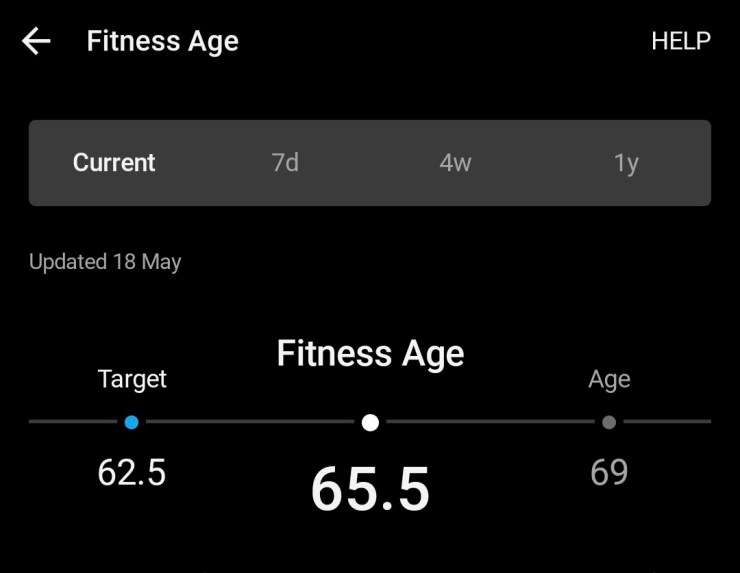
Garmin Fitness Age of 65.5

Accept the Project

I’ll start this article with clarification. This article will not apply to every person (remember we are all different) or every chronic illness or disease. But it does apply to many of us in the chronic illness population demographic. Remember, at least 47% of the population have at least one of just ten nominated chronic illnesses, so there are a few of us.

Please note as you read, I am using the word “accept” as per this Thesaurus definition: to accept or continue in a situation that is difficult or unpleasant: accept can be used when you want to say that you know a difficult situation will not change and you have decided to stop trying to change it.

But you CAN manage it in many cases. With, of course, the expertise of your doctors and allied health practitioners (physiotherapy, osteopathy, myotherapy, exercise physiologists particularly). Manage it to the point it is far less unpleasant.

The very first thing we have to do is truly accept the new us. Like you accept a new project in the work environment. Now, you may not like that project, you may not want to undertake that project: but you need to feed and clothe yourself, so you accept the project. You take it on board. You embrace it and do it to the best of your ability.

Discovering you have a chronic illness is a shock, no doubt about it. Many of us initially do some or all of the following:

  • Hope it will go away
  • Hope the medicine will do all the hard work
  • Deny the reality of the illness
  • Try to keep living “normally”, ignoring the illness
  • Think if they change aspects of their life to accommodate the illness they are “giving up”

The last one is the big one here. Let’s go back to the project at work analogy. To take on that project you may have to delegate some of your current role to other staff. You may need to relocate your office. You may have to hire new staff. Any number of aspects of your current work may have to change. You will have to set project milestones and goals.

With a chronic illness, same deal. YOU are the Project Manager of your life. To all intents and purposes, your doctors are your new employees (sorry, doctors, don’t read that the wrong way!).

It takes time to accept this new role. I estimate it took me four years. Oh, I started the Movement As Medicine immediately: it was the other things that took longer. Like cutting my work hours to part-time. Eventually I retired earlier than I would have liked. I’ve spoken to other patients who cite times from one and a half years to eight years. The risk of not accepting this new Project is that your illness may progress faster (or quite simply drain you) than it otherwise would have.

As I have written in the past, the energy depletion with many chronic illnesses can be astounding. If, for example, we continue to work full-time, at the end of the day we are exhausted. No Movement As Medicine happens. Weekends are spent recovering some energy for the next week. Or if we see getting My Aged Care as “giving in”, we are using our energy reserves to do housework rather than care for our bodies.

I have a damaged lumbar spine (result of a car accident about 44 years ago). In 2016 surgery was considered, as the pain was consistent and rather debilitating. That surgery would not have been permanent. Instead, I elected to try strengthening my posterior chain. It is now 2025 and that has been successful – no radiofrequency denervation of the lumbar spine for me! While not directly part of my illness, my illness (as do many illnesses) does love to exacerbate weak spots – a 44 year-old injury is a weak spot.

Clearly, to work on my posterior chain strength I need both time AND energy. Project Management priorities! Should I have continued working full-time and hoped my back would right itself? We all know that would have been unlikely. Or dropped my working hours and used that energy and time to work on my body?

If you are diagnosed with a chronic illness, you cannot ignore it in the hope it will go away. This IS the new you. The faster you take on that Project Manager role, the better your chances of maintaining your independence, mobility and freedom for as long as possible will be.

Stavros is another patient who took on the Project Manager role. You can read his Type 2 Diabetes story here: https://dodona777.com/2025/05/16/why-dont-people-choose-to-heal/ Stavros took charge of his project: control his Type 2 Diabetes.

Yes, I know I’ve been quiet for months! You see, I’ve been so wrapped up in enjoying my much improved body since the new diagnosis, and getting my own Movement As Medicine back on track, that’s been my primary focus (evidenced by the feature photo). I’ve increased my weight lifting/training from every third day to three times a week. For any readers raising their eyebrows about strength training, in closing I refer you to recent research findings:

The residents’ average age was 88, and three-quarters of them were women. Every resident had multiple medical conditions. Almost half required help to engage in the essential activities of daily life: getting out of bed, going to the bathroom, bathing, walking, eating.

One simple exercise proved older adults can build and retain muscle – and caused a paradigm shift in science

Source: The Guardian The ninetysomethings who revolutionized how we think about strength training

Be Careful Who You Believe!

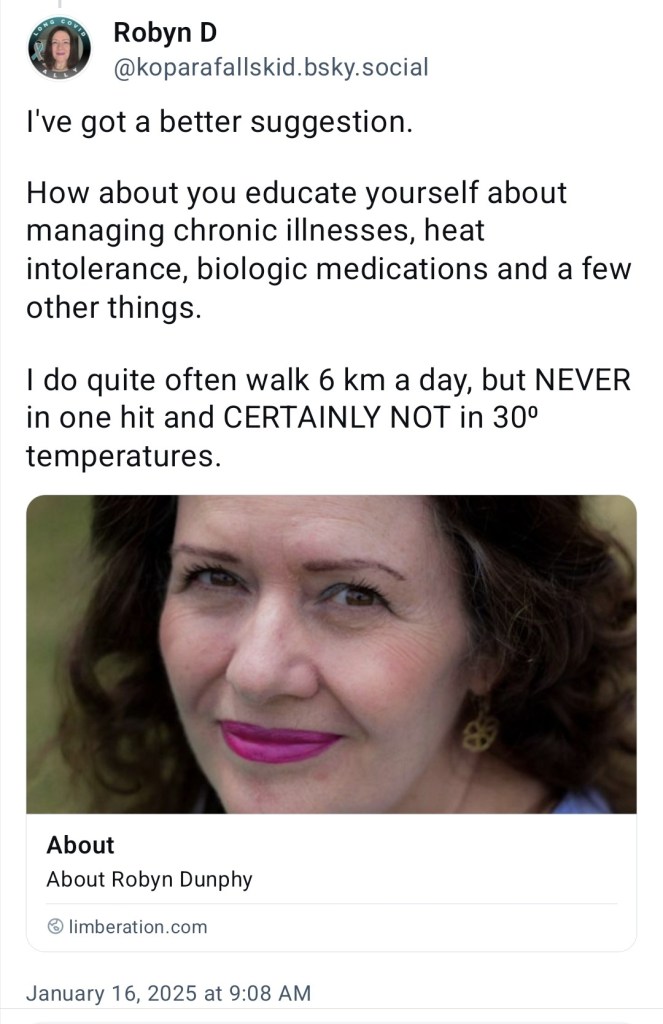
I had a very concerning conversation on social media across yesterday and today. I made a post (see below) and the reply poster (I’ll call him RP from here on) told me my exercise regime was wrong, according to his doctor. Not only that, what he told me to do was COMPLETELY incorrect for my situation. What concerns me is people new to chronic illness life may be persuaded by him to follow his advice which may be COMPLETELY contraindicated for those people. Everyone is different!

To put some context around the conversation that took place, on December 29 I had an infected cyst removed from my back by a plastic surgeon. Because it was infected I was given strict instructions NOT to get the dressing wet or to sweat. It is not a waterproof dressing, due to the fact the cyst was infected. We are in Australia, in summer: we can sweat walking to our letterbox. So I have had to take that into consideration in the last couple of weeks.

Secondly, I am clinically heat intolerant. In the past I have ended up in the Emergency Department due to my heat intolerance. I prefer to avoid that.

To top it off, we have been in the middle of a heat wave. Looking at the RP’s social media profile, I think he may not be used to temperatures around the 40o Celsius mark. Trust me, not the sort of temperatures it is safe for me to be out and about in.

Most of my followers were aware of all the above when I made the following post, so I didn’t go into specific detail.

YAY! After the heat inhiiting my working, II finally got my daily goal again! Next 2 days will be OK, then we are back in the 30+ range again. (includes two pics from Garmin

The reply I received?

“Walking? That’s more of a stroll! Let’s start with 5 km a day!”

He had not, I think, clicked into the actual image (full image above title) to see I had in fact walked 4.1 km in total.

My reply:

've got a better suggestion.

How about you educate yourself about managing chronic illnesses, heat intolerance, biologic medications and a few other things.

I do quite often walk 6 km a day, but NEVER in one hit and CERTAINLY NOT inn 30 degree temperatures. (Included link to my About page)

At that point I thought that would be the end of the discussion. But no! This morning I woke up to a stern lecture.

RP’s reply to me:

“I don’t have to, my doctor has recommended that I go for regular walks for various health reasons. And he didn’t mean 10 minutes around the corner, but 30-60 minutes a day! So I can only recommend that you educate yourself!”

He then added, “BTW: At every weather!”

I have redacted his ID in the image below.

Image of text quoted above.

I am actually qualified to give exercise advice, which he would have discovered if he had bothered to actually look at my About page.

I replied:

No, RP, you are not correct is assuming what is recommended for YOU is suitable for ALL patients. If you do that, you risk causing someone damage.

l am qualified, thank you very much, to give the advice I give. You are not. So please pay attention and learn some things you clearly do not know.

I do exercise for a hour a day, just not all in one hit, which would lead to the Boom/Bust cycle, something you clearly know nothing about.

Again, I am qualified in this field. You are not. I also have 10 years lived experience. Into my 11th year now. It is not safe for you to give incorrect advice to other patients based on something your doctor told you for your medical situation. Please do not do that!

So his doctor has recommended he walk for 30 to 60 minutes a day. Great. FOR HIM! He clearly knows nothing about the Boom/Bust Cycle, Pacing, chronic pain management and a host of other things. But he sees fit to tell me, in my 11th years of managing my chronic illnesses and qualified in exercise and having attended a chronic pain management program, that his doctor’s advice applies to ME? Furthermore, he tells me to educate myself?

Importantly, not many doctors are also qualified exercise practitioners. That is why we have Exercise Physiologists, Physiotherapists, Fitness Coaches and Personal Trainers. Exercise Physiology is a four year degree: not many doctors will have added that onto their already lengthy medical degree and training.

Of course, in attacking me, he chose the wrong person. I know what I am doing. My medical specialists are in total agreement with me. I was qualified to hit back.

What worries me is people new to chronic illness life, or their family or friends, may believe this random uneducated person on the internet and do themselves some serious damage in the process. Always make sure you receive advice from QUALIFIED practitioners who ALSO know YOUR specific medical situation. RP’s doctor knows NOTHING about me, but RP thinks his advice somehow magically applies to me. I wouldn’t give RP advice unless I had done a complete assessment consultation and he had medical clearance in writing.

Reference Articles (some are already linked above):

Beat the Boom/Bust Cycle
Pacing for Beginners
Pacing THRU, Pacing UP, Pacing DOWN
Let’s Revisit Pacing
Exercising in Summer When You Are Heat Sensitive

Getting Back Into It!

I’d put off writing about my IMPROVEMENTS until I was reasonably sure I was staying on track! I’ve reached the point I’m reasonably sure! If you are catching up, please read A New Diagnosis: and Other New Stuff to understand recent events.

One thing I have learnt is often when we are in the midst of an absolute crap time, we don’t realise just how bad it was until we are out the other side. To give you an example, last week I started swimming again. Given how bad my shoulders had been, there had been no swimming for quite some time. I didn’t realise how long: when I looked back in my Garmin records, I had swum twice in 2023 and not at all in 2024. Had you asked me, I would not have thought it was that long. Lifting weights wasn’t quite as bad, but almost. I’d lived most of those two years, off and on, taking prednisolone and Celebrex. Earlier this year I had two rounds of steroid shots in each shoulder. Of course, during that time I’d also had my second knee replaced and an ankle fused.

The biggest problem had been the inflammatory stuff though, not the surgeries. At one point I had sore shoulders, fingers, wrists, elbows, the unoperated ankle and my neck and TMJ played up as well from time to time. Even my knees were painful at times – after all, after knees are relaced, the original muscles, tendons and ligaments are still there for any inflammatory disease to attack. My blood pressure (BP) was also up.

I am being VERY CAREFUL! Once I realised how much I hadn’t done, I knew I had to be slow and steady. Follow your own advice, Robyn! I had kept walking though. In fact August 2024 was my best walking month ever (well, since I started recording steps) and that only happened because a friend on BlueSky challenged me. But the upper body was a nightmare.

Personal Step records per Garmin.
Most steps in a Month: 317,557 31/8/2024

To put some dates around this, my first injection of my new medication was on October 16. A few weeks of loading (weekly) injections, then fortnightly. Yesterday was the eight week mark. I’d said I wasn’t going to be sure about progress until about the middle of December as when I first started I had the previous medication still in my system (presumably it was doing something, even if not much) and was on loading doses of the new medication. By now the old med will be washed out of my system and I’m on the standard injection regime, fortnightly.

One BIG plus? NO Celebrex! YAY! Looking back on my symptom diary, I assessed myself as feeling 15% better the morning after the first injection. I’d noted specifically that elbows and fingers were not as bad. Since then, constant improvement. I have not taken any major pain medication either. The odd Panadol Osteo for my back, which is not surprising given I hadn’t been able to keep up my posterior chain strength for the osteoarthritis.

I did a couple of very tentative gym visits in November to see how my body would react, than on December 1 I started back with a strategy.

Before you look at these numbers please bear in mind for some readers (e.g. healthy young weightlifters) these numbers will look terrible. To a chronically ill person of probably any age, these numbers may look like a bridge too far. And there will be people to whom the numbers look achievable or where they are at or they are already above. To those starting out, DO NOT rush in where angels fear to tread. Seek professional guidance if you can. Read my Pacing articles. Remember, I’m qualified to guide myself AND I’ve had 10 years practice at reading my body. Just because I’m doing something doesn’t mean you should – but it doesn’t mean you should not either. It isn’t really the numbers themselves that are important here – it is the fact I am improving! That’s the important bit.

Yes, to me the kgs look awful! But this is what (re)starting from scratch looks like, so I’m being transparent!

At the moment I am lifting weights every third day. By December 10 I had improved a few things! I did get pec dec on the other two days, just, of course, not the day I’m using here. I’m halfway back to my PB leg press of 160 kg. That is my PB since I’ve been chronically ill, not PB ever. I prefer to only compare within my health status – comparing to a healthy me is unfair and somewhat demoralising, so best not to do it.

I also got back in the pool. Given my shoulders had been SO BAD earlier in the year I am being very careful. I did 10 laps of the 25 metre pool, so 250 metres. The hardest part I found was my breathing! So long without swimming and I was struggling. Breathing during breast stroke was OK, but breathing during front crawl (commonly called freestyle) was a challenge. Today I swam again and my breathing was better. I’d like to swim more often, but lane availability is scarce, sadly. Am looking into how I can schedule more swimming without getting to the pool at 5:45 am – that is NOT a good time for people like me due to morning stiffness. The 50 metre pool has more availability, but until my breathing improves I don’t want to risk it. Very embarrassing to have to stop halfway down the pool.

In summary, I am very happy! My fingers are still a bit bothersome, but manageable. The wrists need strengthening – I could do heavier bicep curls, for example, as the biceps are fine – but the wrists get grumpy if I up the weight too much at the moment. There is improvement though and that is what counts. I’m not trying to head for the Olympics, just maintain and improve mobility and strength. My BP is back to normal, I’ve lost weight and my brain aneurysm has shrunk – a few very nice added benefits!

leg press

Are Strong Pain Meds and Exercise a Good Combination?

Rule number 1 – discuss your specific situation with your doctor if in any doubt. Having said that, my experience is no, usually not a good combination.

Now, obviously I am not talking about trying to lift weights on pain meds after surgery! Just listen to your rehab physiotherapist!

What I am talking about is when patients are in situations like mine. We have a chronic illness, in my case psoriatic arthritis, and one of several things happen (or more than one happen together).

The most obvious examples are:

  • The condition flares
  • The primary treatment medication stops working for the patient
  • The patient is waiting for a new medication to start working.

At times like this the patient may have no option but to resort to a stronger pain medication than Panadol Osteo or similar.

Side note! If you are a friend, family member or colleague of a patient reading this, please be aware changing medications is not a simple thing with many of these diseases. A new medication can take anywhere from two weeks to six months to reach full effectiveness, with hopefully incremental improvements along the way. The medications are also NOT a cure. Not all medications work for all patients: I’m a prime example, my newest medication is medication number 11 in the 10 years I’ve been managing my disease. Medical science may develop cures in time, but we are not there yet.

My usual routine is I lift weights, walk and swim. If I am on strong pain meds, I do not lift weights. If the shoulders are involved, I do not swim either.

In order to exercise safely you need to be able to listen to your body. Perfectly healthy people lifting weights need to listen to their body: it is even more important for those of us with an illness we are managing to be able to listen to our bodies. Some time ago I wrote Changing Your Exercises for Safety where I looked at some adjustments we can make to exercise safely. I didn’t discuss pain medications as back then I really wasn’t using any of the “big stuff”. In 2023 I wrote about changing medications and what you can expect – it isn’t always easy!

If I am on strong pain meds, I can’t read my body as well as I need to be able to, to protect myself from inadvertently injuring myself or making my situation worse. I can’t necessarily tell if I should drop (reduce) the weight I’m lifting because it is possible the pain meds are blocking any discomfort I am causing myself.

Yes, not going to the gym may cause other issues. At the moment my lower back is a bit grumpy because I have been not willing to risk doing the extensive range of posterior chain exercises I usually do which keep my back in a pain-free state. But I’ve been on pain meds, off and on, for much of this year. I’ve just started my third treatment medication for this year and have been able to stop the strong meds.

I returned to the gym yesterday. I was VERY careful. Lifted very low (for me) weights to see how my body responded. No trying to do 160 kg on the leg press, I assure you. I did 45 kg. So embarrassing. I found the leg extension a real challenge, so was very careful. Despite how much walking I do, clearly my quads have taken a little holiday.

The quads are a good muscle to compare with others from yesterday. They seemed so weak that I don’t think I’d have physically been able to do myself any damage even if I was on pain meds – the strength just wasn’t there. However, the chest press was a different story: I had the strength to lift more than I did, but doing so hurt my shoulders and I could feel that, so dropped the weight back. On pain meds I probably would not have been able to feel that warning. I may have overly stressed my shoulders which are in recovery mode at the moment. I will say my shoulders feel better today than they have for months. I had steroid injections in them a few months ago – they were bad. But I need to go slow and steady to build up my strength again. And give the new medication a chance to work.

Why have I not been swimming? Same thing: reading my body. On strong pain meds I would not be able to tell if I was aggravating my shoulders or not. I will try swimming this week and see how the shoulders react, but I will be very careful.

Each disease is different. Each patient is different: patients will be on different pain meds and even if on the same pain med they may be on different doses or strengths. This isn’t a one size fits all situation.

If I know beyond doubt it is only my upper body flaring, for example, I’ll still do lower body exercises and vice versa. But it takes experience to be able to determine these things. I’ve clocked up 10 years this year and every year brings something different to learn as a patient.

Movement IS Medicine – but we need to be very careful when our disease is running riot and we are having to resort to strong pain medication.

It Is Like Two Days In One

I’ve had a weird day. Even for someone who has had this disease for ten years, this is a weird day. I’m writing about it for three different audiences:

  • Medical professionals, because this is the stuff we never get to cover in an appointment with you
  • Friends, family and colleagues of chronic illness patients, to provide some insight into what your friend, family member or colleague may be going through
  • Other chronic illness patients – sometimes we can feel as if we are the only one having particular experiences.

The overall situation I describe here is not unique to psoriatic arthritis, but some aspects will be. As that is the disease I have, that’s what I am writing about.

Let’s get into it. This morning I woke up at 6:15 am feeling like a broken doll. I had sore fingers, sore wrists, sore upper arms and a sore neck. Thankfully, my lower body seemed perfectly fine. There was also a very blah feeling. Malaise? Not sure I was quite at the malaise stage, but I certainly didn’t feel like singing and dancing.

By about 10 am I thought to myself, “Oh, I think it is starting to lift!” Tossed up whether to shower or have a coffee, decided om the coffee first. By 12:36 pm I was actually showered, dressed and had lipstick on (I mean, really, did you doubt the lippy?). Yes, the above photo is me, today, AFTER I felt human.

I remember thinking to myself as I drove to the gym at 1 pm, “This is like two completely different days in one.”

At that point I felt like I could climb Mt Everest. OK, not quite, but the difference was SO stark. Unusually so. This slow, crappy start to days is not unusual, but often the bad is not so bad and/or the good is not such a massive improvement as what happened today. I really felt like a completely different person, physically.

I think there is a tendency for the general population to understand that mental health conditions may fluctuate, but tend to perhaps think of physical conditions as being more consistent in presentation – not totally consistent, of course, but shall we say mostly more consistent. Some are, I agree. Some are not.

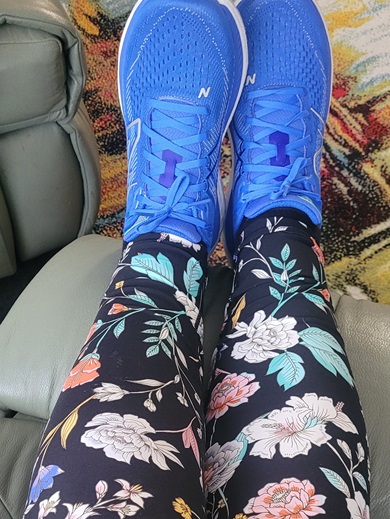
I had steroid injections in my shoulders on Thursday so had deferred going to the gym out of an abundance of caution. I really wanted to go today, but waited to see what my body decided to do. My favourite gym leggings helped, of course.

Ultimately, I had a good workout.

  • 1 km on the treadmill as warm-up
  • Leg press
  • Chest press (left shoulder clickity clicking on this)
  • Leg extensions
  • Seated row
  • Vertical knee lifts
  • Triceps
  • Leg curls
  • Back extensions
  • Lat pull-downs

The free weights area was a little overpopulated so I skipped biceps and shoulder press – they can wait for next visit.

As I write, it is 4 pm. I’m pretty much a “healthy” person.

This was a GOOD day, in that I came good as the day wore on. Sometimes we are not so lucky. OR we may wake up already feeling ready to take on Mt Everest. The issue is, we never know until we open our eyes in the morning. One morning recently I woke up unable to bend my left knee. Another day (some time ago) I was driving when I suddenly realised I couldn’t turn my head to the right (to check for traffic). On both occasions the rest of me felt fine!

This unpredictability makes planning life difficult. In time, my new medication hopefully will make everything more stable: it is still early days. But for many of us, today (or variations thereof) is what we live with. It can be hard for those around us to understand, especially when we do not LOOK sick. The invisible illness scenario.

The recent shoulder issue is a classic example of that. I LOOK fine. But reaching forward to put stuff in the microwave, or turn on a power switch, or turn on a tap were problematic. Lifting my arms about chest height, or anything involving internal rotation. Getting dressed was super challenging. Let’s not even discuss bras! But I LOOKED fine.

I can generally go with the flow because I’m retired. I’m not trying to get kids ready for school or meet a work deadline. I’m not trying to cook for a family of six. I really feel for those patients who have these types of responsibilities.

To my fellow patients – you are not alone. There are many of us out in the world facing similar challenges.

To everyone else – just because you can’t see something, doesn’t mean it isn’t there. You aren’t living the daily, sometimes even hourly, challenges. Support your family member, colleague, friend or patient.

Me? Hey, I just hope tomorrow is as good!

Feel Like I’m in a Holding Pattern

It goes like this. On April 6, 2024 I started my NINTH psoriatic arthritis medication. Sequential, not together! Some medications have a loading dose period: this is one of them. So for four weeks I have injections once a week. Then I move to monthly injections. The first monthly injections are the week after the last loading dose injections, so effectively the patients have weekly injections for five weeks in a row.

You’ll notice I said injectionS – no, that is not a typo. The dose is not available in Australia in one pen, so I have to use two pens. This is not a problem for me as I find the pens really easy to use.

A previous biologic I was on was fine during the loading phase, then when I got to the normal doses, in that case an injection every eight weeks, I found it wasn’t as effective. I’d be great for about three weeks, then steadily feel worse for the next five weeks. Not a great situation to be in.

So, while I feel very good right now, I am waiting until June/July to see if this medication will be effective for the full four weeks between injections. Of course I am hopeful! But that is why I feel like I am in a holding pattern. There are things I want to do, get involved in, but I feel I can’t yet commit to anything that involves other people until I know how this treatment is going to pan out longer term.

At least I’m not taking any NSAIDs or prednisolone and I’ve taken Panadol Osteo about three times a week. YAY me! Or YAY the new medication. Because I’m not taking those additional medications (and I’m moving), I’m also managing to shed the weight gain that occurred while I was taking them. Thank you, 2023. Not my favourite year, let me tell you.

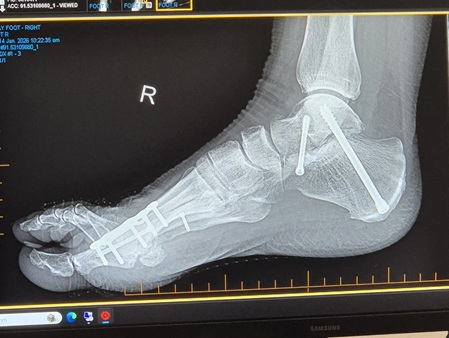
Another aspect of being chronically ill that is driving me nuts at the moment is the amount of effort required to remain, well, functional. So much planning goes into ensuring I get the movement required, balancing with the rest required. Then of course I’ve just had nine months of rehab exercises from first the knee replacement surgery then the ankle surgery. Not to mention the cast and the knee scooter and the moon boot! At the moment I’m kind of on the come back trail: the last four weeks have been good, let’s keep going. My first walk after the ankle surgery was February 14, a whole 0.8 of a kilometre. Now is much better.

I drop my target step count on the days I lift weights, which is every third day. Some days the weather may impact my step count! This is Melbourne, after all: we can have sunshine one minute and a howling storm five minutes later.

Reconditioning one’s body after nine weeks essentially immobile when that body is already challenged by psoriatic arthritis (and, umm, advancing years) requires a bit more planning that usual. Yesterday was a classic case. I did not make my 7,500 steps. I needed another kilometre, but for whatever reason/(s) a few things were grumpy by the end of the day. I opened my front door. Stood there for about 30 seconds and decided (sensibly) this was not happening. Closed the door and came back inside!

My lower back did play up off and on once I got moving again. Being “misaligned” for nine weeks on the knee scooter then the moon boot was not something my back muscles and left glutes liked AT ALL, I discovered. Lots of heat packs and stretches involved and all is now back to normal.

In summary, some days I end up feeling as if all I do with my life is work at keeping this disease under control. In the early years, I was still working, I had a purpose to keeping it under control. Now there are days when I wonder why on earth am I putting in all this hard work? Which is why I need to be DOING something other than just “keep active”. I need to have something to DO. Which explains the holding pattern dilemma. Thank goodness for my psychologist allowing me to vent!

I’ll get there! It is just a frustrating time and we all have them.

I’m still happy to be past the tip of the bell curve (top photo) for my daily step count given my situation. And remember, that is only Garmin wearers, many of whom will be very active, not the whole population!

By the way, I’m freaked out by the number of people that are freaked out about patients injecting ourselves! Many diabetics have been doing it for years! I’m not sure why we (i.e. those with other conditions) are seen any differently.