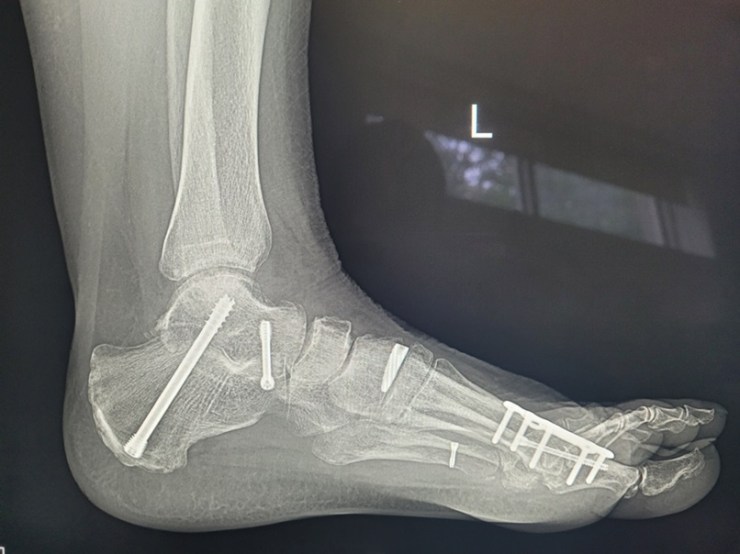
Tough, But Worth It!

Yes, I’ve been very quiet. VERY quiet. I know, I’m sorry. Recovery from my November surgery took quite a lot of effort. On top of that, the mobility restrictions meant my psoriatic arthritis decided to complain, so I was fighting on two battle fronts.

My ankle surgery took place on November 28, 2023. My first completely pain/discomfort free walk was March 22, 2024. 16 weeks and 2 days.

I’m not repeating the details previously documented, so if you are catching up, read the surgery article linked above first! The moon boot was better than the cast and knee scooter for sure. I could shower without “bagging” my leg in plastic bags! I didn’t have to sleep in the moon boot! I was no longer doing three-point turns in my small apartment or constantly reversing in and out of spaces. I could drive! I was no longer so totally dependent on other people, I had a modicum of freedom.

I was allowed to go to the gym to do upper body work. ONLY upper body work, but at least it was something! The gym staff looked at me a little askance, but let me in.

I was to gradually increase the percentage of weight on that leg each week and could try proper shoes at week four of moon boot life. I will admit I snuck into shoes a couple of days early because the moon boot meant my legs weren’t the same length and my right piriformis muscle was not overly impressed with that situation. I was VERY careful though.

At my 12 week post-op my surgeon was very happy with how everything had knitted and I was finally allowed to go to the physiotherapist. It is amazing how weak your calf and ankle muscles can become after 12 weeks of no use. Surprisingly, this physiotherapist wasn’t as bossy as the knee physiotherapists: exercises every second day instead of every day.

On February 14 I started short walks – between 500 and 800 metres depending on how the ankle was feeling. I managed my first 1 km walk on February 20 and have slowly built up from there. March 21 I walked 2 km in one hit! I should add I was doing multiple walks a day by this stage, with the physio’s permission.

While the ankle/foot wasn’t really painful, it wasn’t 100% comfortable either until March 22. That was the day I felt free!

Funny conversation with surgeon at the 12 week post-op.

Me: “So I have no restrictions now?”
Surgeon: “No, you’re fine!”
M: “So I can do the leg press?”
S: “Sure!”
M: “So what weight can I start at?” (Thinking to myself 50 kgs seemed reasonable to start)
S: “Oh, just the plate, no weights!”
M: Thinking – that sounds like a restriction to me!

It always pays to clarify. I think maybe he didn’t consider his nearly 70 year-old patient was going to be doing things like the leg press. Have I got news for him!

I have interesting rehabilitation exercises, such as standing on one leg for 30 seconds and calf raises on one leg. Now, to be honest, I still cannot do the one-legged calf raise, but I’m getting there with a little help from the other leg. A little less help each day. Hoping I can do the single leg calf raise by my next physio visit!

So yes, it was well worth it, but man alive, am I glad I only have two ankles. I’ve learnt a lot of this experience and will plan the next one with the knowledge I now have about how VERY different this is from knee replacement surgery.

Of course not every ankle surgery will be exactly the same as mine. Other patients may spend less time in a cast for example. Or more time in a moon boot. It definitely isn’t as easy as knee replacement though.

Due to the lack of exercise during those weeks of recovery, my back is not happy. It is getting happier now I am back to a more normal routine, but some days have been quite tough. Moving is not as bad, most of the time, as being stationary, luckily. My back has been under control for some years, due to the work I keep doing on my posterior chain to support it, but at my age we decondition faster than in our twenties – I’m having to build up that strength again. The shoulders and wrists didn’t like the crutches either – the psoriatic arthritis complained. Both wrists and shoulders are now improving with increased exercise and no irritation from the load of crutches.

One thing I wasn’t happy about was once I could walk 1 km, I discovered I’d lost another point on my VO2 Max reading. I was devastated. While I don’t do high intensity exercise and therefore don’t expect a high VO2 Max reading, I do want something healthier than “poor”! Thankfully, I’ve worked hard enough this week (shown below) and last week to recover that measly one point. The lost of the one point had worried me because it was the continuation of a downward trend that started early 2023 and so desperately want to turn it around and get back to where I was.

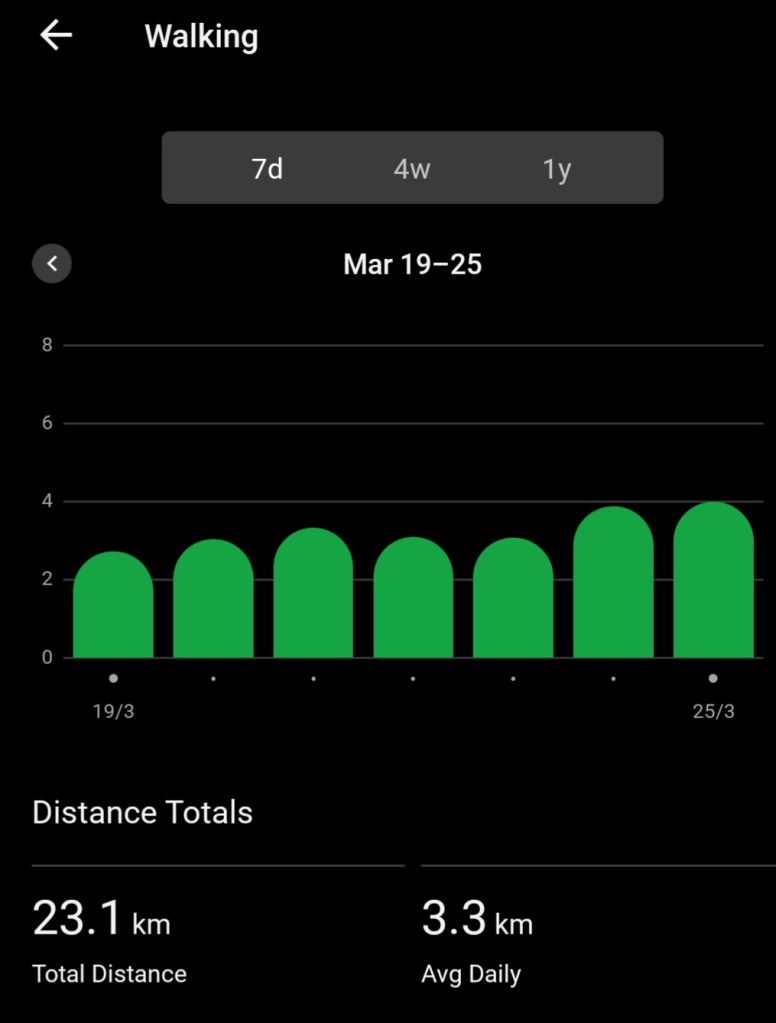
Steps per day March 19 - 25
Formal measured walks per day March 19 - 25

So that’s it for this ankle. When the next one will be done is debatable. Naturally the surgeon looks at risk mitigation from the perspective of the risks of surgery. I’m looking at it from the recovery perspective. It doesn’t matter how brilliant his surgery is if I am not well enough to manage the recovery properly and at this point in time I’m still not sure we will get my psoriatic arthritis under control. I needed my wrists, shoulders, piriformis and back to be better behaved. I managed, but it was tough.

Onwards and upwards! I need another 3,700 steps today to hit my daily goal, so off I go!
Doctors and Exercise

I last wrote about incidental exercise, but what about a more structured approach to exercise? Many of us with chronic conditions would benefit from exercise. Most of us also probably have doctors in our lives, either general practitioners or specialists (called consultants in some countries) such as a rheumatologist.

Over the Easter weekend an interesting report appeared in the Medical Journal of Australia, “Exercise: an essential evidence-based medicine”. Naturally, I was excited to see exercise receiving coverage in the medical media!

Regular physical activity is highly beneficial for the primary, secondary and tertiary management of many common chronic conditions. There is considerable evidence for the benefits of physical activity for cardiovascular disease, diabetes, obesity, musculoskeletal conditions, some cancers, mental health and dementia. Yet there remains a large evidence–practice gap between physicians’ knowledge of the contribution of physical inactivity to chronic disease and routine effective assessment and prescription of physical activity.

There was a similar report last year out of the UK, “GPs in England ‘unconfident’ discussing physical activity with patients – report”.

Now a nationwide study has revealed that 80% of GPs in England say they are unfamiliar with the national guidelines, and more than one in seven doctors say they are not confident raising the issue of physical activity with their patients.

“Many people have described [physical activity] as the most cost-effective drug we have, yet we are not implementing it properly,” said Justin Varney, co-author of the research from Public Health England (PHE). “This is as appropriate as having a conversation about smoking,” he added.

The medical advice I was given when I became sick was, literally, “Get some exercise.” Not how, what, when, frequency, intensity – just “Get some exercise”. As we know, I did better than that, I went and got an exercise qualification. After that, I asked my rheumatologist what weight he thought it would be safe for me to lift on the leg press, without negatively impacting my condition. His response? “I have confidence in you, you’ll work it out”. Which, in my case given my qualifications and experience, is fair enough. To a patient that is an exercise novice, I know my doctor would not have said that particular phrase. He and I have known each other quite some time now and have a very good patient/doctor relationship. I wouldn’t be writing this article if he had not set me on the exercise path in the first place. I share these conversations to provide real world examples of the above two articles.

Exercise is not a discipline many doctors are trained in, which is fair enough – they can’t be experts in everything and I need my rheumatologist to be an expert in rheumatology! Apart from anything else, a medical specialist would be a very expensive personal trainer. I really do not want to pay his medical charge rate for exercise advice. Look at it this way: a specialist or general practitioner may also send you to a physiotherapist, but do you expect that doctor to BE a physiotherapist? No, you don’t. So we should not expect our doctors to be able to write us a tailored exercise program either.

A member of a chronic illness support group today shared a similar experience, having essentially been told to “figure it out” by one of her doctors.

I recently wrote an article titled “Preventing Tomorrow’s Pain”. I didn’t really write it – I recorded a video. NOW, some time later, when I look back at that video, I can clearly see the improvement in my demeanour/attitude before I walk (after sitting in a conference all day) and while I am walking. Yes, I was pain free the next day and I swam 1,000 metres.

If your doctors don’t mention exercise, raise the topic with them. Really, your doctors don’t need to be exercise trainers, they just need to reassure you and encourage you that exercise will help you manage your conditions. They need to give you a medical clearance to undertake exercise. People like me can do the rest.

The above two articles, from opposite sides of the world, provide clear evidence that just because your doctor may not have mentioned exercise does not mean exercise should be ignored. Exercise may be the best medicine for you, just not mentioned by your doctor. Another contact told me when she offered to do exercise, her doctor was so surprised and said “You’re prepared to do that?” giving my contact the impression maybe he’d just given up over time trying to get patients to exercise. Doctor was very excited, patient exercises and her body does not “turn to concrete”. On a side note, I love that phrase, as it explains so well how many of us can feel if we don’t MOVE!

I use this graphic often: this is what happens if you don’t move. No, you don’t have to be lifting weights, start with simple stretches. Just MOVE it!

de-conditioning

Patients can be reluctant to try exercise as medicine. After all, instinctively we know pain is a warning signal and we believe rest will make it better even though science shows the opposite is true more often than not. We may fear those first few painful steps. A friend said the other day, “the cave you fear to enter holds the treasure you seek”. This, I feel, applies to exercise for so many people. We want the treasure: minimal pain, to be free of opioids, regain functional movement and retain quality of life. The cave is exercise and movement.

You may be reading this because you are searching for a solution. You are researching, perhaps. Do not be afraid to enter the cave. Ask your doctors, raise the topic of exercise with them. If they raise it with you, listen to them. Bear in mind the “how to” of exercise is not their specialty.

If you are ready and willing to try movement as medicine, call me or send me an email.

This article constitutes general advice only and may not be suitable in all situations. You should always seek a medical clearance to undertake exercise if you have medical conditions. Always apply the pain management principles of pacing when starting an exercise program.