leg press

Are Strong Pain Meds and Exercise a Good Combination?

Rule number 1 – discuss your specific situation with your doctor if in any doubt. Having said that, my experience is no, usually not a good combination.

Now, obviously I am not talking about trying to lift weights on pain meds after surgery! Just listen to your rehab physiotherapist!

What I am talking about is when patients are in situations like mine. We have a chronic illness, in my case psoriatic arthritis, and one of several things happen (or more than one happen together).

The most obvious examples are:

  • The condition flares
  • The primary treatment medication stops working for the patient
  • The patient is waiting for a new medication to start working.

At times like this the patient may have no option but to resort to a stronger pain medication than Panadol Osteo or similar.

Side note! If you are a friend, family member or colleague of a patient reading this, please be aware changing medications is not a simple thing with many of these diseases. A new medication can take anywhere from two weeks to six months to reach full effectiveness, with hopefully incremental improvements along the way. The medications are also NOT a cure. Not all medications work for all patients: I’m a prime example, my newest medication is medication number 11 in the 10 years I’ve been managing my disease. Medical science may develop cures in time, but we are not there yet.

My usual routine is I lift weights, walk and swim. If I am on strong pain meds, I do not lift weights. If the shoulders are involved, I do not swim either.

In order to exercise safely you need to be able to listen to your body. Perfectly healthy people lifting weights need to listen to their body: it is even more important for those of us with an illness we are managing to be able to listen to our bodies. Some time ago I wrote Changing Your Exercises for Safety where I looked at some adjustments we can make to exercise safely. I didn’t discuss pain medications as back then I really wasn’t using any of the “big stuff”. In 2023 I wrote about changing medications and what you can expect – it isn’t always easy!

If I am on strong pain meds, I can’t read my body as well as I need to be able to, to protect myself from inadvertently injuring myself or making my situation worse. I can’t necessarily tell if I should drop (reduce) the weight I’m lifting because it is possible the pain meds are blocking any discomfort I am causing myself.

Yes, not going to the gym may cause other issues. At the moment my lower back is a bit grumpy because I have been not willing to risk doing the extensive range of posterior chain exercises I usually do which keep my back in a pain-free state. But I’ve been on pain meds, off and on, for much of this year. I’ve just started my third treatment medication for this year and have been able to stop the strong meds.

I returned to the gym yesterday. I was VERY careful. Lifted very low (for me) weights to see how my body responded. No trying to do 160 kg on the leg press, I assure you. I did 45 kg. So embarrassing. I found the leg extension a real challenge, so was very careful. Despite how much walking I do, clearly my quads have taken a little holiday.

The quads are a good muscle to compare with others from yesterday. They seemed so weak that I don’t think I’d have physically been able to do myself any damage even if I was on pain meds – the strength just wasn’t there. However, the chest press was a different story: I had the strength to lift more than I did, but doing so hurt my shoulders and I could feel that, so dropped the weight back. On pain meds I probably would not have been able to feel that warning. I may have overly stressed my shoulders which are in recovery mode at the moment. I will say my shoulders feel better today than they have for months. I had steroid injections in them a few months ago – they were bad. But I need to go slow and steady to build up my strength again. And give the new medication a chance to work.

Why have I not been swimming? Same thing: reading my body. On strong pain meds I would not be able to tell if I was aggravating my shoulders or not. I will try swimming this week and see how the shoulders react, but I will be very careful.

Each disease is different. Each patient is different: patients will be on different pain meds and even if on the same pain med they may be on different doses or strengths. This isn’t a one size fits all situation.

If I know beyond doubt it is only my upper body flaring, for example, I’ll still do lower body exercises and vice versa. But it takes experience to be able to determine these things. I’ve clocked up 10 years this year and every year brings something different to learn as a patient.

Movement IS Medicine – but we need to be very careful when our disease is running riot and we are having to resort to strong pain medication.

It Is Like Two Days In One

I’ve had a weird day. Even for someone who has had this disease for ten years, this is a weird day. I’m writing about it for three different audiences:

  • Medical professionals, because this is the stuff we never get to cover in an appointment with you
  • Friends, family and colleagues of chronic illness patients, to provide some insight into what your friend, family member or colleague may be going through
  • Other chronic illness patients – sometimes we can feel as if we are the only one having particular experiences.

The overall situation I describe here is not unique to psoriatic arthritis, but some aspects will be. As that is the disease I have, that’s what I am writing about.

Let’s get into it. This morning I woke up at 6:15 am feeling like a broken doll. I had sore fingers, sore wrists, sore upper arms and a sore neck. Thankfully, my lower body seemed perfectly fine. There was also a very blah feeling. Malaise? Not sure I was quite at the malaise stage, but I certainly didn’t feel like singing and dancing.

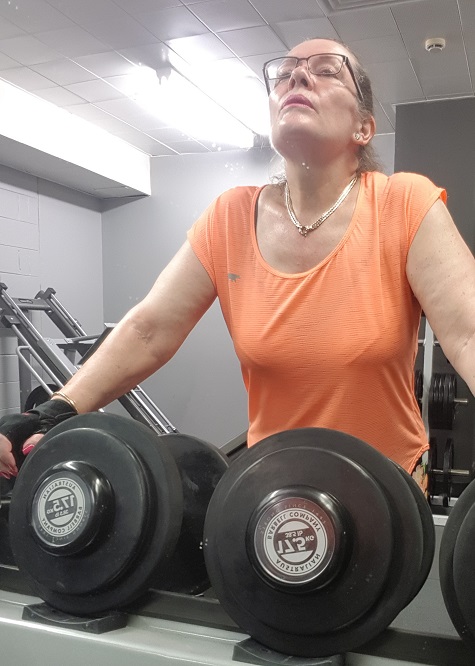
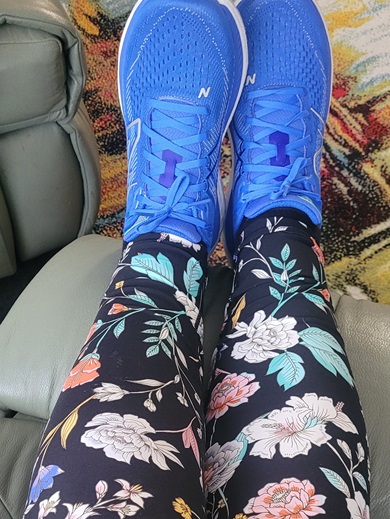
By about 10 am I thought to myself, “Oh, I think it is starting to lift!” Tossed up whether to shower or have a coffee, decided om the coffee first. By 12:36 pm I was actually showered, dressed and had lipstick on (I mean, really, did you doubt the lippy?). Yes, the above photo is me, today, AFTER I felt human.

I remember thinking to myself as I drove to the gym at 1 pm, “This is like two completely different days in one.”

At that point I felt like I could climb Mt Everest. OK, not quite, but the difference was SO stark. Unusually so. This slow, crappy start to days is not unusual, but often the bad is not so bad and/or the good is not such a massive improvement as what happened today. I really felt like a completely different person, physically.

I think there is a tendency for the general population to understand that mental health conditions may fluctuate, but tend to perhaps think of physical conditions as being more consistent in presentation – not totally consistent, of course, but shall we say mostly more consistent. Some are, I agree. Some are not.

I had steroid injections in my shoulders on Thursday so had deferred going to the gym out of an abundance of caution. I really wanted to go today, but waited to see what my body decided to do. My favourite gym leggings helped, of course.

Ultimately, I had a good workout.

  • 1 km on the treadmill as warm-up
  • Leg press
  • Chest press (left shoulder clickity clicking on this)
  • Leg extensions
  • Seated row
  • Vertical knee lifts
  • Triceps
  • Leg curls
  • Back extensions
  • Lat pull-downs

The free weights area was a little overpopulated so I skipped biceps and shoulder press – they can wait for next visit.

As I write, it is 4 pm. I’m pretty much a “healthy” person.

This was a GOOD day, in that I came good as the day wore on. Sometimes we are not so lucky. OR we may wake up already feeling ready to take on Mt Everest. The issue is, we never know until we open our eyes in the morning. One morning recently I woke up unable to bend my left knee. Another day (some time ago) I was driving when I suddenly realised I couldn’t turn my head to the right (to check for traffic). On both occasions the rest of me felt fine!

This unpredictability makes planning life difficult. In time, my new medication hopefully will make everything more stable: it is still early days. But for many of us, today (or variations thereof) is what we live with. It can be hard for those around us to understand, especially when we do not LOOK sick. The invisible illness scenario.

The recent shoulder issue is a classic example of that. I LOOK fine. But reaching forward to put stuff in the microwave, or turn on a power switch, or turn on a tap were problematic. Lifting my arms about chest height, or anything involving internal rotation. Getting dressed was super challenging. Let’s not even discuss bras! But I LOOKED fine.

I can generally go with the flow because I’m retired. I’m not trying to get kids ready for school or meet a work deadline. I’m not trying to cook for a family of six. I really feel for those patients who have these types of responsibilities.

To my fellow patients – you are not alone. There are many of us out in the world facing similar challenges.

To everyone else – just because you can’t see something, doesn’t mean it isn’t there. You aren’t living the daily, sometimes even hourly, challenges. Support your family member, colleague, friend or patient.

Me? Hey, I just hope tomorrow is as good!

Feel Like I’m in a Holding Pattern

It goes like this. On April 6, 2024 I started my NINTH psoriatic arthritis medication. Sequential, not together! Some medications have a loading dose period: this is one of them. So for four weeks I have injections once a week. Then I move to monthly injections. The first monthly injections are the week after the last loading dose injections, so effectively the patients have weekly injections for five weeks in a row.

You’ll notice I said injectionS – no, that is not a typo. The dose is not available in Australia in one pen, so I have to use two pens. This is not a problem for me as I find the pens really easy to use.

A previous biologic I was on was fine during the loading phase, then when I got to the normal doses, in that case an injection every eight weeks, I found it wasn’t as effective. I’d be great for about three weeks, then steadily feel worse for the next five weeks. Not a great situation to be in.

So, while I feel very good right now, I am waiting until June/July to see if this medication will be effective for the full four weeks between injections. Of course I am hopeful! But that is why I feel like I am in a holding pattern. There are things I want to do, get involved in, but I feel I can’t yet commit to anything that involves other people until I know how this treatment is going to pan out longer term.

At least I’m not taking any NSAIDs or prednisolone and I’ve taken Panadol Osteo about three times a week. YAY me! Or YAY the new medication. Because I’m not taking those additional medications (and I’m moving), I’m also managing to shed the weight gain that occurred while I was taking them. Thank you, 2023. Not my favourite year, let me tell you.

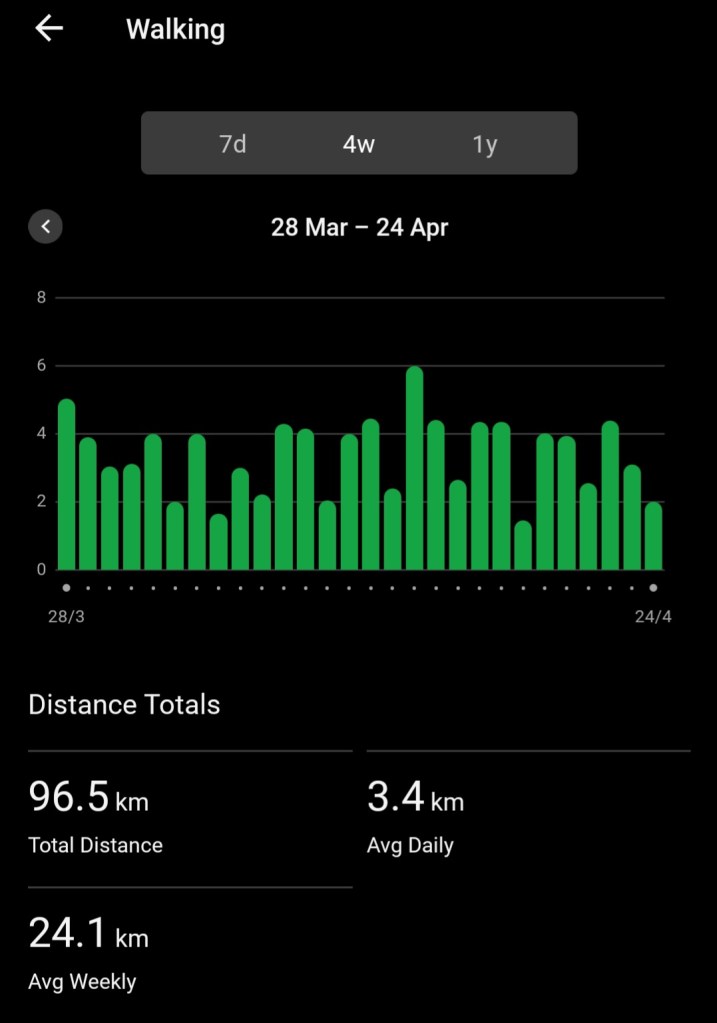
Another aspect of being chronically ill that is driving me nuts at the moment is the amount of effort required to remain, well, functional. So much planning goes into ensuring I get the movement required, balancing with the rest required. Then of course I’ve just had nine months of rehab exercises from first the knee replacement surgery then the ankle surgery. Not to mention the cast and the knee scooter and the moon boot! At the moment I’m kind of on the come back trail: the last four weeks have been good, let’s keep going. My first walk after the ankle surgery was February 14, a whole 0.8 of a kilometre. Now is much better.

I drop my target step count on the days I lift weights, which is every third day. Some days the weather may impact my step count! This is Melbourne, after all: we can have sunshine one minute and a howling storm five minutes later.

Reconditioning one’s body after nine weeks essentially immobile when that body is already challenged by psoriatic arthritis (and, umm, advancing years) requires a bit more planning that usual. Yesterday was a classic case. I did not make my 7,500 steps. I needed another kilometre, but for whatever reason/(s) a few things were grumpy by the end of the day. I opened my front door. Stood there for about 30 seconds and decided (sensibly) this was not happening. Closed the door and came back inside!

My lower back did play up off and on once I got moving again. Being “misaligned” for nine weeks on the knee scooter then the moon boot was not something my back muscles and left glutes liked AT ALL, I discovered. Lots of heat packs and stretches involved and all is now back to normal.

In summary, some days I end up feeling as if all I do with my life is work at keeping this disease under control. In the early years, I was still working, I had a purpose to keeping it under control. Now there are days when I wonder why on earth am I putting in all this hard work? Which is why I need to be DOING something other than just “keep active”. I need to have something to DO. Which explains the holding pattern dilemma. Thank goodness for my psychologist allowing me to vent!

I’ll get there! It is just a frustrating time and we all have them.

I’m still happy to be past the tip of the bell curve (top photo) for my daily step count given my situation. And remember, that is only Garmin wearers, many of whom will be very active, not the whole population!

By the way, I’m freaked out by the number of people that are freaked out about patients injecting ourselves! Many diabetics have been doing it for years! I’m not sure why we (i.e. those with other conditions) are seen any differently.

Tough, But Worth It!

Yes, I’ve been very quiet. VERY quiet. I know, I’m sorry. Recovery from my November surgery took quite a lot of effort. On top of that, the mobility restrictions meant my psoriatic arthritis decided to complain, so I was fighting on two battle fronts.

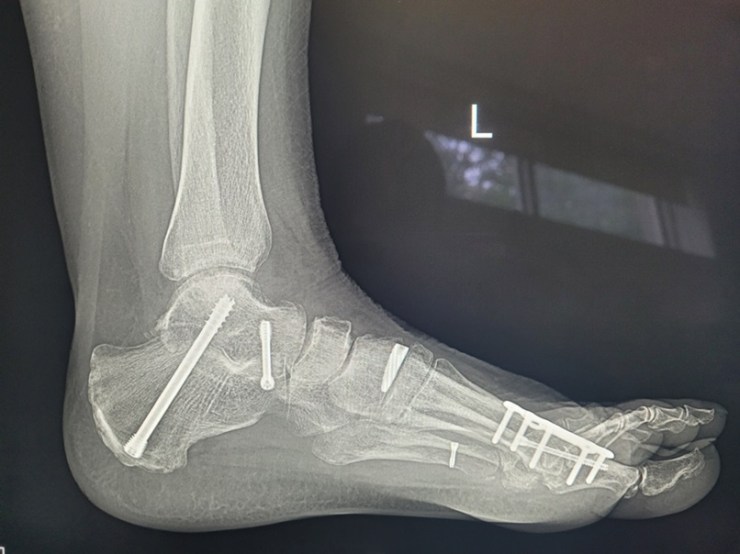
My ankle surgery took place on November 28, 2023. My first completely pain/discomfort free walk was March 22, 2024. 16 weeks and 2 days.

I’m not repeating the details previously documented, so if you are catching up, read the surgery article linked above first! The moon boot was better than the cast and knee scooter for sure. I could shower without “bagging” my leg in plastic bags! I didn’t have to sleep in the moon boot! I was no longer doing three-point turns in my small apartment or constantly reversing in and out of spaces. I could drive! I was no longer so totally dependent on other people, I had a modicum of freedom.

I was allowed to go to the gym to do upper body work. ONLY upper body work, but at least it was something! The gym staff looked at me a little askance, but let me in.

I was to gradually increase the percentage of weight on that leg each week and could try proper shoes at week four of moon boot life. I will admit I snuck into shoes a couple of days early because the moon boot meant my legs weren’t the same length and my right piriformis muscle was not overly impressed with that situation. I was VERY careful though.

At my 12 week post-op my surgeon was very happy with how everything had knitted and I was finally allowed to go to the physiotherapist. It is amazing how weak your calf and ankle muscles can become after 12 weeks of no use. Surprisingly, this physiotherapist wasn’t as bossy as the knee physiotherapists: exercises every second day instead of every day.

On February 14 I started short walks – between 500 and 800 metres depending on how the ankle was feeling. I managed my first 1 km walk on February 20 and have slowly built up from there. March 21 I walked 2 km in one hit! I should add I was doing multiple walks a day by this stage, with the physio’s permission.

While the ankle/foot wasn’t really painful, it wasn’t 100% comfortable either until March 22. That was the day I felt free!

Funny conversation with surgeon at the 12 week post-op.

Me: “So I have no restrictions now?”
Surgeon: “No, you’re fine!”
M: “So I can do the leg press?”
S: “Sure!”
M: “So what weight can I start at?” (Thinking to myself 50 kgs seemed reasonable to start)
S: “Oh, just the plate, no weights!”
M: Thinking – that sounds like a restriction to me!

It always pays to clarify. I think maybe he didn’t consider his nearly 70 year-old patient was going to be doing things like the leg press. Have I got news for him!

I have interesting rehabilitation exercises, such as standing on one leg for 30 seconds and calf raises on one leg. Now, to be honest, I still cannot do the one-legged calf raise, but I’m getting there with a little help from the other leg. A little less help each day. Hoping I can do the single leg calf raise by my next physio visit!

So yes, it was well worth it, but man alive, am I glad I only have two ankles. I’ve learnt a lot of this experience and will plan the next one with the knowledge I now have about how VERY different this is from knee replacement surgery.

Of course not every ankle surgery will be exactly the same as mine. Other patients may spend less time in a cast for example. Or more time in a moon boot. It definitely isn’t as easy as knee replacement though.

Due to the lack of exercise during those weeks of recovery, my back is not happy. It is getting happier now I am back to a more normal routine, but some days have been quite tough. Moving is not as bad, most of the time, as being stationary, luckily. My back has been under control for some years, due to the work I keep doing on my posterior chain to support it, but at my age we decondition faster than in our twenties – I’m having to build up that strength again. The shoulders and wrists didn’t like the crutches either – the psoriatic arthritis complained. Both wrists and shoulders are now improving with increased exercise and no irritation from the load of crutches.

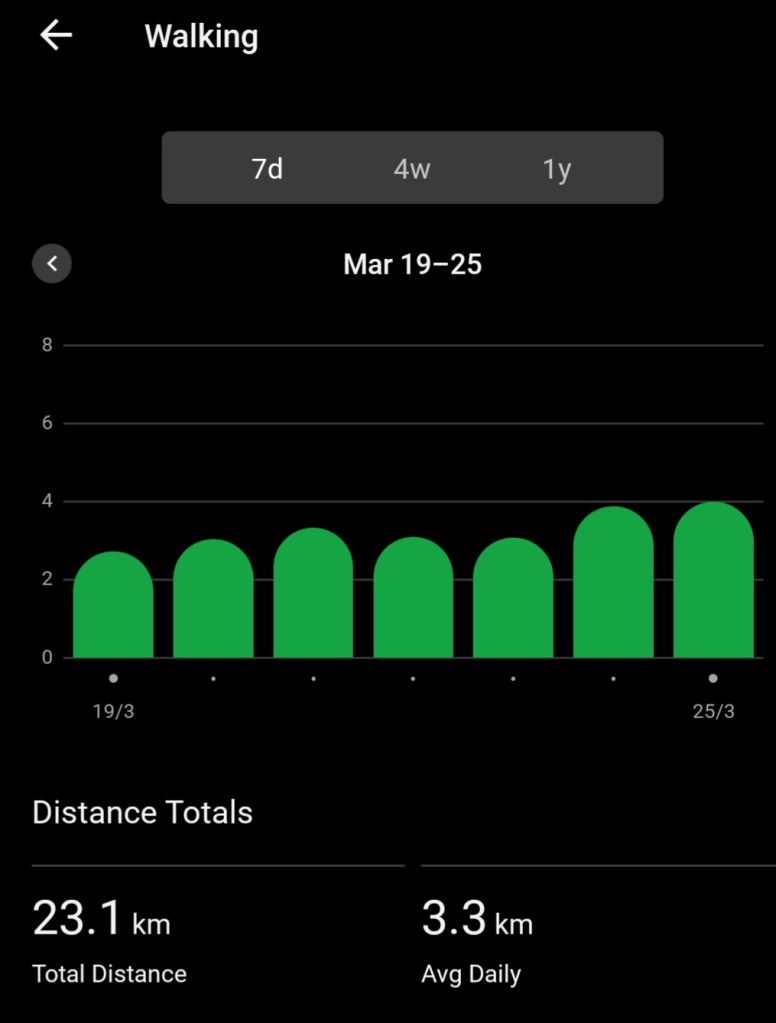
One thing I wasn’t happy about was once I could walk 1 km, I discovered I’d lost another point on my VO2 Max reading. I was devastated. While I don’t do high intensity exercise and therefore don’t expect a high VO2 Max reading, I do want something healthier than “poor”! Thankfully, I’ve worked hard enough this week (shown below) and last week to recover that measly one point. The lost of the one point had worried me because it was the continuation of a downward trend that started early 2023 and so desperately want to turn it around and get back to where I was.

Steps per day March 19 - 25
Formal measured walks per day March 19 - 25

So that’s it for this ankle. When the next one will be done is debatable. Naturally the surgeon looks at risk mitigation from the perspective of the risks of surgery. I’m looking at it from the recovery perspective. It doesn’t matter how brilliant his surgery is if I am not well enough to manage the recovery properly and at this point in time I’m still not sure we will get my psoriatic arthritis under control. I needed my wrists, shoulders, piriformis and back to be better behaved. I managed, but it was tough.

Onwards and upwards! I need another 3,700 steps today to hit my daily goal, so off I go!

Doctors and Exercise

I last wrote about incidental exercise, but what about a more structured approach to exercise? Many of us with chronic conditions would benefit from exercise. Most of us also probably have doctors in our lives, either general practitioners or specialists (called consultants in some countries) such as a rheumatologist.

Over the Easter weekend an interesting report appeared in the Medical Journal of Australia, “Exercise: an essential evidence-based medicine”. Naturally, I was excited to see exercise receiving coverage in the medical media!

Regular physical activity is highly beneficial for the primary, secondary and tertiary management of many common chronic conditions. There is considerable evidence for the benefits of physical activity for cardiovascular disease, diabetes, obesity, musculoskeletal conditions, some cancers, mental health and dementia. Yet there remains a large evidence–practice gap between physicians’ knowledge of the contribution of physical inactivity to chronic disease and routine effective assessment and prescription of physical activity.

There was a similar report last year out of the UK, “GPs in England ‘unconfident’ discussing physical activity with patients – report”.

Now a nationwide study has revealed that 80% of GPs in England say they are unfamiliar with the national guidelines, and more than one in seven doctors say they are not confident raising the issue of physical activity with their patients.

“Many people have described [physical activity] as the most cost-effective drug we have, yet we are not implementing it properly,” said Justin Varney, co-author of the research from Public Health England (PHE). “This is as appropriate as having a conversation about smoking,” he added.

The medical advice I was given when I became sick was, literally, “Get some exercise.” Not how, what, when, frequency, intensity – just “Get some exercise”. As we know, I did better than that, I went and got an exercise qualification. After that, I asked my rheumatologist what weight he thought it would be safe for me to lift on the leg press, without negatively impacting my condition. His response? “I have confidence in you, you’ll work it out”. Which, in my case given my qualifications and experience, is fair enough. To a patient that is an exercise novice, I know my doctor would not have said that particular phrase. He and I have known each other quite some time now and have a very good patient/doctor relationship. I wouldn’t be writing this article if he had not set me on the exercise path in the first place. I share these conversations to provide real world examples of the above two articles.

Exercise is not a discipline many doctors are trained in, which is fair enough – they can’t be experts in everything and I need my rheumatologist to be an expert in rheumatology! Apart from anything else, a medical specialist would be a very expensive personal trainer. I really do not want to pay his medical charge rate for exercise advice. Look at it this way: a specialist or general practitioner may also send you to a physiotherapist, but do you expect that doctor to BE a physiotherapist? No, you don’t. So we should not expect our doctors to be able to write us a tailored exercise program either.

A member of a chronic illness support group today shared a similar experience, having essentially been told to “figure it out” by one of her doctors.

I recently wrote an article titled “Preventing Tomorrow’s Pain”. I didn’t really write it – I recorded a video. NOW, some time later, when I look back at that video, I can clearly see the improvement in my demeanour/attitude before I walk (after sitting in a conference all day) and while I am walking. Yes, I was pain free the next day and I swam 1,000 metres.

If your doctors don’t mention exercise, raise the topic with them. Really, your doctors don’t need to be exercise trainers, they just need to reassure you and encourage you that exercise will help you manage your conditions. They need to give you a medical clearance to undertake exercise. People like me can do the rest.

The above two articles, from opposite sides of the world, provide clear evidence that just because your doctor may not have mentioned exercise does not mean exercise should be ignored. Exercise may be the best medicine for you, just not mentioned by your doctor. Another contact told me when she offered to do exercise, her doctor was so surprised and said “You’re prepared to do that?” giving my contact the impression maybe he’d just given up over time trying to get patients to exercise. Doctor was very excited, patient exercises and her body does not “turn to concrete”. On a side note, I love that phrase, as it explains so well how many of us can feel if we don’t MOVE!

I use this graphic often: this is what happens if you don’t move. No, you don’t have to be lifting weights, start with simple stretches. Just MOVE it!

de-conditioning

Patients can be reluctant to try exercise as medicine. After all, instinctively we know pain is a warning signal and we believe rest will make it better even though science shows the opposite is true more often than not. We may fear those first few painful steps. A friend said the other day, “the cave you fear to enter holds the treasure you seek”. This, I feel, applies to exercise for so many people. We want the treasure: minimal pain, to be free of opioids, regain functional movement and retain quality of life. The cave is exercise and movement.

You may be reading this because you are searching for a solution. You are researching, perhaps. Do not be afraid to enter the cave. Ask your doctors, raise the topic of exercise with them. If they raise it with you, listen to them. Bear in mind the “how to” of exercise is not their specialty.

If you are ready and willing to try movement as medicine, call me or send me an email.

This article constitutes general advice only and may not be suitable in all situations. You should always seek a medical clearance to undertake exercise if you have medical conditions. Always apply the pain management principles of pacing when starting an exercise program.