My Total Knee Replacement (Knee Arthroplasty)

My early birthday present this year was a bionic knee. My surgeon will tell you very clearly it is NOT a bionic knee: the Australiam Orthopaedic Association clearly advises, “After knee replacement you cannot run, squat, kneel, crawl or play twisting, impact sports“. So not very bionic, but I like the idea.

Warnings re this article.

  1. It is long. Very long.
  2. Your experience may be very different. Each body is unique. That’s why the title includes “My”.
  3. I do try to inject some humour into the proceedings, otherwise it is a very dry topic.
  4. There are wound photos, but none of them are gory. I forgot to ask the team to take gory photos.
  5. This is written from the patient perspective (obviously) and no, not everyone gets praise (most do) – there are some bouquets and brickbats at the end.
  6. I do not name hospitals, doctors or medications.
  7. This article deals with the period of hospitalisation and rehab. I will write a second about being home (and continuing physio).

Background

We will call this knee Lennie (for left knee). Just to bring newer readers up to date with Lennie, back in 2014 it started being a little on the grumpy side. I had a Synvisc shot as an experiment and it worked well, but knee replacement was initially discussed back then. In October 2019 Lennie got really grumpy and I had fluid drained and a steroid shot. Temporary relief. By the end of January 2020, Lennie had me in hospital for five days. A cyst dissecting my popliteus muscle was discovered. At first it was thought that could be removed, but two eminently qualified orthopaedic surgeons said “No.” Mr T, the surgeon I went with, did explain a little more comprehensively. The view was the inflammation was so bad I’d simply develop more cysts. The time had come.

I was shocked. I had been expecting keyhole surgery to remove a cyst. NOW I was looking at rebuilding Lennie. Slightly more major event. Psychologically this was challenging for me – I WANTED to be able to manage the osteoarthritis (being careful here to distinguish from my psoriatic arthritis, different conditions) with exercise and strength and physiotherapy. Yet I had to admit this was not going to be a happening thing: Lennie was just a little too damaged. No matter what we did, Lennie would rage.

Once I made the decision, I was raring to go. Let’s get this show on the road. We had to time surgery around my drug trial injections. Surgery was booked for April 8, 2020.

Preparation

This is not surgery undertaken lightly, let me tell you! After the consult with Mr T to agree to let him cut out some of my bone and insert some metal and plastic bits and pieces I then had a schedule.

  • Consultation with a physician, Dr M
  • Blood and other tests
  • ECG
  • Visit with hospital staff re post-surgery planning
  • Another pre-op consultation with surgeon

Dr M’s job was to make sure I was healthy enough to survive surgery. He was also responsible for my post-operative welfare in hospital. I spent an hour with him, lovely guy, very thorough. Pulled prior medical tests from my various other specialists, including the cardiologist. More on THAT a little later – because I got a little surprise.

Dr M also ordered me to stop some medications I was on. This is very patient specific but I can tell any women of my age reading, it includes stopping (temporarily) HRT. Also verboten were anti-inflammatories. This is fun when you have a rather inflamed knee and are still trying to walk three kilometres a day and do exercises to keep your muscles “recovery ready”.

Then Covid happened and everything got cancelled. I did however still go and have the blood tests and ECG. The plus was I could go back on anti-inflammatories and HRT (temporarily)!

During this time my left ankle was becoming more and more painful until one morning I absolutely could not weight bear at all. I was convinced this was all tied in with Lennie’s misbehaviour, as from my January hospital excursion I had been unable to control that foot. Mr T was unconvinced, but I also did not explain to him (my patient oversight) the specific loss of foot control I was experiencing. The 4 second video below illustrates what I could NOT do with my left foot.

FINALLY and fortunately and I am forever grateful I GOT A NEW SURGERY DATE! May 20, 2020. Back off the anti-inflammatories and HRT. This however meant my knee was swollen and painful. My GP worked out a pain management regime so I could keep moving. As always, I was very nervous about this as I didn’t want to develop a tolerance to medications and have pain medications not be as effective as possible post-surgery. My GP assured me I wasn’t taking enough, or for long enough, for that to happen. By the last couple of days pre-surgery, I was in considerable pain and not a very happy person.
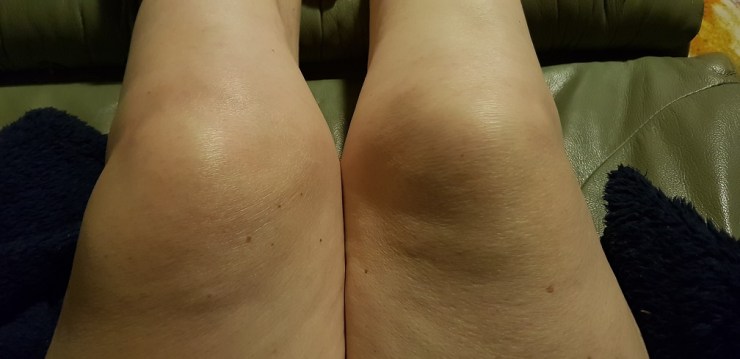
May 16 – not at the most swollen, but just a snap I sent to my daughter

Due to Covid, the hospital appointment mentioned earlier happened by phone. I also needed another (updated) lot of blood tests, which I had done at the hospital on May 8.

I had groceries delivered the day before surgery, changed the bed linen, did all the laundry and the dishes and cleaned the fridge. All I would need when arriving home was fresh milk and fresh fruit.

I was VERY happy to arrive at the hospital at 6 am on May 20, after starving myself from midnight.

Surgery Day

The very first thing I was required to do was have an antiseptic shower. I was first on the theatre list. The anaesthetist popped in to see me, the assistant surgeon dropped in, Mr T popped in to draw on my leg (the big black arrow from my ankle you will see in a later photo). I commented to him I’d love to watch the surgery. I think he was a bit surprised. His response was it was a worksite and I wouldn’t “want to hear all the swearing”. I figure I’d have talked too much anyway, asked too many questions: I’d have distracted them from the task at hand.

Dr M popped in at some stage, I forget exactly the sequence of events now, BUT he blithely informed me I was going to the HDU post-surgery. The conversation went a little like this.

Dr M: You’ll be going to the HDU post-surgery.
Me: What is the HDU?
Dr M: The High Dependency Unit
Me: WHY? I’m healthy as an ox, I just have a bung knee!
Dr. M: You have a nocturnal AV block.
Me: …………????????

I had no idea what a noctural AV block is, or that I actually had one. My recollection of my cardiological investigations was I was pretty damn good on the cardiovascular front, just every now and then my heart would miss a beat, nothing to worry about – I certainly don’t still see a cardiologist! Unless, it seems, you are having fairly major surgery. As I write I still do not know much about the mysterious nocturnal AV block, but I’ve been busy concentrating on my knee. I’ll find about the AV block later (that’s going to be delegated to my trusty GP).

By 7:30 am I’d seen four doctors, been drawn on and discovered I had something that was sending me to the HDU. I also mentioned to the surgeon and the anaesthetist that it had occurred to me I never research the anaesthetist, despite the number of surgeries I’ve had. Check out the surgeon, yes, but then just trust him/her to pick an anaesthetist that will keep me alive! I just found it interesting.

My daughter and I had agreed they would not visit on the day of surgery as I might be a bit “out of it”. As it turns out, the day of surgery I was fine, would have been a great day to visit! Day 1, when they did visit, I was “out of it”.

I woke up to be greeted by this.

Now when I say I could feel nothing, that’s exactly what I mean. Nothing! I could not move the leg at all, it was like a lead weight, seriously. It was also cocooned on a padded frame I did not take a photo of. Just holds the leg safely in position.

I thought if this is as bad as it gets, this is a walk in the park.

Mr T did pop in to see me and share with me the news that he had not been able to remove all the inflamed tissue as per his normal practice as that would have been just a bit too dangerous in my case. In my experience doctors use the word “dangerous” very sparingly so I’m guessing my knee was a little messy once it was opened up. Will find out more detail when I see him again in a couple of weeks.

Then My Glutes Went Crazy

At about 10 pm, so roughly ten to twelve hours post-surgery, I mentioned to the nurses that I was starting to feel pain and my glutes (the muscles in the buttocks) were spasming. This glute spasming thing had happened back in January too. Wasn’t fun in either January or May, let me tell you. I won’t go into all the detail of the next few hours, but those hours were not pleasant. The anaesthetist got a 4 am wake up call (although apparently he was already awake – do those guys ever sleep?). Dr M got in on the pain management act as well. I want to stress here, it really wasn’t the knee that was causing me the issues. It was everything else: the glutes and the ITB mainly (I’ll talk about the ITB later, at this point I didn’t separate the knee from the ITB pain, that dawned on me later in rehab).

The glute spasms came in waves, just as they had in January. Those wave peaks were intense. The great team did get it all under control fairly quickly, but the glutes continued to be an issue, reducing in severity over time, for nearly four weeks. In hospital the nurses would ask that great pain question “What is your pain on a scale of 1 to 10?” My answer would often be, “The knee is zero, the glutes are 6.”

I ended up with three drips in various locations on my right arm and I was on a cocktail of drugs Day 1 (surgery day is Day 0).

I’m an information technology person: we make ONE change at a time when troubleshooting. If that change doesn’t give the desired result, we roll it back, make another change, test. Rinse and repeat. When you have a patient in considerable pain, I can understand they don’t have the luxury of the time to try one drug, it doesn’t work, take it away, try another one, rinse and repeat. Hence the cocktail. To me, with my background, it was like “But which one worked/is working?” I’m a pain medication minimalist at the best of times, I make an exception for surgery, but I was staring at the IV pole in horror.

Yes, it was an unpleasant few hours but would not happen to every patient and was probably more specific to the state of my anatomy at the time. Nowhere in all the copious information are glute spasms mentioned as a possible post-surgery event! I’d got an extra five years out of the knee since surgery was first discussed, so I can’t complain too much if during that five years other tissues had suffered: shortened, tightened, etc due to coping with the damaged knee.

Preventing Blood Clots
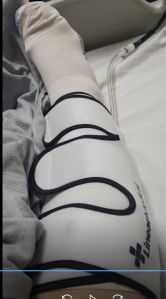
Blood clot prevention is big these days! Compression stockings, daily injections of a blood-thinning agent and these intermittent pneumatic compression (IPC) sleeves. Apparently some people hate them, but I loved them. I would have stolen them if possible. Like a constant leg massage. The only problem was I would count the compressions. One leg was doing 17 before the rest between sequences, the other leg was only doing 5 compressions. Was something wrong, I wondered? Did I have faulty sleeves? As a patient, I expected them to do the same thing to both legs. No-one seemed to know, which worried me even more. They rebooted the pump, unplugged and replugged the connectors, still the same. I can’t remember now who did know the answer, but apparently these sleeves don’t work in unison, but have a pre-programmed variation. It is likely many patients would not sit there counting the compressions to compare, but of course, I did!

I still find it amusing that I had to stop anti-inflammatories before surgery because they thin the blood (don’t want us bleeding too much in theatre, after all) then as soon as surgery is over, we get blood-thinners daily!  I understand the logic and am very grateful for the level of care, but it still amuses me.

Dr M also gave me deep breathing and coughing exercises to do.

Day 2 Onwards

Day 2 it was suggested I go to rehab. By Day 2 I was feeling much better, but thought I’d be guided by the experts, so I agreed. I do live alone and thought perhaps this may be a wise choice. Transfer was scheduled for the coming Monday. The remainder of my hospital stay was reasonably uneventful. The glutes were kept under control, I gradually lost IV connections and started to move about. Had my first shower sitting in a chair (first time ever!). That was the only chair shower I had, all others were standing. Another issue was sleeping on my back. I have never been a person that sleeps on my back, but all of a sudden I was expected to. That was hard. My back didn’t like it overly either. As soon as I was able to sleep on my side using a myriad of carefully positioned pillows, I did.

I learnt how to hook my right foot under my left ankle and swing my still as heavy as lead leg up onto the bed. The monkey bars above the bed were a great assistance! You will of course note by then I had painted my nails!

Day 2 I also had an x-ray. Mobile x-rays are wonderful things, plus the lovely staff took photos of the x-rays for me. I could finally see IN my knee! I could see Mr T’s handiwork, even though I missed out on seeing it happen.

X-ray without moving from my bed!

The bubble wrap looking stuff is the dressing. But there it was – Lennie was replaced, no more angry knee. Yes, my patella got some attention as part of the whole deal, so it lights up as well. Apparently, yes, I will set off the airport metal detectors.

The actual knee itself looked pretty good, if somewhat swollen (as is to be expected). And there is the aforementioned big arrow the surgeon drew on my leg before it all started.

BEST OF ALL? I discovered I had control of my foot again! I could move it as demonstrated in the little video above! The nurses were a bit mystified at my excitement, but I was ecstatic. I had control of my foot back!

I swapped between a walker and crutches for a couple of days as I have to say the walker was convenient for hanging clothes and towels on moving from bed to bathroom. Other times I would use the crutches. I had little exercises to do in bed to start stretching and bending the knee.

Day 4 I was feeling pretty chipper, but was still in a nightdress. Still no haircut either.

Off to Rehab

Day 5 was off to rehab day. I got dressed!!! All by myself! The last IV connection came out and off in the ambulance I went (very squishy ambulance, just as an observation).

Rehab is mostly about physiotherapy, moving, functionality. The monkey bars are gone, for a start, as was the walker (although I’d not used that for a few days by then). I ended up with the start of abrasions on my elbows from dragging myself up the bed, so we had to cover my elbows at one stage to protect the skin. I did learn to use my hands more than my elbows, which helped!

Unfortunately, the glutes decided to spasm badly again once I reached rehab. That was disappointing and frustrating. I missed a physio session due to the glutes. The whole pain management process started again, but this was about the glutes, not the knee.

They have a gym! First trip to the gym is in a wheelchair, but most after that on crutches (even if the physio followed me with a wheelchair “just in case”). Some physio sessions were in the room. For example, I’d go to the gym in the morning, then in the afternoon the physio would come to me.

It was in the gym I had my ITB epiphany. Refer back to the above section about the glutes going crazy. At that point, immediately post-op, I hadn’t differentiated between my knee (the operated bit) and the ITB. As a patient you are still a bit foggy from the anaesthesia, it is all in the same area, pain is pain at that point. But in the gym, six days later, your brain is working a lot better. I was doing one of the rehab exercises and realised it wasn’t the surgical site that was hurting, it was my ITB. It was painful and restricting my movement.

The physiotherapist and I had a chat about what we could do. The rehab hospital had a clinical massage therapist so we decided to give that a go. ONE treatment and the ITB pain was gone. I have no idea what he did, but it was fantastic! He also worked on the glutes a bit too. I had two treatments with him. My own physio, now four weeks later, is still working on those areas for me.

I’d have a heat pack on my glutes and an ice pack on my knee. The knee wasn’t necessarily painful, the ice was more preventative and to help with the swelling.

The goal for release from rehab is knee flexion (bend) of 90 degrees. I reached 93 degrees on Day 11 (post-surgery day count, that is). That was also the day I found myself in the bathroom with no crutches – I’d just got off the chair and wandered into the bathroom. Hmmm, I thought to myself, perhaps I’d better get Mr T’s OK, because I don’t think this is the first time I’ve done this in the last couple of days. Mr T’s office said that was fine, I was close enough to two weeks. I could “potter about” without crutches or walking stick. I promised not to go to the supermarket (just yet) without crutches.

By the very next day, my knee flexion was 105 degrees. Day 14 I finally came home! Now, almost a month after surgery, I am walking about 3,000 steps a day and my flexion is 125 degrees (as of Tuesday this week) – more on that in Episode II.

I had an appointment to see my surgeon on Day 13, but because I was in rehab we agreed the rehab doctors could review me and so that appointment was cancelled. In hindsight, I wish I’d gone to that appointment, just for information and post-op guidance.

Bouquets and Brickbats

Mostly I have bouquets. Just three small brickbats. Overall the care and staff were fantastic.

Surgeon – wonderful work. What more can I say? Fantastic.

Physician, anaesthetist, assistant surgeon – as far as I can tell, all did a great job! Sorry about the 4 am wake-up call.

Physiotherapists – terrific. They were really encouraging, understanding and supportive.

Nurses – all bar one night nurse were wonderful.

Food – some was great, some was not so great, but hey, it isn’t a restaurant. I was happy to get home to a higher protein diet though.

Pillows – terrible. Next time I am taking my own pillows into hospital IF that is allowed (it occurs to me maybe that would be considered an infection risk).

One rehab night nurse – I was not impressed. Towards the end of my stay I avoided calling her at all costs. HOWEVER, given the number of wonderful nurses over the 14 days, I think only one being not as helpful as I would have liked was not too bad really.

Release Process – oh, OK, discharge. I was sent home with various medications, two of them were pain medications. I was released just before a long weekend, so I was thankful for the coverage. It occurred to me over the weekend I had been given NO instructions how to get off these things. Remember I’m the pain medication minimalist – BUT I was also aware I’d had pretty invasive surgery, I didn’t want to change anything on a long weekend and cause a pain episode. Off to my GP I went to find out what I could stop taking and when. We stopped the slow release, kept some instant release up our sleeves IF necessary. I was happy. On reflection, I feel not enough information was given to me on discharge about the medications. Really, a small complaint very easily rectified by a visit to my GP.

A Clinical Trial – Patient Journey – Part IV

Catching up?

I last wrote in September about my clinical drug trial. So much has happened since! I did reach the conclusion, despite how good I felt by September, that I was on the placebo for the first 24 weeks. So why did I feel so good in September? To work that out we have to look at my specific treatment history. I’d failed three DMARDs when I started the drug trial and had just started a fourth DMARD. The rules of the trial were we could stay on up to two DMARDs during the trial.

Having adverse reactions to medications is not fun and while in each case I typically cite one prime adverse reaction, in reality there are probably other issues going on with the body as well.

Timing is the other factor in my case. Due to the adverse reactions to the DMARDs, by the time I started the trial my treatment regime had been a bit stop-start. To recap, November 2018 I stopped DMARD #2, did three month washout. Tried DMARD #3 in February 2019, but only lasted five weeks due to adverse reaction. Another small washout period, started DMARD #4, on a low introductory dose, in April 2019. By the time I started the drug trial in July 2019 I was really recovering from a lot of adverse reaction events and had not had continuous, effective treatment for almost eight months. It is therefore, to my mind, not surprising that I felt better in many ways! I was, if nothing else, recovering from the medications my body had not looked upon too favourably! When I wrote Part III (link above), I was also still on that low dose of DMARD #4 which may well have been having a positive effect on the psoriatic arthritis.

However, DMARD #4, like the previous three treatments, also resulted in an adverse event for me. My, shall we say, gastrointestinal activity started to go through the roof. I won’t go into details, I think you get the picture! It was not at all pleasant and worsened over time. After discussions with my gastroenterologist, rheumatologist and the research team we recorded yet another adverse event and I went off DMARD #4.

Around the same time the left knee, the topic of my last article, was starting to make its presence felt. I also developed trigger finger in late December and started splinting my fingers at night. I got different colours so I’d know which one was for which finger! These splints are from an great occupational therapist. So I had a few things going on.

While I could still fit my runners on, my feet were still slightly swollen. I developed a few clearly visible small nodules here and there: one on a pinky finger, one on a second toe and one on a big toe. These were new, small, and bothersome. The feature photo shows the finger one, completely gone now. The toe one below would now not be noticed by anyone else, I can just see where it was.

The joint assessment at my October trial visit still lit up all my toe joints and some finger joints. There really wasn’t any improvement in that joint assessment at all, even though I still felt better in many other ways as noted in my prior articles.

But what about the skin? Yes, it remained 100% clear. If I was on placebo AND off all DMARDs, wouldn’t my skin possibly flare? No, I don’t think so for the very simple reason my skin had never been a problem in the past, it came to the fore in a big way as a result of DMARD #2. Off that specific medication, my skin ultimately returned to normal. The timing just happened to coincide with the clinical trial. It was easy to look at my skin improvement and think, YAY, I got the good juice!

The bottom line is, by November/December 2019 I was saying to my doctors I think I’m on the placebo. If that was the case, then January 2, 2020 was to be my first active intervention injection. I certainly didn’t have long to wait!

After the January 2 injection, on the morning of January 16 I was vastly improved. I specifically noted the date in my symptom diary as I woke up feeling a switch had been flicked. I actually had to considerably tighten the laces on my runners! My feet had really shrunk! The trigger fingers had improved dramatically during the day. My shoulders, which had been grumpy, were also feeling better. Both knees were very good (bearing in mind the left one had had the rescue steroid shot in mid-November). I was very pleased. I was, if you like, now doubly improved!

Then we reached the end of January and the osteoarthritis in that left knee went haywire and I ended up in hospital (detailed in my immediately previous article).

I was therefore a week late getting my loading dose because my rheumatologist wouldn’t let me out of hospital to go and get it, even though I promised to come straight back! Also, due to the hospitalisation, the clinical trial medical monitor had to give clearance for me to continue on the drug trial. Clearance was granted, much to my relief!

I am due for my next injection in late April (injection every 12 weeks after the loading dose).

Aside from my osteoarthritic knee, my psoriatic arthritis is definitely improving. I am still splinting those two fingers at night but the hands are fine during the day. In fact the right hand is fine all the time now, just the one finger on the left hand is still an issue, but definitely improved. The small nodules I referred to above have almost disappeared and at the last two joint assessments, each time less joints have lit up. In fact, at this month’s assessment, I think from memory only two finger joints lit up (very slightly) and only about half my toe joints and even then they were much less painful than before. Shoulders are fine. Of course, my CRP was back up in early February (don’t have March results yet) but we’ve attributed that to the knee inflammation, which was pretty gross at the time.

Comorbidity makes things challenging. Like my CRP rising due to my osteoarthritic knee, even though my psoriatic arthritis is coming along nicely. Then there is the theoretical question of how much do osteo and psoriatic play together? I have this image of little psoriatic soldiers being sent on reconnaissance missions around my joints. They find the osteo damaged knees and the Sergeant-in-Charge decides it is a great place to attack where the defences are down! Not too sure what my doctors think of my visualisation but it amuses me! Obviously my knee didn’t get that bad or the cyst develop overnight – the aforementioned eight months of stop-start medications probably was a contributing factor and if I had been on placebo, the two conditions really had free range to play together.

One thing I am noticing is with the self-isolation required by Covid-19 AND the fact I can’t get out and walk due to the knee, I am missing my usual swimming and weight training. I’m doing remedial type exercises at home, but it is not the same as being in the gym. Medications don’t do everything, exercise is still a major part of condition management.

Oh, and STAY HOME: Social Distancing is critical!

Where Have I Been? I’m Glad You Asked!

I’ve been everywhere, man, as the song goes. In hospital, in MRI machines: all sorts of fun things.

I wrote last year about my right knee sending to me to the emergency department just before I started my clinical drug trial. It is important to emphasise here, I have two different forms of arthritis: psoriatic arthritis (for which I am on the drug trial) and osteoarthritis.

In 2014 my left knee got very grumpy. Total knee replacement was mentioned way back then, but we tried a Synvisc-One shot as a less invasive treatment. With that and the proper exercises, I got another five years out of that knee. However, it seems time is up. In October last year, after my right knee had recovered, the left knee went out in sympathy. Badly.

At Week 16 of the drug trial I was allowed an intervention: a steroid shot in the very cranky knee. I also had an MRI. This was November last year. Sitting in my GP’s office later, the conversation went like this.

GP (reading MRI report): “Hmmmm, Grade 4 osteo.”

Me: “How many grades are there?”

GP: “Four”

Me: “Oh”

Not exactly the best news, but we hypothesised that the flare in my right knee had increased the load on the left knee, so now it was reminding me to look after it – in no uncertain terms. The steroid shot, some exercise, I’d be fine. That was my thinking. All was progressing positively for about ten weeks after the steroid injection. I was thinking I could start activating Limberation again.

Then came Australia Day weekend (end of January for overseas readers). Friday I woke up, the knee was a little swollen and stiff. I went and did some hydrotherapy. Saturday it wasn’t any better so I went for a walk around the block to see if that would help. No. On Sunday, I had lunch, looked at the dishes and thought “I’ll just go the bathroom first.” As I stood up from the toilet, something at the back of my knee snapped or popped or did something. So painful I fell back onto the toilet. Sat there for a minute, thought, “OK, I can’t sit here forever, got to get up somehow.” So I very gingerly managed to get off the toilet. The excruciating pain of the pop had gone, but this was one very unhappy knee. And it got unhappier as time progressed. I took some panadol osteo – I may as well have taken jelly beans. By an hour later I decided hospital was the place to go.

The poor taxi driver was quite distressed, I think, because by the time we got to the hospital, I was in….. a lot of pain. The hospital staff got me out of the taxi, into a wheelchair and into triage. To cut a very long story short, I was admitted. Finally got the pain under control at 1 am Monday morning. I don’t think the nurses believed me, but I was adamant the pain was worse than when I woke from my hysterectomy. It wasn’t just the knee, but now my foot was excruciating and my glutes were spasming. Because it was a public holiday weekend I didn’t get my MRI (yes, another one, I am now dating the MRI machine) until the Wednesday morning.

You know that look doctors get when one of their patients has something interesting, unique? I recognised that look! My rheumatologist came into the ward, holding the results, with excited stars in his eyes. “I’ve never actually seen one of these myself”, he said. I don’t mind when they get all super excited because it means you are medically interesting!

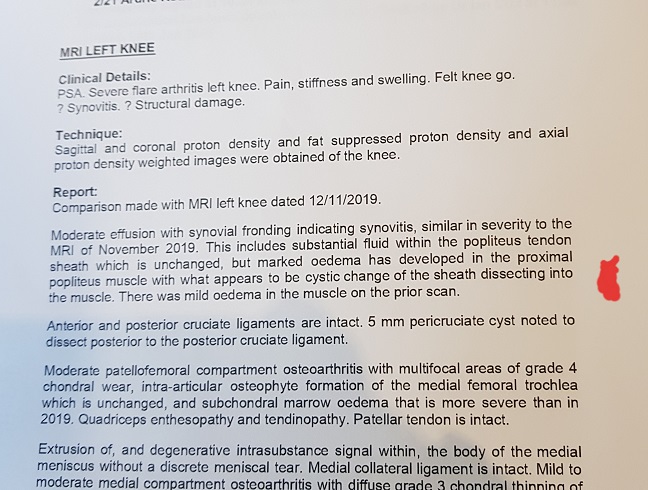
The MRI showed, amongst other things, a cyst dissecting my popliteus muscle. Not a Bakers Cyst, I must emphasise. This is different. The idea at that point was we could perhaps remove the cyst with keyhole surgery. This was good news, as I didn’t (and don’t) want to get kicked off the drug trial for the other arthritis! Minimal is best, I was thinking. Here is an extract of the report if you are medically minded.

So off to see a surgeon. Surgeon was not happy that my quads weren’t working, I couldn’t flex my toes and my left foot was just one big blob of pins and needles. He also quickly killed the keyhole surgery idea. I needed a total knee replacement. This was a shock, not really something I was planning on. Surgeon sends me off for another MRI, this time of my lumbar spine to ensure my muscle weakness wasn’t coming from my spine. I was wheeled down to the MRI department to make an appointment and they very kindly fitted me in on the spot. Wonderful.

Next day the surgeon rang me. They found a cyst on my spine too, so now I needed to have electrophysiology testing. Off to see a neurosurgeon. Now, dear reader, over the years I’ve had a lot of medical poking, prodding, needles, tests, monitors – but electrophysiology testing would have to be my least favourite. Interesting to be sure, but not so pleasant. You know that old saying, there’s a fine line between pleasure and pain? No, just no. Honestly, it isn’t terribly painful, but it certainly is not pleasant. The second part, where they stick needles in the muscles is not nearly as bad as the first part (but then again, needles never worry me). However, all good, the cyst in my back is not a concern, too small and not in the usually problematic location, not causing any issues. Mind you, he hadn’t seen a cyst in that spot before. Why was I not surprised?

I was still a bit stunned about the whole total knee replacement thing though. So I sought a second opinion. Same advice, total knee replacement required. This surgeon did explain the situation in a way I was better able to understand the problem. In his opinion, the inflammation from the osteoarthritis, with maybe some assistance from dear friend psoriatic arthritis, was causing the cyst. The cyst isn’t in a particularly good position to try removal safely and in his opinion unless we fixed the knee, even if they did remove the cyst, I’d just get more cysts. Great. Not.

Then I had to decide which surgeon to go with. In the meantime, what else was going on? We were, by that stage, in early March. Covid-19 was ramping up around the world. I decided to go with the second surgeon, Mr T, and surgery was duly booked for April 8. I needed a pre-operative health assessment by a physician, the knee components had to be ordered, then another pre-op with Mr T and a rehabilitation prep session with the hospital. All were booked, I was good to go. I had the pre-op health assessment and was sent off from that for a raft of tests (blood, ECG etc).

Then on Sunday, March 22 I got a call from Mr T (my pre-op with him was for the following day). Please don’t come in. Shortly thereafter, of course, all surgery was cancelled.

Consequently, I am now in limbo. A bung knee that has somewhat settled since the end of January hospitalisation, but only if I am careful. I’ve worked out I should do about 2,500 steps a day, in small time blocks, evenly spread throughout the day. Too much activity, knee swells. Too little, knee seizes. I can get around the house now without the walking stick, but for excursions to the supermarket I need the stick.

On top of that, I am self-isolating because I am on an immunosupressive medication.

When surgery will start up again is an unknown at this point: all depends on our containment/management of Covid-19. The surgeon will call as soon as they know. So I wait.

My next article will be about my clinical trial progress, which is going very well (although there is a twist to the story). It was a toss up whether to write about the knee or the clinical trial first!

Oh, and STAY HOME: Social Distancing is critical!

Incommunicado Quads and Walking Sticks

I know I’ve been incommunicado – unfortunately the quads in my right leg also went silent – so silent I couldn’t move my right leg. At 1 am on a Friday morning, not knowing what was wrong, I’ll admit to being a little panicked.

This was a few days after I’d had some very minor, completely unrelated surgery, so it was a bit of a busy time. My knee was already playing up then, as the hospital had helped me into a wheelchair from the taxi on arrival for admission.

Initially I thought I’d just been lying funny and my leg had “gone to sleep” and would recover in a few minutes. When it didn’t, I was a little more concerned. I couldn’t actually make it out of the bedroom – every time I tried, using the windowsill as a walking stick, then swapping to the bed frame – I’d get halfway across the end of the bed and feel SO nauseous I’d have to lie down again. Took me three or four attempts to actually get out of the bedroom. The doctor later told me this would have been due to pain, yet I do not recall any pain, I just could not use my leg. Well, yes, it was very painful if I put any weight on it, but I was studiously avoiding doing that – or so I thought!

To cut a very long story short, I dragged my poor daughter out of her bed, a 40 minute drive away, to take me to the emergency department. By 10 am I could lift my leg about 1.5 centimetres off the bed in ED. By noon I could bend it 90 degrees! Yay! I did not want to be admitted because the following week I was starting a clinical drug trial and intervention at this point might very well have excluded me. More on the drug trial in my next article – it is FANTASTIC.

So I was allowed home with a prescription of rest and elevation. The knee was rather swollen. Something else I didn’t need. It was the swelling in the knee that cut off my ability to use my quads. I should have known: earlier in the week I’d used an ice pack. I remember thinking “This ice pack isn’t very cold” then popping in on my left knee for a moment and thinking “This ice pack is FREEZING”. Clearly there was already a bigger problem brewing than just a sore knee.

My quads shutting down had nothing to do with my psoriatic arthritis. This was just a new problem arriving with very bad timing.

An MRI later and the results were in: “significant osteoarthritis, particularly behind the patella”. Oh, great – just what I need – not.

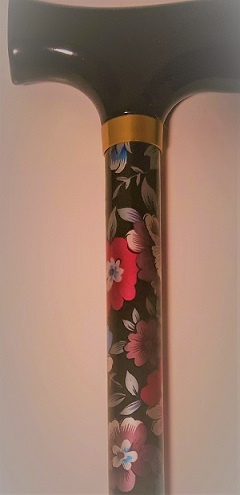
I got one of those awfully boring grey hospital sets of crutches so I could get around. Of course I thought I’d only need them for a day or two. Umm nah. I did manage to get down to one crutch, but I hated the grey, the cuff didn’t fit properly over my denim jacket and I was about to go to a conference in Sydney (more on that in a later article too). So I bought a very pretty walking stick (see above). If I had to use one, I was going to at least be semi-stylish!

Second problem was how to rehabilitate this knee. My rheumatologist advised (just as well, really) exercise to build my muscle strength back up. With the challenges I’ve had since January with medication changes and the resultant psoriatic arthritis flare, my exercise had taken a temporary back seat. It doesn’t take long to lose strength, especially as we age! I am reasonably sure this contributed to the osteoarthritis letting me know it was not at all happy with me. In order to make 110% sure I was doing the right thing, I enlisted the help of an exercise physiologist, Jack. Yes, I’m a personal trainer, but in this specific case I wanted to triple check my approach was correct. Jack has higher qualifications than I do and I do not hesitate to call in the big(ger) guns if necessary. He did get me to start a little slower than I might otherwise have done (a good thing), but by the second appointment he essentially let me loose. I did pick up some nice new very specific rehab exercises from him and am very grateful for his guidance and expertise.

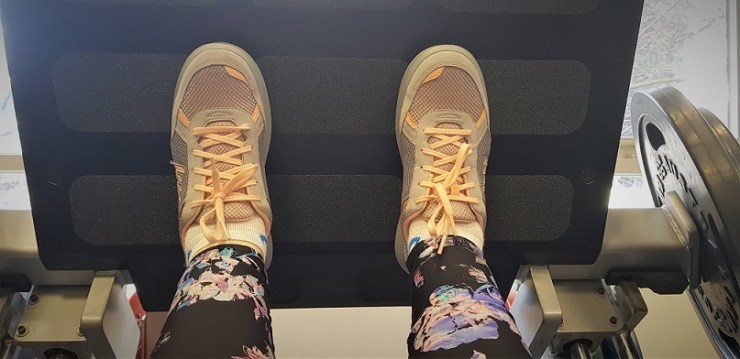
I retired my walking stick on August 29th after six weeks. Yesterday I was back on the leg press, high reps, low weights. VERY low weights. I did one set at 40 kgs and two sets at 60 kgs. I was doing 160 kgs last year! This picture won’t mean much to readers, but to me it was getting my mobility back!

I’ve also been doing hydrotherapy. I’m “allowed” to do as much hydrotherapy as I like. Jack was thrilled I was doing squats in the hydrotherapy pool, I was thrilled he was thrilled with my adaptation! I do them out of the pool as well, but in the pool is good, especially with this darn knee.

Back in 2014 I’d had a Synvisc shot in my left knee (which was great) but of course that strongly indicates that left knee is not all that wonderful. It also indicates (although I didn’t have an MRI of the right knee back then) that perhaps both knees were a little under the weather back then. I had an arthroscopy on this right knee many years ago and until now had no further issues. Well, now I know I have two knees requiring a little extra care and attention. With the extra load the left took while my right was on strike, by the time I retired the walking stick, my left knee was reminding me it is no longer a perfect 20 year-old knee. I threw my hands in the air and applied the rehab exercises to both knees.

I’m lucky – I have been able to retire the walking stick. Using one is like driving, it takes a long time before it becomes second nature. I felt I was on “L” plates the whole time. I’d drop it when trying to juggle bag, stick and anything else I happened to have – such as a morning coffee. Getting on and off trams was a challenge but at least I was no longer one of the invisibly ill and people jumped up to give me the special needs seats. I now had a badge. I never seemed to be able to lean it anywhere without it falling over – poor Cleo (my cat) nearly got whacked by the flying walking stick several times as it fell to the floor. I felt I just could not get it right. I also felt SO SLOW.

I have a new appreciation and understanding of those who use mobility aids permanently or semi-permanently. In the last week, I carried it with me, but used it less and less as my knee recovered – however then people look at you in very odd ways as you are carrying but not actually using a walking stick. I never thought of getting a folding walking stick – lesson learnt!

That particular situation is much better addressed by Kristen Waldbieser, who does not need her wheelchair 100% of the time.

Between minor surgery and the above, I hope you forgive me for being very quiet. I’m going to make up for that in the coming days. I have a drug trial and a conference to write about! Stay tuned!