I’m Not Lazy

Neither are YOU lazy. The title above is stolen, with permission, from a social media contact’s tweet.

We’re not lazy, nor are we responsible for other people’s expectations of what THEY think we should or shouldn’t be able to do. Sidenote: often those expectations are based on our appearance. Refer to You Look So Healthy! for more on that.

There are four other articles you may like to browse as background material to this article:

One of the challenges we face is helping people understand the whole energy availability thing many of us struggle with. In the conversation related to the above tweet, J told me she had mowed the lawns, done the edging, walked the dog and cooked dinner. J has the same disease I do, psoriatic arthritis (PsA). While I don’t know or understand the specific expressions of many other chronic conditions, this is one I do understand. J couldn’t see me, but if she could have, my eyes nearly popped out of their sockets.

Other conditions can be very similar, but I will stick with the disease I know for illustrative purposes today.

On a great note, for PsA management, J had certainly been moving. Movement is Medicine! However, J had probably used up more spoons or internal battery than she had available. All that in one day would cost her later, as she well knows from experience.

Society conditions us, well before we get sick, as we are growing up: doing our share, work ethic, earn our way. We then place expectations on ourselves. We don’t want to be sick, we don’t want to let others down by not doing our bit. In the first few years, of course, in the back of our minds we think it is temporary. To understand a bit more on that, you may like to read Will Society Adapt? When? How? Even we ourselves have to adapt to our new normal.

PsA is a very odd disease. At its worst for me, I can wake up in the morning with painful feet, ankles, knees, wrists, fingers; maybe even throw shoulders and neck in on a particularly bad day. I may have to use crutches to get around first thing in the morning. I’ll be unable to turn a tap on. Can’t lift the electric jug, struggle to open the coffee jar. Put on a bra? Are you kidding? Pull on tracksuit pants? Yeah, right. That sort of thing. About 11:30 am I’ll be fine. Virtually pain free. My body will have de-solidified. I’ll head out for a walk, go to the gym and do a weight training session. Sadly 160 kg leg presses aren’t happening any more, but maybe again one day…….. I am a completely different physical specimen at 4 pm than I am at 7 am. I saw my Plan B GP on Tuesday (Plan A was away), who hadn’t seen me for probably a year. She said “You look great!” This was 6:30 pm. I said to her, “You didn’t see me at 7 am!”

This can be VERY difficult for our friends, colleagues and family to understand. You need rest but you also need to go to the gym? That doesn’t make sense! Actually it does make sense and the reasons why are discussed in more detail in the above linked articles, so I won’t repeat myself.

We know, we can see it in their eyes. The doubt. The lack of comprehension of the situation.

We know people think we are just being lazy (at best) or hypochondriacs (at worst). J is right, it is VERY exhausting to be constantly explaining it to people, yet we know if we don’t explain it, if we don’t share the knowledge, social understanding and acceptance will never happen. We use analogies: spoons, internal batteries, even daisy petals. Over time our nearest and dearest do start to understand. If they want to.

If we live by the rules of pacing our activities and energy consumption, many of us can achieve a fantastic very nice quality of life, given our disease. The problem is, to OTHER people our rules can make us look lazy in their eyes – or at least that is how we can feel.

I work six hours a day. I have just entered my eighth year of having PsA, so I’ve had time and practice to build my personal pacing skills. Even so, I still feel guilty some days that I’m not “doing my fair share” at work. I have to lecture myself along the lines of this is what I MUST do or I won’t be able to work at all. I did try full-time for a while in 2019/2020 – it was WAY too much. Recently, we had a systems issue at work. That day I worked ten hours – I was petrified I was going to crash before we solved the problem. Thankfully, I didn’t, but those feelings and fears are what we live with every day. We don’t need to feel others are judging us because we MUST do less than they do in order to regain and retain quality of life and independence.

No, we do not have to vacuum the whole house in one day. A room a day would do!

No, we do not have to mow the whole lawn in one day. J, are you listening?

Spreading out those sort of tasks DOES NOT mean we are lazy. It means we are protecting our bodies, our internal battery and our quality of life.

Today I was going to go grocery shopping. But today is also weight training day. The grocery shopping can wait until tomorrow. Both on the same day would mean I wouldn’t be able to do what I have planned for tomorrow. Grocery shopping will fit with my plans for tomorrow as the overall intensity tomorrow is less.

We are not lazy. I am not lazy. Don’t let yourself be guilted into doing things that break your pacing rules, whatever they may be for you. The goal is to balance activity and energy so you achieve consistency in your state of health.
Will Society Adapt? When? How?

Just over 2 years ago, October 2019, I wrote Society and Chronic Health Conditions. In that article I proposed that as a species we understand three states of health: terminal, curable and healthy. I suggested we are not yet accepting the new, fourth state: chronic illness.

In talking about this situation with a friend recently, I realised my generation is effectively the first generation of this new health state. No wonder we are struggling as a species to adapt. It is all so new. Historically most of us would have died or been cured: there was very little “in-between”. Now we have that in-between, but the powers that be don’t like it. Because that in-between costs money. It doesn’t fit the capitalist dynamic. We are not the only generation: my children are now in their forties and many conditions are not age specific. We are just the first of any number due to scientific advances.

There are many factors at play here. More advanced science. Longer life expectancy. Horrifically rapid population growth (see graph further down) over the last century. Now we are being told by certain theorists we need to increase the birth rate to support society, while that will further degrade our environment. It will also increase the number of people requiring some form of assistance and support. I’m not looking at environmental impacts in this article, but it is something that impacts all of us because chemicals and damage to the environment may well be contributing to health issues in a broader sense. There are many reference and source links (underlined or blue, depending on your device) in this article, so be warned! (Edited 23/01/2022 Since writing this I have looked at environmental impacts in Underlying Conditions)

Science and medicine have advanced in leaps and bounds in the last 100 years particularly. People who would have died 100, 200, 300 or more years ago now can be saved by medical or surgical intervention. We may live the remainder of our lives physically disabled (for example in a wheelchair after a car accident) or we may live with a chronic condition (or conditions) as I do, those conditions held in check or managed by modern medications.

Not only has medicine and surgery advanced, it has improved. Let’s look at knee replacement (because I’ve had one two of them, so have patient experience). The first Total Knee Replacement was performed as recently as 1968, believe it or not. However, a German surgeon began the journey when he implanted primitive hinge joints made of ivory in 1860. My knees are titanium, a far cry from ivory. (Updated to recognise my second knee replacement)

Medications have been developed and are continuously advancing. Biologics have seen expansive growth since human recombinant insulin was approved in 1982.

As a result of these innovations, developments and advancements the reality is we NOW have more and more people living life with permanent (chronic) health complications than ever before in human history. I’m not terminal: neither am I curable. Thousands of people are in the same situation and the number, the percentage of the population, is growing. in 2017-18, 47% of Australians had one or more of only 10 selected chronic conditions.

Generally incurable and ongoing, chronic diseases affect approximately 133 million Americans, representing more than 40% of the total population of this country. By 2020, that number is projected to grow to an estimated 157 million, with 81 million having multiple conditions.

Source: About Chronic Diseases

The reality is we often reach the point of needing some form of support to live at some stage of our life. In Australia there has been much discussion of late about the Disability Support Pension (DSP) and the National Disability Insurance Scheme (NDIS). People are being rejected or having their support budgets reduced/cut.

The government complains it is just too expensive to provide the supports and pensions. I could suggest if there was less pork barrelling going on there would be more money available, but I digress.

https://ourworldindata.org/world-population-growth

The population of the world has grown from 1.65 billion in 1900 to 7.7 billion in 2019. More than 40% in at least two countries have chronic health conditions – I haven’t been able to source a global figure, but suggest it would be similar.

So what did humans think was going to happen? That the disabled and chronically ill could live on air and water? Many of us are like me, still working, paying our own way, essentially looking after ourselves – for the moment. Even for us, our conditions are often degenerative and progressive: our self-sufficiency may have a time limit. Or the conditions can be decidedly unpredictable: good one day, unable to function the next. Not only that, some of our treatments are not cheap. Government’s choice, society’s choice, is either fund the expensive treatments that keep us as healthy as possible, or look after us when we deteriorate on cheaper but less effective medications.

Or adopt the American style health system where only the rich can afford the good treatments.

‘Profit over death’: millions of American diabetics struggle to afford insulin

https://www.theguardian.com/society/2020/oct/30/americans-diabetes-insulin-cost

I’ll never forget the case of the the 51 year-old who won the lottery so could finally afford to go to the doctor. He died.

Among his other priorities, Savastano, who couldn’t afford life insurance before the winnings and hadn’t been feeling well, wanted to visit a doctor, the station reported.

https://abcnews.go.com/US/weeks-winning-million-lottery-man-dies-cancer/story?id=52765754

Even here in Australia where we have the Pharmaceutical Benefits Scheme whereby the government subsidises expensive medications like biologics, we limit who can have access by stringent qualification criteria. While jumping through the hoops required to qualify, the patient may deteriorate badly. An argument can be made that this policy is false economy as the costs of care over time may well outweigh the costs of treatment with better medications. The rich can afford private prescriptions.

As a species we could decide we don’t want to have this new health state of chronic and tell medical science to stop researching, developing and advancing because we just can’t afford the result.

We could accept that only the rich can afford treatments.

We can hope ultimately we will develop cures for these pesky conditions, but what do we do in the meantime?

Or we can adapt as a species. We can accept this fourth health state, chronic, as NORMAL. As normal as the existing states of less-than-healthy of terminal and curable that we have lived with for as long as we have existed as a species. We can find ways to support our people. Accept our new normal.

We’ve made advances with accessibility: ramps for wheelchairs, sounds on pedestrian crossings for the blind, special seats available on public transport. We haven’t really advanced re financial support. I’m not going to quote current federal ministers’ statements on the DSP and NDIS – most of us know their perspective.

The 65-year-old was told last year that her cancer had spread and she had two years to live. “You can imagine the shock,” she says. “Even now, I feel quite well, but the minute I’m physically doing a lot, you can feel the tiredness coming to your body. It’s nothing to do with, ‘I can’t be bothered.’ It’s just your body. You just feel weary. “I said to my son, ‘How could I be expected to do a full-time job? There’s no way.’” Yet it was only with this diagnosis that Penfold’s hospital social worker felt she had a genuine chance of accessing the disability support pension, the primary welfare payment for those unable to work.

https://www.theguardian.com/australia-news/2021/oct/10/disability-pension-rules-leave-thousands-with-cancer-on-44-a-day

Governments tell the voters we are “a burden”. The government fear the ever increasing numbers. While I have every confidence science will in time develop many cures, that’s not the situation at this time. Society needs to adapt. One way or the other, we patients need to know where we stand, we need clarity.

I joke that I work to pay my doctors to keep me well enough to work to pay my doctors. Many of us are in the same boat. The fear that one morning we will wake up and our treatment will have stopped working (it happens) or the condition/(s) have suddenly progressed to the point where the pain is too much to work is very real. Where will we live? In 2019, there were 148,500 households on the waiting list for public housing, down from 154,600 in 2014. That’s households, so way more people. I have heard it is now 155,000 households. Yet if we can’t work, we can’t pay private rent, let alone pay for our medications and the other costs of managing chronic conditions. We don’t own our own home? Well, that was very badly planned by us, wasn’t it – back to us being a burden. Even if we do own our own home, we may not be able to manage it. What if we are in our twenties, no time yet to build a nest egg or have bought a home?

Look at the population numbers again. Not everyone in the world can be a millionaire or billionaire. Oh, we want workers and customers and taxpayers and plenty of them – we just don’t want to have to care for any of them if they aren’t terminal or curable.

For example, although I work, I can’t change my bed linen or clean my shower recess. I have My Aged Care (which I pay for). No NDIS? Well, no, you see, because like many of us, I failed the test of my condition being stabilised or completely treated. I will be dead before I could realistically exhaust all the available possible treatments. My condition is notoriously unstable. I am not alone! I’m merely using myself as an example because I have intimate knowledge of the details of my own case.

As if all this wasn’t enough, we are excluded from Voluntary Assisted Dying (VAD) legislation (because we are never terminal) and now we have the organisations like the ACL fighting VAD:

The current conservative government in Australia needs to go to the polls openly with the policy they really seem to want: to essentially minimise or remove both the DSP and NDIS. Would they actually prefer the ever increasing number of chronically ill people in the population just be put down? Like dogs or cats or horses. Of course, that conflicts with their aversion to VAD. They can’t have it both ways. What is their plan? Do they have policies? I doubt it.

As I have stated before, I don’t like the term “chronically ill” because of the inference of the word “ill”.

I am not ill in the sense I am not able to live a relatively normal life. I’m not confined to bed, I’m not in hospital, I’m not on a drip: I’m still driving, swimming, working. I have chronic conditions I must MANAGE, I can never stop managing those conditions, but I am not ILL in the sense of the common usage of the word. I stress the difference between common use and medical use of the word ill.

https://limberation.com/2019/10/26/society-and-chronic-health-conditions/

As a species, as a society, humans MUST determine a humane solution to this problem. As I wrote at the top of this article, there are many factors involved here: environment, population growth, advanced science, advanced medicine and of course the greatest god of all, The Economy.

While I am not suggesting society can afford to provide 24 hour home care for every chronically unwell person, I am saying we need innovation here. There may be solutions no-one has thought of yet. While my generation is the first in any great number, there are the generations after us. This social conundrum is NOT going to disappear. It is going to get worse before it gets better.

Society needs to adapt. Don’t throw us away, for we are your lab rats in this period of history. Future generations will benefit as science develops and perfects treatments and hopefully cures.

Foot Surgery

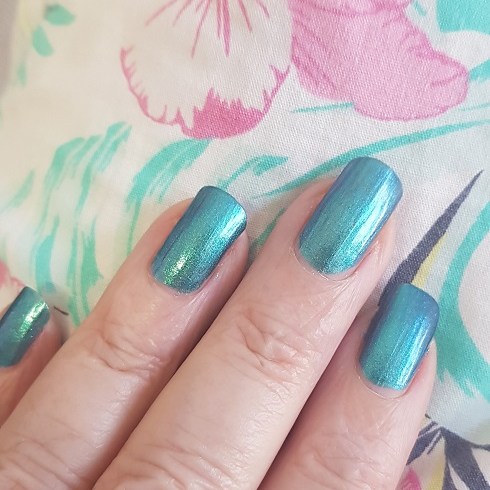
As if a replacement knee wasn’t enough, I had to have foot surgery a year later. Graphic images warning: if you dislike scars and stitches, proceed with caution. Note: the painted toes above are BEFORE surgery – thought a scary pic was not a good opening pic!

There was a bit of a story to it: innocent little me asked the knee surgeon to remove a couple of annoying ganglion cysts on top of the bunions while he had me under for the knee. Seemed logical to me, I was going to be asleep, he’d have a scalpel or two lying around!

He was horrified. Knee guys, I discovered, do not touch feet – at least not at the same time as fiddling with knees. Infection control. Fair enough, keeps me safe! So off I went to see a foot guy.

Engineering comes into play here. The surgeons prefer to go down the leg – so hips, then knees and lastly feet. But yes, my feet needed some surgical intervention. Foot refurbishment was his jocular phrase to my physician. I liked the term, but I’m assured it isn’t actually a medical term.

The plan, therefore, was to wait until I’d had the second knee done. However, the second knee recovered relatively well from the strain of the extra load during recovery from the first knee surgery, while the big toes were not so happy. The ganglion cysts had faded, but would most likely come back if the feet weren’t refurbished. So the decision was made to fix the feet before the second knee (which might last for a couple of years if I’m lucky). At this point I was just having the bunions (on big toes) and bunionettes (on little toes) corrected (which would remove the driver for the ganglion cysts). Unfortunately, I needed to change surgeons prior to the surgery and the new surgeon had a whole different plan of attack.

First step was an MRI of my left foot to confirm his suspicions. Yes, my big toes needed a “fusion of hallux” (fusion of the 1st MTP joint) and there was a cyst drilling a hole in my metatarsal bone. Oh. That needed a bone graft. OH.

It seems that just like my knee, where there had been a cyst dissecting my popliteus muscle, here was another cyst only this time it was attacking my bone. The osteoarthritis and the psoriatic arthritis had found another place in my body to have a party, it seems. Together, they are more destructive than alone, I am learning.

He also wants to replace my ankles, but that is a story for another day. One step at a time!

Preparation was very similar to the knee replacement preparation, so I won’t go through it all again. Had the same physician, Dr M, who is a darling. ECG, bloods, etc etc.

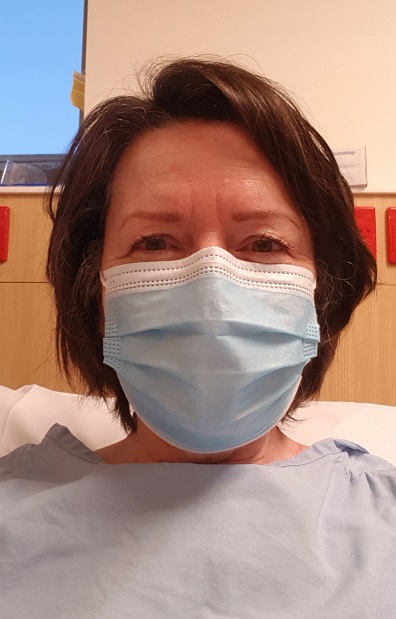
So on May 6, 2021 I arrive at the hospital at 6 am.

Waiting for the action

Just for later comparison, here are my toes before surgery – as you can see there is no gap between my big toe and the second toe. But this is not nearly as misaligned as some photos I have seen.

Before the action

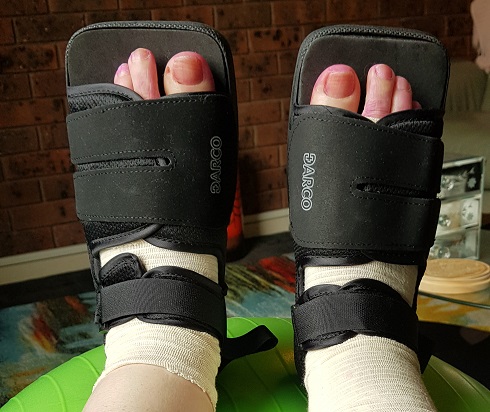
What I woke up to was this view of my feet! The pink stuff is the antiseptic wash they use in theatre and my feet are elevated. For the first two weeks, the feet are elevated 23 hours a day. ONE hour a day “feet down” is permitted for toilet privileges. Shower with the feet bagged. So the pink stuff stays, really. All weight is through the heels when walking, no rolling of the foot at all. No toeing off! No driving. There is never any driving.

After the action – duck feet as protection

This is what I now have in my big toes. There was discussion about these prior to my going into theatre. I wanted to know if they are actually this pretty blue colour. While the surgeon looked at me as if I was from outer space, the surgical Fellow assured me yes, they are. It is an important detail. I refer to these as my toe jewellery. The bone graft to fill the hole drilled by the cyst was synthetic bone – yes, I asked that question too.

Apparently, I also have screws in my little toes now, I only found that out at my six week post-op review.

Of course I had nail polish and lippy on as soon as I was allowed – it was a whole THREE days before I was allowed nail polish! Naturally it matches my PJs – well, that pair, anyway.

The anaesthetist, the physician and the surgeon had all warned me that post operative pain management can be difficult with feet, so I had mentally prepared myself. Although I was sure foot surgery would not cause the glute spasms that the knee surgery had caused, I still watched the clock until the 10 hour mark (that was when the spasms kicked in after the knee surgery) had safely passed. Despite the warnings, which were much appreciated, I was one of the lucky ones. I had a virtually pain-free recovery. I cannot express how grateful I am for the excellent care, although I do understand there may have been some luck involved. The nurses would come around to do obs and ask the “On a scale of 0 to 10, how is your pain” question and I would say zero. Admittedly, the pain medications were kept on schedule, but really, it was a pain-free journey.

The hardest part was no movement. I hated it with a vengeance. I am told the ankle surgery is longer, so I am not in a rush. Psychologically it is really, really difficult for me to do nothing physical: no walking, no swimming, no weights.

I didn’t hire the cushion from the surgeon for elevating my feet in bed at home. My daughter and I elevated the foot of my mattress to achieve the same effect.

At two weeks the stitches came out, steri strips went on and I was FINALLY allowed to get my feet wet!!! This was a wonderful day! I was shocked at how dry my skin was after two weeks of being untouched. I also suspect the antiseptic wash had quite a drying effect. This dryness resolved very quickly, thanks to QV Cream and being able to finally shower (but definitely NOT soak) my feet. I also was given smaller duck feet. The nurse taking the stitches out was quite horrified at the size of the duck feet I had been put in after surgery. Now I could see my toes!

These smaller duck feet were also easier to walk in. The next four weeks were pretty much the same. I started working again, from home, and kept my feet as elevated as I could under the desk. For that my daughter set up an aerobic step platform on two reams of paper. Necessity is the mother of invention. It worked. Swiss balls are excellent for elevating when sitting in a lounge chair.

At six weeks I went back to see the surgeon for the post-op all clear to walk and drive and live a normal life again. He was pretty pleased with my progress, as was I. I had started 500 metre walks on the Saturday prior, so I had cribbed a couple of days. It was my birthday, I could not stand being cooped up on my birthday! All was well. The shot below was taken exactly a month after surgery. Now, nearly three months after surgery, that gap between the toes still stuns me – compare with the top photo with no gap. It is not this dramatic when standing on my feet!

In hospital, during one of the frequent checks, a nurse asked me if I could spread my toes. I looked at her stunned. I didn’t know anyone could spread their toes like we can spread our fingers. Apparently being able to do so is good for our feet and our balance. I also discovered I am not the only one that cannot spread my toes. I can wiggle, I can bend: but no spreading.

I have had to buy a couple of new pairs of runners as my usual runners were just a little snug when I was first allowed out of the duck feet. I also developed blisters on the lateral wounds (little toes). Nurse said that is not unusual as the skin becomes very calloused where there are bunionettes. The blisters weren’t really an issue though, just applied Betadine for a few days.

The right foot little toe took a little longer to feel 100% than the left foot, but we can’t expect mirror image healing.

Now there is hardly even a scar to be seen, I’ve healed very well.

I had a great recovery. I will end this with this caveat: not all patients will necessarily be as fortunate as I was, there may be some post-operative pain. Even so, the medical profession are constantly improving pain management. Discuss it with your surgeon.

Flaring

For the uninitiated, flares are what we chronic condition people call the times our condition (or conditions) decides to remind us it exists, usually in no uncertain terms.

Barb, who, like me, is a complex comorbid patient including psoriatic arthritis, sums up flares succinctly!

The unjoys! The phrase “Oh the joys!” is in common usage, the implication being something is not actually so joyful. But I love this new word. For me, it hits a home run.

I had one yesterday. While the experience is fresh in my mind, I’m writing about it. We tend to get used to them, they become just part of our new way of life, while healthy people can find the flares of others confronting.

If you are friend, family or colleague of a chronic condition person, or you are new to this chronic world, hopefully I provide some insight to “what happens”. Everyone is different, what I describe is specific to me, my conditions and my current circumstances, but should give readers a feel for flares generally. Flares can be long or short: once my right wrist flared for about eight hours, then was fine. No rhyme nor reason.

Yesterday’s flare was different. For a start, it was whole body, not just one joint.

I now realise it started on Wednesday. I was driving to the office and my upper arms were sore when dressing and driving. Sore upper arms usually means shoulder inflammation. Nothing too bad, but I did take panadol osteo to see me through the day. Driving home from the office that night I felt nauseous and sleepy and nearly drove through a red light. Not good.

Thursday was a little worse, more areas were sore. I was WFH that day, so I managed. Even my total knee replacement scar felt tight, stretched and tingly. This was a new thing. The joints at the base of my thumbs were sore. My right (unoperated) knee was painful. My right hip was grumpy. You don’t need the whole list!

I woke up Friday morning in a full flare. Not only did I have many sore bits, I had no energy. I had to work, because…. deadlines. At least I was working from home though. No meetings scheduled. I certainly would not have gone into the office, but I felt I could manage the most important tasks in solitude at home. I resorted to panadol osteo and a stronger pain med to get me through the day – I hoped.

Yesterday is the first time ever I have worked in my dressing gown. I am the sort that puts on the lippy and mascara every day, working from home or not. For me to not even get out of my dressing gown is an indication of how crap I was feeling. Healthy people reading this may be horrified at this admission – chronic people will be nodding their heads and thinking, “Oh, yes, know that feeling well.” I did 1,172 steps for the day, between my office and my kitchen mostly.

It is very hard to explain how awful it actually feels. I liken it to possibly feeling as if you have run a marathon – at least that is how I envisage a marathon runner may feel at the finish line. It is only the start of the day, but you feel done already. Like, literally, DONE! That’s before any pain is taken into account. Or maybe the old “run over by a truck” phrase is applicable.

I did manage to get through the work day, almost – I finished slightly early. I doubt my productivity was any way close to normal, but I got some important deadlines met. I will probably work a few hours this weekend to catch up on other tasks. If at all possible DO NOT DO THIS! If you are flaring, REST. I’m setting a bad example here, I know that – but my example also underlines the fact sometimes we are caught between the devil and the deep blue sea.

After I finished work I sat in an armchair and my lumber spine decided to be excruciating. It had, I’ll admit, been building as the day wore on, now it was awful. No idea why – my lumbar spine hasn’t been a problem since 2017 (except for changing the bed linen, that irritates it). Pain medication was required, most definitely. Then, I got stomach pains. My eyes were dry and irritable. Like, what next?

This morning I woke up feeling absolutely fine! Made myself a lovely cinnamon rolled oats and pink lady apple breakfast, have been for a 1.6 kilometre walk, had a coffee at my local café. After lunch I went to the gym for a strength training session. The only slightly sore bits are the joint at the base of my right little finger and only if I hyperextend it, plus my soon-to-be-operated on toes are a bit off (but that’s understandable). I have energy, I feel perfectly fine.

The flare is over, just like that. Gone.

What causes flares when we are on a stable medication that is working and we are doing all the right things (eating properly and sleeping, hydrating, exercise)?

I will never forget my rheumatologist saying to me in late 2014, “Get the stress out of your life.” Great advice, but easier said than done. While the evidence is pretty conclusive that stress exacerbates many conditions and causes flares, we still have to live life! Earn money to pay the bills.

If I stand back and look at what has been happening in my life during the last few weeks there are several factors that alone may not be a problem, but the culmination of the stress of each has resulted in this flare. If you are flaring more than usual, take a look at everything that is going on in your life in the time period preceding the flare. In my case, right at the moment:

  • Pending surgery, with a late change of surgeon
  • Late change of the actual surgery procedure (extra stuff)
  • Teaching a relief staff member to do my role while still doing my role
  • Usual work deadlines
  • Fitting extra pre-op tests into my schedule
  • Mountain of pre-op paperwork
  • Lack of exercise due to work hours and therefore internal battery depletion
  • 42 minute phone call to Medicare – even things like that add to the stress load
  • I’d let my dietary protein drop while distracted with the above concerns

There is stress related to each of the above. Any one item alone is probably not an issue: add them all up and the body goes “What are you doing to me????”

Realistically we can’t avoid these life stressors. We can’t necessarily spread them out over time to minimise the impact on us, sometimes they just all come together. I haven’t really flared for years. You might ask what about the knee surgery, did I flare then? No, but the list was smaller then. No late change of surgeon, no late change of proposed procedure, I wasn’t working at the time so no work-related pressures. I was getting exercise. Sure, I was unemployed and THAT alone is hugely stressful, but I was able to mentally put that on the top shelf out of sight while I concentrated on the knee. I knew the knee rectification was important in order to be able to get a job – I prioritised.

There is no way I could have avoided the culmination of the above stressors, it is just the way life has played out over the last week. I saw the new surgeon on Thursday, had to digest his unexpected news about what needed to be done, fit in an MRI on the Saturday, phone consult and decision on Tuesday, flare started Wednesday, Friday full conflagration.

Surprised I feel so fantastic today after feeling SO bad yesterday. It really is like getting into a brand new car: today I am driving a brand new car! Yet that is what flares can be like and why it can be hard for healthy people to understand or, worst still, easy for assumptions to be made about “it is all in your mind”. No, it isn’t: it is what happens physically.

If you are friend, family or colleague of a chronic person, including healthy looking chronic people, please be compassionate. Be supportive. We don’t like these flares, we don’t have them to inconvenience others!

If you are a chronic condition person, please share any advice or your experiences in the comments.

We Need Personalised Numbers!

2,000 calories. 10,000 steps. These numbers float around and almost become related: subconsciously there can be a belief that if we do 10,000 steps a day we’ll be fine eating 2,000 calories a day! Will we?

2,000 calories a day is as much a myth as is the 10,000 steps a day. While there is always the caveat that the 2,000 is an average recommendation for the average person, etc etc, it is the 2,000 number that sticks in people’s minds.

Based on these rather wide, and self-reported, ranges, some pretty loose rounding happened, and the number 2,000 was settled on for a standard. In other words, not only was the calorie standard not derived based on prevalent scientific equations that estimate energy needs based on age, height, weight and physical activity levels, but the levels were not even validated to ensure that the self-reported ranges were actually accurate.

US News
From Samsung Health app

The 10,000 steps originally came from a marketing campaign.

The magic number “10,000” dates back to a marketing campaign conducted shortly before the start of the 1964 Tokyo Olympic Games. A company began selling a pedometer called the Manpo-kei: “man” meaning 10,000, “po” meaning steps and “kei” meaning meter. It was hugely successful and the number seems to have stuck.

BBC .
Garmin Connect app

Readers who know me on social media know I am very big on getting my movement every day. This website originated from my personal dedication to Movement IS Medicine. So am I against pedometers? Not at all, I highly recommend pedometers. Just forget about the 10,000 steps a day.

Let’s look at each of these aspects of our lives separately. First, the calorie conundrum.

2,000 Calories?

My favourite illustration is the car fuel tank versus the human body. My car’s fuel tank capacity is 60 litres. No matter how hard I try, I can’t put more than 60 litres of petrol in that tank. My body? Ohhhh, I can consume as much fuel as I like. I would just keep expanding to store it all!

I have several factors at play:

  • I’m over 65 – age reduces our basal metabolic rate
  • I’m short
  • I have a chronic condition which limits my fuel burn
  • I’m on medications – medications can affect metabolism.

It would take me an hour of weight lifting in the gym on top of my three walks a day and 7,500 total steps to burn slightly over 2,000 calories a day. My usual burn would be 1,800 on a good activity day. On that basis, if I consumed 2,000 calories a day I’d be storing 200 calories a day. A rule of thumb is one kilogram of fat on the body is 7,000 calories, so I’ll let you do the maths on that. Yes, I lift weights and I walk, but not at the intensity required to be building too much lean muscle with that extra 200 calories a day!

In the image above from my Samsung Health app 1,352 calories a day is recommended for me given my age, weight, height and gender. It doesn’t know about my medical conditions or my medications – if it did, it might recommend less! That is 648 calories less that the 2,000 number that gets thrown around with abandon.

My nutritionist recommended 1,400 a day for me, just for comparison.

Everyone is different and we need to tailor our intake for our particular circumstances and output (burn). We also need to be very careful about what we eat as we have less calories to “fit in” the needed nutrients. For example, I aim for 1.5 grams of protein per kilo of body weight per day. The extra protein chews into my calorie allowance.

Those of us with chronic conditions that have a boom/bust aspect do not have the luxury of “burning it off tomorrow” either. We can’t “do extra” or we end up with a flat battery. It is all interwoven.

10,000 Steps?

I aim for 7,500 personally, at this time. A pedometer is a good way of measuring how much we are moving. It is not the number itself that is critical, it is the consistency. Not moving leads to de-conditioning which is not what we want as it has negative impacts on our bodies.

de-conditioning

A pedometer is also useful when it comes to calculating our pacing up. It is an indication of what we have done and therefore helps us calculate what our 10% increase target is. It doesn’t matter if the number is 2,000, 3,000 or 8,000. It is the relatively and consistency that matters.

I talk about steps as part of my movement regime because it is what I and many other people use. There are, of course, also many chronic condition patients who use other movement modalities. The underlying premise remains the same.

Tracking and Recording

I track and record because let’s face it, even healthy people forget they had a muffin at morning tea. Add cognitive impairment on top of that and it is easy to forget what we ate during the day. I’d be hopeless if I didn’t keep track. With only 1,400 calories to play with, I need to make sure I don’t accidentally eat 2,000!

The same with activity/movement. It is easy to think we moved more than we have and over time we find we’ve paced down unintentionally instead of UP. Our pain levels may increase as a result of less movement and more weight. Not what we want at all.

Personalised numbers are needed. Know our BMR, know our limits, work out our personal parameters and targets based on our individual circumstances and bodies: age, gender, height, weight, medications, conditions.

Personal Energy Use

Early in my chronic illness life, I wrote an introductory article, Pacing for Beginners. More recently, I wrote about Pacing THRU, Pacing UP, Pacing DOWN.

Pacing, balancing my life, has become even more critical since starting a full-time job. The earlier articles talk about the spoon theory and the battery analogy. Today I’m going to stick with the battery analogy as we all understand what happens when our mobile phone battery dies. That’s it. The screen is dead. You can’t make a call. The only option you have is to recharge the battery.

I find energy difficult to write about. I can’t quantify it like I can quantify calories or steps or weights. Energy seems elusive, hard to pin down. Even though I am using the battery analogy, I don’t have a charge meter on my arm. I can’t tell how much battery I have left at any given point in time. So if it seems like I’m pondering as I write, it is because I am pondering as I write.

Many of us with chronic conditions are a bit like a mobile phone. The battery has a limited capacity. I’ve written about fatigue/lethargy before too, in When was the Last Time You Yawned? Working full-time hours again, I have had to revisit my condition management plan to ensure I avoid the dreaded Boom/Bust Cycle. So far, I’ve managed, although my weight training has taken a bit of a back step, sadly.

The difference between me and my phone is if my phone goes flat, I can plug it into power, turn it on and make a call. If my battery goes flat, that is it. Coffee is not going to help. A sugar hit is not going to help. In fact, either might make the situation worse. Imagine if that phone battery could actually go negative and had to be charged back up to zero before use, even when connected to power. THAT is how we can be (not how we can feel, how we can BE) if we are not careful, if we break the rules.

While I was working part-time, I had everything worked out beautifully for me. I got the exercise I needed, the sleep I needed, I did my job well. I never let myself get a flat battery.

While I was not working in the early part of 2020 my plan was to pace up my exercise to build physical resilience in readiness for a new job. With the success of my new treatment, I could do this. There were some interruptions! A knee put me in hospital, then Covid-19 lockdowns followed by a total knee replacement meant things were a bit stop-start, but I was way ahead of where I had been at, say, the end of 2016.

Working full-time has changed how I can arrange my time and also shone a light on the fact the boom/bust cycle is still very much a risk. There have been times at the end of the work day where I quite simply feel my brain shut down. It goes from 90 miles an hour to a dead stop. Nothing I can do about it. The battery is dead. It isn’t just about physical activity, this battery also runs our brain.

It is challenging for people who have no prior experience of these sorts of conditions to understand what happens. After all, many of us, myself included, LOOK fine! It took my daughter some time to come to grips with it, but she now asks “Do you have enough spoons, Mum?” when suggesting something.

I’ve become better at declining social invitations – no, not on an evening before a work day, or no, not two events on one day.

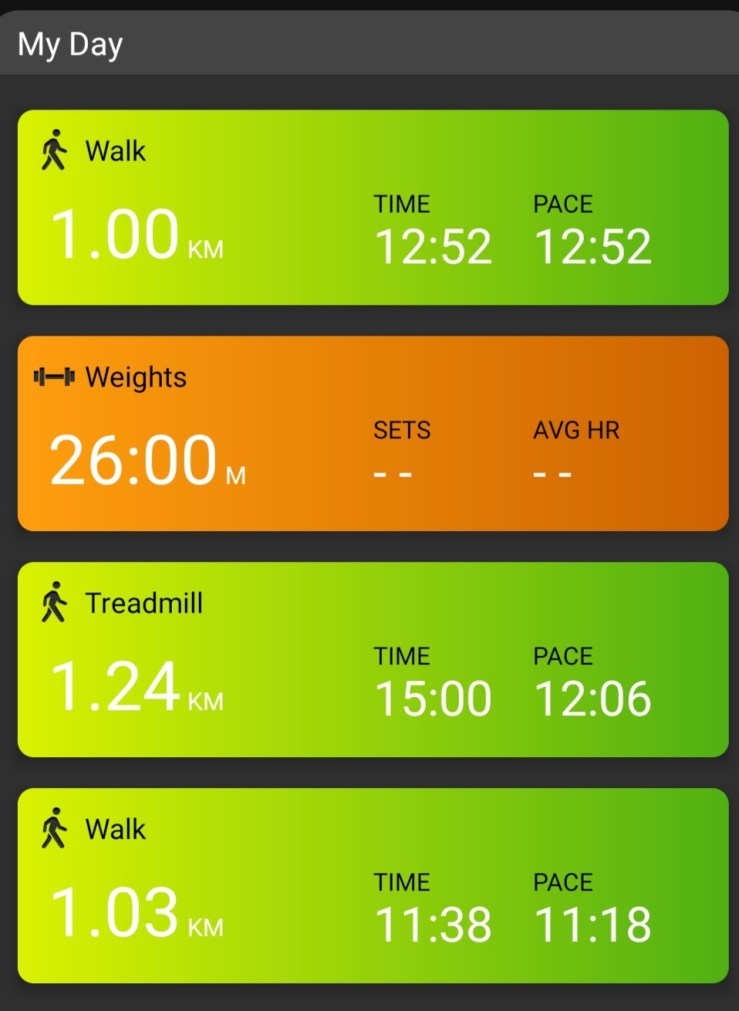
Every activity we do uses battery power. Showering, drying our hair, driving, working, exercising, cooking. In my experience some things use more battery power depending on the time of day: driving is a classic example. Driving for one hour in the morning is not nearly as tiring as driving for one hour in the evening after a day at work. It is almost as if once the battery gets low, it depletes faster. We have to be aware of all these things. I don’t want to cause a fatal car accident because I lose concentration because I haven’t paid heed to my battery level. Look at the pace column of my walks in the image above. the first walk of the day is the fastest, the last is the slowest. This is a constant pattern.

Early in my journey, I would have been unable to do a weight training session and grocery shopping on the same day. That would have used way too much of my battery. Even now, I shower in the evenings. Why? Because I can do it at a slower pace in the evenings and I am not using up vital battery life I need for the work day.

A good night’s sleep should recharge us, you say? We wish that were true. In many cases it is true – unless we have drained too much – then we end up in that negative charge scenario. Not good. However, disrupted sleep is often a symptom experienced by those with chronic conditions. Imagine trying to charge your flat phone, but the charger plug keeps falling out of the phone overnight. In the morning your phone battery is still at only 50%. That can be us.

Strength can fluctuate as well. I happily did 32 kilogram chest press sets one day with every intention of increasing next visit. Next visit I struggled with 25 kilograms. Why? No idea. By no idea, I mean no rational “healthy” explanation. Just that day my body said, “No, not today”.

Endurance is linked to our battery too. Some days I can walk two kilometres easily in one walk – other days I have to stick to three separate one kilometre walks. I’ll feel exactly the same at the start of any walk – then sometimes the body just says, “No, not today”. Part of this is linked to my not having the time available at the moment to consistently Pace UP. Between work and weather I have been limited to grabbing my walks in a somewhat patchy manner which breaks all the rules of pacing. Consistency is key. I’m not getting consistency. I suspect similar applies to the weights.

It is very hard to explain to people what this whole energy thing is like. How we constantly have to be aware of how much battery we’ve used. Healthy people would not, for example, think of having a shower as using energy, or should I say using any great amount of energy. I can assure you, many of the chronic illness community will attest to having to rest after a shower.

In my last article I raved, quite rightly, about the medication I am on. I also stated it hadn’t completely solved the energy/lethargy/fatigue aspect, or the “brain fog”. Despite my writing about energy today, these aspects are still much improved from where I was three years ago. To give some sense of measurement, three years ago I was working 24 hours a week and Saturday morning would always be a recovery morning – I’d do nothing until at least noon. Now I am working 38 or more hours a week and I’m actively doing something by 10 am on Saturdays. I might be at the gym, grocery shopping, doing laundry: I’m active. So a major improvement. And some quantification, which makes me happy!

However, I’ve had to cut my second weight session a week because the energy required to drive to the gym, do weights, drive back and then shower is more than I can manage at the end of a work day. I rarely write any more because usually by the end of the work day my brain has said, “No, not today”. I started this article on December 31, it is now January 16 and I still feel this is very scrappy writing. On the other hand it is a very scrappy topic: as I said I can’t quantify it very well. My thoughts about it come and go: after all, we learn, over time, to live with it. It becomes our new normal. At the same time we recognise that our healthy friends, family and co-workers can be baffled by something they have no experience of and it is not visible.

When I wake up in the morning, assuming I haven’t overdone it the day before, I feel perfectly “normal” just as I did before I became a chronic condition patient. The main difference is at the end of the day I will NOT feel as I did at the end of a day back then. Furthermore, depending how much “charge” I use during the day, I could hit that flat battery state earlier in the day. Other patients will not be as fortunate as I am, I am aware of that. So readers, just because I say I can do something, DO NOT, please do not, assume your mother, father, sibling, friend or co-worker can. They may be “better” or “worse” that I. I am simply n=1 – I’m not a study, I’m just one example trying to explain what it can be like!

As I write, at the beginning of 2021, I am very concerned for the long haul Covid-19 patients, many of whom cite fatigue as an ongoing issue. While the studies of this phenomenon may shed scientific light on ME/CFS, we will also have more chronic patients. My thoughts on society and chronic conditions are expressed in Society and Chronic Health Conditions. As communities, we have challenges ahead.

18 Months In – Thank You Science!

My clinical trial rocks! No other way to describe it! If you are unfamiliar with the backstory, there is a series of articles, the first of which is A Clinical Trial – Patient Journey – Part I, exploring how I came to be on a clinical trial and the initial phases. In summary, I am on a clinical drug trial for a medication for psoriatic arthritis (PsA), a condition that affects an estimated 24 in 10,000 people (0.24% of the population).

I am now 18 months down the track, so thought it time for an update on progress!

No sore entheses! This is fantastic. The enthesis is the connective tissue between tendons/ligaments and bone. PsA rather likes entheses, unfortunately.

At my last injections I had ONE, let me say that again ONE, toe joint that glowed faintly when all the toe joints were tested. That’s a major improvement from 20!

No sore finger/thumb joints. Not one. The base of my thumbs used to be really painful. I am also no longer splinting my fingers at night on a daily basis to prevent waking up with my hands locked into fists. I find I may have to splint them about a week out from my next injections, but not always.

Left and right index finger splints

My shoulders are fine. Admittedly I do a series of exercises to maintain my shoulders which have helped considerably, but the reduced inflammation is fantastic.

My wrists, which would flare regularly, have not flared for months. I can’t remember the last time.

There has been no progression to other joints. There was no hip or elbow involvement, for example, and there still is no hip or elbow involvement.

My skin in 100% clear. Yes, 100%, clinically assessed.

My finger nails are back to being perfect, although two toe nails persist in having white spots and and the tell-tale ridges across the nails. But they no longer crumble off.

No dactylitis (sausage fingers/toes) this year.

I have lost the 20 kilograms I’d gained with all the various medication changes prior to starting the trial.

Energy levels are much improved. I won’t say back to normal, but much better than previously. This is evidenced by the that fact I am back working full-time. No, I did not take on a senior management role, that would have been too much, but I’m working.

The dreaded brain fog is also much improved, as I have noted before. I don’t like the term brain fog, as readers may already know, but everyone is familiar with the term.

No adverse side effects! After my previous experiences, this is yet another fantastic aspect for me personally.

At my latest appointment, one of the staff commented, correctly, I was lucky I don’t have any joint deformities, especially of the hands. I put this down to early medical intervention – I was lucky to be diagnosed early in my journey.

I’m not cured. I am as close to being cured as I probably ever will be and that is a great thing. The medication, risankizumab, isn’t the only weapon in this war though. I am, as is well known, I firm advocate of Movement is Medicine. I keep my muscles strong. I still wear my “special” shoes to help my back. I had a total knee replacement this year, osteoarthritis – not something risankizumab can fix. Overall, I am very happy with progress.

Are You Moving Less While Working From Home?

Working from home is with many of us, perhaps for longer that we may have initially envisaged. It is very important for all of us, but most especially those with arthritic and other chronic conditions where movement is beneficial, to ensure we don’t fall into the trap of becoming more sedentary! Most of us working from home are sedentary enough already, bound to our desks and laptops as we tend to be.

The good aspect is we now have the opportunity to put the commuting time to better use – we just have to make sure that IS what we do!

I am now balancing being back in an accounting role with my medical need to keep movement levels up plus the continuation of post-surgery knee rehabilitation exercises. What have I learnt already? I let my rehab exercises slip a couple of days, I ate at my desk twice and one morning I sat for WAY too long without getting up! Not good. For some inexplicable reason I found myself drinking more coffee and less water, so I’m being more aware of that now.

My daily physical activity commitments currently are:

  • 40 to 45 minutes of formal walking
  • achieve a total of 7,500 steps a day (limited due to post-surgery)
  • 40 minutes of rehab exercises

Swimming and weight training aren’t in the list as the gyms and pools are still closed in Melbourne due to Covid-19.

There is the need to avoid that dreaded boom/bust cycle and pace all of the above accordingly with working hours. These are not necessarily considerations for people without underlying health conditions: even so, worth bearing in mind!

Although the rehab routine is not tiring, the walking can be; especially if one has worked all day. Fatigue IS a symptom many of us live with. Mine is now minimal (thank you risankizumab), but I remember the days when I suffered quite badly from the fatigue. So rest time is important, it has to be part of the routine we establish.

I’m still at the stage of developing a daily routine. Finding what works for me. For a WFH day, I eat breakfast, walk for 25 minutes, then get ready for work (do my hair, pop on the lippy etc – all those video meetings!). Watch out for those back-to-back meeting days! The sitting time can easily extend to three hours. If you don’t have a sit/stand desk (mine is arriving soon!) this can be a trap. Watch your calendar: suggest different times for meetings if you have too many one after the other. Remember to take regular breaks from your desk.

Make sure to take a lunch break. This is important: move your body, stretch, sit in a different chair, break the mental exertion too. Do not eat at your desk.

I’m still working out the best time to do my rehab routine. If I do it in the morning, I need to get up earlier. If I do it after work, I’m becoming fatigued and I still have another 15 to 20 minutes walking to do. I’m thinking lunchtime might actually work best and will try that this coming week. The second walk is important because the one thing we lose while WFH is incidental exercise. No campus to walk around, no walking to and from the car park or tram stop. Those activities all add to our step count for the day. But we do have that extra time from the commute we no longer do, as mentioned earlier. It is finding the right balance.

Catching up on activity on the weekend is usually not an option for those with chronic conditions. Catching up just initiates a boom/bust event and none of us need that. So consistency is our friend. It is finding the right routine for each individual that is critical. What works, what doesn’t work?

Consistency is our friend

Weather can also throw all our plans completely out the window. I walk in the rain and in the cold – I can’t manage the heat. The heat intolerance that came with the hyperactive thyroid does seem to be finally abating: I found it much less troublesome last summer. I hope that persists! For others, the cold could be an issue. Weather is not related to WFH specifically, but working does mean we have less flexibility to juggle our physical activities around the weather.

Walking in the Rain

On days I physically go into the office (few and far between) I know I will get more incidental steps walking around the campus, to and from the car park, etc, therefore I don’t worry about a second formal walk on those days as long as I hit the 7,500 step count.

It is important to keep moving, get outdoors (mask up!) and not become glued to our desk and laptop. And on that note, I am now going to move, because it is Saturday and writing this is enough sitting for today!

An Announcement

I have made the decision to no longer offer personal training services. I will still write and share chronic condition experience, research and information. I am available to participate in applicable research projects and very open to speaking engagements.

I’ve made this decision slowly over the last 12 months. The primary factor that drove my decision was my responsibility to clients. Personal trainers are required to maintain current first aid and CPR certifications. The last time I did my CPR certification I struggled maintaining the position required due to my knees and my back. Now I’ve had a total knee replacement kneeling is challenging (not impossible, just challenging).

I don’t want to paint a bad picture – my operated knee is fantastic and my back rarely bothers me except for certain positions, giving CPR being one of them. I am well aware that were I struggling to maintain a CPR rhythm due to my physical limitations, that could be disastrous.

In addition, recently I have found my physical strength is not what it used to be. Partly this is due to the limited strength training I have been doing myself, partly it is due to the simple fact I’m not getting any younger. I find loading a 20 kilogram weight onto the leg press a challenge and as a working personal trainer I should be able to do that for clients.

While I am a firm advocate of Movement is Medicine and exercise has done absolute wonders for me and my condition, I don’t feel I am strong enough myself to provide the level of service to which I aspire!

It is spring, the blossoms are out, time for new opportunities!

Keep MOVING! I will be!

Thirteen Weeks! (Knee Arthroplasty)

It seems like months ago, yet really it is no time at all! Thirteen weeks have flown by.

I kept up the rehab exercises every single day for twelve weeks. With the approval of my surgeon, I have now dropped to every second day but I have increased my walking. I was aiming for my first four kilometre walk today, but missed it by 120 metres – slight miscalculation on my part! It is important to keep up mobility work on your knee, so I do.

With the encouragement of my trusty physiotherapist, I’ve even managed to do single leg glute bridges. I was doing 30 glute bridges a day, now I’m doing 30 every second day. Unless I get super bored by Covid-19 lockdown and then I might still do sequential days.

What can I say? I. LOVE. MY. NEW. KNEE.

I think at thirteen weeks it is safe to say that! I’ve even knelt on it – not too often and not for too long as yes, kneeling on it does feel very odd. I don’t think I’d be out kneeling for long periods weeding a flower garden, for example. Plus the risk of kneeling on something sharp and not feeling it is always a possibility – to be avoided at all costs.

I can now walk down stairs normally, rather than the bringing the two feet together on one step method employed initially. My flexion was last measured (about week 10) at 145 degrees: I was very happy about that!

My right (the still natural knee) decided to be nasty almost a month ago. My physiotherapist said in her experience this is not unusual and should settle with some love and care. It seems to be settling down this week, possibly a load issue due to the operated knee not doing its fair share for a few weeks.

The only remaining issue I had at 12 weeks was a bit of pain around the kneecap getting on and off the toilet. However, even that seems to have resolved. I had adjusted one of the rehab exercises to strengthen the muscles used in that action and it seems to have worked. Plus the glute bridges, of course!

I recognise I’ve had a very successful knee operation. My surgeon is great, my physiotherapist is great and yes, I was dedicated to doing my rehab consistently and effectively. Between us we got a great result.

A word about rehab exercises. I used the word effectively in the paragraph above. From my experience, that is critical. It can be tempting to “back off” if an exercise causes a little discomfort (most don’t). Especially I found the stretches can really feel as if you are stretching! I’m not suggesting suffering pain, but at the same time don’t back off at the first twinge of discomfort either. Check with your physiotherapist if you are unsure.

One of the extra exercises my physio gave me was to lie prone (face-down) across the bed with a weight on my ankle and let my leg be stretched that way. Let me tell you, trying to take a photo of yourself lying face-down in this position is not easy, so I’ve drawn a little stick figure to give you the idea. CHECK WITH YOUR PHYSIO FIRST before trying this at home. Everyone is different!

I’m using this exercise to illustrate the discomfort factor. I started with one kilogram for 30 seconds. I can now do two kilograms for over a minute. Yes, it does hurt a bit this one. Not the actual knee, but the muscles. In my specific case we have been working on getting those muscles working properly again. I persevered. No, I didn’t let myself get into a really painful place (a martyr I am not), but I didn’t stop as soon as I felt a twinge either. The physio did warn me it would hurt a bit. The benefit is I have 145 degrees of flexion!!

We are all different, we all have different pain tolerances. Even so, we should feel as if our exercises are doing something.

The flip side of that coin, of course, is not to go to the other extreme and overdo things. When I was leaving rehab, I asked the physio how far was I allowed to walk, one kilometre, two? She looked at me and in a stern voice said, “I was thinking the end of the street”. One of her colleagues, who had worked with me on some days I was there, piped up from the other side of the rehab gym, “Just make sure she doesn’t live on Dandenong Road!” For those with no knowledge of Melbourne, Dandenong Road is very long, a major arterial road. I got the message.

I was splitting my walks, one in the morning, one in the afternoon. However with Melbourne in lockdown, where we are only allowed to leave the house once a day for exercise, I’m increasing the single walk.

I miss the gym, swimming and hydrotherapy pool. I was hoping to be back on the leg press by now! All in good time. EDIT: I was missing the gym and swimming etc because of Covid lockdowns, NOT because of my knee! It made sense when I wrote it, but realised now it sounds completely different!

Oh, did I mention? I. LOVE. MY. NEW. KNEE. 

Previous:

My Total Knee Replacement
Home: Now the Willpower Kicks In