EXTRA Slip, Slop, Slap Needed!

While the Cancer Council reminds us ALL to ensure we have adequate protection from the sun, those of us with chronic conditions need to be extra, super duper, especially careful.

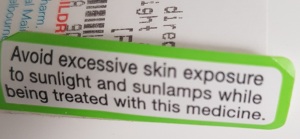
One of my drugs comes with this little warning sticker.

warning, photosensitive
Warning Label on prescription meds

Let me tell you, that word “excessive” can be very open to interpretation. For some of us, that can be a whole 10 minutes. While I don’t enjoy sharing bits of my body openly like this, in the interests of education, I am doing so here. This is a snapshot of one of my breasts, I hope suitably cropped to retain a health focus!

sun exposure

That was THREE weeks after the actual exposure. I finally went to the pharmacy and asked if they had a cream I could use.

Knowing what else I was on, the pharmacist, in a very firm voice said, “Will you just go to the doctor? Please?” I mumbled, grumbled and complained, but I went.

Doctor says, “I need to send you to a skin specialist.”

I reply, “NOOOOOOOOO! I see enough specialists already! Can’t you prescribe something?”

Anyway, the point is: SLIP, SLOP, SLAP. Extra!

Sometimes it is our meds, sometimes it is the conditions. Sometimes it is a combination. Check your meds, check the symptoms of your conditions.

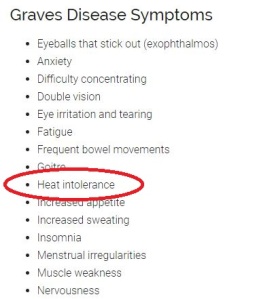
Hyperthyroid has heat intolerance as a symptom.


hyperthyroid, heat intolerance
Source: http://www.thyroid.com.au/thyroid-disorders/graves-disease/

Here is just one paper on PubMed discussing sunlight interacting with drug medications.

The interaction of sunlight with drug medication leads to photosensitivity responses in susceptible patients, and has the potential to increase the incidence of skin cancer. Adverse photosensitivity responses to drugs occur predominantly as a phototoxic reaction which is more immediate than photoallergy, and can be reversed by withdrawal or substitution of the drug. The bias and inaccuracy of the reporting procedure for these adverse reactions is a consequence of the difficulty in distinguishing between sunburn and a mild drug photosensitivity reaction, together with the patient being able to control the incidence by taking protective action. The drug classes that currently are eliciting a high level of adverse photosensitivity are the diuretic, antibacterial and nonsteroidal anti-inflammatory drugs (NSAIDs).

Not all people will be susceptible. Two people could take the exact same medication and one be photosensitive and the other not. The same with symptoms of conditions: not everyone has the same symptoms. Unless you know for sure, it pays to do your research BEFORE you get over exposed.

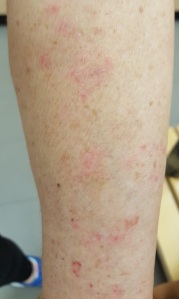
My arm has had a problem for some time, as it keeps getting exposed. I initially thought I had got sunburn on that arm driving around on a beautiful winter day in August with the roof down on my car. It just never would heal completely. I have noticed a vast improvement since I stopped one of my drugs recently. I am monitoring progress while still applying the treatment the dermatologist prescribed after I was diagnosed, via biopsy, with photosensitive eczema.

photosensitive

That photo is not particularly bad, but I think you can see the lesions. While sun exposure would cause it to flare up, it is/was also heat sensitive: when I work out at the gym, those areas would become bright red.

In Cancer Council ACT’s recent media release, Dr Andrew Miller, President, Australasian College of Dermatologists is quoted:

“Melanoma rates in Australians aged 40 and under are dropping and the children of today are our most SunSmart generation ever. However, it’s a real concern that sun protection behaviours overall don’t seem to be improving and that over 2.7 million Australians are putting themselves at risk of skin cancer by getting sunburnt on summer weekends.”

A media release from Cancer Council Victoria states:

New data from a Cancer Council Victoria survey shows more than a third of Victorians do not know the correct indicator of sunburn risk – putting themselves and their families at risk of sun damage and ultimately skin cancer.

The survey found 22% of Victorian adults aged 18-39 incorrectly selected temperature as the most useful measure to calculate sunburn risk for the day, while 8% thought cloud cover, wind conditions or humidity were sunburn indicators, and 9% didn’t know which measure to use.

Just 61% were able to correctly identify the sun protection times or UV level as the best measure to determine sunburn risk.

Of course, all of that is for normal people! We spoonies have to be extra careful.

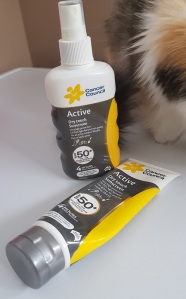
I use a Cancer Council sun protection that is non-greasy.

sun screen, sun smart

I initially bought the spray, but I find the nozzle clogs up quite quickly, so I have moved to the cream in the tube. Yes, my cat was trying to get into the photo – she gets into EVERYTHING. The non-greasy is better for work, although that may be all in my mind.

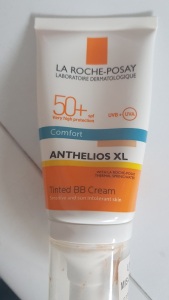
I also have a special dermatologist recommended cream for my face.

sun smart

If I don’t use it, I can go from perfect skin to THIS horror over night. Go to bed perfectly fine, wake up horrified. I’ve learnt my lesson.

sun smart

Have I scared you yet? I hope so, that was the entire point!

Go check your meds and your condition symptoms and SLIP, SLOP, SLAP not just in summer, all the time. I got my arm damage in August.

Do I let any of that stop me being active? No. While my skin may react to sun exposure and heat, I can manage that with suitable sun protection. If I don’t keep moving, I can’t manage my pain. The moving, exercising wins! I will say my gym is in a basement, so I’m safe down there.

Here is proof of me swimming, for no other reason than one of my readers complained on Twitter I had used shots of the pool I go to, but he never saw proof of me actually IN the pool. @MlsMichael, here is your proof. From today. Before the thunderstorms.

Most Australians already know what “Slip, Slop, Slap” means, but for overseas readers:

  • Slip on a t-shirt
  • Slop on sun screen
  • Slap on a hat
leg press

Change Your Exercises for Safety

The target audience for this article is those who are already gym literate. You know how to do a dumbbell bench press and load the leg press. Your technique has always been good and you’ve never hurt yourself in the gym. You are trying to pick up where you left off, but now you have the complication of our new partner, our chronic illness, or some degenerative change making things a little different.

Here are some personal practical examples to illustrate you can change what you are used to doing and still achieve your goals. No, not your old goals – your NEW goals! The ones you have now for regaining or retaining your quality of life!

Dumbbell Bench Press

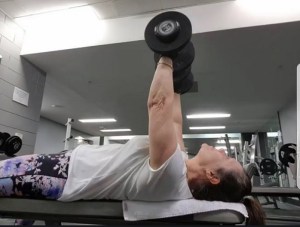
As previously mentioned, I have a few problems in my lumbar spine: a bulging disc, a herniated disc and some very grumpy facet joints. I have always preferred free weights. I knew something I was doing in the gym was irritating my back, but I wasn’t 100% sure which exercise. I suspected it was the dumbbell bench press – not the actual exercise, but getting off the bench at the end of a set. Every time I finished a set, I felt a definite sharp twinge (that may be an understatement there) in my lumbar spine and I would suffer varying degrees of discomfort in the following days.

I stared at the chest press machine and decided I was going to have to give that a try.

The action of getting off the machine is not subjecting my back to any undue stress.

It works. No aggravation of my back as I step out of the seat. No, I’m not happy about giving up my free weights, but I’d rather adapt my exercises than not do them at all.

Much easier than getting off the bench!

In February I will under go Radiofrequency Facet Joint Denervation which will hopefully help: in the meantime I have adapted. If the RFJD works, then I’ll have time to work on building the muscles supporting the spine in readiness for when the RFJD wears off.

Edit March 2018: I avoided the above-mentioned denervation! Exercise rules!!

Loading the Leg Press

Those weights for the leg press have two handles – use them! I realised lifting and carrying a 20 kilogram weight one-handed was not something I should do any more. By the time I’d loaded six of these onto the machine, plus the top-up weights, I was feeling it. Then there is putting the weights away at the end. You DO put the weights away, don’t you? Yes, I knew you did! Using two hands feels a bit awkward at first, but better to use two hands than stop doing the leg press altogether. 

Some readers may have no difficulty with a mere 20 kilograms, I realise that. Some of us more mature souls, or those starting back slowly may be very wise to take things gently initially! Pace up!

Leg Curl

Prone (face down) leg curl is another exercise my back doesn’t like. Luckily my gym has a seated leg curl machine. I’ve found I can do my leg curls with no issues at all in a seated position. No, it doesn’t look as tough, but I no longer care about looking tough, I care about staying limber and strong-ish.

Leg Curl

General Tips

Remember to PACE! While you might be an old hand in the gym, are you new to the concept of pacing for medical reasons?

Make sure you adjust the seat heights (or anything else that needs adjusting) for your particular height. While we may all have been a little cavalier about such details in the past, it pays to be picky about such details now. I usually find tall people have been on everything just before me and I have to adjust every single thing! Your body will thank you.

I don’t recommend lifting to failure, unless you are well and truly on a path to remission or lucky enough to be in remission. I do, now (“now” being until my iron vanished into thin air), lift to failure, but it is something I’ve built back up to and I certainly don’t make a habit of it – besides “failure” is a lot less now than it used to be! Russian Volume Training is probably not a great idea for us either. We’ll end up in the Boom/Bust cycle again, if not with pain, with fatigue.

Slow and steady should be our mantra for the moment. All is not lost though: I know a young man who was diagnosed with reactive arthritis. Told he would not play professional sport again, he became a hypertrophy competitor, fitness professional and was one of our teachers. He is a pretty buff guy.

I hope this may give you some ideas. If you would like assistance, contact me.

Be careful and safe!

I’m done for the day!


Let’s Stretch

Stretching helps us get our movement back. We don’t have to do Olympic level stretches: to start, do what you feel comfortable with. Day by day you will improve. Your aim is to increase your flexibility and functional range, not run the marathon or climb Mount Everest. It can be discouraging when we see “everyone else” able to do things we can’t. It isn’t everyone else, though – there are plenty of people in a very similar situation to ourselves. We need to let go of the “everyone else” comparison because it does us no good at all.

Range of motion can even lead us to not buying clothes we like. I tried on a dress I loved. BIG problem: it had a full length zip up the back. I no longer have the range of motion in my shoulder joint to be able to zip that dress up by myself. So I had to buy a different dress. Still bugs me every time I think about it!

David Tom MD, an Arizona-based chronic pain specialist, says patients who are successful in managing their conditions see movement as medicine. I love that phrase. Movement is the one of the best drugs we can use.

What stretches should you do? This is will depend on your particular situation, but a good set to start is listed below. Hold each for three calm breathes, do each stretch twice. That is, twice each side where the stretch is a side-to-side stretch. Do stretches in a controlled slow manner, paying heed to your body. This is a not a race, the only aim here is to get our body moving.

  1. Neck stretch 1 – simply tuck your chin to your chest.
  2. Neck stretch 2 – tilt your head to the side, turning your chin towards your armpit and your ear to your shoulder. Be careful not to lift your shoulder to your ear! If you are tilting to the right, you can place your right hand on your head to gently add some additional “pull” to the stretch.
  3. Shoulder rolls – rotate your shoulders in a circle backwards, with your arms at your sides. In gyms you may see people doing full arm rotations, forwards and backwards. This is not necessary to achieve your short-term objective. Do not rotate shoulders forwards, the body prefers backwards and we want to give the body what it prefers at this stage.
  4. Shoulders, chest, biceps – stretch your arms straight behind you. You can retract your shoulder blades if you are able, and clasp your hands behind your back but this is not necessary. Again, watch those shoulders – make sure you aren’t lifting your shoulders. Take you arms back only as far as you can comfortably.
  5. Side bend – sitting or standing is fine, depending on your current ability. I won’t describe this one in words as I demonstrate it in the video above.
  6. Back rotation – this can be done lying down or sitting. I prefer lying down. Lay on the floor arms outstretched, knees bent. Roll your knees to one side as close to the floor as you can, hold. Return your knees to the centre, roll to the other side. This may be too challenging, so the seated version is to hug yourself and rotate your upper body to one side, hold. Return to the centre and repeat the other side.
  7. Hamstring stretch – the hamstrings are the big muscles that run down the back of your legs. These can get very tight, especially if you haven’t discarded those high heels yet! That was a not-so-subtle reminder to check out my KyBoot recommendation. There are many ways to do a hamstring stretch, here are two.  You can sit on the edge of a chair and place one leg out in front of you, heel only on the floor, toe pointing towards you, straighten the knee and bend slightly forward at the waist. A second option is to lay on the floor and raise one leg at right angles to your body, your hands behind your thigh to gently encourage your leg towards a 90 degree angle to your body, knee as straight as possible.
  8. Quad stretch – quads are the muscles at the front of your thighs. My favourite place to do these is in the warm water gentle exercise pool with ankle floats. On land, stand behind a chair or beside something you can hold on to for support. Lift your foot up behind you towards your bottom. If you are able, you can catch hold of your ankle and lift the foot higher. You will feel the stretch in the front of your leg above the knee.
  9. Calf stretch – another stretch with options. Option 1 is to stand facing the wall, hands about head head height against the wall, one knee bent, the other leg stretched out behind you, heel to the ground. Press your heel into the floor and bend the other knee. Option 2 is to stand on a step on your toes and drop your heels below the step. This is my preferred version. You will need something to hold onto.
  10. Glute (the muscles in your buttocks) stretch – sitting in a chair, lift one your left foot up and place it on your right knee. You can push down on the left knee to increase the stretch if you wish, providing that is comfortable. Repeat for the other side. If this is too much, simply lift your left knee up and point it towards your right side. A more advanced version is to lay on the floor, bend your knees with your feet close to your buttocks, place your left ankle on your right knee then place your hands either side of the right left and pull your right knee towards your chest just until you feel the stretch in your left buttock.
  11. Thoracic Stretch/Snowangels – our upper back can get quite stiff when we are not as active as we should be or we spend too much time at a keyboard. You will need a long foam roller for this one. The pictures illustrate, I hope! Just laying on the foam roller is a good start. Snowangels add arm movements: start with your arms positioned at your sides, palms facing the floor, then take you arms in a wide arc to stretch out behind your head, palms facing the ceiling. This needs a bit of floor space as you may be surprised just how far your reach is when your arms are at a right angles to your body! This is not a “three calm breaths” one – stay on the roller as long as you feel comfortable. Perhaps start with 30 seconds if you’ve never done it before.

In the first image I have moved my arm so you can see the roller. In the second you can see my head is totally supported – hence the need for the long roller.

This is not the easiest to do and may be too advanced for beginners. Some readers will have difficulty getting on the roller and will need to build up flexibility and strength. The aim is not to hurt ourselves, so BE CAREFUL! I still prefer to hold onto something while lowering myself onto the roller. I love the way my upper back feels when I get off the roller.

Stretching daily is a very good thing. Build the time into your daily schedule and stick to it, even on the “bad” days. Design a simple spreadsheet and place it on the fridge, mark each day off as you go. Stretching isn’t the only activity we need, but it is a good place to start.

If you would like some help, Contact Limberation.

This article constitutes general advice only and the stretches outlined above may not be suitable in all situations. You should always seek a medical clearance to undertake exercise if you have medical conditions.


Movement As Medicine

Pacing For Beginners

Pacing in the context of managing our pain relates to our rate of activity or our performance progress. In this article I am using walking (that’s why the feet!) as an illustration, but the same logic can be applied to sitting, standing, resistance (weight) training or whatever activity it is that we are having trouble doing to the level we want to. The activity might be sweeping the kitchen floor, or sitting long enough to fly interstate. Walking is just the example here.

As I have shared previously, when I was first started on this journey, I walked five minutes at a time, four times a day. Five minutes was how long I could manage before I experienced pain. Slowly, by pacing, we can build up.

Please be aware pacing is only one component of condition management, it is not THE solution. This is a general introduction only, each person requires specific planning tailored to their circumstances.

Warning: Maths Ahead

Let’s assume for the maths that like I could, you can walk five minutes before you experience discomfort. It is very important to know your starting point. Smartphones have easy calculators: the keystrokes for the below example are 5 + 4 = 9 / 2 = 4.5 * .8 = 3.6.

The important point here is just because you CAN do 5 minutes, that is NOT the starting point.

    1. Take that five minutes as your Test 1 measurement.
    2. After a suitable rest, do a second Test. The Test 2 result might be four minutes.
    3. Add 5 + 4 = 9. To find the average of your two trials: 9/2 = 4.5 minutes.
    4. Now you need your baseline, your official starting point. This is 80% of your average. 4.5 * 0.8 = 3.6 minutes, or 3 minutes 36 seconds.
    5. Increase at a rate of 10% from your baseline. 3.6 * 1.1 = 3.96 minutes. Let’s just call it 4 minutes!

Each day (or week depending on the type of activity) you increase by 10%. JUST 10%. On your calculator that is “current time” * 1.1 = “new time”.

10% a day increase is reasonable at a 5 minute walk, but for longer durations and other activities, the increase should be spread over a week.

Putting Pacing into Practice

How does this work in practice? I did some timings on a stroll the other day. It took me 217 steps and 1 minute 48 seconds to walk from one tram stop to the next.

What is a tram, you ask? I’m glad you asked! This is a Melbourne tram. Terrific mode of city transport.

If you don’t have trams in your area, do you have an alternative?

Why was I doing the timings? Because we can use local infrastructure to our advantage. After a while you will get very bored with your backyard or walking around the same block. Tram lines are fantastic because we can walk, hop on a tram for a rest, get off further down the line preferably within one or two metres of a nice cafe, finish our rest over a nice coffee and then repeat the exercise back.

As we build up, we can use the distance between trams stops as stepping stones. Looking at my 1 minute 48 second walk between stops cited above, that is way more than a 10% increase from a 4 minute baseline. That would be closer to 50%, WAY too much. But later on it will be possible. You are not stuck on 4 minutes for long! As you build up you can walk just past a tram stop then back and still catch a tram to reward yourself with coffee. Over time you will be reaching the next tram stop.

A little reconnaissance may be necessary. This is the tram stop I was passing. In the middle of a busy main road, there are lots of steps up from the pavement, an over-bridge and then more steps down. This may not be ideal for those pacing up slowly! This is one of the tram stops you might want to zoom straight past – as a passenger!

Of course there are many alternatives: drive to a favourite park or beach, then walk. I don’t suggest the shopping centre, as it could take 20 minutes to walk from the car park to your store of choice!

The Rules

Rule #1: stick to the times. DO NOT be tempted to do more than you should, despite how great you might feel right that minute. You risk undoing all your hard work to date if you do that.

Rule #2: do it every day. Even if you don’t feel the best today, do your allotted time. Every day. Note this is for these small starting activites. I would NOT do a leg press every day!

Rule #3: Wear appropriate footwear. If it is sitting you are working on, ensure you have an appropriate chair.

Other Thoughts

I also apply pacing strategies to manage the fatigue, along the lines of how much I do on any given day. I’ve mentioned before I don’t do grocery shopping on days I do a strength workout. I don’t do strength workouts the days I work eight hours in the office. We work out rules for our individual circumstances.

Christine Miserandino (lupus and fibromyalgia) has written The Spoon Theory which is a great way to visualise the energy/fatigue situation. I found it very early on in my journey and it certainly helped me adjust to my new life. I do have many more spoons these days than I used to, but that didn’t happen overnight.

Challenges of Living Alone with Chronic Conditions

If you have newly discovered you have a chronic illness/condition/disease AND you live alone, there are challenges patients living with family don’t face to the same degree. Some of the items below I have mentioned before, but today I am looking at the specific circumstances of living alone, which can complicate matters. While we may not have children or a partner to care for (in some ways making life a little easier perhaps), the flip side of living alone means no-one to make us a nice cuppa, to help us make the bed (or let us off the hook entirely), or to just snuggle up to for comfort.

Even if we have a nice neighbour to call on for help (as I have done from time to time), we may need to plan our activities very carefully. It is easy to fall back into the boom-bust cycle, both physically (pain) and psychologically (the stress), especially in the early days. We aren’t used to the “new me” at all, we tend to think of it a bit like having the ‘flu, we’ll just get over it. No, sorry, this is here to stay (unless we go into remission, which is possible in some cases). We can learn to manage it, yes. In time and with practice.

Today I’m asking you to carefully consider the physical and practical aspects of managing day-to-day tasks. It WILL get easier as your treatment starts to work and you build up your resilience over time, learn to pace and build up (or build back) your strength, but today we are talking about the beginning, when we are adjusting to living this new life. These are some of the things I wish I’d known in the early days.

Grocery Shopping

Grocery shopping can be a challenge. Yes, I could order on-line and have my groceries delivered, but that costs money: if we live alone we don’t usually buy enough to qualify for free delivery! It is OK to carry the bags in from the car one at a time if necessary – or even half a bag at a time. Take the frozen stuff first, in case you need a rest between loads. Once you get stronger this will improve – but don’t try to do what you used to do before, not until your body is ready. If we struggle to carry in all the bags at once, where do we go? Yep, back into that pain boom-bust cycle.

Shop more frequently if possible and necessary.

Showering

I remember standing in the bathroom in tears when my shoulders were playing up badly. I could not dry my back after my shower. It wasn’t just the pain, it was the inhibited range of motion. Also, this was out of the blue, completely unexpected. Situations like that can make fears of the future rise up and cause anxiety, anger and frustration. Living alone means we have no-one to talk to about those fears right there and then, no-one to comfort us in our time of stress. Also, no-one to dry our back. Mindfulness exercises will help. Relax our mind and relax our muscles – often times that is just enough so we can complete the task at hand. That alone makes us feel better.

Bath sheets instead of bath towels are very useful. Being larger, not so much shoulder movement is needed to dry one’s back. While there is a lot of technology out there to assist people, I haven’t found anything yet that helps dry one’s back. I admit I haven’t looked very hard because the problem was not ongoing for me.

The unexpected can happen. Negotiating our ablutions, unexpected events or not, can be a challenge. Putting prescribed skin cream on areas you can’t see, for example, can be a bother to say the least.

Changing the Bed Linen

I’ve mentioned before that changing the bed linen used to wipe me out. But there is no-one else to do it, so it is either manage it somehow or sleep in dirty sheets – not the best option. Break it down over the day. Get the linen off the bed (I find that not too difficult) early, then do the rest spaced out over the day if necessary. Put on the bottom sheet, go away and do something else or rest. An hour later tackle the top sheet. If putting on the new doona cover is too hard to do in one hit, break that down too. It is OK, you are the only one seeing your messy bedroom! You have all day to get the bed back together! If we give in to the “I must do it now” story to do our bed in one hit, where do we go? Yep, back into that pain boom-bust cycle.

Above is Cleo, very comfy in her little fluffy igloo. She feels safe and warm and protected. We need to feel the same, we just don’t need to cause ourselves a flare getting there.

Our Hair

For anyone with long hair, this can be a challenge, especially if our shoulders are involved in our condition, or if standing causes pain (a chair in front of the mirror would solve the standing issue). Blow drying long hair can take twenty minutes or so, our arms raised for much of that time. On a bad day just don’t do it – letting your hair dry naturally is not a crime, the fashion police will not issue a citation. Actually, no, the fashion police might very well issue a citation, but WHO CARES! Our path to regaining our functional movement and managing our pain is WAY more important than someone caring about our hairstyle. If we force ourselves to do our hair to meet social expectations, where do we go? Yep, back into that pain boom-bust cycle.

Dishes and Ironing

Ironing is easy – I’ve talked about that before – just don’t do it. One item when you need it, that’s enough. Although sitting may be a solution, I find I don’t get enough pressure happening so the clothes don’t look “done”.

A fellow patient I know says it takes her three tries to get the dishes done, with rests in between. Standing is a major source of pain for her at this time. It is what it is – if you have to wash a plate at a time, so be it. Build up to two plates. In time you should be back to being able to do all the dishes at once, but feeling guilty because you can’t now is not going to help. Wash anything you use as soon as you use it is a strategy I adopt most of the time. Living alone we tend not to generate a dinner wash of six plates and cups, which is a good thing. If you have a dishwasher, I hate you already (I don’t).

Cooking

Cooking is a little different. We need to ensure we are eating healthy, nutritious food: the two main reasons are to enable our body to fight this battle the best it can and to minimise or reverse any weight gains due to medications and our reduced activity levels, thereby protecting our joints and internal organs. Unfortunately, cooking is not necessarily as easy to spread over the day as other tasks can be.

We need to plan our food preparation so we don’t do more than we should at any given time. We may simply have to give up some of our favourite dishes – for a while – if they require lengthy preparation. There is NO point in spending a painful hour preparing something only to be too exhausted or in too much pain to actually enjoy the fruits of our labour. Don’t put yourself through it. Console yourself with the knowledge that a dish requiring less preparation is probably a healthier dish anyway!

This is where living alone can actually be a plus, as we aren’t faced with anyone complaining about the “plain” food. Then again, someone else could be cooking for us! It is what it is, just please eat healthy, nutritionally balanced meals!

If you can afford it (many of us, having reduced our working hours due to our conditions, can not) delivered meals such as Lite n’ Easy can be a great solution, at least to have some in the freezer as a standby. I use my slow cooker to cook six meals at a time and freeze five. My freezer is bulging with pork, beef and lamb meals which take seven minutes to defrost and three minutes to heat in the microwave. Lifesavers if I have a tiring day at work. I’ve been known to boil two eggs and have them with a steam fresh bag of vegetables if all else fails.

I never peel potatoes or carrots, the skins are good for us anyway. I’m not allowed green beans or onions, so I avoid a lot of slicing and dicing. There are great kitchen appliances available to make these things quick and easy. Make Christmas present requests. I know two people who are stroke survivors, both need to manage with one hand and have quite a few utensils that are very useful. Look at what is available that will make food preparation easier for you.

General Housework

One thing to avoid is the temptation to clean up like a whirling dervish if visitors are coming. Try to spread out doing tasks over the week and have a room you can just chuck stuff in if need be and close the door! “OMG, Jane’s coming over, I must have a pristine home” is a recipe for disaster, especially in the early days when you are learning your new life. Most of us who have worked all our lives are very much into the routine of spending a good part of our weekend doing everything: clean the bathroom, dusting, vacuuming, clean the oven, maybe mow the lawns, wash the floors, change the linen, do the laundry, ironing for the week ahead, grocery shopping and THEN we used to add some socialising on top of all that.

socialising is important
I do get to socialise! It is important.

Ummmm – not a good plan any more. It doesn’t matter what your major symptom is; pain, lethargy or other. Trying to do it all is not going to help. Stop. Don’t be tempted. We have no-one to delegate tasks to and can be so tempted to do it all at once, to feel we HAVE to at least try to appear “normal”. No we don’t. We have a new normal now. If Jane is a really good friend, she is not going to care if your place doesn’t look like Martha Stewart’s been your housekeeping consultant, Jane is going to care how you are feeling, how your health is.

Summary

Look, all that and I haven’t mentioned exercise once! I am now. No, I don’t write template exercise routines and publish them because that, I believe, is inappropriate for my client base. Every single one of us is different. Different conditions, different stages, different trouble spots in our bodies. It is important we make sure we have time to build our physical condition though, in ways appropriate for us as individuals. This is NOT a luxury any more so we can look good on the beach come Christmas holidays, this is now a necessity.

Living alone can make exercise harder. No-one to motivate us or support us. No-one to take that first short walk with us. It can be easier to just turn on the TV and hide from the world.

All the above careful planning of our activities will be for naught if we don’t build conditioning into our routine. Even before I did any formal exercise or pain management studies, I learnt very early on if I moved, my stiffness and pain receded. That’s what led me to learn more. Why was it so? How much better could I get?

Have I had bad patches? Of course I have. I remember the shower incident mentioned above, another day I was woken up by pain in my right arm that was excruciating, a day I lay down for fifteen minutes and then couldn’t get off the bed. Overall am I better now than I was in late 2014? Definitely. So. Much. Better.

For Melbournites, yesterday I walked from the corner of Nicholson St and Victoria Parade to Federation Square. Stopped, had a coffee (very nice Bailey’s Latte it was too), then walked to the Arts Centre.

Bailey's Latte
This was SO delicious.

Three years ago I was on crutches.

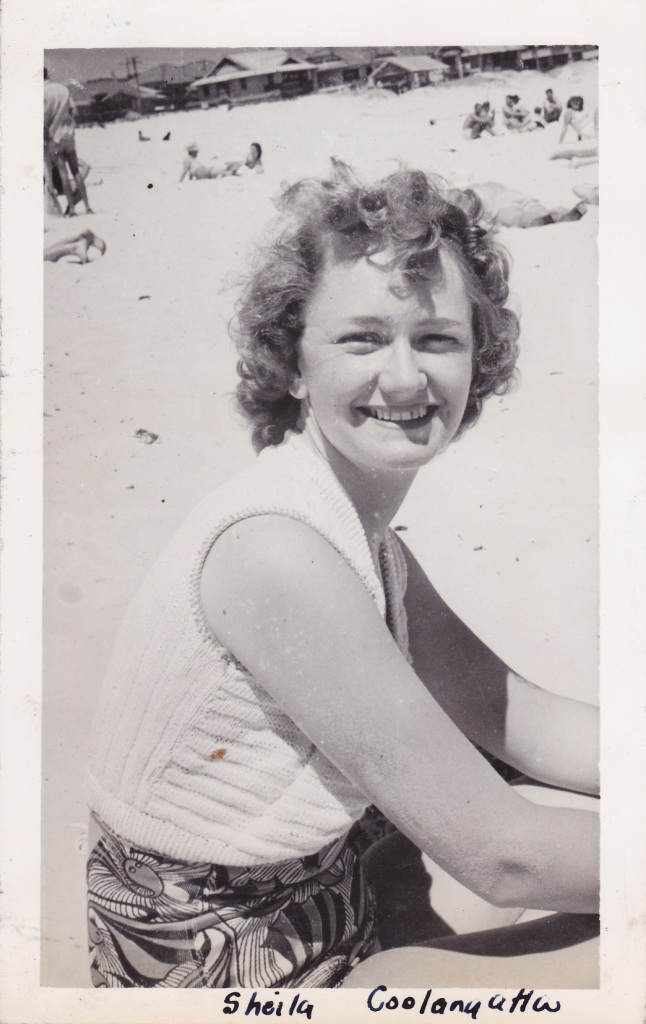
Sheila Constance Lacey

Science is Not Static

Fifty years ago my mother (above, photo 1949) was admitted to hospital for exploratory surgery. To see if she had cancer. Today a very dear friend of mine is bravely fighting cancer: he is in week two of chemotherapy and radiotherapy. A scalpel hasn’t been near him yet. There will be surgery, but the diagnosis hasn’t required surgery. We have ways to look inside the body that we didn’t have in my mother’s time.

It Began With Sudden Blackouts. Then Came Some Alarming News is about a woman’s survival today that would not have been possible fifty years ago. G.C.M. is a rare autoimmune disease.

It was giant-cell myocarditis (G.C.M.), the most dangerous of the possibilities. This mysterious and deadly autoimmune disease has only been diagnosable before autopsy since the development of the heart biopsy some 50 years ago. Effective treatment has only recently emerged.

In Get the Stress Out of Your Life I talk about another RA patient I met at the gym. I can’t help but wonder had he been diagnosed in this era, rather than over twenty years ago, would his outcomes have been different?

Many people will remember thalidomide. Thought initially to be a great drug for treating morning sickness during pregnancy, it caused babies to be born with limb deformities.

About 40% of babies damaged by the effects of thalidomide died in their first year. But there are adults alive today who are living with disabilities caused by thalidomide.

Medical science learnt and the drug was no longer prescribed to pregnant women for morning sickness.

Medical science continues to learn. There are many articles in the media of late about opioids and addiction. Here are just two recently published; one from the USA, one Australian.

Neither article paints a positive picture. From the latter article:

…health authorities worldwide are grappling with soaring rates of opioid addiction and deadly overdoses. In Australia, the majority of opioid overdose deaths are now related to prescription painkillers rather than heroin.

Earlier in the week I became involved in a discussion on Twitter about alternative approaches to the management of chronic pain. I had just published an article, Our Pain, Our Brain and Our Nervous System. I work very hard to stay off pain killers and am very happy with my progress. In this twitter conversation I was told by an American MD there is no evidence supporting activity as a strategy. I wished my pain clinicians had been in my study so they could have taken over! As I was somewhat outnumbered and I do find 140 characters limiting, I bowed out of the conversation. I felt it didn’t matter what evidence I presented, I was not going to be heard. Two of the participants in that conversation reached out and I am communicating with them individually.

That experience got me thinking. We, both doctors and patients, are happy to use our new imaging technologies. We are grateful there is now a way to save a G.C.M. patient. We embrace biologics such as adalimumab. Why then are some so resistant to the concept there may be other ways to treat chronic pain than pain killers? UK studies have found GPs are “unconfident” discussing exercise with patients. This is perhaps related to the bigger picture.

The Pain Management Research Institute (University of Sydney) offers the ADAPT program.

When no effective or curative treatments are available the person in pain needs to shift their focus from seeking pain-relieving treatments to things they can do something about, despite ongoing pain.

These include increased activities, physical fitness, strength, mood, sleep, reducing reliance on unhelpful medication, developing useful coping strategies, improving relationships at home, getting back to suitable work, etc.

This requires that the person in pain has a good understanding of their pain and accepts the idea of living a normal life despite ongoing pain.

I can attest it doesn’t happen overnight. Yes, it takes effort. But the rewards and results are worth it.

Alternatives to pain killers are definitely worth considering. The programs do have exclusion criteria (refer the ADAPT link above) and people like myself with underlying on-going medical conditions do face additional challenges. It works for so many of us. What have you got to lose? More importantly, what can you gain?

Use of strong pain killers can result in drowsiness – no driving, perhaps unable to work, limits social interaction. One common one makes me and many other people very nauseous to the point all I can do is lie still. Not how I want to live my life. None of the pain killers cure the pain or help me live a normal life. We do less; as a result our bodies de-condition. As a result of that we most likely develop more pain. Weak muscles lead to unstable joints. I can’t build muscle strength if I am lying on the bed too nauseous to move from the use of a pain killer. I got my life back.

Resource:

Manage Your Pain (Australian Pain Management Association)

Our Pain, Our Brain and Our Nervous System

Most of us felt cynical, and disliked the physio and doctors enormously. We’d talk among ourselves, ‘Oh it’s all right for them to tell us so and so, they’re not in pain.’ “Like most in the group, I’d been protecting my painful body, using the old reasoning, if it hurts, rest it. I’d bundle my arms around me and pick things up with my toes. My life had become massively restricted.” Source: Barbara’s Story The University of Sydney

That is Barbara Walker speaking about her initial introduction to a new approach to managing her chronic pain (see definition below). While Barbara was skeptical, the approach worked so well she and her family were instrumental in establishing the centre in Melbourne.

The following short video covers a lot in five minutes, please do take the time to watch it.

I was very surprised to learn 1 in 5 people worldwide suffer chronic pain. This is not a small percentage of the population. Think of all the people in your family, your workplace and your circle of friends. 100 people? I like round numbers. So it is statistically probable 20 are suffering or will suffer chronic pain.

I am writing this as a patient, just like you or someone you know. My objective today is to highlight there are evidence based approaches to living with chronic pain which you may like to consider. Referral information and other details about the Barbara Walker Centre for Pain Management are found on this St Vincent’s web page for those in Melbourne.

Because I am not qualified to speak on the topics of neuroplasticity or the finer points of nerve receptors and neurotransmitters, I’m not going to. This is actually sad, because I’d LOVE to, it is interesting and exciting stuff! It is also very specialised and the multi-disciplinary team have many years of clinical experience. Providing patients with an in-depth understanding of how pain works is a vital component of this approach to improving our quality of life. The relationship between our nervous system and our brain is very much a part of the solution. No, the pain isn’t “all in our heads” – but our brain is involved.

Ask yourself what are all the things you have tried to date? Has your quality of life improved as a result, or has there been only brief periods of respite? How often have you felt you had to choose between taking pain meds OR going to work, because invariably doing both is not an option? Is it worth trying something different, as Barbara did in 1995? As I have done and continue to do.

I feel as if I’m writing an advertorial for others, when if I should be writing one for anyone, it should be for my services! The truth is, while exercise and movement are part of the equation, there are other variables, some of the practical ones I have addressed in previous introductory articles. I would be remiss if I didn’t draw attention to the work being done and the support available in this sphere. After all, I didn’t know of pain centres until I was referred by a general practitioner.

Chronic pain is defined as pain that continues after the initial cause of the pain (injury, surgery, inflammation etc) has healed. Those of us with chronic conditions/illnesses/diseases may have ongoing causes of pain – so perhaps a mix of chronic and acute pain but the approach should still help us.

Image Credit: Designed by Freepik

Are Your Shoes Contributing to Your Pain?

I’m not just talking about six inch stilettos. Our shoes affect how we walk, how we stand and consequently our posture. If we are already facing joint issues, postural imbalances aren’t going to help. In simple terms, we can end up favouring (guarding or protecting) some aspect of our body which can place more strain on another part. It can become a case of the chicken or the egg, trying to work out where it all started.

Part of the solution may be changing your footwear. My rheumatologist gave me a stern lecture about heels. OK, his tone wasn’t stern, but I could tell his intent was! We know high heels aren’t good for us, but we keep wearing them anyway – until we get to the point that it is JUST TOO PAINFUL to persevere. We have to find more suitable footwear.

My Shoe Adjustments

About six months ago I bit the bullet and went on a “low heels” shopping spree for the office and social wear. In my down time I was living in runners, but that’s not such a good look in the office. Socially? I was warned, in no uncertain terms, by a girlfriend NOT to wear runners on a night out. Even with these lowest of low heels I was still experiencing pain in my right buttock and lumbar spine at various times, usually towards the end of the day.

I’ve found a great help for me – and for a neighbour, a friend and the friend’s husband. This may not work for you, but I’m sharing in the hope others may also benefit.

In sheer desperation one day I dragged my old MBT shoes out of the closet and wore them for two days. NO PAIN! However, they were so old (I’d forgotten I had them) that wearing them triggered end of life (theirs, not mine). Not surprising really – nothing lasts forever. I tried to buy replacements. Very, very hard to get in Australia these days.

kyboot by kybun

Doing my “can I buy them somewhere else” research I stumbled across kyBoot by kybun. I discovered the brains behind the original MBTs, Karl Müller, had moved on to developing his next generation shoes. There are only four stockists in Australia: one in Melbourne, two in New South Wales (Sydney and Mona Vale) and one in Brisbane. kyboot don’t have a very high profile in Australia – yet.

What makes them different? This is an American video, but illustrates the technology.

I visited a then Melbourne stockist in early July with NO intention of buying, just seeing what they had and trying them on. Yes, I walked out with my first pair. As soon as you walk around in them you can feel yourself standing differently. A co-worker who sees me at work every day told me I was walking as if I was twenty years younger – and without dobbing that person in, they are qualified to make that assessment.

I walk around a lot in my other job so my first priority was something I could wear to work that looked professional (i.e. did not look like runners). As you can see from the video below, they are fine for an office environment.

My Contacts’ Reactions

I posted about them on my personal Facebook page and spoke to a neighbour in my apartment building. It isn’t just me. My neighbour bought two pair: one for work and one for social. Her comment to me, “I don’t even take them off when I get home, they are too comfortable”.

The Facebook contact’s experience is best shown by her posts to me (I have redacted her name to protect her privacy).

After a while this was her follow-up note to me.

She sent me a picture of her choice.

Kyboot

A Second Pair

So now I had solved my office problem, but I wanted some that I could wear working in Limberation. Something that would go with my gym gear. On the kybun website I had spotted the very colourful style featured at the top of this article. Sadly, this style is not stocked in Australia. Yet, anyway! The then Melbourne stockists, Peter Sheppard, very kindly ordered them in for me specially. I was very excited when they arrived. I was able to determine the size required by trying on another similar shape style prior to ordering.

Pros and Cons

These are not cheap. Up to $500 a pair depending on the style. As a friend said to me, “You can’t put a price on pain reduction”. Yes, my budget has been very tight this month, but I’m set for a while now.

The heel can also look a little odd when walking. Ignore the cat hair, she was all over me when I got home! In this photo I am landing on my heel to show the “squishiness”. The runners I have bought are not as squishy.

Kyboot

You really must try them on and be correctly fitted. My two pairs are two different sizes – the runners I wear with socks are slightly bigger than the ones I wear with stockings or bare feet. Take a typical pair of your socks with you to ensure the correct fit. I was really interested in getting a pair of sandals for summer, but I have very flat feet and in an open shoe my toes don’t stay where they should, so I think I’ll have to stick to closed styles.

The benefits, if these shoes suit you, are worth every cent. Everything we do – controlling our weight, increasing our movement & exercise (re-conditioning our bodies), reducing stress in our lives – all contribute to us managing our conditions and improving our quality of life. If a shoe helps us experience less pain or be able to move for longer before we experience the change (onset of pain), then we are going to be better off. Not only will we experience less pain, but we will re-condition faster than we might otherwise have done which in turn will help us manage our pain.

Summary

Before you ask, no, I don’t get any payments or discounts for writing about the kyBoot. I’m sharing because I’ve been so amazed and so have two contacts of mine. I have worn mine every single day since I got them (nearly two months ago). One of the Peter Sheppard staff told me that is what she had done the day I bought my first pair and frankly I didn’t believe her. Now I do.

The styles available in Australia are not the full range, however styles will change over time and if you are travelling overseas you may find different styles available in different overseas outlets. Just make sure you are getting the genuine article by checking the kybun stockists page.

Research. Read the kybun site to familiarise yourself with the product. The English version of the site probably doesn’t read quite the same as the Swiss version, but the basics are covered. There is even a section on “Initial Reactions” as depending on how you are standing/walking now you body may need to adjust. I didn’t have that experience, nor did the people quoted above, but be aware it is a possibility.

These may not be suitable for you. Even if these aren’t, it won’t hurt to evaluate your shoe wardrobe. Ask yourself whether you suffer less pain, or last longer before pain starts, in one shoe compared to another. Get rid of the ones you know are not doing you any favours. I hated giving up my heels – but now I just don’t care! I’m happily walking around everywhere! Yes, I kept my low heeled fashion shoes – there will be social occasions when I want to wear a dress shoe.

If you were a MBT wearer, these are much easier to walk in. There is a MBT v kyBoot comparison page on the KyBun site.

If you already have some kyboot shoes, please share your experience in the comments.

Update November 19, 2017

Above I stated I received nothing from kybun for writing this article. That is correct. I am disclosing that as a result of this article I have since been engaged to write for kybun for a period of twelve months.

Update October 21, 2022

As there is no longer a Melbourne stockist, I buy my kybun from Future Footwear in Sydney:

sales@futurefootwear.com.au

Future Footwear Pty Ltd
Shop 4 / 12-14 Waratah Street
Mona Vale NSW 2103

Tel:   02 9979 1713

How tough is it to get moving?

You may be asking yourself “How tough is it really, to get moving?” This may be moving again or starting from scratch. I’ll be honest, it may be tough-ish. How tough (or easy) will depend on many aspects: your specific condition, were you diagnosed early and therefore received appropriate medical care early, your pre-diagnosis level of activity, the medications you are on, the symptoms you specifically experience, do you have a chronic condition or are you in recovery from treatments such as chemotherapy.

The aim  of moving is to prevent de-conditioning, which I spoke about in Launching Limberation. Specifically here I am referring to pain management, but the benefits extend beyond this.

My Journey

I’ll share some of my own journey but as you read please be aware your situation may be entirely different. I do use time, distance and weight in this article to provide a sense of progress. Different people, different situations, different numbers, different timelines. What applies to me may not apply to anyone else at all.

Thankfully, I wasn’t completely starting from scratch – while I’d had an activity hiatus for roughly four years, I did have a gym junkie background to leverage. Or so I thought. In the beginning it certainly didn’t feel like I was leveraging anything!

Because I was diagnosed with two different autoimmune conditions at once, my medical team advised we stabilise one condition (hyperthyroid) before attempting to treat the other (autoimmune arthritis). Fatigue was a major problem for me in the beginning. Coping with getting to and from work, work itself and home life was draining what energy I did have. There was basically nothing left in the tank in the early days.

At the Starting Line

When I did start, I started very slowly. I did five minute walks four times a day. It didn’t take me long to realise I felt better when I moved. Pain and stiffness receded very quickly once I was actually MOVING. I increased to ten minute walks, three times a day. Finally I got to twenty minute walks, twice a day. I also moved as much as I could during the working day: sitting was hell. Even now, writing this in my home office where I do not have a sit-stand desk, I will not sit for long. No amount of activity is too small to start.

I didn’t do any strength (resistance) work at all in the beginning. I added some swimming: gone were my 2.5 km sessions: my physio was advising I swim 250 metres. I mumbled and grumbled that 10 laps wasn’t worth getting in the pool for, but I did stick to her advice the first time. The inflammation was also in my shoulders, meaning I had to strengthen my shoulders: be able to do 20 prone shoulder rotations (each side) daily with a 2 kg weight before I was allowed back in the pool.

Resistance Work

I wasn’t until late 2015/early 2016 I got back on the weights. I’d always liked the leg press, but had no idea what I should try to start with. Prior to the autoimmune arthritis and the hyperthyroid diagnosis, I’d been diagnosed (by MRI) with meniscus tears in my left knee, not a lot of cartilage to speak of and I’d had a Synvisc shot. I was understandably cautious, but knew I was continuing to lose muscle strength which wasn’t going to help me long term at all. I needed strength to support my joints, especially the damaged ones.

I loaded 10 kg weights on either side of the leg press and felt SO frail. I was in my school gym – most (not all) fellow fitness students were athletic and I felt like I didn’t deserve to be there. 20 kg was perhaps overly cautious. I upped the weight to a total of 60 kg quite quickly. From 60 kg to 100 kg took quite a bit longer. If I recall correctly, I got stuck around the 80/90 kg mark for quite some time. One of the issues was not actually physical by then – it was not knowing what was safe for me to aim for and no-one I asked was quite sure either. Will I ever get back to 200 kg? Right now, I doubt it – and you what? I’m OK with that. I know I have achieved what I set out to do – stay off pain medication. I’ll let the healthy people worry about 200 kg leg presses.

Climbing back up

Ultimately I asked my rheumatologist, who is very supportive of what I am doing, “How far is it safe for me to go? I don’t want to damage anything”. He is well aware I am using my own body as a research subject. He smiled and said “You’ll be fine. You’re sensible. Back off if it hurts.” After that I was more confident to push myself. I am careful. I don’t subscribe to the “no pain, no gain” philosophy – after all, pain is what I am working to manage, I don’t need to have more of it. Pace, incremental gains, no lifting to failure. My definition of “push myself” is not the general fitness industry definition – for very good reason.

I have just, this month, August 2017, managed to do a dumbbell bench press with 12.5 kg dumbbells (25 kg). I started back at 5 kg (10 kg total): it has taken me over 12 months to get to this far.

Other Considerations

Sometimes progress stalls. I find I lose gains very quickly if I miss a strength workout. Whether this is due to medications, the conditions themselves, my age (yes, I do have to consider that these days) or a combination of all three, I’m not sure. I’ve searched for research around such questions but have yet to find anything specific.

In late July 2016 I had a change of medication. I found this helped dramatically with the fatigue and therefore it has helped all the other aspects of my re-conditioning.

I don’t run. My knees are pain free and I want to keep them that way so I just don’t risk putting them through jogging or running. I walk a lot. I walk to my Pilates classes, I walk to or home from the gym, I walk to the next tram stop. While I’d love to get back to 10,000 steps a day, I’ll settle for 8,000 plus my other activities. I do indoor rowing, great whole body exercise.

In 2014 I could swim a 2.5 km session. In 2016 I was finally allowed by the physiotherapist to swim 250 metres. Now I’m back to 1.2 km sessions. Sometimes I only swim 800 – it depends on how I feel and how my shoulders feel. The message here is listen to your body at all times. Don’t use that as excuse to not do anything – but listen to your body. On Saturday I did my usual strength workout: I had every intention of increasing that leg press again, hopefully by 10 kg – I was aiming for 140 kg. As soon as I did my warm-up set I knew for whatever reason today was not the day. My strength was just not there. I suspect it was lack of dietary protein the day before – I’m currently monitoring how I feel against my dietary protein levels as mentioned on the Science Stuff page. So I simply did not try any increase. Next week will do, there is no rush, I’m not competing with anyone. I didn’t go backwards and that is my focus.

I’ve added Pilates to the mix at the suggestion of my physiotherapist. While this may look easy (looks like I’m doing absolutely nothing, doesn’t it?), trust me, after ten of these retracting the scapulae and opening the chest, I don’t want to do any more until the next day!

Objective Achieved!

As you can see, it isn’t achieved overnight. I’ve worked at it. Slowly, but surely, I’ve achieved my original goal: to stay off pain medications. Now on to the next goal, which is to help others in similar situations.

Will you give movement a try? Contact me for a preliminary chat. Limber Up to Live Life.

Disclaimer: This article is based in part on personal experience and is of a general nature, not tailored for any individual circumstances. Where appropriate, readers should seek medical clearance before embarking on an exercise program. 

Launching Limberation!

Welcome! Limberation is now live!

Stay tuned for weekly articles of interest to people trying to manage the competing demands of a job, family, pets, medical conditions and their own physical maintenance.

Managing the demands of life is difficult enough for most people. Then one day you come out of a doctor’s consultant with a diagnosis and referrals to specialists. Your life just got a bit more complicated – or a whole lot more complicated.  Now you have to fit in taking care of yourself.

You know how sometimes you used to skip breakfast because the mornings were just so hectic and you have to catch THAT particular train or you’ll be late for work? Not so fast. NOW you have to find time for breakfast because you have to take medication and that medication must be taken with food. No scoffing down those pills on an empty stomach – that’s just asking for more trouble.

You’ve been busy the last few years and your exercise regime has fallen by the wayside. Suddenly finding time for exercise is mandatory. But you feel tired all the time now, hitting the gym or even just walking around the block is more challenging that you thought it would be.

I’ve experienced days where just getting off the bed was so painful I didn’t know how I’d actually get on my feet. I also knew once I did get on my feet, once I got moving, my pain improved dramatically. This will NOT be the case for every person immediately: those suffering chronic pain, for example, may need to work slowly to desenitise their nervous system. Just because something works for one person does not mean it work for another. We are all different.

Years ago I spent a lot of time working out – then I got too busy and I let it go. After all, I rationalised, I can get back to it when things settle down. This can be a psychological challenge post-diagnosis: for a competitive person, finding I could only leg press about 30% of what I used to be able to do was demoralising and demotivating. I had to fight that feeling of uselessness. I felt completely incompetent in a gym setting, yet I knew strength training was important for me.

The challenges those of us with chronic conditions face are not just medical. There are social, family, financial and psychological challenges. We have to examine our values and goals and reset some if not all of them.

Learning to pace ourselves can be the biggest challenge. Maybe working full-time is no longer the best thing for us, despite the financial ramifications. Maybe our current career is not helpful to us physically. In my case, sitting for long periods, being stationary, is not pleasant (and that is putting it mildly). A sit-stand desk helps greatly: changing careers to one with greater movement helps much more.

We need to prevent the de-conditioning of our bodies.

Deconditioning

None of this is likely to help us manage our conditions long term.

If your doctor hasn’t already told you to “get exercise” (as mine did), ask if exercise will be beneficial for you.

Then let’s Limber Up to Live Life.