My favorite walking spot

Active Rest Days

Movement As Medicine is a balancing act. Sometimes we have to adjust our weights, our speed, our range of motion or other aspects of our exercise regime due to our conditions misbehaving unexpectedly. In this article, I’m not looking at those situations: this is about when our conditions are behaving! It is important to keep moving every day: it is also sensible to have active rest days. Active rest days are not specifically a chronic illness tool, it is a standard fitness coaching recommendation. It can be useful for us too!

I am using my stats to illustrate. I don’t run or cycle, but the concept is the same, just apply the underlying logic to whatever your exercise preference is.

If I’m moving, how am I resting, you ask? Funny you should ask, that’s just what I am about to explain.

I have several personal objectives at the moment:

  • Improve my VO2 Max
  • Increase my walking speed
  • Maintain my daily step goal streak (sitting at 72 days as I type)
  • Increase my weights

Doing the above every day relentlessly would NOT be practical. Pacing is critical at the best of times! While pacing is about improving (if possible), it is also about making sure we don’t boom/bust. Active rest day are days we do keep moving, but we are not trying to break any records. When just starting out, of course, no-one is breaking records, pacing rules everything we do (not just exercise). However, once we reach a more stable state with our conditions and providing we take due care and do not overdo things, we can have some objectives we could not have managed in previous years.

I don’t lift weights on an active rest day. I don’t try to increase my walking speed. I will still hit my step goal for the day. I’ll just do it slower and possibly in smaller chunks.

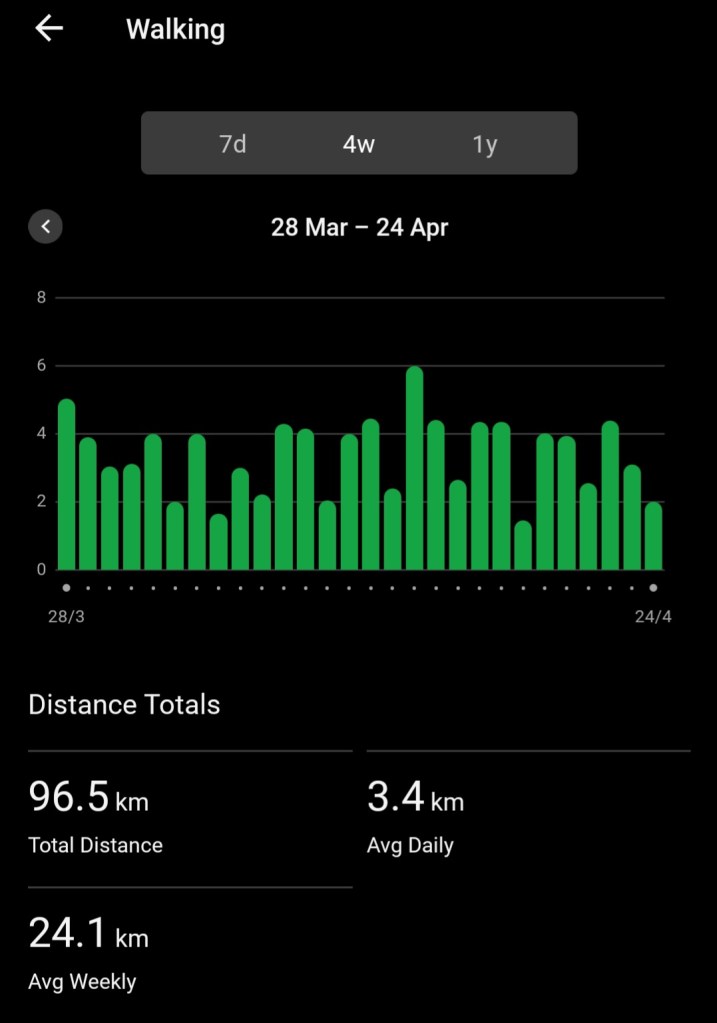
My daily step goal is 7,500 steps. I also have a goal of formally walking 4 kilometres a day. Why both? I’m retired (so not working) and I live in a very small apartment so I don’t get many incidental steps. I can walk 4 kilometres in less than 7,500 steps (5,600 steps to be precise). Other days I might be running errands and clock up some of the 7,500 steps pottering around the pharmacy etc, but not have achieved 4 kilometres in formal walks. On weight lifting days, I’ll clock up steps at the gym. Those days, because I’ve used energy to weight lift, I am happy to not achieve 4 kilometres as long as I still get 7,500 steps. None of that explains active rest days, but it paints the picture of where I am at.

Over time I’ve improved my walking pace from around 13 minutes a kilometre to somewhere between 10:30 to 11:30 minutes, depending on the day – I walk faster in cooler weather!

On an active rest day I’ll drop that speed back to around 12:00 to 12:30 minutes per kilometre.

I’ll also take shorter walks. On a “workout” walking day, I’ll aim for a distance between 2.5 to 3 km in my main walk (depending on where I am actually walking). I will take a shorter walk later. On an active rest day I’ll walk three or four times, about two hours apart. So I’m slower and have lowered the intensity. I’m still moving so nothing seizes up, but I’m doing it more gently. I’m actively resting.

I recently increased my weight lifting sessions from every third day to three times a week. I lift weights Monday, Thursday and Saturday, keeping Tuesday and Wednesday free for other commitments like medical appointments, walks or lunch with friends and other normal things. Even with my weights sessions, I make Saturday a lighter workout than Thursday and Monday, simply because I don’t want to risk overdoing the heavier weights such as leg press and chest press, especially as I’ve recently upped the overall regime. There is flexibility here too. In six months time I may decide to make Saturday a little more intense, but I’m seeing how my body holds up first!

In case readers are wondering, “If she is pacing UP, why is she not trying to increase her step count per day or the 4 kilometres?” Fair question. We can’t increase everything at once. At one point, when I first reintroduced weights into my exercise plans, I used to drop my step count goal on weights days. Gradually I’m got to the point I no longer need to do that. Also, studies have shown that 7,500 steps a day is fine – for healthy people. So I’m in no hurry to try to hit 10,000 (it was a marketing thing) steps. As for the 4 kilometres – some days I do walk more, but 4 kilometres is my target. If I exceed it, great, but I don’t make exceeding it a goal at this time. Increasing my speed is my current goal.

The featured photo is of my favourite walking spot, taken from one of the bridges that crosses the creek. This is where I do walks of 3 kilometres or more. Listening to the birds.

Feel Like I’m in a Holding Pattern

It goes like this. On April 6, 2024 I started my NINTH psoriatic arthritis medication. Sequential, not together! Some medications have a loading dose period: this is one of them. So for four weeks I have injections once a week. Then I move to monthly injections. The first monthly injections are the week after the last loading dose injections, so effectively the patients have weekly injections for five weeks in a row.

You’ll notice I said injectionS – no, that is not a typo. The dose is not available in Australia in one pen, so I have to use two pens. This is not a problem for me as I find the pens really easy to use.

A previous biologic I was on was fine during the loading phase, then when I got to the normal doses, in that case an injection every eight weeks, I found it wasn’t as effective. I’d be great for about three weeks, then steadily feel worse for the next five weeks. Not a great situation to be in.

So, while I feel very good right now, I am waiting until June/July to see if this medication will be effective for the full four weeks between injections. Of course I am hopeful! But that is why I feel like I am in a holding pattern. There are things I want to do, get involved in, but I feel I can’t yet commit to anything that involves other people until I know how this treatment is going to pan out longer term.

At least I’m not taking any NSAIDs or prednisolone and I’ve taken Panadol Osteo about three times a week. YAY me! Or YAY the new medication. Because I’m not taking those additional medications (and I’m moving), I’m also managing to shed the weight gain that occurred while I was taking them. Thank you, 2023. Not my favourite year, let me tell you.

Another aspect of being chronically ill that is driving me nuts at the moment is the amount of effort required to remain, well, functional. So much planning goes into ensuring I get the movement required, balancing with the rest required. Then of course I’ve just had nine months of rehab exercises from first the knee replacement surgery then the ankle surgery. Not to mention the cast and the knee scooter and the moon boot! At the moment I’m kind of on the come back trail: the last four weeks have been good, let’s keep going. My first walk after the ankle surgery was February 14, a whole 0.8 of a kilometre. Now is much better.

I drop my target step count on the days I lift weights, which is every third day. Some days the weather may impact my step count! This is Melbourne, after all: we can have sunshine one minute and a howling storm five minutes later.

Reconditioning one’s body after nine weeks essentially immobile when that body is already challenged by psoriatic arthritis (and, umm, advancing years) requires a bit more planning that usual. Yesterday was a classic case. I did not make my 7,500 steps. I needed another kilometre, but for whatever reason/(s) a few things were grumpy by the end of the day. I opened my front door. Stood there for about 30 seconds and decided (sensibly) this was not happening. Closed the door and came back inside!

My lower back did play up off and on once I got moving again. Being “misaligned” for nine weeks on the knee scooter then the moon boot was not something my back muscles and left glutes liked AT ALL, I discovered. Lots of heat packs and stretches involved and all is now back to normal.

In summary, some days I end up feeling as if all I do with my life is work at keeping this disease under control. In the early years, I was still working, I had a purpose to keeping it under control. Now there are days when I wonder why on earth am I putting in all this hard work? Which is why I need to be DOING something other than just “keep active”. I need to have something to DO. Which explains the holding pattern dilemma. Thank goodness for my psychologist allowing me to vent!

I’ll get there! It is just a frustrating time and we all have them.

I’m still happy to be past the tip of the bell curve (top photo) for my daily step count given my situation. And remember, that is only Garmin wearers, many of whom will be very active, not the whole population!

By the way, I’m freaked out by the number of people that are freaked out about patients injecting ourselves! Many diabetics have been doing it for years! I’m not sure why we (i.e. those with other conditions) are seen any differently.

When Was the Last Time You Yawned?

Fatigue, lethargy, exhaustion, lack of energy – call it what you will, many chronic condition patients will experience varying degrees of lack of get up and go. Are you fatigued without ever (or rarely) feeling actually sleepy?

The Royal Australian College of General Practitioners describe fatigue as:

Fatigue is ‘that state … characterised by a lessened capacity or motivation for work … usually accompanied by a feeling of weariness, sleepiness, irritability or loss of ambition’.1 It is derived from the Latin fatigare, to tire. For the purposes of this review article, we regard fatigue as synonymous with tiredness and malaise.

Source: Fatigue – a rational approach to investigation

Most chronic illness patients learn to pace. I’ve written Pacing for Beginners and Pacing UP, Pacing THROUGH, Pacing DOWN so I won’t go into detail again. Pacing is critical so we don’t boom and bust. Yet none of that answers the question of WHY are we lacking energy? Why do we burn out so easily?

At one stage I researched the research. I couldn’t find anything that gave me a concrete answer. Many theories and ideas, but no solutions or treatments. Many writers suggest the fatigue or lack of energy is caused by pain. Of course, the experience of pain can be worse if we are tired. What comes first, the chicken or the egg? While that is very valid in many cases, as pain is indeed tiring, it doesn’t explain those of us who have minimal pain. I can go for months without pain, but the lack of energy was always there.

In some cases it is suspected fatigue is a side effect of medications. This will be the case in some situations. But fatigue was one of my first symptoms, prior to any medications. Admittedly, in my specific case, I had a hyperactive thyroid which is known to cause fatigue, at least partly through disrupted sleep. I also had undetectable levels of Vitamin D back then. Comorbidity can indeed complicate troubleshooting!

I read also of pain leading to depression leading to fatigue. Again, possible in many cases. So it IS complicated. I hear SO MANY fellow patients complain of fatigue when it seems their primary condition is well managed – aside from the fatigue. Some conditions (mine is one) do list fatigue as a known symptom, while other conditions do not.

The focus was/is primarily on improving/maintaining mobility, and pain management, I could find little about improving or minimising the fatigue levels. Yet so many of my chronic illness contacts are vocal about the impact on their lives.

There has certainly been work done on measuring fatigue. Measuring fatigue is an important starting point, for how can we treat something if we can’t measure it? But any measuring is going to have a degree of patient subjectivity. A bit like the pain scale, which we are all familiar with. An allied health professional shared with me recently it is not unknown to have a patient cite a back pain of 8, only to easily bend over and pick up something they had dropped on the floor. How can we measure fatigue objectively? Would the medical profession take it more seriously if there was a blood test for that? Yes, there are blood tests that may isolate a cause for fatigue: Vitamin D, iron, thyroid function to name a few of the more common. Assuming all those are A-OK, there is no objective measure of my level of fatigue as a psoriatic or rheumatoid arthritis patient compared to any other patient with the same condition or any other condition.

I was discussing fatigue with a doctor recently. She said many patients across the range of arthritic conditions say they can manage the pain, but not the fatigue. The fatigue affects their quality of life far more than the pain. What can we do about it? Can anything be done about it?

One of the main improvements I am hoping for from the clinical trial I am on is an improvement in my fatigue levels AND to prevent it getting any worse. I totally recognise my fatigue is NOT too bad – I am aware it could be way worse. Even so, it is sufficient that yes, I have to pace, I have to avoid the boom/bust cycle. I have to be careful.

Recently a friend invited me to her birthday dinner. It was on a Monday night and a fair drive away. I knew if I worked Monday, drove and socialised Monday night, I would not cope as well as I should on Tuesday at work. I declined. Yet before I acquired my new life partner, psoriatic arthritis, that would not have been a problem at all. Fatigue is a far bigger problem for other patients than it is for me personally (at this time).

We need to exercise (where appropriate and recommended): that takes energy. We need to work (those who are able): that takes energy. We need to take care of our homes: that takes energy, especially if you own a cat – all that vacuuming. We need to shop for proper food and cook: that takes energy. When energy is limited, something gets dropped. Usually exercise is the first to be let go. That then means we don’t sleep as well, likely exacerbating the fatigue we already feel. Our bodies decondition, as a result we feel more pain, more pain makes us more fatigued. It becomes a vicious cycle.

About two weeks ago I was sitting in my lounge in the evening and yawned. I don’t think I’ve yawned for possibly five years. Yawning can be a signal we are ready to sleep (or hungry or bored). I’ve been sleeping better of late: now I’ve started yawning again. There may be more to yawning than we think. This article in The New Yorker from 2014 discusses yawning is a broader context – it isn’t only related to sleep hygiene. Even so, most of us can relate to yawning when we are tired.

I remember once being advised by a psychologist to go to bed/sleep “when you start yawning”. I recall thinking at the time,”That’s odd, I never yawn anymore”. I didn’t mention it though and promptly forgot about yawning. I was told if you delay, it will be 90 minutes before you feel sleepy again.

Yawning made me think about my experience of chronic illness related fatigue. I rarely felt sleepy (with or without yawns). There is a difference between feeling very, very tired and actually feeling sleepy. I’d forgotten what feeling sleepy actually feels like. Tired, yes – sleepy no. Am I alone in this? 

Where am I going with all this? To be perfectly honest, I’m not really sure. I am very interested in hearing of others’ experiences. What can we patients do to raise the profile of fatigue as an issue we want fixed if at all possible? Yes, it is recognised, but what is happening to develop strategies or medications to relieve this debilitating symptom?

Please share your thoughts and experiences.

  • Do you, as a chronic illness patient, feel fatigue is seen as important by the medical profession?
  • Do you experience being really tired, but not sleepy?
  • Am I the only one who stopped yawning?
  • What impact does fatigue have on your quality of life?
  • Do you think in your case it results from pain, medications or is it a symptom of your condition?
  • Do you think your family and friends understand your fatigue?
  • If you are a family member of a chronic illness patient, do you feel you understand?
  • Anything else you would like to share?

Let me tell you something – writing about yawning makes a person yawn. A lot!

PLEASE NOTE: Fatigue can be caused by a great number of medical situations and can range from annoying to critically serious – this article is ONLY addressing where it is a symptom of an underlying condition. If you are concerned about ANY change in your fatigue levels, please consult your doctor.

I Am Medication Free! For Now, Anyway……..

Right now I am medication free! No, I have not forsaken the wonders of modern medicine in any way shape or form, but in careful consultation with my rheumatologist I am taking nothing at the moment. How long this will be the case, I am unsure: we will reassess in February. If anything goes belly up, I’ll just make a phone call.

NEVER CHANGE YOUR MEDICATIONS WITHOUT YOUR DOCTOR’S APPROVAL.

Why is this happening? The medication I was on, my second inflammatory arthritis medication, was GREAT for the arthritis. However, it is considered not so great for my skin. This is my left arm a couple of days after the biopsies. This is the worst patch, always has been the problem area. Ignore the scar circled in black – that was the result of having a run-in, literally, with a broken fire extinguisher. The area circled in green is one of the biopsy sites.

Why is my suture not covered? Well, the steri strips started to come off, so I soaked them off. I can not use bandaids of any sort any more, my skin is so fragile – I remove them and the skin comes with them. Rather nasty, so I just don’t go there. It is bandages after bllod tests these days.

About two years ago we investigated my skin and it was then diagnosed as photosensitive eczema. It looked a little different back then. This November I have a completely different diagnosis. This does not mean the original diagnosis was incorrect – things change. In 2016 I was on different medications. Around the time of that first diagnosis I changed my arthritis medication and early this year (2018) I ceased taking medication for my hyperthyroid, having undergone radioactive iodine treatment. So a few changes in the two years.

My skin diagnosis now is atypical psoriasis, believed to be exacerbated (considerably) by my arthritis medication. My dermatologist discussed the matter with my rheumatologist and off the medication it is! I am starting UV B light therapy in the new year – can’t wait! I say atypical because it looks more like subacute cutaneous lupus erythematosus (SCLE) (per dermatologist) than psoriasis, but the biopsies, thankfully, told a different story.

My nails, which usually readers never see due to my passion for polish, look like this. Not all the time, it comes and goes, but the little fingers are particularly unhappy at the moment.

The next medication in line for me, agreed to by my dermatologist, rheumatologist and gastroenterologist, is methotrexate. By the time I saw my rheumatologist, I had been medication-free for a month and I don’t feel too bad at all. I asked about the possibility of seeing how I go without any medication. Other medical professionals are investigating some other symptoms I’m experiencing, some of my blood tests have been a bit erratic – it might be easier to isolate a cause if I’m medication free. That consideration aside, the less medication the better makes me happy. Methotrexate only takes four weeks to “kick in” and I’m certainly not going to be a martyr about it – if I feel I’m going downhill, I’ll be in my rheumatologist’s office very quick smart. I have backup medications in case I flare.

As I have to change medication anyway, it is an opportune time to try and see what happens. My arthritis related blood tests have improved considerably since late 2014 when I was diagnosed.

So how am I finding it? My feet have niggled at me a few times, both my knees are slightly grumpy at night if I walk too much during the day, the base of my thumbs hurt a little bit with certain grip actions (think holding my drink bottle to unscrew the top). If I have a really busy day I do stiffen up at night – but then that is not exactly new, I don’t think it has gotten worse – it is also more likely related to the degenerative changes in my lumbar spine than the arthritis. Other than that, I can’t complain. I swam 1,100 metres today, the first time I’ve managed a swim session over 1,000 metres for quite some time. I did 40 minutes strength training yesterday, my quad strength is actually improving. I did 9,000 steps (accidentally) on Thursday with no ill effects.

My biggest concern is my fatigue/lethargy may return. For me, that was a major problem. Settling the thyroid helped, of course. Now my bloods are indicating my parathyroid is not behaving – endocrinologist appointment in January to try to get to the bottom of that.

The BEST part is I can go out in the sun – sensibly, of course. I’ve spent two years avoiding any sunlight because of my skin, slathering sun cream from head to toe: slip, slop, slapping to within an inch of my life. Yes, I still have to be Sun Smart, but at least I can be normally Sun Smart now instead of paranoid! I also feel better psychologically: I felt as if I was a constant Seasonal Affective Disorder patient.

I don’t know if I will stay free of medication for the arthritis. I see this as an experiment. I do seem to be susceptible to the side effects of medications so if I can stay as healthy as I am now, I’ll be happy. Any deterioration, I’ll be in my rheumatologist’s office. It takes a while for the drug to wash out of one’s system, so I won’t really know for three months – I’m only a third of the way through.

I am very grateful to my specialists for allowing me to try this. It would not be an ideal option for a lot of patients, I know. I am certainly not recommending what I am doing and would definitely NOT be doing it without having discussed all the pros and cons with my guardian angel doctors. I am monitoring myself carefully.

The physical fitness and strength I’ve slowly spent four years building back up has certainly helped me manage my condition so far, but no, there is no guarantee by itself it is enough.

We shall see – wish me luck!

A Tale of Two Fountains

We are different now. Some of us will regain our pre-illness selves, some of us have an unknown prognosis, some of us know we will never go back. For the moment, all of us are changed from our old selves.

I think of the fountain above as my old self. I think of the fountain below as my new self. Or visa versa, it really doesn’t matter.

Just as these are both beautiful and different fountains, in both incarnations I am a useful, valuable person. I just do things a little differently these days. Well, yes OK, some things I might do a LOT differently. So might you.

It is easy to feel hopeless, useless, incompetent and a whole host of other negative words when we face chronic pain or fatigue/lethargy. When we have to set aside time to self-manage our health we may feel guilty because we are not doing other things friends or family may think we should be doing.

Look at the fountains more closely. One shoots water into the sky using, I imagine, quite a lot of pressure to achieve the height. The second fountain does the complete opposite: water gently falls from many small outlets. In both fountains the water is successfully circulating through the system. Both fountains bring pleasure to visitors. Birds stop and drink. Grass grows around them. So it can be with all of us.

Yes, we are different now. With the right support and guidance we can live a meaningful life, despite the pain and/or the fatigue.

Most of the normal people around you will not understand, especially if you have no visible evidence of illness. No-one can see my friend’s cancer tumor. No-one can see my fatigue. No-one can see the pain another friend suffers from fibromyalgia, This was brought home to me personally this week, when I was diligently recording the calories in a mini muffin at a work birthday afternoon-tea. “Oh”, my colleague said, “you can work that off in five minutes, don’t worry about it!” No, I can’t work it off in five minutes because I can no longer do that level of exercise. Yes, I do a lot of exercise, but gone are the days when I could eat anything I liked. Because I don’t look sick, people don’t comprehend the self-management we need to adhere to in order to live the lives we want. We cannot expect people to “get it”, but we can set appropriate limits.

We are still beautiful fountains. We just function a little differently these days.