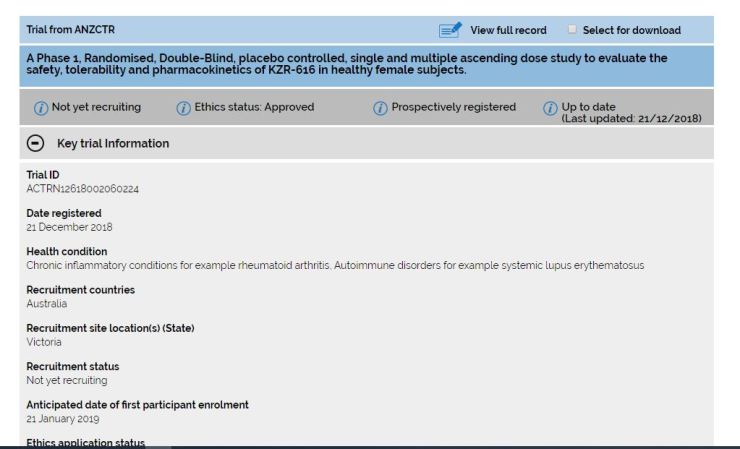
A Clinical Trial – Patient Journey – Part II

I mentioned at the end of A Clinical Trial – Patient Journey – Part I that I had originally planned not to share my experience until after the placebo arm was over. On reflection, I realised that would in fact be unintentionally biased reporting, because events during, and the experience of, that first six months, when I may or may not be on the active intervention, are valid when discussing clinical trials from a patient perspective.

I had convinced myself I would get the placebo. I do not have a history of winning at chance! The lottery? Yeah, nah. Raffles? Not a hope. Scratchies (are they still a thing)? Never! I did once win $100 in a work event of some sort, but that is hardly indicative of a great winning streak. Psychologically, it is easier to plan on having a further toughish six months than be disappointed if nothing happens. Makes sense, I think!

In Part I, I also mentioned I thought I may get an early indication based on any skin improvement. This graph is from psoriasis clinical trials.

Source: http://www.medicines.org.au/files/vepskyri.pdf

As can be seen from the above, results in the skin trials were seen very quickly. Although the trial in which I am participating is for the arthritic condition, the skin condition will also be treated.

Let’s pick up where we left off, at the baseline visit.

Baseline

After dealing with all the paperwork, doctor consultation, having bloods and urine taken, temperature and blood pressure checked, joint and enthesitis assessment and answering a lengthy quality of life type questionnaire on an iPad, it was time for the injections. I remember watching it go in (yes, I watch injections, apologies to squeamish readers) and thinking, “There’s my saline solution dose for the day”. One into the abdomen, one into the thigh.

From November 2018, I had been having UV B light therapy for the psoriasis. It really works well, but one of the criteria of the trial is no light therapy. Makes sense – the aim is to test the efficacy of the drug and that would be most difficult if certain other therapies (see explanatory comment below) were being employed at the same time. So I had to stop light therapy a specific period of time prior to the baseline visit.

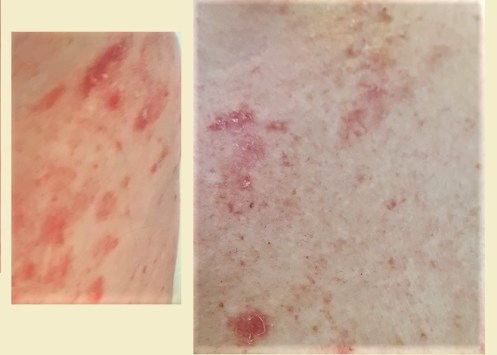
The following two photos I took July 6. While with UV B and methotrexate it had reduced dramatically, once off both those therapies the skin had flared again. My baseline visit was July 17. I’d stopped the UV B therapy a little earlier than I otherwise would have, because I’d stopped in preparation for one trial, then ended up on the sister trial with a later start date.

These photos are embarrassing to share, nor are they anything like “clinical quality” as I just snapped them with my phone, but they are more meaningful that quoting percentages. If my articles are to be useful to readers, I have to be prepared to drop the mask of normality so many of us wear a lot of the time. I wanted my own baseline for comparison. We forget how things looked, over time: I wanted to be able to look at my skin further down the line on the trial and be able to see (or not see) any change. As this trial is for psoriatic arthritis, not psoriasis, no photos are part of the trial documentation.

The image on the left is a patch on my leg. The image on the right is my upper chest, just below the collar bone. You can see older images of my arm on “I am Medication Free! For Now, Anyway…

The skin makes swimming and hydrotherapy embarrassing. Rightly or wrongly, I worry other swimmers are going to think I’m contagious. It just looks…..horrid. Worth mentioning, perhaps, this sort of skin involvement is new to me – when I say new, I mean I went through MANY years of my life with the odd tiny patch which would disappear, or absolutely none. I am not used to this.

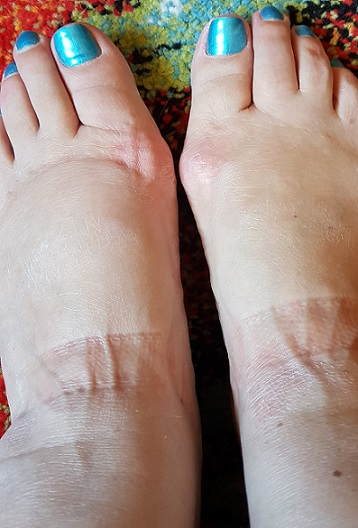
I’ve shared this swollen foot photo before, this was February, just as DMARD number two washed out of my system. This is the psoriatic arthritis aspect. The right second toe is clearly also swollen – dactylitis. Yes, you may indeed compliment me on my choice of polish!

The joint and enthesitis assessment is quite lengthy because it involves an independent assessor testing the many finger and toe joints as well as, jaw (TMJ), feet, elbows, shoulders, sternum, knees and hips (SIJ). It seems as if, if you have a joint, they will assess it! I never think of my toes being sore, aside from the big toes, yet it is surprising just how sore they are when a relatively light test pressure is applied. I knew my thumbs were sore, but all those toe joints: ouch, ouch, ouch.  My fingers, aside from the thumbs, are OK. Even the thumbs are not bad – the soreness doesn’t stop me doing anything AT THIS TIME: however my concern is disease progression. I want, if at all possible, to stop progression.

The assessor also looks at and records the percentage of the body showing skin involvement.

At the point of the above photo, I could not fit my runners on at all – that makes exercise difficult as the gym frown on bare feet for safety reasons. The swelling had reduced a bit by July, but I was still struggling to wear runners for any length of time. The assessor, using a clinical approach rather than my layperson’s visual assessment, flagged many of my toe joints as swollen as well as sore. We get used to looking at our own bits and pieces and over time the abnormal can start to look normal.

Which injections you get is controlled by a mysterious person far, far away. To that mysterious person I am just a number. My co-ordinator emails the mysterious person, who I suspect at baseline tosses a coin to decide which arm I’m in: active or placebo. Of course I am joking – it is likely much more scientific than that. Now I’m curious – I must ask next visit!

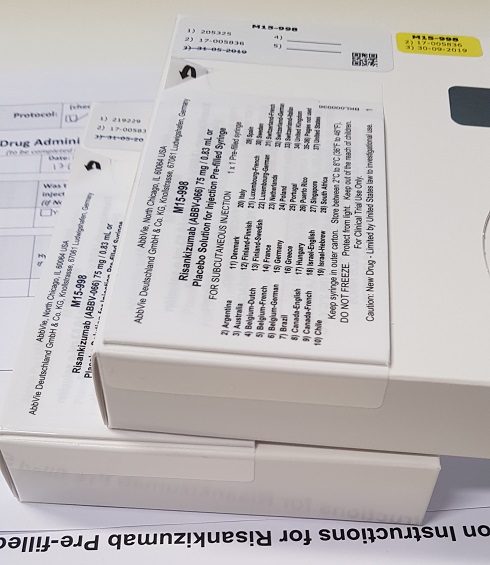
An email comes back advising which two numbered boxes are to be used for my participant number. I wanted to keep the boxes as souvenirs (main photo) but they have to be kept for the trial auditors to check I was given what I was supposed to be given.

None of us, the investigator, or my co-ordinator, or I know what is in those syringes. It is a 50/50 lottery at baseline.

After the injections the trial participant (i.e. me) sits around for two hours in case of an adverse reaction.

Take a book or iPad or Kindle with you is my advice! You may have another participant, of your trial or another trial, to chat to or you may be sitting alone. Very comfy chairs, nice throw rug for colder days, but essentially a pretty boring two hours.

Then time to go home.

Please, PLEASE bear in mind that even if you were on the exact same trial as I am on, you may have a completely different experience to my experience. Your disease would not be at the exact same stage as mine, you may have more or less joints affected, you may have more or less skin involvement, you may suffer more or less fatigue than I do. So many variables. What I write is my specific experience. Your experience may be similar, or not.

The next stage in the loading dose. This happens four weeks after the baseline injections.

I know, I know, you want to know where I am on that graph! Can I fit my runners on now? Well, I gave the runner answer away in a recent article if you are paying attention. Be patient, all will be revealed in good time. I had to wait and see!

Explanation re Concurrent Therapies

Although light therapy is not allowed, participants may stay on up to two DMARDs while on the trial. After all, if the participant is in the placebo arm, if no concurrent therapies were allowed, those participants would effectively be receiving no treatment at all for six months. Each clinical trial will have restrictions specific to that trial.

I am also restricted in what other medications I can take, such as pain medications. Given I rarely take any pain meds (exercise is my pain management), that didn’t worry me. I can’t change my dietary supplements, although I can stay on the ones I started on e.g. Vitamin D as ordered by my endocrinologist, fish oil as recommended by my sports physician. There are rules around surgery during the trial.

These are all considerations when deciding whether to participate in a clinical trial.

A Clinical Trial – Patient Journey – Part I

Background

After discovering last November (2018) that my second DMARD (disease-modifying antirheumatic drug) had to be retired from my treatment regime, I did two things. I tried going medication free. I also started researching drug trials. If being medication free didn’t work, what was going to be my next step? What choices did I have that might be outside the standard treatment pathway?

Why research drug trials in particular? The first DMARD I was prescribed was developed in the 1930s. The second was introduced in 1955, originally to treat malaria but was later found to have immunomodulatory properties. These drugs are as old or older than I – surely modern medical science had something better by now? Something I wouldn’t have reactions to?

Well, yes, there are newer drugs available. Biologics are available on the PBS (Pharmaceutical Benefits Scheme) – IF the patient qualifies. That qualification bar can be high. As a example, this link to the PBS has the qualification requirements for one biologic that may be used to treat psoriatic arthritis. Click on the red “Authority Required” link to see the qualification requirements. When would I qualify? When I was 80? Not really a very positive thought for me. Yes, a private script can be given, but at $1,049.69 for four injection pens that is a little outside my price range long-term. And that is one of the cheaper ones. $40.30 with PBS subsidy. The schedule is usually inject once a week, so that is a monthly cost.

After much researching I found a drug trial that appealed to me. I don’t know who thinks up drug names, but this is risankizumab. Before I learnt how to say it, I referred to it as the “Kazakhstan drug! I had researched the drug extensively, then looked for trials in Australia. The drug had already been approved in some jurisdictions to treat the skin condition psoriasis, so there was plenty of information available. On July 23, 2019 it was announced this drug received TGA (Therapeutic Goods Administration) approval for use in Australia, but is not yet on the PBS.  Published results from those clinical trials were very informative and positive.

The trial in which I am a participant is to assess the efficacy for psoriatic arthritis.

So I had found a drug trial I was interested in for a drug that looked very promising.

What Was I Looking For?

At this point you may be asking what was I looking for by considering doing a drug trial. As odd as this may sound, I was looking for treatment stability. I am now on my fourth DMARD. Each one has not been the right medication for me. As noted above, some of these were not the newest drugs around. Plus there was this encouraging line on the patient information sheet of one: “It is not clear how [drug X] works.” Or this one: “It is not clear how [drug Y] works in inflammatory conditions; however it is thought to have an action on the immune system.”

There is my personality type to take into consideration. I’m one of those annoying yellow quadrant HBDI people – we are the experimental thinkers. This might make me a radical patient, I suspect! It means I’m always looking “outside the box”.

I’d also had the experience of having a Synvisc injection when it was very new – that experience had been extremely positive for me. Trying new stuff is not something that scares me in the slightest.

I have faith in medical science. No, we don’t always get it right, thalidomide being the classic example as I have discussed before. I don’t seem to qualify for the biologics currently on the PBS, yet I was desperate to at least try a medication younger than myself. A medication where the therapeutic action was actually known.

I wanted something that worked without the myriad of side effects I’d experienced to date. I was also looking for a medication that might address the fatigue that goes hand-in-hand with many chronic conditions, including psoriatic arthritis.

A Third and Fourth DMARD

There was an event that drove me even more in the direction of being involved in a drug trial. In March this year, while I was still mulling over the prospect of being a lab rat, I suffered an adverse reaction to my third DMARD. I was prescribed a fourth DMARD. It seemed if there was a reaction to be had from these DMARDs, I was unfortunately a person who was going to react. By this stage I had lost faith in DMARDs as a treatment for me. I must stress, they work perfectly well for many, many people. I’m just not one of those people, it seems. One of the DMARDs had worked wonderfully for the arthritis, but ruined my skin, for example. There was something with each of them.

Again, I stress, all these were the standard treatment pathway. I wasn’t being “mistreated” in any way.

Next Steps

I discussed the proposal with my GP, my dermatologist, my urologist and my pharmacist. All four were very supportive. I have since also brought my gastroenterologist up to speed and he is also supportive. I must make clear I was not asking them from a rheumatological perspective of course, I was seeking any concerns they may have for me in their field of speciality and/or any concerns they may have about MABs in general.

I signed up and waited for the screening appointment. While waiting I bit the bullet and got a second opinion. This rheumatologist was also supportive of my desire to do the trial. Disclosure time. Through sheer coincidence this professor happens to be involved with the drug trial. My GP had written the referral well before I’d found the trial I was interested in. My GP had not even known I was researching drug trials, I had never mentioned it. The fact there was a connection was serendipitous.

Screening

My initial screening appointment was on my birthday! That was in June. So. Much. Blood! They do take a lot of tubes of blood, let me tell you. At least for this trial. I failed the first screening. Probably because I’d been taking prednisolone to try to control the inflammation while DMARD four ramped into gear, my CRP (C-reactive protein) had dropped 0.15 below the cut-off. A month earlier it had been way over. Luckily there was a sister trial with different patient qualification criteria and those criteria I did meet. That meant a second screening appointment. That took place in July. Of course, at this later screening my CRP was back up again, well over the cut-off for the first trial, but the rules are the rules. I am on the sister trial.

You are weighed, height measured, vitals taken, blood tested, joint and enthesitis assessments are done. The skin is assessed. There is paperwork, lots of paperwork. A medical history is taken (I took in a typed history from birth to now). A consultation with a site doctor. All up the screening process takes about two hours.

When I cite visit durations, these are for this particular trial. Other trials for other medications may be longer or shorter.

Active or Placebo?

This is a double blind clinical trial. Those wanting further information on clinical trial protocols in Australia can read this link at Australian Clinical Trials. Yes, there is a placebo arm. While the trial goes for four years, the placebo arm only goes for six months, after that all participants are on the active intervention. My rationale was six months of placebo could not be more difficult than the last six months I’d been through and I would only have to manage for six months if I lost the 50/50 lottery. I had nothing to lose.

I also knew that results from the trials for treating the skin condition showed very little placebo effect and that results had been seen quite quickly. I felt I would have a very good indication before the six months was up of whether I was on the placebo or the risankizumab, based on my skin.

Baseline

My Baseline appointment, the appointment where you actually receive the drug or the placebo, also took place in July. This was a much longer appointment. Essentially all the steps of the screening appointment are repeated, plus the injection, plus the patient has to wait for two hours post injection to ensure there is no adverse reaction. The coffee is good.

How is it going?

I was originally not going to write about this until after the six months. The fact I am writing earlier should be a slight hint. This will be a series as there is way too much information for one article! Tune in later in the week for Part II!

Incommunicado Quads and Walking Sticks

I know I’ve been incommunicado – unfortunately the quads in my right leg also went silent – so silent I couldn’t move my right leg. At 1 am on a Friday morning, not knowing what was wrong, I’ll admit to being a little panicked.

This was a few days after I’d had some very minor, completely unrelated surgery, so it was a bit of a busy time. My knee was already playing up then, as the hospital had helped me into a wheelchair from the taxi on arrival for admission.

Initially I thought I’d just been lying funny and my leg had “gone to sleep” and would recover in a few minutes. When it didn’t, I was a little more concerned. I couldn’t actually make it out of the bedroom – every time I tried, using the windowsill as a walking stick, then swapping to the bed frame – I’d get halfway across the end of the bed and feel SO nauseous I’d have to lie down again. Took me three or four attempts to actually get out of the bedroom. The doctor later told me this would have been due to pain, yet I do not recall any pain, I just could not use my leg. Well, yes, it was very painful if I put any weight on it, but I was studiously avoiding doing that – or so I thought!

To cut a very long story short, I dragged my poor daughter out of her bed, a 40 minute drive away, to take me to the emergency department. By 10 am I could lift my leg about 1.5 centimetres off the bed in ED. By noon I could bend it 90 degrees! Yay! I did not want to be admitted because the following week I was starting a clinical drug trial and intervention at this point might very well have excluded me. More on the drug trial in my next article – it is FANTASTIC.

So I was allowed home with a prescription of rest and elevation. The knee was rather swollen. Something else I didn’t need. It was the swelling in the knee that cut off my ability to use my quads. I should have known: earlier in the week I’d used an ice pack. I remember thinking “This ice pack isn’t very cold” then popping in on my left knee for a moment and thinking “This ice pack is FREEZING”. Clearly there was already a bigger problem brewing than just a sore knee.

My quads shutting down had nothing to do with my psoriatic arthritis. This was just a new problem arriving with very bad timing.

An MRI later and the results were in: “significant osteoarthritis, particularly behind the patella”. Oh, great – just what I need – not.

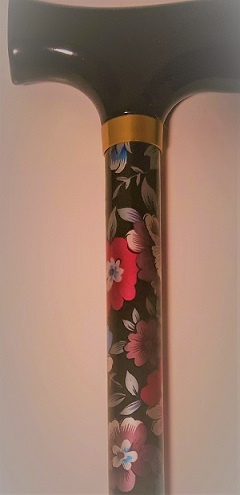
I got one of those awfully boring grey hospital sets of crutches so I could get around. Of course I thought I’d only need them for a day or two. Umm nah. I did manage to get down to one crutch, but I hated the grey, the cuff didn’t fit properly over my denim jacket and I was about to go to a conference in Sydney (more on that in a later article too). So I bought a very pretty walking stick (see above). If I had to use one, I was going to at least be semi-stylish!

Second problem was how to rehabilitate this knee. My rheumatologist advised (just as well, really) exercise to build my muscle strength back up. With the challenges I’ve had since January with medication changes and the resultant psoriatic arthritis flare, my exercise had taken a temporary back seat. It doesn’t take long to lose strength, especially as we age! I am reasonably sure this contributed to the osteoarthritis letting me know it was not at all happy with me. In order to make 110% sure I was doing the right thing, I enlisted the help of an exercise physiologist, Jack. Yes, I’m a personal trainer, but in this specific case I wanted to triple check my approach was correct. Jack has higher qualifications than I do and I do not hesitate to call in the big(ger) guns if necessary. He did get me to start a little slower than I might otherwise have done (a good thing), but by the second appointment he essentially let me loose. I did pick up some nice new very specific rehab exercises from him and am very grateful for his guidance and expertise.

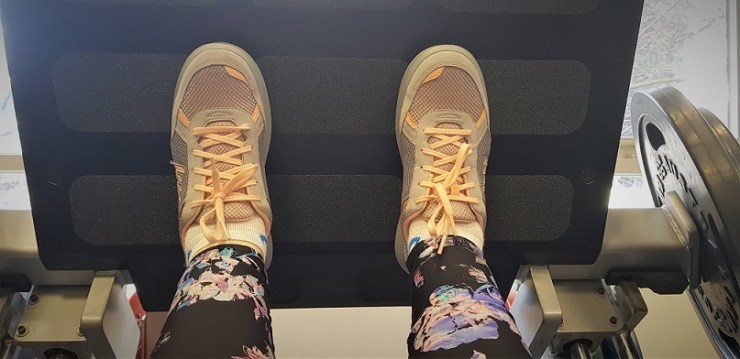
I retired my walking stick on August 29th after six weeks. Yesterday I was back on the leg press, high reps, low weights. VERY low weights. I did one set at 40 kgs and two sets at 60 kgs. I was doing 160 kgs last year! This picture won’t mean much to readers, but to me it was getting my mobility back!

I’ve also been doing hydrotherapy. I’m “allowed” to do as much hydrotherapy as I like. Jack was thrilled I was doing squats in the hydrotherapy pool, I was thrilled he was thrilled with my adaptation! I do them out of the pool as well, but in the pool is good, especially with this darn knee.

Back in 2014 I’d had a Synvisc shot in my left knee (which was great) but of course that strongly indicates that left knee is not all that wonderful. It also indicates (although I didn’t have an MRI of the right knee back then) that perhaps both knees were a little under the weather back then. I had an arthroscopy on this right knee many years ago and until now had no further issues. Well, now I know I have two knees requiring a little extra care and attention. With the extra load the left took while my right was on strike, by the time I retired the walking stick, my left knee was reminding me it is no longer a perfect 20 year-old knee. I threw my hands in the air and applied the rehab exercises to both knees.

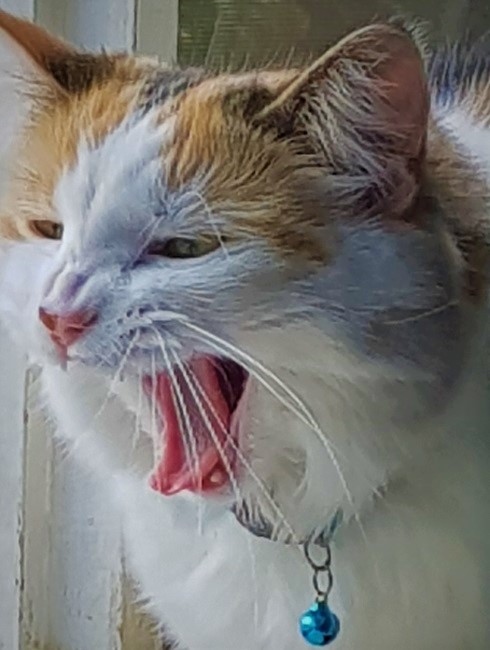
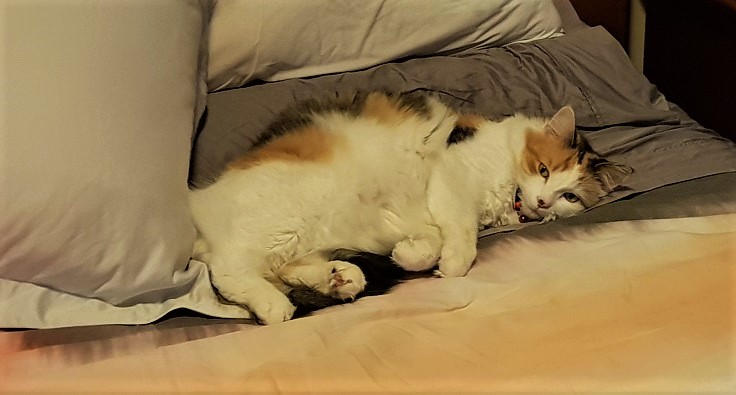
I’m lucky – I have been able to retire the walking stick. Using one is like driving, it takes a long time before it becomes second nature. I felt I was on “L” plates the whole time. I’d drop it when trying to juggle bag, stick and anything else I happened to have – such as a morning coffee. Getting on and off trams was a challenge but at least I was no longer one of the invisibly ill and people jumped up to give me the special needs seats. I now had a badge. I never seemed to be able to lean it anywhere without it falling over – poor Cleo (my cat) nearly got whacked by the flying walking stick several times as it fell to the floor. I felt I just could not get it right. I also felt SO SLOW.

I have a new appreciation and understanding of those who use mobility aids permanently or semi-permanently. In the last week, I carried it with me, but used it less and less as my knee recovered – however then people look at you in very odd ways as you are carrying but not actually using a walking stick. I never thought of getting a folding walking stick – lesson learnt!

That particular situation is much better addressed by Kristen Waldbieser, who does not need her wheelchair 100% of the time.

Between minor surgery and the above, I hope you forgive me for being very quiet. I’m going to make up for that in the coming days. I have a drug trial and a conference to write about! Stay tuned!

Packaging Our Pills in Plastic

Plastic is the horror product of our times. A relatively recent innovation, plastic penetrates every aspect of our lives. Scientists have estimated 8,500,000,000 kilograms of plastic waste is ending up in our oceans every year (source “How Much Plastic Is In Our Oceans”, second video below).

That is a lot of plastic in anyone’s language. Plastic shopping bags, plastic drink bottles, product wrappings. Although there has been much furor recently in Australia over the banning of single use plastic shopping bags at supermarkets, I have been noticing other uses of plastic that we could surely rethink.

Product wrappings: I have been on a linen buying spree of late and the amount of plastic in which sheets sets and doona sets are packaged is quite amazing. Not really reusable either.

Fresh fruit and vegetables: this is one of my biggest gripes. If they are not prepackaged, then we use those silly little plastic bags in the fruit and vegetable section of the supermarket. We get home and into the rubbish they go. There are paper bags for the mushrooms – why can’t we use recycled paper bags for buying our vegetables?

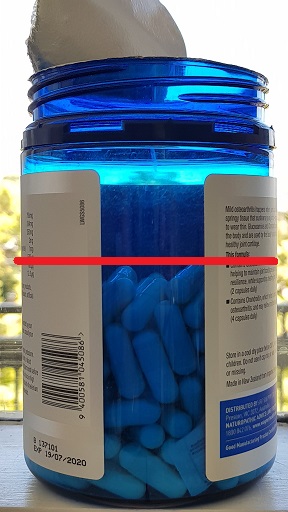
There are many examples. My focus today is medication packaging. Not just prescription medicines either. This first came to my notice when I bought a fish oil supplement.

Red line added to indicate the wasted space

That’s a lot of plastic serving no good purpose.

Then, a month or two later I picked up a prescription for some new medication. The bottle seemed rather large to me for 15 tablets – I was thinking these must be “horse tablets” and was not looking forward to the swallow challenge. Nothing could be further from the truth!

Itsy bitsy teenie weenie yellow tablets that did not even cover the bottom of the plastic bottle. OK, a one-off, I thought to myself. Then that medication got replaced in my regime by another one. These are a bit harder to see, being white in white. At least there are 30 tablets in this bottle, not quite as bad as the bottle above, but really?

I have other medication. Predisolone. Let’s compare the pair.

The bottle on the left in the above picture has 100 – yes, that’s right ONE HUNDRED tablets in it. The bottle on the right has 30. Just 30.

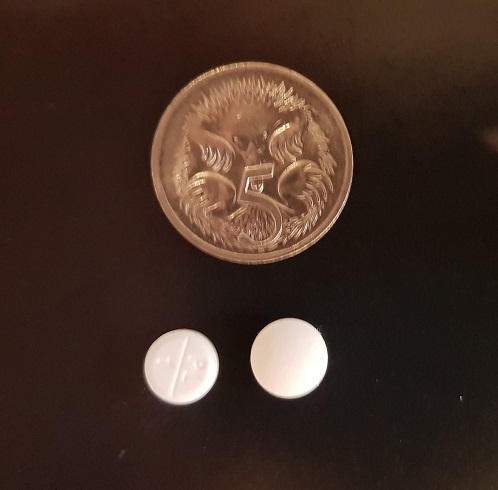
Just to tie up loose ends, let us compare the actual tablets from the above bottles.

Not much difference in size, is there? The tablet on the left is from the little bottle, the one on the right is from the big bottle. But you can’t tell how big the tablets actually are, you say? I thought of that. So here they are below with a five cent piece for scale.

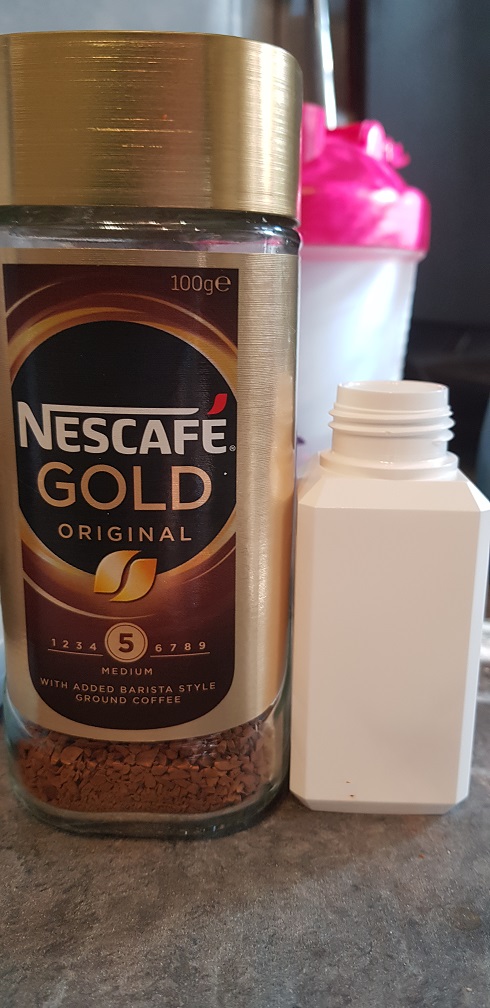
How big is the pill bottle compared with a standard household object? Here it is compared to a coffee jar.

Comparison with a common coffee jar.

I am just one person out of the 7.6 billion people on this planet and I have looked at only THREE pill bottles: two prescription and one a supplement. Extrapolate that out over the world. How much plastic waste is coming from our pharmaceutical industry? Worse, how much of it is superfluous? Containing nothing more than air.

How are these bottles disposed? It varies: the itsy bitsy teenie weenie yellow tablets had to be returned to the pharmacy for controlled destruction. What happened to the bottle itself I do not know, but I trust my pharmacist took the responsible recycling option. But what do most of us do with most of our empty pill bottles? All the bottles I have carry a recyclable symbol. Do we all recycle? Privacy concerns have been mentioned to me: the information on the dispensing label is personal. We can and should return them to the pharmacy, but how many of us do?

Not only are there a lot of them, surely if we have to use plastic we could at least use appropriately sized bottles, not these humongous monstrosities.

Other medications come in blister packaging. While I am focusing on plastic today, there are surely waste concerns around blister packaging as well. At least there doesn’t appear to be as much superfluous plastic involved.

Blister packaging

One suggested explanation for the size of the bottles was that the dispensing label needs to fit. Yet the pharmacy managed to adhere a dispensing label quite well to the smaller prednisolone bottle above. The larger bottle didn’t even get a dispensing label attached as the bottle came in a cardboard box and the label was affixed to the box, not the bottle.

Other patient-centred considerations driving size might be:

  • The need to have a child proof or child resistant cap. None of the examples cited here had child resistant or child proof caps.
  • Larger bottles for ease of use by the patient – yet all those bottles are for me and I have to say ease of use is about the same for all of them.
  • The need to print information on the bottles. Medications come with Consumer Medication Information leaflets. These contain far more information than could be fitted on any size bottle. There are minimum requirements for “on bottle” information.
  • Differentiation so patients don’t get medications confused.

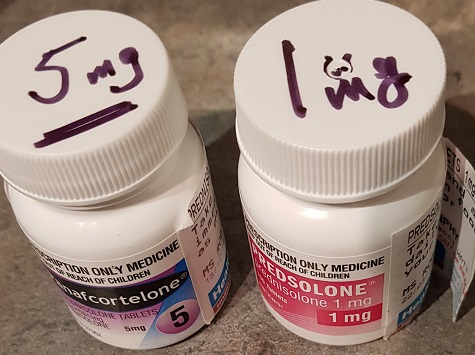
That last one would seem logical if it wasn’t disproved by the following example. These two bottles are exactly the same, but contain different strengths. As you will see I’ve written the strength in large letters on the caps because yes, I have accidentally taken the wrong strength in the creeping morning light when in a hurry. The labels are different colours, but who notices that at 6:30 am?

There are of course cost and manufacturing considerations. The above example, using the same bottle, reduces production costs. Yet if I go look in my medicine cabinet those are the only two that are the same. BioCeuticals, a company producing a wide range of supplements, do use the same bottles for many products. It is cheaper to print and adhere different labels than it is to manufacture a wide range of bottle sizes.

We are concentrating on plastic shopping bags and single use drink bottles. Yet many of us would dispose of more medication and supplement plastic bottles than plastic drink bottles. I might buy a disposable bottle of water once or twice a year only. Yet I have a considerable number of health related bottles in my cupboard.

The other consideration is leachate. Leachate is discussed in the Ted Ed video below. Not all medication bottles are discarded empty. I mentioned above one medication that was required to be returned to the pharmacist for destruction because of the toxicity of the medication. We’ve heard of estrogen ending up in rivers and streams. Other drugs excreted by humans do too.


Medications such as antidepressants, painkillers, antibiotics and estrogen are excreted by humans, and they wind up in treated sewage that is released into the environment, where fish and aquatic animals, even humans, can be exposed.

Source: Scientific American

Over time, discarded, unused medications are going to become part of the leachate from landfill where they have been discarded into the general waste bin OR the recycle collection has ended up in landfill due to contamination, which is more frequent that we like to think about. How dangerous is that over time?

If a bottle still has medication in it, does that contaminate the recycling collection?

How can we encourage the pharmaceutical industry to rethink packaging so we don’t end up with five or six times the amount of plastic needed to dispense a few tablets? It may not be as big a problem as plastic shopping bags, but it is contributing to the global plastic problem.

REFERENCES:

Department of Health, Therapeutic Goods Administration medicine labelling and packaging review, 2012

The videos below discuss plastic pollution generally. Both have been referenced in the above article.

Here is a video with lots of facts and figures from November 2017 – and the situation is only getting worse.

If you are too young to recognise the “itsy bitsy teenie weenie yellow” reference, here it is, just for you.

R

When Medication Messes With Your Mind

Warning: This article discusses mental health issues (medication side effect).

If you are feeling depressed, down or anxious the following support lines are available in Australia.

WHERE have I been? I had an unpleasant reaction to a medication prescribed to treat my autoimmune arthritis. It has taken me a while to feel in a position to write ANYTHING (other than a 280 character Tweet).

My usual policy is not to name medications in my articles, simply because everyone’s experiences are very different with these medications. I don’t want anyone to think negatively of a medication because of my specific experience. However, in my last article I did name the medication I had recently started, methotrexate.

I had an unexpected reaction: both my dermatologist and gastroenterologist prescribe it for conditions in their specific areas of expertise and have never had any of their patients experience a similar reaction. I did locate a study reported on Science Direct that looked at three DMARDS and mental health in rheumatoid arthritis patients: “Anxiety, depression and suicidal ideation in patients with rheumatoid arthritis in use of methotrexate, hydroxychloroquine, leflunomide and biological drugs“. Perhaps there are condition factors at play, but as a patient going through the awfulness, that is really, at the time, irrelevant.

There is no doubt (and plenty of supporting documentation out there) that chronic illnesses can lead to, or indeed have, depression as a co-morbidity.  I’m also well aware and have written before about the importance of maintaining our mental health, so I always ensure I am taking the recommended actions to minimise the risk for myself. This was different.

I thought the first couple of weeks were OK – not fantastic, but OK. I went downhill after that. I won’t cover the full timeline in detail, suffice to say it progressively worsened. In the earlier weeks, there were days when I would feel the cloud lift, could almost set my watch by it, which made me think my body was simply adjusting to the new medication and all would be fine. I took the fifth tablet on the Friday as scheduled (weekly tablet). By the following Monday (three days later) I was leaning against the bathroom hand basin feeling completely unable to shower, do my hair, clean my teeth. Going to work just seemed beyond the realms of possibility. I’d already had time off, waiting for this medication to kick in, I didn’t want to take more time off. I didn’t want to crawl back into bed and hide under the doona, I wanted to crawl under the bed and stay there. It was awful. I had also been crying at the drop of a hat building up to this crescendo.

I dragged myself to work that day, I’m not sure how. The first stop I made was to my wonderful pharmacist. I explained how I felt and asked could this be the medication. Call your prescribing doctor was his immediate answer. So I did. Got an appointment for the Friday of that week. This simple action did make me feel slightly better, I’d done something, I’d taken action.

By this point it was as if there were two people in my head. One, the logical, practical, ex-science student, educated systems professional saying “this is a side effect, hang in there, there is help available”. One of my other doctors, in just general discussion, has suggested that was quite likely part of my problem – I was too logical about it and should have pulled the plug earlier! He thought he’d possibly be the same in a similar situation, which made me feel better about my stubborn perseverance! The second person in my head was the emotional or psychological me just wanting to crawl up into a ball and hide from the world. At times it was like the two were at war.

Did I feel “at risk” at any stage? I don’t believe so, but the logical me kicks in again now when answering that question and says “Can you be really sure? Your mind was not yours at the time.” The best I can say is while I felt, at the worst of it, that I was drowning in some sort of deep, dark, oxygen-depleting substance, at some level I still wanted to rescue myself, to get out of the quagmire.

My prescribing specialist took me off the medication immediately, prescribed another DMARD (this is my fourth since early 2015) and told me to do a two week wash out of methotrexate before starting the new medication. He said if I didn’t feel better in two weeks to see someone (i.e. a mental health professional). I actually did a three week wash out because I had an unrelated day procedure looming in another specialty and he asked me to wait an extra week. Oh, the juggling of it all.

By the end of the following week, (two weeks having transpired since last tablet taken) I was feeling perfectly normal psychologically. Or should I say, normal for me.

Another of my specialists asked why I had been taken off the medication. My response was this.

There is a difference between wanting to die and not wanting to live, but it is a very fine line.” The former requires taking an action, the latter does not. I had at times felt the latter.

In my particular case not being able to exercise, due to the swollen foot and very grumpy shoulder, added to my “downer”. The two physical flares together made both gym and swimming activity inadvisable. I felt defeated. Exercise is not only my primary pain management tool, it is also a great mood lifter. Other clinical benefits are helping control weight and strengthening muscles, thereby protecting and supporting joints. Without exercise I felt I was losing on all fronts. I felt I was not in control of anything.

Mentally/psychologically I’m now fine, but I will never persevere as long again if I have another similar reaction to a future medication. I am aware this is the second time medication has messed with my mind, the first time being when I lost my sense of direction completely. At the time, I didn’t link that symptom to the medication I was on: I thought perhaps it was age related or similar. I’d even asked my then GP was there a test for early-onset Alzheimers as it was so debilitating and I was concerned maybe I shouldn’t be driving.

I remember being in my daughter’s car as she drove me to an appointment, fully functional GPS, very good driver (I taught her, so OF COURSE she is good). I was CONVINCED we were driving in the wrong direction. One week after stopping that particular medication (for other reasons), my sense of direction miraculously reappeared and I’ve had no problem since. No, correlation does not mean causation, but in this case, given I’d never had the problem before and haven’t had it since, I’m leaning towards it being a side effect. With two incidents now, may this indicate I have a predisposition, genetic or otherwise, for these medications to mess with my mind? I have no answer, but I’ll be super cautious from now on.

How am I, right now, physically? It is going to take up to eight weeks for the new DMARD to fully kick in; I’m in my second week. In the meantime I’m supplementing with prednisolone and the occasional Celebrex. I’ve started SLOWLY tapering off the prednisolone, but it will take time. I’m back swimming and gyming, more gently/lower intensity than previously at this point, but I’ll build back up. High reps, low weights for the moment. If I have to nominate a problem body part, it is feet and ankles which have never been a problem for me in the past. New challenges!

We are constantly learning on this chronic illness journey. For each one of us the lessons are different. This has been a difficult couple of months for me, without a doubt. My heart goes out to those people who suffer clinical depression, as I suspect what I experienced, albeit for a relatively short period, may be similar. I am so very grateful my solution was simply to remove a medication and thereby quickly regain my mental health.

On a good note, methotrexate was fantastic for my skin – the primary reason for the medication change! The UV B light therapy had worked wonders, but progress seemed to have stalled before the point of final perfection was reached. There was a small rough patch on my chest I was using as a progress gauge which had stopped reducing in circumference – a couple of weeks on methotrexate and that patch had completely resolved.

I cannot sufficiently thank my medical team, especially my GPs who again went above and beyond, providing additional support at very short notice. My daughter took a tearful phone call from me while she was still at work and spent a Sunday with me for which I was extremely grateful. I should also thank my Twitter friends for putting up with me – they didn’t know what was happening, but in some ways Twitter was a bit of a lifeline – it helped take me out of the darkness, with non-medical topics to try to focus on. I was on there WAY TOO MUCH!

I have deliberately written this article in “patient voice”. Not just for fellow-patients but for any health professionals that may wander past. None of us are alone. I realise I am taking a personal risk in publishing this: we are generally not a society that deals with chronic illness terribly well. We do much better with acute illness, where people get better. I still work in the “real world”, so publicly disclosing vulnerability can carry a price. Yet if we continue to hide ourselves away, to be silent about the challenges we face, we will not encourage change. I’m taking that risk.

If you notice a detrimental change in yourself that just doesn’t seem right, don’t try to soldier on without consulting your health professionals. It isn’t always new medications either, sometimes problems can arise after considerable time, for example two years. A special word of warning to those of us who live alone. We don’t always recognise what is happening to ourselves, especially if the change creeps up on us. We don’t have others to give us feedback. Looking back now, this was a little insidious. The accelerator really pushed down in that last week. We have to be extra vigilant, I think.

Time will of course be the judge, but hopefully I’m back on an upward path. All this because I wanted my skin back!

Footnote: This article is the third in a series detailing my medication change experiences. The first two articles are:

No Remission for Me – At Least Not This Time

My experiment didn’t pay off. Am I sorry I did it? Not really, because knowing me, had I NOT done it, I would have always wondered. That is a very personal characteristic: it would not apply to everyone! While I am a firm supporter of modern medicine, I don’t like taking any more medications than absolutely necessary – had I not done that three month wash-out, I would have always wondered was I taking medication when I didn’t need to. Now I know! I need a medication!

The one thing I have learnt is this autoimmune arthritis, currently considered to be psoriatic arthritis, has a tighter grip on me than I thought.

So what happened? I was fine until about two weeks before the three month wash-out period ended. First I got a sore toe on my right foot. I thought nothing of it as I had been wearing in some new shoes plus it was possible I’d stubbed the toe without realising it. Then I got a VERY sore brachialis origin – thought maybe I’d strained myself in the gym, but couldn’t quite figure out what I had done, given I am so careful. Plus my right shoulder was tiring when I was swimming.

A week before I was due to see my rheumatologist, my left foot started swelling. Right at the moment I have only one pair of shoes I can wear and that is only because they are sandals with adjustable straps! These are my feet compared after a day at the office.

Today, I have a sore toe on my right foot, a swollen left foot, my whole right shoulder and upper arm are causing me issues and the discomfort is radiating up my neck. My fingers are a little stiff, but nothing too bad. My knees are grumpy, both of them. I’d being trying to avoid prednisone, but I’ve capitulated. Only a small dose though, to tide me over.

On a good note, my skin and nails look fantastic!

Two weeks ago I started methotrexate. Too soon yet to feel any improvement: so far no side effects. My dermatologist will be very happy – he wanted me on it straight away.

I am sad I’m back on medication, but I am grateful there are medications that will help. This is my third medication since the start of 2015. I am hoping this one will improve the fatigue and the brain fog, both of which have always been a bigger problem for me than actual pain (until right now, that is).

The brain fog is partly why I haven’t been writing – thinking is actually a struggle, particularly at the moment. Aside from that, I was wary of writing that I was fine until the jury was in at the three month mark. I knew I was taking a risk and did not want to sound celebratory until I knew whether I had anything to celebrate!

Will I do it ever again? I think, given my age, probably not. If I can get the brain fog to lift, I’d be ecstatic, as it is the one symptom that I find really soul destroying. I’m  good at managing the level of pain I experience, it is the brain fog that drives me nuts. I used to be an avid reader – now I am not simply because the combination of fatigue and brain fog makes it a challenge rather than enjoyment. Mind you, it is all relative I suppose. I was speaking to a contact the other day, bemoaning the cognitive impact. The response was something along the lines of, “Well, I’m glad I didn’t have to debate you before you got sick, you’re sharp enough now!” Maybe they were just trying to be nice. But us sufferers, we feel the loss very keenly.

The fatigue is helped by exercise, but with swollen foot and dodgy shoulder, I’ve been instructed to rest for the moment. This is SO not me, I’m struggling with abiding with that instruction. Mind you, it is difficult to go to the gym when my runners don’t fit!

In another two weeks I can hope for some improvement. Regular blood tests are again the order of the day, something else to fit into my schedule.

I have four weeks of UV B light therapy to go. Although it only takes a couple of minutes, it does require careful scheduling and at three times a week I will be glad when it is over: I won’t have to dash from work to the dermatologist at a specific time. A little flexibility will be restored!

Yes, I’m disappointed, but I’m happy I had the opportunity to try. Many people are too unwell to even consider such a trial. The fact I could, I am taking as a positive.

Now, just let me get back in the pool!!! I miss my swims!

I Am Medication Free! For Now, Anyway……..

Right now I am medication free! No, I have not forsaken the wonders of modern medicine in any way shape or form, but in careful consultation with my rheumatologist I am taking nothing at the moment. How long this will be the case, I am unsure: we will reassess in February. If anything goes belly up, I’ll just make a phone call.

NEVER CHANGE YOUR MEDICATIONS WITHOUT YOUR DOCTOR’S APPROVAL.

Why is this happening? The medication I was on, my second inflammatory arthritis medication, was GREAT for the arthritis. However, it is considered not so great for my skin. This is my left arm a couple of days after the biopsies. This is the worst patch, always has been the problem area. Ignore the scar circled in black – that was the result of having a run-in, literally, with a broken fire extinguisher. The area circled in green is one of the biopsy sites.

Why is my suture not covered? Well, the steri strips started to come off, so I soaked them off. I can not use bandaids of any sort any more, my skin is so fragile – I remove them and the skin comes with them. Rather nasty, so I just don’t go there. It is bandages after bllod tests these days.

About two years ago we investigated my skin and it was then diagnosed as photosensitive eczema. It looked a little different back then. This November I have a completely different diagnosis. This does not mean the original diagnosis was incorrect – things change. In 2016 I was on different medications. Around the time of that first diagnosis I changed my arthritis medication and early this year (2018) I ceased taking medication for my hyperthyroid, having undergone radioactive iodine treatment. So a few changes in the two years.

My skin diagnosis now is atypical psoriasis, believed to be exacerbated (considerably) by my arthritis medication. My dermatologist discussed the matter with my rheumatologist and off the medication it is! I am starting UV B light therapy in the new year – can’t wait! I say atypical because it looks more like subacute cutaneous lupus erythematosus (SCLE) (per dermatologist) than psoriasis, but the biopsies, thankfully, told a different story.

My nails, which usually readers never see due to my passion for polish, look like this. Not all the time, it comes and goes, but the little fingers are particularly unhappy at the moment.

The next medication in line for me, agreed to by my dermatologist, rheumatologist and gastroenterologist, is methotrexate. By the time I saw my rheumatologist, I had been medication-free for a month and I don’t feel too bad at all. I asked about the possibility of seeing how I go without any medication. Other medical professionals are investigating some other symptoms I’m experiencing, some of my blood tests have been a bit erratic – it might be easier to isolate a cause if I’m medication free. That consideration aside, the less medication the better makes me happy. Methotrexate only takes four weeks to “kick in” and I’m certainly not going to be a martyr about it – if I feel I’m going downhill, I’ll be in my rheumatologist’s office very quick smart. I have backup medications in case I flare.

As I have to change medication anyway, it is an opportune time to try and see what happens. My arthritis related blood tests have improved considerably since late 2014 when I was diagnosed.

So how am I finding it? My feet have niggled at me a few times, both my knees are slightly grumpy at night if I walk too much during the day, the base of my thumbs hurt a little bit with certain grip actions (think holding my drink bottle to unscrew the top). If I have a really busy day I do stiffen up at night – but then that is not exactly new, I don’t think it has gotten worse – it is also more likely related to the degenerative changes in my lumbar spine than the arthritis. Other than that, I can’t complain. I swam 1,100 metres today, the first time I’ve managed a swim session over 1,000 metres for quite some time. I did 40 minutes strength training yesterday, my quad strength is actually improving. I did 9,000 steps (accidentally) on Thursday with no ill effects.

My biggest concern is my fatigue/lethargy may return. For me, that was a major problem. Settling the thyroid helped, of course. Now my bloods are indicating my parathyroid is not behaving – endocrinologist appointment in January to try to get to the bottom of that.

The BEST part is I can go out in the sun – sensibly, of course. I’ve spent two years avoiding any sunlight because of my skin, slathering sun cream from head to toe: slip, slop, slapping to within an inch of my life. Yes, I still have to be Sun Smart, but at least I can be normally Sun Smart now instead of paranoid! I also feel better psychologically: I felt as if I was a constant Seasonal Affective Disorder patient.

I don’t know if I will stay free of medication for the arthritis. I see this as an experiment. I do seem to be susceptible to the side effects of medications so if I can stay as healthy as I am now, I’ll be happy. Any deterioration, I’ll be in my rheumatologist’s office. It takes a while for the drug to wash out of one’s system, so I won’t really know for three months – I’m only a third of the way through.

I am very grateful to my specialists for allowing me to try this. It would not be an ideal option for a lot of patients, I know. I am certainly not recommending what I am doing and would definitely NOT be doing it without having discussed all the pros and cons with my guardian angel doctors. I am monitoring myself carefully.

The physical fitness and strength I’ve slowly spent four years building back up has certainly helped me manage my condition so far, but no, there is no guarantee by itself it is enough.

We shall see – wish me luck!

Magpie

Exercising in Summer When You Are Heat Sensitive

Many of us with chronic conditions are in the unfortunate situation of needing exercise yet at the same time, we are heat sensitive (sensitive is an understatement in my view, but it is what it is). Exercise makes us hot – or at least warmer than normal, depending on the intensity of our routines. How can we get through summer and keep up our exercise regime? We need to keep pain and stiffness away!

For those of us not native to Australian heat, it may be even more challenging. Well before I got sick, way back in 1974, I arrived in Melbourne on a February day. 38 degrees Celsius. Up until that point in my life, 23 degrees was a warm day! I thought I’d landed in Hades! I had a girlfriend living in Adelaide at the time whom I visited. If my memory serves, over there it was 43 degrees. I remember lying on her kitchen tiles to try to keep cool.

Earlier today I saw the magpie above, pictured here keeping cool under the protection of the leaves, with beak open and wings lifted from his body to maximise heat loss. I missed that image, but was pleased to see him looking cooler.

Over the years I had somewhat acclimatised, until I got sick. For many of us, heat intolerance/sensitivity is entirely new, so how best to cope?

Ensure Your Gym is Properly Cooled

This gives you some flexibility with staying active. Today, I will be walking inside, not outside. Treadmills are not my preference, I much prefer walking outside, but I found even walking at 6 pm last night uncomfortable and we are nowhere near summer yet.

Allow yourself to cool down before you venture outside.

Swim

If you can, swimming is a great exercise and the environment is cool. Getting to and from the pool may not be so cool, but with good air con in the car and a close car park most of us should manage.

If you have never learnt to swim, think about lessons. In addition to the physical benefits, swimming has been shown to have mental health benefits, so important to those of us managing chronic illness.

You may need to invest in a rashie for adequate UV protection depending on the time of day you prefer to swim.

Hydrate!

I wrote Hydration Habits – Are You Drinking Enough? recently, so I refer you to that article for the detail. Make sure you hydrate before, during and after exercise.

Cool Your Skin During Exercise

I have lesions on my left arm, the result of medication-related photosensitivity, which become bright red when I exercise. I run my arm under cold water between sets. A wet towel on your face, chest or back can help. Some gyms have large fans facing the cardio equipment – turn them on.

Change Your Routine

In Victoria we are into daylight savings time. Use it to your advantage. The UV danger window has shifted an hour and the evenings are lighter. Check the UV ratings every day, work around it. If walking outside, walk later when it is cooler, or earlier if you are an early riser. Early is not an option for many with chronic conditions as our energy levels seem quite depleted most mornings.

Hydrotherapy Pool

If you have access to a hydrotherapy pool, this can be an alternative to strength workouts in the gym. I find the water temperature a little warm for me personally, but I still do exercises in it. A quick dip in the normal pool to cool off before the trip home is a sensible move, or a cool shower.

Wear Light, Loose Clothing

I’m a minimal clothing person in summer, I always have been. The concept of long-sleeve shirts, rashies in the pool, sunnies and hats was never my style. Now I own long-sleeved shirts of 50+ protection fabric. Of course, while this helps my photosensitivity, it doesn’t help my heat sensitivity as much! Learn to juggle the clothing style, time of exercise and type of exercise that best suits your personality. Why is your personality important? Because we are all more likely to do something we are enjoying. If we HAVE to wear a hat and we hate hats, we will be less likely to go for that walk. Better to change the time so we don’t need the hat.

Summary

It is getting warmer now, so now is the time to experiment and plan for the warmer times coming. Know what you will do on really hot days, so when they arrive you are prepared. Know what temperature is your definite “Don’t leave the house” temperature. What will you do those days, to keep yourself moving? Double your stretches, maybe. Use thera-bands. Do body-weight squats and push-ups at home. Leg lifts with ankle weights. There are options. These ankle weights of mine have 4 x 575 gram removable weights, so super adjustable for home use.


If you are in a pacing UP phase, the UP may need to be put on hold on really hot days – it just may not be sensible to have that level of exertion. That’s OK, just keep moving.

When all else fails – get a manicure! At least the salon will be cool.

Manicure


Tiger Pacing

Pacing THRU, Pacing UP, Pacing DOWN

Pacing is very important in the management of chronic conditions, including chronic pain management.

A year ago today I wrote Pacing for Beginners, an article that essentially talked about pacing UP, In other articles, such as Beat the Boom Bust Cycle, I have referred to pacing, in the context of pacing THRU. What’s the difference? Isn’t pacing, pacing? Well, not really.

We need to understand the difference so we don’t get stuck doing one, when in fact the other or both may be more beneficial for our long-term condition management. We risk pacing DOWN.

Pacing THRU

Many chronic condition patients suffer fatigue. The degree will vary from day to day, the severity will be different for each patient. Natalie van Scheltinga has a very good description in Fatigue In Chronic Illness Explained, using “The Battery Analogy”. Some people find this analogy works better for their situation that the oft-cited Spoon Theory. Both are good illustrations of how the fatigue can affect one’s daily life.

We are all different. Both these images below are daisies, yet one has WAY more petals than the other. Think of each petal as a unit of energy. We could make this really complex and compare the size of each unit of energy, but let’s not delve that deeply today. Most chronic illness patients have a certain number of petals they can use per day. Increasing the number of petals, if possible, is a good thing.

White Daisy

Pacing THRU is about getting through the day with the energy we have. Yes, we DO have to be careful not to go overboard. Even now, as healthy as I now am, I am still technically “sick”. I know that a two hour commute to work would not be something I could do on a regular basis. On the days I do my strength workouts, the strength workout is the only major “task” I do that day. I am playing around with my routine currently, more on that later.

Pacing UP

Pacing up is used in clinical pain management settings. It is, of course, also used in sports, personal training and a host of other activities. I paced UP, over a four year period, from 5-minute walks several times a day to whole body strength work-outs and swimming. No-one runs a marathon without building up to it.

Pacing UP is not just about being able to walk further than yesterday or regaining the ability to sweep the floor. It is also about energy levels. As we improve our physical endurance and strength and reduce or eliminate our pain, we sleep better, energy levels improve, functionality improves. Our overall quality of life improves.

It should be noted pacing UP does not always involve movement. For example, if sitting causes pain, pacing UP may be used to extend the body’s tolerance to sitting. For the purpose of this discussion today, I am referring to movement.

Pacing DOWN

If we only pace THRU and don’t have a strategy in place to pace UP, we run the risk of pacing DOWN. When we pace DOWN we run all the de-conditioning risks I repeat regularly (some may say I repeat ad nauseam). We will get sicker, likely experience more pain, lose more functionality.

de-conditioning

Our quality of life will deteriorate, we risk losing our independence, our freedom and possibly our financial stability. Pacing DOWN is not good. As with pacing UP, pacing DOWN happens gradually. We may not even really notice it: until the day we realise we can’t do something we used to be able to do easily or we notice our pain has increased. Yes, for some this will be because of disease progression – for many others it will be the result of inadvertently pacing DOWN.

We are a little delicate, like the dandelion seed head. Remember as children blowing them? It doesn’t take a lot to blow us away either. Yet we are also stronger than we realise. Bring that strength to the fore, use it.

Dandelion

Pacing THRU and UP

It is a recipe. A lot of THRU and a little bit of UP to start. Mix gently and simmer over a low heat.

Most chronic illness patients will need to do both. Initially, more THRU than UP. The plan should be to reach a point where UP become easier and THRU becomes less of a concern. DOWN? Avoided totally.

Practical example from my own experience. For some time my routine has been two strength workouts a week, one  swimming session and daily walking. I’ve been pacing UP within those sessions; increasing weights, increasing swim set metres. This is where balancing UP and THRU comes into play. I have a target number of steps for the day, at the moment 7,500. When I am in the gym, I still clock up steps. When I am in the pool, I don’t, even though 1,000 metre swim is considered roughly 4,000 steps. So, if I were to increase my total swim use of energy, should I still aim for my 7,500 steps? I’d have paced UP my swimming, but I would NOT have paced THRU my day and run the risk of draining myself and paying for it the next day. Then I would possibly actually drop my activity level the following day, which is not to my long-term benefit. Sure, one day here or there is not a massive issue, but if a pattern develops, it becomes a problem as it can lead to pacing DOWN. Yes, my ultimate aim is to have both: increased swimming distance AND my steps target. I have to balance getting there.

The appropriate balance needs to be carefully planned out for each person, depending on their particular situation, conditions and degree of condition progression. Sometimes we can feel discouraged. Giving up, giving in, is not an option.

SMART Goal Setting

It is important to set goals to measure progress when pacing UP. Please click through to Make 2018 YOUR Year for SMART Goals, where I outline how and when to use goal setting to assist you. I know 2018 is drawing to a close, but the strategy remains the same!

I am looking at new goals for myself for 2019. That’s why I am playing around with my routine. When I moved from one strength session a week to two a week, I needed to be careful to not overdo any particular day. I increased my total for the week, but each individual session is less that my original single weekly session. If I increase my swimming, how much do I adjust my step target on those days? What will work for my body? So I’m trialing options at the moment. I’ve reached a stage of improvement where I can do that.

This article is of a general nature and does not constitute specific exercise advice for any individual person. For patients with particularly complex or advanced conditions, this may not be appropriate. If in doubt, seek professional guidance.

Contact me for a confidential chat as a starting point to pacing UP.

Main image “Pacing Tiger” Heather Ruth Rose/Shutterstock.com

Further Reading:

4 Resilient Ways to Cope With Chronic Pain – Huffington Post

Doctors and Exercise – Limberation.com

posture

Is Your Posture Exacerbating Your Pain?

What exactly IS posture? When I was a young girl we were taught “shoulders back, tummy in” and a lady NEVER looked down when descending stairs. We learnt to walk with a book on our heads. I am sure many of you remember similar lessons.

Good, or ideal, posture is when there is a state of muscular and skeletal balance which protects the body against injury AND/OR the progressive development of irregularities. More on that in a bit.

Faulty posture is when we sit or stand or move in such a way that we create a faulty relationship between various parts of our body, primarily musculature, which places undue/increased strain on some muscles and not enough effort is required of other muscles. This leads to imbalances: some muscles become weak, others may become tight. Some may become stretched, others shortened over time. Pressure can be applied to other soft tissues causing additional pain or discomfort or restricting function.

What all this can lead to is a worsening, or progression, of any musculoskeletal issues we may be having. As regular readers will be aware, I have several back issues, the reason I converted to kyBoot shoes in the first place.

It may not be chronic conditions that cause faulty posture. It may be chronic habits! The most common such chronic habit is sitting at a desk all day. Office workers can develop upper crossed syndrome (UCS). The person may end up with permanent forward head, increased cervical lordosis, rounded shoulders and thoracic kyphosis. This all involves tight/shortened upper trapezius and levator scapulae and six other muscles in the region. Seven muscles, including serratus anterior, rhomboids and lower trapezius all weaken. Not sounding good is it?

How are you standing?

Injuries that may result include headaches, bicep tendonitis and impingement of the rotator cuff. Chronic habits can lead to chronic conditions! It worth noting the rotator cuff is actually made up of four different muscles: infraspinatus, subscapularis, teres minor and supraspinatus.

What we tend to do is adjust how we sit, stand or move to relieve a discomfort or pain we may be feeling. This is called guarding. While this is certainly logical in cases of acute injuries, for example, if we have broken an ankle, in situations of chronic conditions like my back, guarding may not be so helpful at all over the long term as it can reduce the muscles’ ability to support the very structures you need those muscles to be strong enough to support. The muscles of the core and posterior chain support the spine for example, but if I don’t stand, sit and move correctly, over time those muscles will not function as well and the back pain I will experience will get worse. I know – I’ve been through it!

Personal trainers, fitness coaches, allied health professionals such as physiotherapists and osteopaths can all assess posture. A fitness professional may refer a client to an allied health professional for additional assistance if deemed necessary, or may prescribe specific exercises or exercise technique adjustments to help strengthen weakened muscles and improve posture.

What, as an individual can YOU do to help yourself when the professionals are not around to monitor your posture? Learn to be your own monitor. Make sure you know what good posture not only looks like, but what it FEELS like. I have a very good eye for detecting postural abnormalities in other people, yet I have had to focus really hard on detecting the same in myself. I know where my ankles should be in relation to my hips, where my ears should be in relation to my shoulders, where my shoulders should be in relation to my hips. But I can’t always see myself and we slip into old habits easily.

Habits are hard to break. We do a lot of life on auto-pilot: drive the same route home each day, walk to the train station without thinking about it. Our posture is also often a habit. We have to work hard at developing a new habit.

Knowing it and doing it can be two different things. When out walking, I will monitor my reflection in shop windows for example. I had, over the years, developed some degree of kyphosis and rounded shoulders (I was a desk jockey for so many years). As a result of the back issues I have, I had also developed a tendency to lean slightly forward. These aspects of poor posture are easily detected in a reflection. I consciously correct myself.

What if I am in the park and there are no shop windows? If I apply mindfulness to my body I can feel myself not standing tall, I know I do not have a neutral spine because I am leaning forward. I make the effort to correct my posture.

Fair warning: when you start doing this, it is actually tiring. The muscles have become weak over time and it does require physical effort to hold yourself in the correct position and keep walking. Just as those muscles became weak over time, they WILL regain strength over time if you persevere.

Yes, you may feel a twinge of pain as well as you straighten up – yet that passes and you actually think, “Gee, that DOES feel better!” A caveat on that – you may need to do strengthening and corrective work before you get to that point, depending on your current situation.

While a fitness professional or allied health professional may have prescribed daily exercises and these certainly will help, being conscious of your posture throughout the day will see results achieved faster.

This is not to say I never have back problems any more. I have degenerative structural changes in my lumbar spine. If I have a day where I completely overdo things, or do something I shouldn’t (such as sit for too long), yes, I will still end up stiff and possibly sore. With the right stretches, some walking and maintaining my strength workouts I now bounce back quickly without any need for pain medications. My kyBoot shoes have been a major component of my personal tool kit over the past twelve months.

I highly recommend consulting with a professional who can assess posture and prescribe exercises that will focus on the problem areas. Increasing or maintaining functional movement needs a long-term comprehensive program including footwear, stretching, appropriately targeted exercises (including strength work) and constant awareness to prevent lapsing into old habits.

For desk jockeys sit-stand desks are great, but be aware research is indicating neither sitting NOR standing all day are good for our bodies, there are health risks in both situations. Movement is the best medicine. I have a sit-stand desk in the office and I am also lucky in that I walk around a large campus quite a bit. Between alternating sitting and standing, and the walking, I move a lot during an office day. Not nearly as much as a nurse or a policeman on foot patrol, but more than many desk bound people.

Ensure you transition between sitting and standing with correct ergonomic positioning of your desk (and chair). If in doubt, ask your Occupational Health & Safety team for advice. The University of Western Australia has good reference material too, including a page on sit-stand desks.

This is an edited article originally published on the kyBun website.

Images used under license from Shutterstock.com