We All Get Those Weeks

Perfectly healthy people get “those weeks”. Chronically ill people get them too, even us retired ones. My purpose in sharing my week is to assure other chronically ill people, you are NOT alone. Things just go nuts sometimes.

For a few weeks I had been experiencing a recurring tightness in my chest, off and on. Then I was getting spasmodic nausea episodes again. Occasionally I was feeling lightheadedness. My gut feeling was along the lines of my actual gut playing up, BUT to be on the safe side, I called Nurse On Call. Because of my medical status and my symptoms, the nurse called an ambulance, so I ended up in the Emergency Department (ED). This was Thursday, October 20.

Why did I call Nurse On Call? Well, last time I tried to walk off left upper quadrant abdominal pain and ended up taking myself to ED, my GP was not overly impressed with my self-care solution, so I thought this time I’d be more sensible.

Even so, I felt like an absolute fraud – I was convinced someone else needed that ambulance more than I did. In ED they did the appropriate blood tests, which all were, thankfully, negative. They organised a NM Myocardial Perfusion stress test for the morning to categorically rule out my heart as the cause of my symptoms. I was allowed to go home.
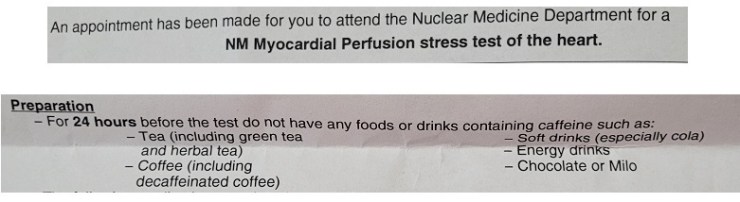
Specific grabs from the paperwork

Prior to my trip to Nuclear Medicine the next morning, I prepared my breakfast (I had checked I didn’t need to fast) and made my coffee. I then re-read the paperwork (luckily). For 24 hours before the test, NO caffeine. The cup of coffee went down the sink. Water it was.

The stress test went without a hitch and despite my known nocturnal AV block, my heart is functioning very well.

The general consensus was at this point back to my gut (after we had discounted gall stones on the basis I have no gall bladder). So I have doubled my Somac (Pantoprazole) as per previous gastroenterological advice.

Missed my weight training on the Thursday. Not happy. Given I now had the heart all clear, I was back lifting weights on Saturday. However, I was modifying my workout because that morning I had woken up with VERY painful hands and fingers. Took 15 mg of Prednisolone per my rheumatologist’s instructions for situations like that. If it wasn’t one thing, it was another. The inflammation in my hands was not going to impact my lower body!

I took Sunday as an active rest day.

Yesterday (Monday) I lost my grip on the coffee jar. It hit the coffee mug. The coffee mug hit the floor.

My coffee mug!

Later in the day I went to cut some cheese. Cheese is soft, right? My right wrist was so painful I could not cut the cheese. The wrist wasn’t sore just hanging around doing nothing, but I could not cut cheese. So 15 mg Prednisolone again this morning (yes, could have taken it last night, but it interferes with sleep, so this morning it was). THIS time I will take it for three days.

Also yesterday I had to venture into dangerous territory – public transport. You see, as well as the above, I had noticed my gums were receding slightly. I needed a trip to the dentist and public transport is the only real option as parking is a nightmare in the city.
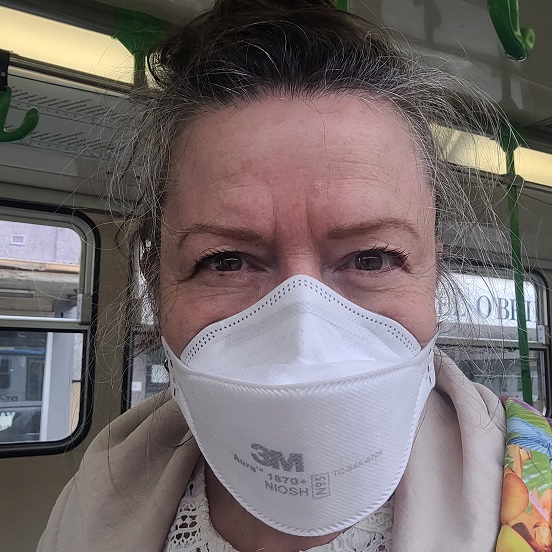
I’m masked for public transport!

Virtually no-one was masked. Going in wasn’t so bad as there were not many other passengers: coming home was a crowded carriage and I counted only two other people wearing masks and one of those two was clearly a health care worker. Now mandatory isolation has been done away with, I can only imagine how many Covid-19 infectious people might have been on that train. Hence the full force mask! That is not a typo, by the way – I do mean full force!

To digress slightly, I have been working with a team on a petition to reinstate mandatory Covid-19 isolation. My suddenly having these personal health glitches was not helping as I was not contributing as I wanted to. As you are reading this, please visit, read, sign and share the petition! We have over 12,300 signatures so far!

All the while my guts were not exactly behaving, but I’m not going into details, that is more than enough information! As I am typing this, I have needed another nausea wafer, but at least there is improvement from last week!

Today it was back to the GP to confirm I am doing all the right things. Then it was off to the gym, again being careful of my hands and adapting my workout. When I came out of the gym, I looked as red as my lipstick, but sadly the darn camera did not capture the redness! I was annoyed at my camera!

After my workout

Despite all of this, I have still kept up my step count, except for the Thursday. I’ve still found flowers, including the great foxglove which reminded me of my childhood.

My walking flowers

So that is my week so far. Some of us will get much worse weeks. After all, I’m just juggling sore hands and a grumpy gut. Even when “mildish”, these weeks can be disruptive. I’ve had difficulty concentrating. I haven’t got the things done I wanted to do this week. I’ve been very grateful I am retired as the fact I’ve been below par hasn’t impacted work colleagues or work deadlines. I still managed to paint my nails (of course).

To friends and family members of chronically ill people, please be aware that even though we may essentially have our conditions under control, well managed: we will still have “those weeks”. Make your patient a cup of coffee, take them out to lunch if they are up for it. Be gentle.

Reminder: this also links into the topic discussed in “We Don’t All Look Sick! Invisible Illness“. Please read that too if you have a moment.


Let’s Talk About the Medicare “Fraud”

Two days ago the ABC published a scathing assessment of fraud and waste. Sadly, this alleged behaviour has generally been attributed to general practitioners (GPs).

My writing focuses on Movement As Medicine and the challenges of chronic illness. Doctors are a vital part of the life of any person with a chronic illness. At one point in my journey I had ten, yes, that’s right, TEN specialists. I am quite an experienced patient, one would suggest, including experience with the topic of billing. Furthermore, I am an accountant. And I have worked in hospital finance departments with exposure to the complexities of billing.

As a patient, I have skin in this game. You come after my doctors, you are coming after me too.

I will say upfront yes, I have no doubt fraud does occur. Let’s be honest here, I am an accountant yet I know full well there have been convictions of crooked accountants. There have been convictions of crooked lawyers. No profession is free of bad apples.

It is also very obvious that Medicare is a VERY complicated system. Sometimes even a stupid system. Example: I can not have two foot MRIs on the same day. Why? I have two feet. Should I have one MRI at 11:50 PM and the other at 12:10 AM the next day? This is a stupid rule. I know of a mother whose child was injured in a sporting accident. Child needed MRIs of BOTH lower limbs. Medicare rebate only allowable for one, so mother had to pay for the other MRI in full. I once went to a pathology collection site with three pathology request forms from three different doctors. I was told I’d need to come back the next day for one of them as two doctors had ordered the same test (amongst others). The pathology organisation in question would not automatically share the result of a single test. Protecting their revenue stream, yes, I get that. Not good, but not exactly illegal. I paid, in that case, as I did not have the time to visit again the next day.

Which brings me to the next point. Medicare is not just GPs. It covers pathology, imaging (MRIs, CTs, x-rays), child dental, psychology, specialists, surgeons, various allied health providers under Health Care Plans….. the list goes on. Why is it being suggested GPs are the primary alleged perpetrators here?

Medicare expert Dr Margaret Faux believes wrongful claims are being applied to millions of billings

https://www.abc.net.au/news/2022-10-17/medicare-leakage-fraud-waste/101537016

Believes? Believes? I do hope Margaret doesn’t say to patients “I believe you have cancer, here take this chemo”. Actually, patients are safe, as Margaret is a lawyer, not a medical doctor. She has a PhD in “Claiming and compliance under the Medicare Benefits Schedule”, completed in October 2021. Interestingly she runs a medical billing business – more accurately an administrative solutions to the health care sector business that includes billing.

I’ll let you think about that, it would be inappropriate of me to comment further.

Quite rightly, many GPs are not feeling great about this sort of media coverage.

I don’t blame them. I’m upset on their behalf. I’m also, personally, concerned that this is being driven by the never-ending attempts by certain political persuasions to completely privatise our health system. To become the USA, where patients ration their insulin. Where you can’t choose your doctor, essentially your insurance company does. Where insurance companies can overrule medically indicated treatments.

I have no doubt errors occur. Classic example is the processing of bulk-billing then charging a gap fee. Simply administratively wrong as the patient then fails to met the safety net threshold (the gap must be recorded). This is lack of training, billing incorrectly does NOT advantage the doctor financially, it is simply incorrect. Not only do doctors need an MBBS or MD degree – they need a masters degree (or their staff do) in Complex Bureaucratic Nightmare Systems. Simplification would solve many of the issues.

Patients, including me, have come out in support of GPs.

I think Ronni Salt summed it up.

When the accusers can show me clear, forensic evidence of widespread fraud, then I will listen. I am not interested in rumour, innuendo and “believing”.

To my own GPs, my specialists, my surgeons and my allied health providers – THANK YOU from the bottom of my heart for your care of me.

Addendum: Since I wrote this article, the MJA’s (Medical Journal of Australia) Insight has published “Medicare rorts? We read Dr Faux’s thesis so you don’t have to“. A very good read!

What is Psoriatic Arthritis?

I mention having psoriatic arthritis (PsA), yet I’ve never explained in layman’s terms what it actually is. This is partly because initially I was diagnosed with rheumatoid arthritis (RA). There is reasonable general knowledge about RA so I didn’t write about it specifically at the time. There are over 100 forms of arthritis – PsA is just one.

PsA is also not to be confused with PSA. PSA stands for Prostrate-Specific Antigen. Usually in reference to the PSA test. In text the difference is clear, but I have had some funny looks from people when I’ve spoken PsA. Even in writing, for example on Twitter, people get confused thinking I’ve just made a typo with the little “s”, but I’m a woman, so….. how could PSA apply to me? It doesn’t. PsA does.

PsA is not nearly as well known as RA is. I know a fellow patient who just tells people she has RA rather than have to repeatedly explain what PsA is. All the PsA patients I know have run into healthcare workers who’ve never heard of it. It is quite similar in some respects to RA, but there are some major differences.

As the name implies, it is related to the skin condition psoriasis. PsA was officially recognized as a distinct disease in 1964 by the (now) American College of Rheumatology. The prevalence in the general population is estimated at around 1%, however the estimates vary. I’ve cited 1% as it is the figure I see most often. PsA is not technically a rare disease. While definitions of rare diseases are different in different jurisdictions, most definitions are around a prevalence in the population of 0.05%. Even so, at 1% we are not the most common patients around either!

Up to 30% of people with the skin condition psoriasis may develop PsA. I’ve seen numbers as high as 42% given in some studies, but for general understanding, 30% will suffice.

For readers who have never seen psoriasis there are different types and they look different. Here is my ankle during one recent flare as an example.

Psoriasis

The genetics of PsA are still being investigated, but strong genetic links have been found. It tends, therefore, to run in families. My doctors and I suspect I am third generation.

PsA is classified as a spondyloarthropathy. It is an IMID – immune mediated inflammatory disease. There are five different types of PsA and a person may have more than one type:

  • Symmetric arthritis
  • Asymmetric arthritis
  • Distal interphalangeal (DIP) predominant
  • Spondylitis
  • Arthritis mutilans

PsA can affect just about any joint in the body, it is not fussy (RA is a little more choosy). It moves around the body. It loves (in my case) entheses – of which we have more than 100! Entheses are where a ligament or tendon inserts into the bone. It can be very “ouchy”. It is also a disease that affects men and women equally.

Getting a formal diagnosis can still prove difficult. I’m a classic example as I was originally diagnosed with RA. I did not have really visible psoriasis at the time. My psoriasis blew up while I was on hydroxychloroquine – this was the driver of my new diagnosis. Hydroxychloroquine has been shown to exacerbate or induce psoriasis. PsA will also express itself in some patients before the skin condition presents itself. There are no easy tests to diagnose PsA, it is often a process of elimination of other possibilities. I was fortunate to be diagnosed and therefore treated early in my journey. We slowed the progression of the disease before too much damage was done.

Comorbidities are common:

Epidemiological studies have shown that patients with psoriatic arthritis (PsA) are often affected by numerous comorbidities that carry significant morbidity and mortality. Reported comorbidities include diabetes mellitus, obesity, metabolic syndrome, cardiovascular diseases, osteoporosis, inflammatory bowel disease, autoimmune eye disease, non-alcoholic fatty liver disease, depression, and fibromyalgia. All health care providers for patients with PsA should recognize and monitor those comorbidities, as well as understand their effect on patient management to ensure an optimal clinical outcome.

https://www.ncbi.nlm.nih.gov/pmc/articles/PMC5298365/

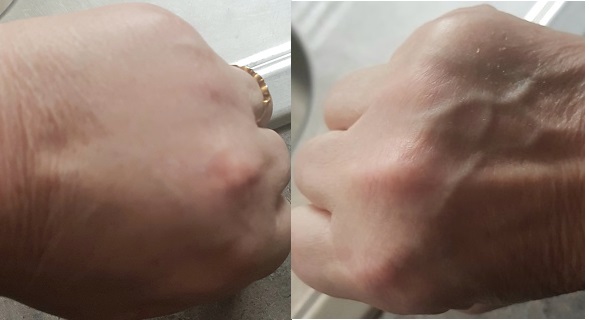
I’ve had cysts develop that in one case was dissecting a leg muscle, in another case the cyst drilled a “huge” (that’s a quote from the surgeon) hole in a toe bone and I needed a bone graft. This sort of thing won’t happen to every patient, of course, but is an illustration of the sorts of challenges patients face. Nodules can grow on tendons – I have a few of those. Cognitive impairment, otherwise known as “brain fog” is common. Fingers and toes can swell to look like sausages, this is called dactylitis. I’ve had a whole hand swell up, while the other remained fine. Here is a comparison of my hands at the time.

Veins and tendons visible on the right, not so much on the left

I’m slowly losing fine motor control of my fingers. It is annoying, but manageable so far.

Malaise is another symptom that I don’t experience often, but it does pop up from time to time. Just feeling crappy, basically. Feeling very blah! Like pain flares, malaise can come and go unpredictably.

Fatigue or lethargy is a symptom that doesn’t get nearly enough attention. It can be debilitating and impact on the patient’s ability to manage the condition appropriately. Exercise is considered critical in the management of PsA, but if the patient has no energy, nothing in the tank, exercise can be challenging. This improves with exercise, over time, but it does take dedication on the part of the patient. Eating and sleeping properly go without saying, naturally!

Flares can appear out of nowhere and disappear as quickly as they arrived. I recall once waking with an excruciatingly painful wrist. Eight hours later it was 100% normal. Flares may also linger. I’ve had steroid shots in both shoulders, vastly different to my painful wrist experience. PsA is notoriously unpredictable. It can destroy your finger and toe nails. Anyone who follows me knows, for me that would be a devastating event! Hence the feature photo of my pride & joy!

No, I haven’t specifically mentioned pain, have I? Everyone’s pain is different. For the most part (aside from the occasional flare or when a medication stops working) I am pain free. That’s due to a combination of factors: early diagnosis therefore early treatment, exercise, appropriate medication. When my previous medication stopped working, I was in heaps of pain. I detailed that in “I Sat in my Car and Cried“.

This is not in any way a medical article, it is a short summary of what PsA is and can be for the newly diagnosed and family and friends. Below I have listed authoritative links readers may find relevant. I will update this list from time to time as new articles become available. Whatever I publish today will likely be out of date tomorrow as PsA is a condition that medical science is still investigating and learning about. The photos I have used are my own.

Informative Links:

Psoriatic arthritis – new perspectives (National Library of Medicine, PubMed) Very informative! (added here 09/05/2023)

Psoriatic arthritis: epidemiology, clinical features, course, and outcome (BMJ)

The Genetics of Psoriasis and Psoriatic Arthritis (The Journal of Rheumatology)

Genetics of psoriatic arthritis (PubMed)

Types of psoriatic arthritis (Psoriatic Arthritis Info, sponsored by AbbVie)

Spondyloarthropathies (HealthLinkBC)

Enthesitis and PsA (Arthritis Foundation)

Psoriatic arthritis – diagnosis (Mayo Clinic)

Understanding Arthritis (Arthritis Australia)

We Don’t All Look Sick: Invisible Illness (Limberation)

We Need Mental Health as well as Physical Health (Limberation)

“How Can I Afford to Exercise?”

This question has been passed to me from a health care worker and is a very valid question. Many people with chronic conditions are on a limited budget. They may be working reduced hours, be on the Disability Support Pension (or worse, have been forced onto JobSeeker) or Age Pension. Disclosure: I am an age pensioner, so I have lived experience of the budgetary constraints! Like me, many will not have qualified for the NDIS. I’ve written before about the The Costs of Chronic Illness, many of which no-one, least of all governments, seem to think about! If we can’t afford to take care of ourselves, the costs of our healthcare rise.

There is definitely an argument for governments, via the health system, to make exercise more affordable for the chronically ill, but what can we do now?

Please note there are many links in this article to past articles. That keeps this article shorter than it might otherwise be. Click through to read the details!

Doctors, I find, are often (not always) good at telling patients to get exercise, but that is where the advice stops! How is left up to the patient!

Most of us can’t afford a private physiotherapist or exercise physiologist on a weekly basis. I have both myself, but unless I need specific support for a specific problem, I don’t see them as it bites the budget. I wish I could see my exercise physiologist on a weekly basis! This was one of the reasons I initially undertook my Fitness Coach education – to help people like me.

So WHAT can we do to keep costs controlled? Then I will look at WHEN we should do the exercise!

Find a gym that offers concessions: I am a member of my local council aquatic centre. This has a fully equipped gym, great hydrotherapy pool, 25 metre indoor pool, 50 metre outdoor pool, spas and a sauna. Everything I need in one place. Due to my PCC (Pensioner Concession Card) I receive a 40% discount on the membership fee. I pay fortnightly so I can suspend my membership for four weeks a year for free (e.g. hospitalisation, surgery, etc). No lock in contract either – watch out for those! Places like this are harder to find in regional areas, unfortunately.

Memberships are generally much cheaper than paying casual rates per visit. Finding a facility that offers all the services you need, as mine does, is a bonus. If you are working reduced hours, you may qualify for a concession card even if you are not technically unemployed or on a pension. Check your eligibility. The Seniors Card also attracts membership discounts.

Aside from weights, a gym gives you access to indoor rowing machines, stationary bikes and treadmills. All very useful equipment.

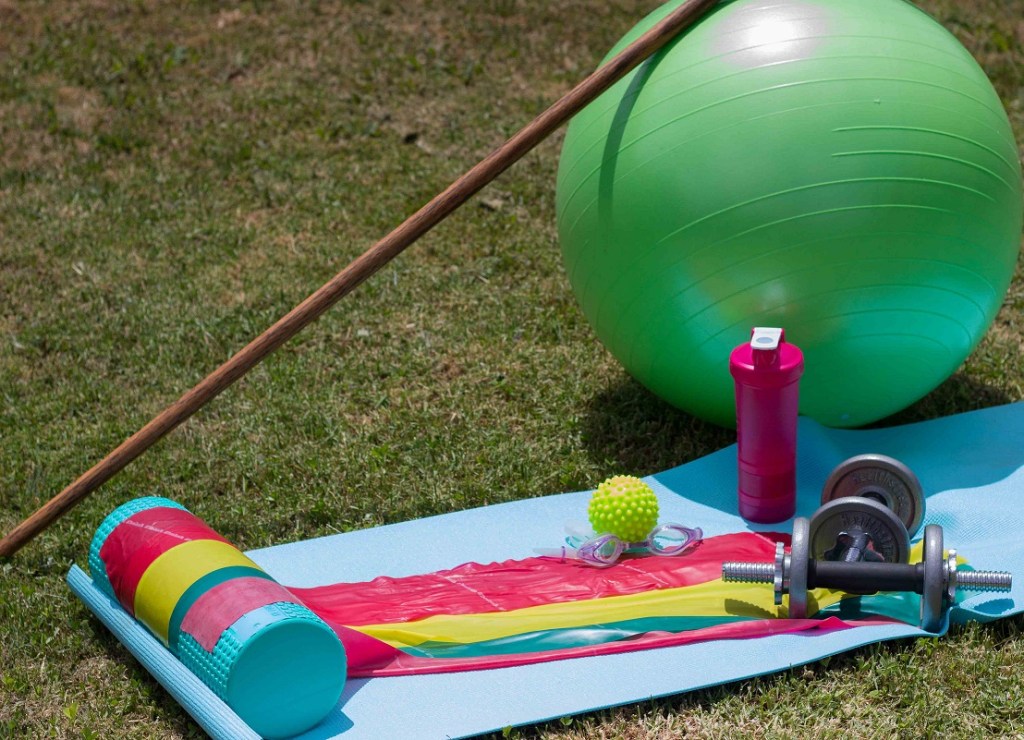
Have equipment at home: therabands or resistance bands come in various strengths and are available from physiotherapists and stronger ones are available at sporting goods stores. I also have a swiss ball and my daughter lent me an aerobic step when I had my knee surgery. Many of us have space considerations therefore having equipment at home has limitations. It isn’t just space: I own 2 kg and 5 kg dumbbells but realistically that doesn’t allow me to Pace UP my strength training. I need the gym for that as I have no space to house a full dumbbell set, nor can I afford one! Suggest to family members a good Christmas Present would be [whatever it is you need].

Home Equipment
Christmas Present from family – was very useful during TKR rehab!

Floor exercises at home: many exercises can be done at home without weights, sufficient for our therapeutic needs. Squats, glute bridges, planks, push ups (against the wall is fine) as a few examples. However, getting down onto the floor and back up again is not possible for all of us. I did glute bridges on my dining room table when preparing for my total knee replacement. After my knee surgery I found a way to slide off a lounge chair onto the floor using my arms, then used my arms to lift myself back up after I’d done my rehab exercises. I strongly recommend paying for at least one formal training session to ensure you have correct technique – you do NOT want to damage anything through incorrect technique. See your GP about a Health Care Plan to have five physiotherapist or exercise physiologist visits covered by Medicare – bulk billing is rare though, so make sure you are on top of your Medicare Safety Net details.

Walking: never underestimate the benefits of walking as exercise. Best of all, walking is FREE! Well, free after you’ve allowed for the cost of decent walking shoes – important with most medical conditions! It helps if you can find a local park or walking track that makes walking a pleasant experience. The featured photo above is of Gardiners Creek, a lovely spot! Some parks are implementing exercise/fitness equipment in a corner of the park, so keep an eye out for such in your locality. However, please take note of my “when” cautions at the end of this article before rushing off to walk your way to a healthier you.

Central Park
Fitness Equipment – free in the park

These public fitness equipment spots generally do not allow for a balanced workout. For example, there is a leg press in that photo but no leg curl for the hamstrings.

Get a step counter of some sort. I recently upgraded from a Vivofit generation 1 to a Garmin Forerunner 55 (bought on special). It also counts my swimming laps. You need to be able to monitor your progress properly. Christmas stocking request! Nothing more motivating than seeing your progress graphically AND wanting to maintain/improve it. Below is a comparison of the last eight weeks. Bear in mind I moved home and retired in August. I was pretty exhausted to be honest, plus there was a health “glitch”. Therefore August/September situation was messy on the steps front. Even with that excuse, I like the graph on the right MUCH better! It is good to actually see your progress.

Compare the months

Garmin Connect on your phone lets you see everything at a glance. The app is free (just as well, because the watches aren’t!). If you already have an Apple watch, check out what you may already have available.

Before any reader goes “Uh ha! We caught you! That’s more that 10%.” Yes, it is more than 10% comparing those two 4 week periods, but not overall! Plus I was still going to the gym and swimming, just the steps and walking took a tumble. I also changed my goal structure after I retired, but that is a whole other discussion for another day!

I will walk to the supermarket or pharmacy and record that as a walk. Just over 1 km. Same back. Walk to my favourite coffee shop. 1.30 km trip. Not possible for all, I know, but think about what activities you can turn into an exercise event in a similar way.

Swimming: see gym membership above. If you live near a beach, even better! Swim for free!

Hydrotherapy: wonderful if you can have access to a hydrotherapy pool with a gym membership as I do. Definitely not enough of these around, especially in regional areas. I also do squats and lunges in the pool. I have specific equipment to help me achieve my goals. Bought before I retired, but perhaps another Christmas stocking option!

Hydrotherapy equipment drying after use

Cycling/Running: both great options if you are able to. Good running shoes are expensive. Buying (and maintaining) a bike and related equipment is even more expensive. Gym membership gives you access to stationary bikes. Stationary bikes can be better when starting out as you don’t accidentally overdo it – you can stop when you feel that change in your body (see Pacing for Beginners) rather than find yourself too far from home and suffering later from over exertion. There is NOTHING to be gained from riding 35 kms today and being unable to do anything for the next three days. Consistency is key.

Motivation: I personally struggle to find motivation to do exercises at home. I’m much better going to the gym. I was fantastic at the daily rehab after knee surgery, but that had measurements and specific goals involved. We are all different, some find being diligent at home easy. I don’t. Unless I’m trying to fix something, like rehab a temporarily grumpy shoulder. Joining walking groups is a great idea, but in practice not suitable for all chronically ill people. For example, a group may walk at a much faster pace than we can safely manage with our condition/(s), walk further or walk at times that don’t suit our condition/(s) (e.g. morning stiffness/pain). I’d love to join the local swimming group, but I need to be able to swim 2 kms without stopping – I’m not there yet. Fitness classes can be demoralising if we can’t keep up. I recommend strength training is more beneficial anyway! We need to select exercise modes that suit us in order to maintain our motivation, especially if we are paying for a membership.

Covid-19 Considerations: no matter where we go at the moment, remember to be Covid safe. We already have underlying conditions, we don’t need Covid-19 on top. But then neither do we want to let our underlying conditions run riot because we are protecting ourselves from Covid-19. I wear a mask into the gym. Depending how many people are there I may well keep it on while training. I may warm-up outside rather than on the treadmill. I’ll wear my mask in the hydrotherapy pool and the spa. For lap swimming I take the mask off just before I put my cap and goggles on.

Medical Clearance: Let me repeat something I often say on this web site: ensure you have your doctor’s approval to undertake exercise and ask if there are any limitations. In most cases, musculoskeletal conditions will have no restrictions other than “listen to your body”. Other medical conditions may have certain cautions. Get a clearance. I do notice men can be more gung ho about it, so please see your GP!

I emphasise it does take time to learn to listen to your body.

Now to the WHEN!

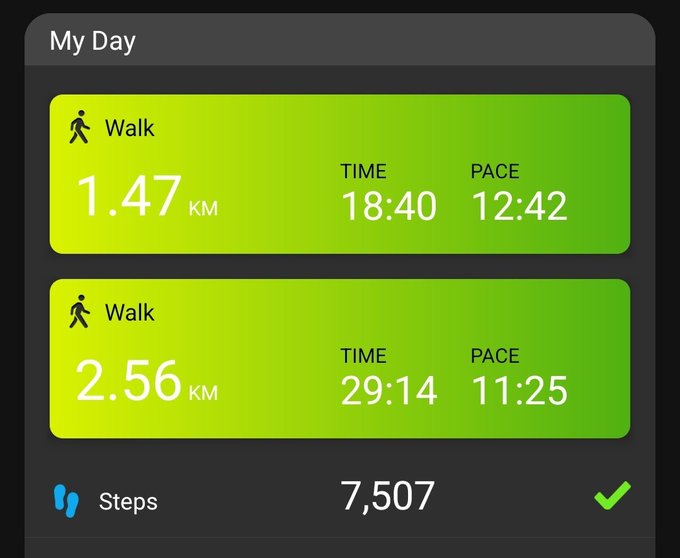
I’ll use walking as an example. My daily target is 7,500 steps a day. I know that if I do very little incidental steps, I need to walk 4 kms to reach that 7,500 steps target. I do not walk 4 kms in one go. Now I am retired from the workforce I can walk whenever it suits me. When I was working I would aim for 1.33 kms before work, lunchtime and after work. Now I generally do 2 kms in one walk and then two separate walks of 1 km each. Many of us can do (say) 4 kms per day easily with respite between the walks, but 4 kms in one burst would drain that internal battery.

Some people may think this takes too much time. Not really. I walk 1 km in about 11.5 minutes. Exercise physiologists tell me each activity over 10 minutes is good. All I have to do is find 11.5 minutes four times a day. That is manageable. In 2014 I started by walking around the block four times a day. Some people have walked around their clotheslines to get started. Where any of us start is not a competition. Maximising your health over time is the objective.

Obviously splitting workouts like that is not really sensible for strength training or swimming – I’m not going to go to the gym four times a day to split up my weight training! Of course, this is where pacing up comes in. Start small, build up slowly.

As mentioned above re cycling, it is critical to follow the pacing principles at all times, even with walking. Where you start with any movement/exercise activity will depend on your current state of health and mobility. We are all different. Cost is not the only consideration here. Depending on where you are starting from, it may be wise to build up on free exercise, then only consider a membership of a gym once you are in a position to utilise that membership effectively. Alternatively, paying a regular membership may actually be motivation to use the facilities: you decide what works for you!

Adjusting Our Goals

When we use Movement As Medicine, we need to set goals: SMART goals. If you are new to the concept of SMART goals, click on this link “Make 2018 Your Year for SMART Goals” and catch up!

My current general goals are:

  • 7,500 steps a day, including active rest days
  • Weight training Tuesday, Thursday & Saturday
  • Swimming Wednesday & Sunday

I say general goals because within each of those, there are more specific goals, e.g. improve my walking pace to 10 minutes per kilometre, increase my leg press weight to 110 kilograms, swim 1,000 metres in a session.

Today is Sunday. I did not swim today. I adjusted my goals due to my condition requirements. Or, to put it another way, I was happy decided to miss that swim goal today. Sometimes we have to. Everything has been going swimmingly (pun intended) however on Friday I did something unusual: unusual for my body, that is. I scrubbed dirt off a window cavity frame well above my head. In fact I was on a stepladder. Yes, I do shoulder presses at the gym, but that is a very controlled action. Scrubbing stuff is not such a controlled action. Oh, I inherited the dirt, I didn’t create it! Just in case you wondered.

As is typical for my joints, two days later (today) the joint I may have overloaded while living life is complaining. The same two day lead time happened with my wrist recently when I used a manual screwdriver to screw 48 screws while building two bedside drawer units.

Lots of screws!

In that particular case, Friday being an active rest day, my grumpy wrist didn’t upset my walking – however on the Saturday I did drop my bicep curl weight. My wrist has to hold the weight. Often we can adjust activity to ensure we are operating in a pain-free range. We can walk for less time or at a slower speed, but do more walks on the day, for example if it is knees, hips, feet or back that is grumpy. I can temporarily lower a weight, as I did with the bicep curl, to ensure I don’t aggravate any inflammation. In that case, inflammation I had caused by doing too much twisting of the wrist.

Swimming is not such an adjustable activity. I can’t do half a stroke. I can’t reduce the range of motion of my arm to swim within a pain-free range. I’d sink and that is not a good look.

I pulled out my hydrotherapy equipment and did 30 minutes of exercise in the hydrotherapy pool. The top picture is my carefully rinsed equipment drying. From the left:

  • Push bells which I also use as dumbbells. I got these instead of aqua dumbbells as I don’t have to grip them, they strap onto my hand.
  • Pillow. I use this in the corner of the pool when I do certain leg exercises. Purely for comfort.
  • The bag I carry the equipment in.
  • Aqua cuffs for the ankles – this particular type is no longer available, it seems.

I bought these from theraquatics.com.au some time ago if you are interested in getting any equipment yourself. Theraquatics are a registered NDIS provider.

The ankle cuffs have extension pieces, therefore the two can be joined to make (for example) a waist “cuff”.

Setting goals is important. Just as important, when we are managing chronic conditions, is the ability to say to one’s self, “It is OK to adapt today”. That can be difficult for some of us. For example, I find it VERY difficult, let’s say impossible, to end a planned 2 kilometre walk at 1.93 kilometres. I’ll walk to the clothesline and back to get that final 70 meters! I like round numbers, I’m an accountant! What can I say?

Yet I knew when I was making my breakfast this morning that my right shoulder was not happy. I knew that swimming would quite likely exacerbate the situation. Then I’d need to take Prednisolone to settle it down. So I did the sensible thing. Gritted my teeth and let my swimming goal slide for the day. I replaced it with an alternative activity. One where I could easily control my range of motion.

Am I annoyed? Yes. Of course I am. At the same time I am also pleased with myself for being sensible!

Goals are good. Adjusting goals is sometimes necessary and also good. Even for stubborn people!

Movement! Exercise! Weights! Health!

Over the last few weeks, I have noticed a few articles in various media about the general health benefits of weight training. All regular readers know I am a strong supporter (OK, advocate) of weight training for ALL adult age groups including my own and older.

The first I noticed was “How Your Muscles Affect Your Mental Health

Muscles at work secrete tiny chemical messengers called myokines that exert powerful effects on organ function, including brain function.

Early 2018 I wrote about the importance of mental health especially when managing chronic conditions. Now it seems with resistance (weight) training, we can kill two birds with one stone! Help ourselves physically and mentally at the same time. This is very encouraging.

I’m on the Pacing UP journey at the moment. My personal best on the leg press in 160 kgs (back in 2018). I did 90 kgs today, will do 100 kgs on Saturday. No, I may not get back to the 160 kgs, but it can’t hurt to try! Plus it makes me feel better!

I’m careful though. I’m asking the gym staff to put the 20 or 25 kg weights on the leg press for me as my wrists don’t like lifting those weights onto the leg press – at the moment. Don’t be afraid to ask for help.

Then The Guardian published “Exercise with weights linked to lower risk of early death, study says“.

Adults who reported meeting the aerobic activity guidelines and weightlifting at least one or two times every week were found to have a 41% to 47% lower risk of premature death.

While many chronically ill patients are younger than I, I am in the older demographic. While I LOVE lifting weights, I do find it challenging to encourage others my age to do so. Hopefully research such as the above will help! For the record, I do weight sessions three times a week, roughly 30 minutes each time. The weights don’t have to be huge! The above photo has small weights, ankle weights, a hand weight for walking with and a resistance Thera band.

JAMA recently published “Association of Dual Decline in Cognition and Gait Speed With Risk of Dementia in Older Adults

In this cohort study of 16 855 relatively healthy older people in Australia and the US, a dual decline in gait and cognitive function compared with nondecliners was significantly associated with increased risk of dementia. This risk was highest in those with both gait and memory decline.

No, the above article doesn’t look at weight training, but it is about movement and exercise and staying physically “on point” if we can. Something I am aiming for personally is to get back to my old walking pace of 6 kms per hour. Now, my GP kinda rolls her eyes at me given my total knee replacement, bi-lateral foot surgery, psoriatic arthritis and age. She could have left the age bit off, but she didn’t.

I’m just not quite there yet. I can do that pace, but not for long enough. Yet. Having goals is something to strive for though – while I accept I may not get back there, that doesn’t mean I should give up!

Exercise generally and the relationship to the onset of dementia is of course a big part of the study I am currently participating in. The study is still recruiting, so if you meet the criteria and are interested, contact them!

This following article I do find a little worrying, given I am, technically, a complex comorbid patient. I have edited this article of mine to add this reference, as I forgot yesterday. I am far from infallible! The article is “Two or more chronic health problems in middle age ‘doubles dementia risk’.

After adjusting for factors such as socioeconomic status, diet and lifestyle, having two or more conditions aged 55 pushed up the risk of dementia almost 2.5 times compared with people who had none. Developing two or more conditions between 60 and 65 was associated with a 1.5-fold higher risk.

Retirement is working for me! Well, not being retired per se, but having the time to do more Movement As Medicine stuff WITHOUT draining my internal battery is working for me. I’ve upped my daily step goal to 7,500 every day. It was 5,500 on my weights and swimming days while I was working, 7,500 the other days. I’ve paced up.

We Don’t All Look Sick! Invisible Illness

Many people who are classified as chronically ill, myself included, don’t look sick or ill. Healthy people can find this a bit of a conundrum. We can be accused of “faking it” or being a hypochondriac. Even worse, we can be criticised for doing the very things we must do to manage our various conditions. With my condition, psoriatic arthritis, I must exercise. This just seems to be a red rag to a bull for the doubters because their understanding of “sick” doesn’t include things like the leg press or lat pull down in the gym!

I wonder how many chronically ill people are actually dissuaded from doing the very things they should do because of this attitude of doubt they encounter from others. That is a study for an enterprising young exercise physiologist and a psychologist to undertake! I’m just posing the question!

In 2018 I wrote “You Look So Healthy!” which was a look at how our emotions can react to being complimented for looking “so good for a sick person”. I also looked at society’s overall acceptance of chronic illness in my more recent article, “Will Society Adapt? When? How?“.

Please be aware not all conditions that MAY be invisible are invisible for everyone. To take psoriatic arthritis as an example, it is invisible in my case SO FAR (and I hope to keep it that way). Other psoriatic arthritis patients will have visible indications of their condition. It may be deformed joints or the need for mobility aids. In fact, psoriatic arthritis is a condition that may wax and wane – so I could be using a walking stick today, but not tomorrow.

People often look for a “gotcha” – and that is very annoying. Having to constantly explain that being chronically ill does NOT mean we have to be in hospital with a cannula in our hand, that yes we can walk 4 kilometres a day but we are still clinically sick is very, very tiring. As I have said before, the reaction I get from the public if I go out with a walking stick is very different to the reaction I get without it. In some respects this is fair enough as without the walking stick there is no indication to anyone that I am not perfectly healthy. However, if I tell someone I need a seat on the tram, I don’t expect to be put through the Spanish Inquisition!

Today I’m looking at the specific question of why, given such a large percentage of the population has one if not more chronic conditions (comorbidity is common), society is not more aware of invisible illness. To use myself as an example, why do people find it difficult to understand that I can do the leg press at the gym, but I can’t clean my shower recess without falling in a heap? For those wondering, it is due to damage in my lumbar spine – which you can’t see. It is invisible.

I sometimes get the strong impression I am not supposed to paint my nails, wear lipstick, or wear my extravagantly floral (happy) leggings. I am supposed to “look unwell”. Why? I think I speak for most of us when I say we go to considerable lengths to NOT look unwell! Doing so makes us happier.

I remember going to my GP once, a while ago now. I was in a flare. My shoulders and wrists were, essentially, unusable. I couldn’t put a bra on (so wore the most bulky windcheater I own to hide the fact). I managed to pull on some tracksuit pants – leggings weren’t happening. Lipstick certainly wasn’t happening. I called a taxi as I didn’t feel safe to drive. “Oh, you are the worst I’ve ever seen you”, she said. True, she had never seen me in such a condition. Had it been my knees or hips or ankles, she would not have seen me in that state: it was only because the joints I use to “look good” were “feeling bad”. Would my GP have recognised how sick I was, though, if I still “looked good”? While only she can answer that, I have been a patient of hers for quite some time now – I think she gets it. But not everyone does.

I would have had NO trouble convincing anyone I was sick that day! But that is not how I want to live my life. It isn’t how I want to look everyday. I don’t want to have to look sick for you to believe I have a chronic condition and trust my requests for certain adjustments.

I don’t want to live my life justifying why I DON’T look like that every day! A friend of mine has MS and he has a card, the size of a credit card, issued by the MS Society confirming his health status. Like me, he doesn’t look ill either, most of the time, to the uninitiated. Maybe a card would be appropriate for more of us.

Above I mentioned walking 4 kilometres. Let me assure you that 4 kilometres is very carefully planned out. I don’t walk out the door and just walk 4 kilometres in one hit. I do hope to pace up to doing that again, but at the moment I’m on the comeback trail. Sometimes, no matter how well we manage our conditions, we have setbacks. We have to pace up again to get back to where we were, provided we can.

I cite myself as having an invisible illness NOW – in ten years it may not be so invisible.

If you are standing in a group of ten randomly selected people, statistically at least four of them will have a chronic condition, maybe more than one chronic condition. There may be absolutely no visible indication. Some readers may have read my rant about public transport – if not, hit that link and read up.

All I ask is don’t assume that a person who looks 100% healthy is actually healthy. Many of the population is not – and we shouldn’t have to explain it every day.

I don’t always win!

I get told many of my audience see me as an inspiration. This is a lovely compliment and I really appreciate it. The recognition actually helps keep me motivated to keep doing movement as medicine to manage my own medical condition/(s).

Having said that, not everything goes according to plan. I think it is appropriate I share the dippy things I do as well as the things that go well!

Today was a dippy day. I had a plan for the day. Around 10 am have two sets of bloods done. For the curious among you, one set was for thyroid function as I recently started Thyroxine. Some years ago I swallowed radioactive iodine and as a consequence, sooner or later I was going to go hypoactive. I was lucky, I got a few years before that happened! The time has come. The second test was to meet the PBS regulatory requirements for the authority necessary to continue a biologic treatment for my psoriatic arthritis.

At 10:30 I had a GP appointment scheduled. Then my plan was off to the gym for weights. Saturday was weights, Sunday was swimming, yesterday (Monday) was an active rest day (walked 4 kms and hit goal of 7,500 steps). So back to weights today. Then I realised that was not a great plan as I was having blood tests – and that means no lifting heavy things afterwards. Hmmmm. OK, compromise, I’ll do just lower body stuff, I thought to myself. Yes, if you are wondering, I wear a mask when doing weights.

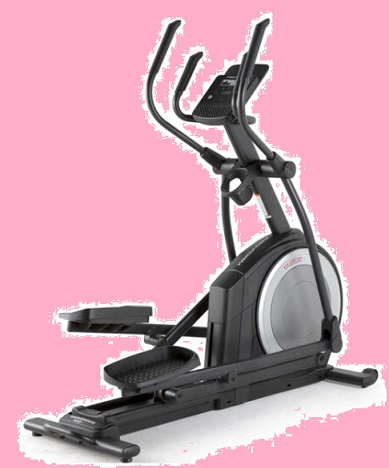
Warmed up on the treadmill. Did leg press, leg extensions, back extensions, hamstring curls, single leg push back. Couldn’t do the seated row, of course, or get on the rowing machine. Did not feel as if I’d done enough and wasn’t keen on getting back on the treadmill. Stationary bike? Nuh, not today. The elliptical machines were standing there looking rather unloved so I decided, not having been on an elliptical machine for WELL OVER 10 YEARS (and I was never a fan of them in the first place), I decided I’d just do five minutes to “top up” my workout.

At the 1 minute 30 second mark (this is me we are talking about, I time EVERYTHING for pacing purposes) my quads were telling me they were not at all impressed with this sudden change to their routine. At this point I thought, “OK, three minutes will do this time”.

At two minutes I hit the stop button. Of course, what has happened NOW is I have decided I must pace up on the elliptical machine, haven’t I? I have no desire to become an Olympic candidate by any means, I’ll be happy with five minutes!

After my recent experience with the screwing of 48 screws with a manual screwdriver, where I subsequently needed to resort to Prednisolone (brief, one day only needed – phew) and a wrist brace, I wasn’t about to overdo the elliptical machine (after a more than 10 year sabbatical). I’d learnt my lesson. Now, why I never applied the pacing logic to screwing things, I have no idea. I know better: excitement at building stuff overrode my thought processes! It happens! But really, *rolls eyes at self* I know full well my wrists are involved in my psoriatic arthritis. I have a special mouse, for that very reason!

I also fitted in my second ‘flu vaccine for the year – one of the joys of being immunosuppressed. Just thought I should finish on a positive note!

Never forget to pace.

Movement! Exercise! Mobility!

As we know I retired in order to concentrate on managing my psoriatic arthritis condition. The obvious question is “So how is it going?”

Very well, thank you for asking!

I thought a short update was in order. After all, while I do delve into other chronic illness related topics from time to time, this website IS primarily about #MovementIsMedicine. About pacing activity to maintain or, even better, improve our mobility and reduce pain and the incidence of flares. Avoid the boom/bust cycle so many chronic illness people are familiar with.

As I type it is 9:20 am. I have already walked a kilometre this morning. Yay me! Yesterday I hit the gym for weights – well, at my age and in my condition, resistance training would be a more accurate description. I am not going into the gym and lifting to failure, after all, so I feel a little guilty describing what I do as weight lifting. I am lifting weights though, just smaller ones than in my 40s!

To paint the picture, I had not been to the gym while the Covid-19 Reff was above 0.80. Saturday was my first day back for a while. Yesterday, Tuesday, was my second day. Saturday I took it gently, probably a step back from where I had been before the latest Covid-19 wave. I did the same with swimming on Sunday – a step back.

Tuesday I was pleasantly surprised to discover I had quite an easy improvement in my leg extensions. I increased my bicep curls by a kilogram with no trouble. Very good.

The best part was at the end, when I reached that point I recognised as “That’s enough for today” and stopped the timer. I’d done 27 minutes! Now, to healthy readers who wouldn’t dream of doing less that an hour, let me tell you for me that was a 5 minute improvement over Saturday. Also, please note I superset my workouts. That means I don’t do three sets of a specific exercise with a break in between sets. Supersetting is like this: a set of leg extensions, followed immediately by a set of chest press, then back to the leg extensions, rinse and repeat until the three sets of each are completed. I tend to combine things like lat pulldown and back extensions, tripcep pulldowns and the wood chop.

Benefits of supersetting are more weights done in less time, obviously. Moves the blood around the body by alternating upper body and lower body exercises. I also use the weight machines more than I used to in my pre-psoriatic arthritis days: I find I can keep my technique correct more easily than with free weights. I’m lifting to keep my body working, I don’t need to accidentally injure myself through poor technique.

I’ve set myself some retirement fitness goals:

  1. Weights sessions x 3 a week
  2. Swims/hydrotherapy x 2 a week
  3. Steps per day 7,500
  4. Increase speed to 6 kms per hour

The last one, increase speed, is related to preventing (or delaying) the onset of dementia. There have been studies that suggest slowing walking pace may be an indicator. I have slowed in recent years. I’ve also been participating in a Monash trial, Better Brains. More on this topic another day – just explaining why that goal is there! My GP rolls her eyes at me, given my ortho surgeries (and recovery times involved) and my arthritis – she thinks my pace currently is acceptable. I am not deterred!

I will still drop my step count on the days I do weights – it’s all about the pacing, folks, all about the pacing! No point in doing weights AND 7,500 steps today if I can’t do anything tomorrow.

As for more specific goals, as in swim how far, leg press of how many kilograms, etc: at this point I’m not fussed. as long as I see progress I’ll be happy. Essentially I’ll stick to the pacing principles of 10%, but I’m not going to rush it.

I am definitely seeing retiring was the right decision for my body and my health.

(Edited to correct the cited day! I had Wednesday instead of Tuesday).

Not All Shingles Vaccines Are The Same

UPDATE: From 1 November 2023, the shingles vaccination schedule under the National Immunisation Program (NIP) will change.

A 2-dose course of Shingrix® will be available for free for:

  • people aged 65 years and older
  • First Nations people aged 50 years and older
  • immunocompromised people aged 18 years and older with medical conditions including:
    • haemopoietic stem cell transplant
    • solid organ transplant
    • haematological malignancy
    • advanced or untreated HIV.

Unlike Zostavax®, Shingrix® does not contain any live virus so it can be given to people aged 18 years and over who are immunocompromised.

Source: https://www.health.gov.au/news/national-immunisation-program-changes-to-shingles-vaccination-from-1-november-2023

I recently discovered not all shingles vaccines are the same. Nor are they equally available in Australia. As I write this, there is talk of changes (edit: the changes happened!), but as of right now, it is costing me roughly $600 to be vaccinated against shingles. Why is shingles important to a person with a chronic illness? Because we may be more susceptible, depending on our underlying condition/(s) and our medications. None of us want yet another health issue to deal with.

What is shingles? Essentially, a reactivation of chickenpox. So, you can’t get shingles unless you’ve previously had chickenpox. You can catch chickenpox from someone who has shingles though. Most younger people have been vaccinated against chickenpox, but even my children (now in their forties) had chickenpox before the chickenpox vaccine was available. If you have never had chickenpox and are not vaccinated against chickenpox, get vaccinated!

It is possible to get shingles more than once, so don’t think that if you have already had it you’ll be fine. Talk to your GP.

“But I was vaccinated for free”, you cry. Lucky you. The previous Australian government changed the rules. As it stands at the moment, there is a vaccine, Zostavax, available for free to those aged between 70 and 79. “So just wait until you are 70”, you say? Well, no, that doesn’t work for me either because I can’t have Zostavax. Ever. It contains live virus and because of my medications I cannot have any vaccine that contains live virus. I am not alone, there are many, oh, so many of us. Many medications stipulate the patient must not have live vaccines.

Those under 70 can pay for Zostavax if they want to have it earlier than reaching 70 years of age. The current list price is $192.50 and only one shot is needed. Quite a price variance. But that’s the vaccine a large cohort of the population, of which I am a member, can’t have. There is also, I think (depending how one reads the bureaucratic wording), provision for certain at risk people under 70 to have the free vaccine for free before reaching 70, but the criteria is complicated and I gave up trying to decipher it: talk to your GP!

So where does that leave us? It leaves us paying $281 (cheapest price I’ve found) for each of the required two vials of the Shingrix vaccine. Two shots, between two and six months apart, so $562 for the vaccine. Then there are the GP consultation fees to get the prescriptions, the travel costs to the GP and the pharmacy, possibly another GP fee for the actual injection. For some, it may total more than $600. This vaccine is not (yet) free when we reach 70.

As I can never have the free Zostavax vaccine and once we are over 50 the risk of shingles increases rapidly, I decided to bite the budget bullet and have it now. Stress is also considered a trigger for the onset of shingles and I have been under considerable “life is complicated” stress lately – the last thing I need right now is to be hospitalised with shingles. Shingles can also lead to longer term health problems, such as postherpetic neuralgia (PHN).

Then there is the question of vaccine efficacy. Various numbers are given in various reports, but essentially Shingrix is about twice as effective as Zostavax. This Harvard link cites more than 90% for Shingrix and 51% for Zostavax. The numbers are less for those of us with compromised/suppressed immune systems.

One has to question the logic of using a less effective vaccine when the costs of hospital treatment for shingles and related complications is surely much more expensive that the cost of Shingrix. While I have no doubt chickenpox and shingles will never entirely disappear, it is those of us old enough to have caught chickenpox before a vaccine became available that at risk – so the numbers and therefore the costs reduce over time. I fully support making the more effective vaccine available on the Pharmaceutical Benefits Scheme for those over 50. Talk to your local member of parliament.

As for the photo for this article: some people are squeamish so I didn’t put a photo of the lesions! There is a link below with images for the braver readers!

Information Links you may find useful:

National Immunisation Program Schedule

Shingles (herpes zoster) immunisation service

What Everyone Should Know about the Shingles Vaccine (Shingrix) (CDC)

Shingles: Clinical Overview & Complications (CDC)

Slideshow: A Visual Guide to Shingles

ABC Radio National – Shingles follow-up (podcast with Norman Swan)

Footnote: If you are unlucky enough to develop shingles, there are antiviral treatments, but they must be started within 3 days of the rash developing. Details can be found here. My view is prevention is better than cure.