Down with the Bad, Up with the Good

Thankfully, my second knee replacement surgery is back on the agenda! Woo hoo! I’m excited!

I suspect some people may wonder why I am getting a knee replaced if I can walk 7,500 to 8,000 steps a day and do “formal” walks totaling 4 kilometres a day. How can my knee be THAT bad if I can do that? Only due to great care and diligence, let me tell you. The aim of this article is to give some tips on how to manage walking leading up to surgery. If I don’t replace the knee, I am very limited in what I can do. I can’t spend my life walking in a straight line.

As described in Crossing my Fingers – Again, we felt my new biologic was finally kicking in. My GP wanted me to keep my medication dosages stable for a week or two, which we did. On May 30 I dropped my NSAID dose by half and have managed to maintain that. I saw my GP again on June 6. We felt if I got a surgery date, we’d make it. So I have a date! Next month! Now, we recognise that during the 10 days before surgery where I have to be at zero NSAIDs, I MAY have to increase my pain medication to compensate, but as this is only for 10 days, that’s acceptable. I did something similar for the last knee surgery too (there are links at the bottom of that article to the full knee replacement story). I also have to reduce my prednisolone, which I have starting doing this week. I’m NOT pain free, by any means, but I’m surviving!

I do have to be very careful to keep the bung knee in line, no twisting! I can’t fully extend it, although flexion is not quite as bad. Bending down to pick something up off the floor? OUCH! Having it bent while sitting at a dining table, for example, results in pain when I first get up from the chair.

I need to keep exercising to ensure I’m ready for rehab. Last time I was doing glute bridges on the dining table. Sadly, down I’ve downsized, my dining table is doubling as a desk, so I have to find other ways.

Here are my walking tips.

  • Make sure you have good, supportive shoes. This is an absolute must.
  • Choose a pleasant place to walk if you can. The photo above is where I love to walk. It is encouraging!
  • Keep an eye on the terrain. If I accidentally step into a small pothole with my bad leg, the pain is NOT GOOD.
  • Pay attention to your posture. If walking in a shopping strip, shop windows can be useful. In a park, check your shadow. Is your back straight? Shoulders back?
  • You may start limping because your body may decide to shorten your stride on the bad leg without you even thinking about it. Try to maintain the stride length if the pain is not too bad. This will depend on several things: what pain management program you have going, how bad the joint is, etc. You will need to “warm up” first, but I find I can control the limping without increasing the pain. Why is this important? Because you don’t want to shorten and/or tighten soft tissue like tendons prior to surgery if you can avoid it.
  • Down with the bad, up with the good. When negotiating steps, stairs or gutters on pavements etc, down with the bad leg, up with the good leg. Why? Less bending of the bad leg (especially bad knees). I stupidly walked down the stairs to the car park in a hospital the other day. Very bad decision, I should have waited for the lift! Even with this tip, stairs are hard to negotiate!
  • Inclines and declines. Where I walk there are very slight (well, very slight for MOST people) inclines and declines. Some on the actual path, but also bridges like this. While I have little problem with the incline, the decline is difficult. Depending on where the damage is in your knee (or other joint) you may find the reverse, or you may find both are a little challenging. Slow down, hold the rails if there are some, maybe decide that track is not for you in future.
Incline Decline
  • Don’t walk until you’ve “thawed out”. As we know, psoriatic arthritis is notoriously bad in the mornings. I take time in the morning to gently thaw myself out. The knee awaiting surgery will most likely also stiffen up overnight. While some mornings are better than others, I rarely do my first walk of the day before 10 am, sometimes not until 11 am. Even then, the first 200 metres or so are warming up.
  • Split the walking if at all possible. I’m retired, I can walk whenever I like, but obviously some patients are still employed. If you can break up the walking, do. At the moment it takes me about 15 minutes to walk a kilometre. You can fit a kilometre in here or there throughout the day. Take a slightly shorter lunch and a longer tea break, perhaps. Not possible in all jobs, I know. Winter means walking after work is not really appealing. Think about ways you can split the load.
  • As we all have different pain management regimes, I can only speak of mine. At the moment I am on a slow release (SR) twice a day and have some instant release (IR) for breakthrough pain. On a day where I’m not too bad, I may need no IR at all. If I am feeling the knee is a little too grumpy, I’ll time the taking of an IR (maybe only half) so that it kicks in before I start walking. This is all about listening to your body.
  • When you get home from a walk, I suggest elevating your feet for a while, but do not allow your legs to “freeze up”.
  • Remember to adjust your goals if you are doing other “stuff”, as I discuss in Why is There a Dip in My Stats?.

Once I have done the first walk of the day, I usually have very low pain levels for the rest of the day. We are all different, our joint damage is different and some, like me, have underlying conditions such as psoriatic which do complicate matters. So while that is my situation, I accept it may not be yours.

I also have two ankles requiring surgery. The left ankle is very problematic at the moment. When I was on my higher dose of NSAID I would know when I hit 500 metres on my first walk of the day as all of a sudden, the ankle would stop hurting as much. When I dropped the NSAID dose on May 30, from then it has taken about 800 metres before my ankle stops hurting. Hence it is important I time that IR dose properly if I feel it necessary. When I say “stop hurting” do I mean pain free? No, sadly, I don’t. Some days are better than others, but the level of pain is low enough that I can keep up the walking. And, once it is gone, it is pretty much gone for the rest of the day, thankfully.

We are all different. Please talk to your doctor and/or physio about what may be specifically appropriate for you.

Do not expect every day to be the same. For some weird reason this morning was awful for me. I even battled to pull my sheets out of the washing machine (nothing to do with my knee). I had a nanna nap after lunch (VERY unusual for me). Yet now, as I write, I am fine. I reduced my prednisolone yesterday morning, I think my body is adjusting to that reduction.

If you have any questions, I am always here to help if I can.

Addendum: The following is a good article from The Guardian about walking technique.

‘I’m not just faster, but taller’: how I learned to walk properly – and changed my pace, posture and perspective

Walking Graph

Why Is There A Dip In My Stats?

Above is a snapshot of my walks for the last four weeks. In my last article I wrote I was improving. Yet we see there was dip yesterday. Why is this so? You’ll be pleased to know it is a deliberate dip. A very deliberate dip, in fact. Recently I wrote Let’s Revisit Pacing. If you are new to my work I strongly suggest you click that link and read that first as this is, essentially, a sequel. A real life example.

Improvement has allowed me to get to the point I am walking 4 kilometres each day: but that was all I was doing! At least that was my primary use of energy over and above actually fueling the bodily functions that keep us alive: pumping blood, breathing, digesting food etc.

Yesterday I did two activities that require energy, that chew through our internal battery charge. I had a shower and I did grocery shopping. This wasn’t a “nip down to the shops and grab a pint of milk” trip, this was a monthly stock up. When I got back to my apartment it was four trips between my apartment and the car to bring everything inside. Then the effort of putting it all away.

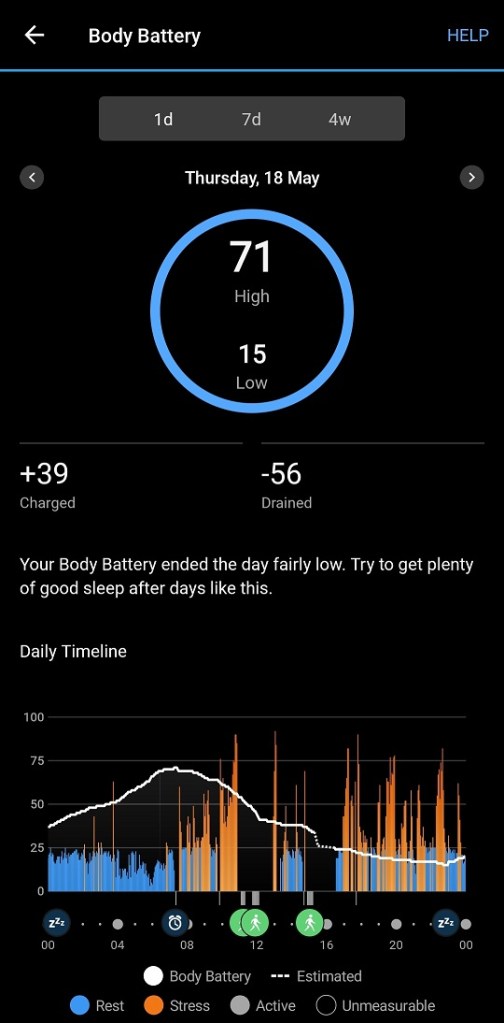
When I initially wrote about what I call our internal battery, I stated I didn’t have a charge meter on my arm! I do now: my Garmin watch. Here it is for yesterday (Saturday) compared with Thursday. For whatever reason, I hadn’t charged my battery as well overnight Friday night, so I was already a little low on fuel Saturday morning. I will state I am not sure how accurate this is for chronically ill people – I’m working on watching it carefully – but it is certainly an indicator. Blue is charging your internal battery, orange is using it up.

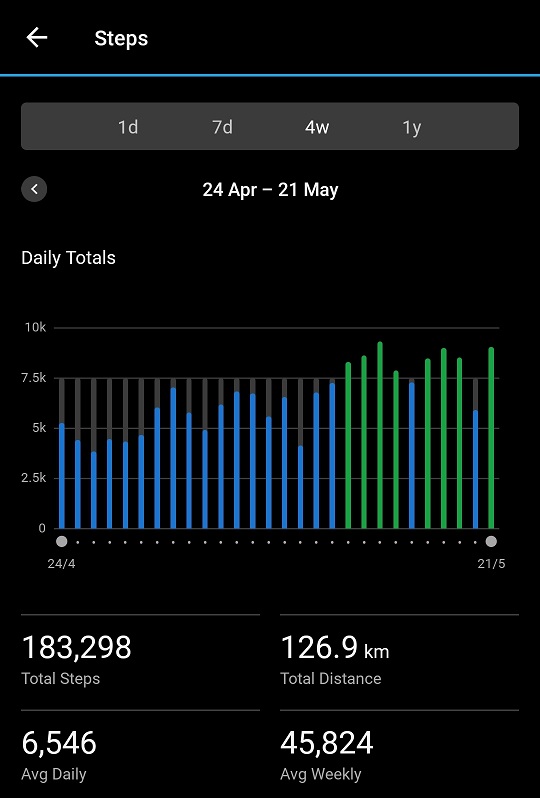
Another point to note is that most of the step counters will not register steps, or register steps accurately, if you are pushing a shopping trolley (or similar activity). Very annoying, as I think I walked about 1,000 steps just around the supermarket. Consequently there is also a dip in my steps for yesterday, even though I was moving. For those wondering the blue bars below are where I did not achieve my daily goal of 7,500 steps. Green bars are goal achieved!

Why not 10,000 steps you ask? Ahhh, well, yes, I have that covered too! Read We Need Personalised Numbers to understand the 10,000 figure is a myth.

Healthy people reading this will most likely understand shopping uses energy. They might raise an eyebrow over the shower taking energy. Trust me, for most of us chronically ill patients, a shower consumes energy. Many of us need a rest afterwards. I don’t usually, but I do at the moment.

What I did yesterday was adjusted my activities so that I did not Boom/Bust. I don’t need to burn through my internal battery one day then be wiped out for the following two or three days. Having a goal of 4 kilomtres a day is great, but at this stage of my “comeback” I am not risking any post exertional malaise (PEM). If I have to do something, like the grocery shopping, I will adjust my walking goal. Hopefully. in a few months I won’t need to: I’ll be back to my “normal”. Right at the moment, I’m not taking that risk. When I do head back to the gym for strength training, initially I will drop my walking goal for that day.

Using Movement As Medicine is not a simple “just get out there and walk”. It requires careful planning and monitoring. I hate “bust” days and monitor myself very carefully to avoid those days. Over time, following the pacing principles, I can do more. Pacing is the golden rule here! Today I walked 5 kilometres. I’ve been working up to it and I did nothing else that used energy today (other than writing this, of course).

Gardiners Creek

Crossing My Fingers – Again

My apologies for my silence over the last six weeks or so. I counted my chickens before they hatched.

On March 12 I published Changing Medications – What Can You Expect?. At that point it was roughly ten weeks since I had changed my medication for psoriatic arthritis (PsA) and I was finally feeling as if the new medication was starting to kick in. I was a little overly optimistic, as it turns out.

Also, although not mentioned in that article, the whole situation became more complicated when I slipped/tripped and fell in the shopping centre car park on March 8. What I initially thought was a simple trip ended up with me back in my orthopaedic surgeon’s office. To cut a long story short, it was decided the time had come to replace my right knee. If you are new to my story, I had the left knee replaced in 2020.

The problem was the slight improvement I’d got overly hopeful about in March did not continue. I was quite quickly back to waking in considerable pain and struggling with malaise and energy levels.

At the time I saw my perioperative physician I was still on 400 mg of Celebrex and 15 mg of Prednisolone a day. In order to undergo surgery on May 10 (the scheduled date) I needed to reduce the Celebrex to zero by May 1 and the Prednisolone to 2.5 mg per day by a week before the surgery. Was this going to be a challenge, I wondered to myself. I certainly didn’t want to just stop the Celebrex cold turkey on May 1 as clearly I was still in need of it to function on a daily basis. I’d needed friends to drive me to a myotherapy appointment and my pre-op Visionaire scans. Essentially, I wasn’t too chipper.

I discovered I had another infected tooth – maybe THAT was the problem? Had that tooth removed. It was a rather complicated event as the tooth was part of a double crown. I spent over an hour in the dentist’s chair, most of that time was spent removing the crown and temporarily recrowning the uninfected tooth. The actual extraction was a minor part of the visit. However, removing the tooth did nothing to improve my overall inflammation.

On April 17 I could see May 1 looming and decided I’d see if reducing the Celebrex was at all possible. Celebrex comes in capsule form – you either take a capsule or you don’t, there’s no pill splitting here! So I dropped from 400 mg to 200 mg on that Monday. Deliberate timing, as I had a GP appointment on the Tuesday. If anything went wrong, I already had an appointment! I also had accepted another kind offer from a friend to drive me to that appointment.

I woke up on the Tuesday in a very unwell state. While I managed to sit up in bed and get my feet to the floor, I could not actually stand up. This was a bit of a worry, to say the least. As gross as this sounds, I’m sharing for transparency: I was very worried about actually getting to the toilet in time. I tried using my walking stick to give myself some leverage, but doing so hurt both my hands and my shoulders due to the angle. Eventually I managed to stand upright and shuffle to the bathroom. While I was on my feet, I shuffled to the front door and unlocked it from the inside – if I had to call an ambulance, at least they could get in. Obviously I was in no position to start reducing my anti-inflammatories!

After various communications between my GP, rheumatologist and knee surgeon, the knee surgery was cancelled for the time being. My CRP and ESR inflammatory markers were rather high and THAT was while I was on all this medication. What would those markers have been reading if I was on no anti-inflammatories?

I did a damn good job on my rehab of my first knee and it is FANTASTIC! I want to be able to achieve the same result with the second knee replacement. At that point in April I was able to walk a mere 800 metres at a time because my ankles were so painful, the left one in particular. I knew that the extra loading of that ankle while recovering from surgery for the right knee could be very problematic. All things considered, cancelling the May 10 date was sensible, but very disappointing. I want the knee done, but there is no point in being a less that optimal patient if that can be avoided.

My next new medication injection was May 4 and I was getting closer to the 24 week mark – SURELY it would start working!

On May 4 (a Thursday) I gave myself the scheduled injection. Nothing much changed until Monday May 8. I did feel an improvement. I managed to walk 1.5 km in one walk. In total I walked 3 km for the day. I have slowly built up during the week and on Friday I walked a total of 4 km over three walks – I’d hit my old goal of 4 km for the day. Saturday I walked 2 km twice. The possibility of post-op rehab is now looking more achievable! I’ve even walked at my favourite walking spot, shown in the picture above.

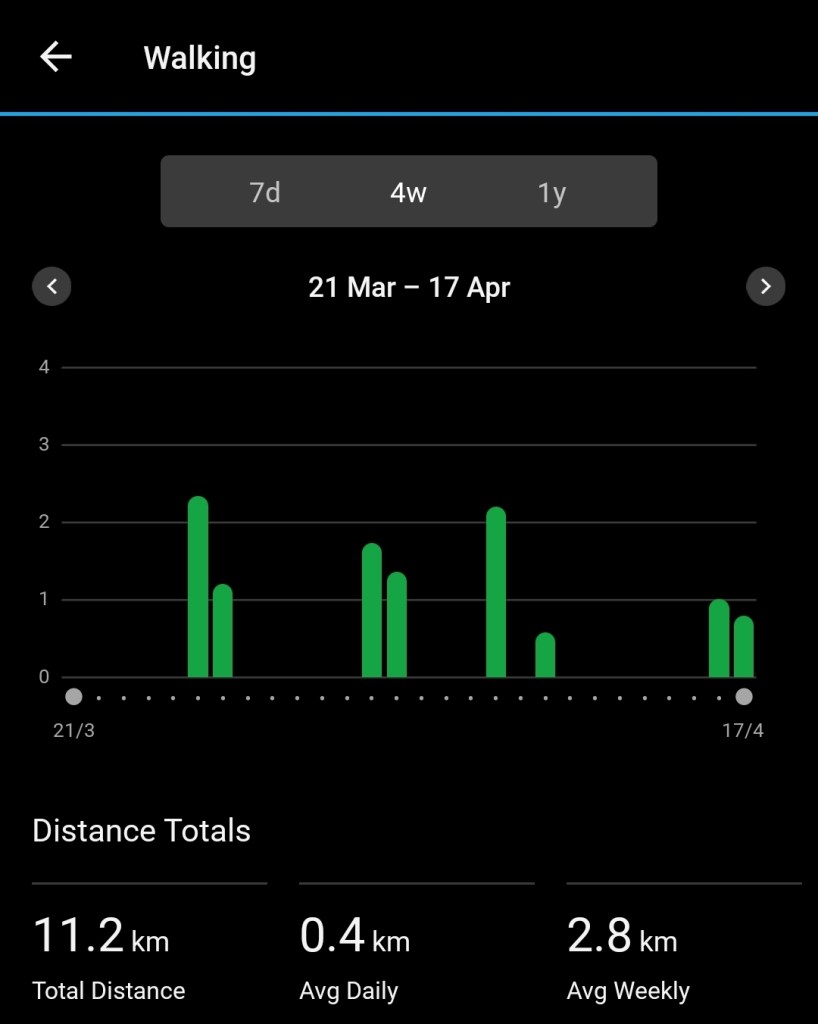
For those into graphic representation, here are the last 8 weeks. PLEASE NOTE Garmin changes the scale between the two periods, which makes the March/April bars look WAY higher than most of the April/May bars. And of course I haven’t finished today! Look at the total kilometres: 11.2 km versus 58.9 km

HOWEVER – I’m still on those same dosages of anti-inflammatories. I asked the GP about a possible test reduction and she was rather adamant that I give myself two weeks before we try to change anything. I haven’t even mentioned the pain medication I’m also taking or the Voltaren gel I am using on my hands and ankles.

While all this was happening, my rheumatologist scanned me for gout. The CT scan came back negative, which as the rheumatologist said is both a good and a bad thing. While it is good I don’t have gout, we are back to square one. Why is my inflammation so high? Is it merely that the new medication is taking its own sweet time to be effective? Or is my body being difficult?

Speaking of difficult bodies, I also did something rather adventurous. Click the image to go to the website.

While I am not going to go into detail about this test, it has been useful to me. My report was 29 pages long. To give you an indication, this is a summary of my genotype for the genes the test currently looks at.

We have changed two of my medications as a result. We also know to watch out for certain other medications in the future. This test does not yet cover every medication known to science, but it covers a lot. If you are interested, I suggest you speak to your GP about whether it may be useful in your situation. Yes, it is rather costly on a limited income but I see it as an investment in my health, given my situation.

Right now I am nervous that I am again counting my chickens before they hatch. Today is day eight of incremental improvement. I’ve managed to walk 4 km three days in a row, hopefully today as well. I have more energy. I’m writing. I haven’t ventured back to the gym yet, although I desperately want to.

In summary, as I said in my first article on the subject of changing medications, it is often not as simple as opening a different pill bottle. Even as I write, I do not yet know if this medication is going to be effective for me, but at least I have had eight straight days of improvement. I can exercise reasonably well again. This morning I woke with far less pain in my hands! So I’m crossing my fingers. The last blood test results showed a slight improvement in my inflammatory markers.

If you or someone in your life is changing medications, please be gentle. Be understanding. Be aware it may NOT be smooth sailing. 

A Dark Day

Trigger warning: this article covers issues that some people may find confronting.

Please be aware as you read this, I am fine. I debated about sharing this experience as I don’t want to worry anyone, but on the other hand the purpose of this site is to help people like me living with challenging health conditions. Yes, the primary emphasis is on exercise and Movement As Medicine, but so much of “life” impacts our struggle on a daily basis, I do venture off on non-movement tangents. This is one of them.

I feel if I do not share this experience, I am not being fair to my readers. One of my objectives is to illustrate we are not alone in our battles. The challenges might be different for each of us, but there are threads of similarity.

As we know, I was recently hospitalised. While there I had three methylprednisolone infusions. Shortly after coming out of hospital my prednisolone (by tablet) dosage was upped to 50 mg per day due to my ongoing psoriatic arthritis (PsA) inflammation. For me, that is a LOT of corticosteroid. It may not clinically be a lot, but I do not know that – I am the patient here, not the clinician.

Most of my life, I avoided anything “cortisone” sounding like the plague. Why? Well, the answer to that can be found in my recently published family history trilogy, starting with “The Background“. In case of “too long; did not read” reactions, short version is my mother committed suicide, I suspect as the result of psychosis – a possible adverse reaction to cortisone use. She had been on cortisone most of her adult life. Probably at higher doses that we now use. Consequently I have always been wary of carrying a possible genetic predisposition to an adverse reaction to the medication.

Over the years since my diagnosis of PsA, I’ve taken prednisolone periodically at generally small doses with no major issues. Sure, for me, it makes me as hungry as a lion, causes fluid retention, weight gain, disrupts sleep (OH, does it disrupt sleep) and my ability to control emotions is reduced. If I am angry, you will hear it in my voice and see it in my eyes.

Today is Wednesday. Yesterday started with absolutely no sleep Monday night. I had slept like a baby Sunday night, which may have been part of the problem – I wasn’t tired Monday night. And yes, Movement As Medicine does come into this because on Monday I did very little movement because I had been to see my GP, driving around, my ankles were sore etc: the very reason I was taking prednisolone in the first place, after all. So I went to bed not physically tired. I couldn’t fall asleep, even with melatonin on board. I did not sleep. All night. May have snagged an hour between 6 am and 7 am, but I’m not even sure of that.

So Tuesday was a pretty shit day, to be honest. It got worse as the day went on. I did not get dressed. There was no lipstick. I felt really, really flat. If anything, a bit like I had felt when I had a reaction to methotrexate. I think that prior experience may have been concerning me a little as well.

Please note: both the medications I talk about in this article work brilliantly for a great many people! I am NOT against the medications themselves in any way.

Now, I’m not sure how to make this next bit clear: if it is unclear, please ask for clarification. The doctor will ask (as she did when I rang) are you having any thoughts of self-harm or suicide. And my answer is “No, not for ME, but I am always aware BOTH my parents did commit suicide and am VERY clear to myself that is NOT where I want to go. HOWEVER, I’m very ignorant (Note to self – fix this ignorance) about what or how “it” could happen. Therefore I think about it in terms of the history and the fact I am on a related medication.”

Now, I have no clinical evidence of my mother’s suspected adverse reaction. However, neither am I going to ignore the possibility. Sadly, I can’t get clinical evidence. It is too long ago, I was provided no medical records at the time. It wasn’t deemed necessary to give kids their parents’ medical records.

At 6:30 pm last night I rang my wonderful GP clinic. I do love them so much! My GP was not available but I did speak to another GP. I explained the situation and said my biggest concern, I realised, was I had NO IDEA what to watch out for IF I was having or going to have a adverse reaction. I also pointed out it could just be the absolutely no sleep, I was aware of that. At this point I hadn’t slept for 36 hours.

The GP pointed out psychosis was considered a very slight risk adverse reaction: I said I understand that, but my family history sort of counteracts that statistic in my mind. I prefer to be cautious!

The GP gave me some contact numbers specific to my location (hence I’m not publishing them as not much use to people in Queensland, for example) should I feel worse at (say) midnight.

Because I was SO exhausted by bedtime I slept like a log and woke up this morning feeling normal. Well, normal for a sick person on ten prescription medications and a few non-prescription ones like melatonin and Panadol Osteo plus Coloxyl to counteract the effects of the pain medications. At no time in my previous eight years of this journey have I been on TEN prescription medications at once and hope very shortly we get that down to three and then two (one for the thyroid, one for the PsA – that’s enough). Do I worry about possible interactions of so many meds all at once? Yes, I do. I just hope if there was a problem it would have been discovered before now.

My message here is don’t be afraid to reach out to your medical team. I could have called my psychologist, my rheumatologist or my GP. I chose my GP because she is who I feel knows me best and would most easily understand where I was coming from. I feel really concerned for chronically ill patients who do not have continuity of provider, it is SO important in managing our conditions. Critical, in my view. But what would I know – I’m just a patient. That comment is made with a very cheeky grin – none of us are “just a patient”. I can’t emphasise strongly enough the benefit it was to me to be able to talk my concerns through with the GP last night on a telehealth. I was able to go to bed not worrying, which I feel contributed to my good night’s sleep.

I’m back to this version of me today!

Mental Health Contacts:

Lifeline: https://www.lifeline.org.au/ Ph: 13 11 14

Beyond Blue https://www.beyondblue.org.au/ Ph: 1300 224 636

I have written about the need for mental health support previously: We Need Mental Health as well as Physical Health

leg press

Variety can be the Spice of Life

#MovementAsMedicine does require some variety (i.e. adaptability) at times. When we consult remedial exercise professionals, they invariably provide us with a program of exercises to follow. For those of us who are pedantic people, we then set about following that program to the letter and can get quite frustrated if we can’t. This frustration can lead to us not doing what we can, when we can, even if we can’t do the whole program.

We need to be adaptable. As regular readers or fellow psoriatic arthritis (PsA) patients will know, PsA is notoriously unpredictable. It isn’t the only condition to be unpredictable, many are.

Let’s assume for the moment I (or you) have a program. But I wake up today and my wrists are borked. I have a choice. I can feel frustrated about the situation and throw the baby out with the bathwater and not do my program at all because I don’t want to leave blank spaces. Or I can simply accept the upper body is not getting done today, but I can do lower body.

Because I am my own trainer, my program is in my head. I adjust what I do in any given resistance (weight) training session based on how various bits of my body are feeling on that day. So I never leave blank spaces on a page – there is no page! Over the last eight years, I haven’t had to be as adapatable as I have had to be during the last six months or so. These have been a trying few months. As I write this article I’m not doing any weight training at all, much to my disgust, but the inflammation is just too high. Until we (“we” being mostly at this point my rheumatologist) get it under control, I’m resorting to water based activity.

Under normal circumstances, current predicament aside, I will leave out what may be problematic on any given day. Borked wrists? I’ll do lower body and core, I can catch up on upper body next time (or the time after). Thankfully my lower limbs don’t usually flare, so I rarely have to skip lower body although I would if necessary. There have been rare times when my piriformis muscle will be grumpy for a day or two and I do steer away from lower body work on those days.

Although yes, it does take us some time to learn to read our bodies, ultimately we, the patient, know our bodies best. I can now tell what is PsA related pain and what is not. For example, stiffness from lack of use! When I say it takes time to learn, I do mean quite some time. A couple of years at least. Even then, it is going to depend how your condition behaves during your learning and how well controlled it is by the medications. It is impossible to learn fine points of differentiation if your inflammation is raging at 100 miles an hour.

Yes, it is a bit of a Catch-22. On the one hand, movement is the very thing that helps resolve inflammation – lifting weights is a little bit more than just movement though and I don’t need to injure myself inadvertently. It does become a judgement call – is the inflammation just normal “typical morning stuff, move to get rid of it” or is it a bit more serious? Swelling plays a big part in my decision making too. If I have swollen hands, they’ll get movement, such as the warm water movement for my hands, but I won’t load the wrists or hands with weights. As an example, on Thursday last week I couldn’t even use my wonderful ergonomic mouse. Now, while we are here, that linked article talks about consistency and in some ways I may appear to be contradicting myself in this article, but that article is about maintenance under a relatively stable situation. Here I am talking about major condition discombobulation! Yes, I mention shoulder pain disappearing after a few reps and normally that is what happens. Right now though, I am in a different situation. I do think resistance training would help my anterior deltoids at the moment, but I need my hands to achieve that and so it isn’t happening right now.

Annoyingly, we need our hands for so many upper body exercises. In fact, just about all of them! So my biceps and lats (and delts) are getting off very lightly at the moment.

Don’t be afraid to be adaptable. Leave out bits of any program on days that a body part is problematic. Catch up later when that body part feels better. Talk to your remedial exercise professional, they will help you determine that line between being in a place where rest is required or where you should persevere. Sometimes it may be a case of reducing the range of motion or using a lighter weight for a few sessions. More reps, lower weight.

Just don’t throw the baby out with the bathwater. Variety can be our strength, just as important as Consistency. And don’t forget to PACE!

Wellways

Interview by Brainwaves

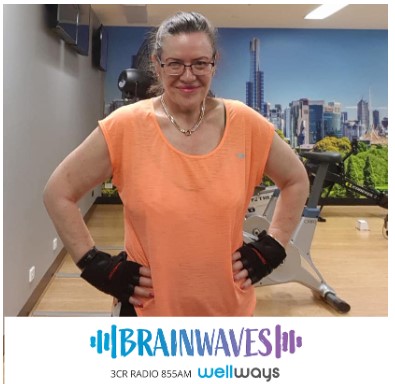
I was recently Interviewed by Brainwaves of Wellways.

The podcast can be listened to at https://www.3cr.org.au/brainwaves/episode/robyn%E2%80%99s-story-chronic-illness

Suzie (@saysgrumpysuzie) drew this tweet below to my attention this morning, an aspect we touched on in my interview.

Self Portrait

Unexpected Hospitalisation

As some will know, I was recently in hospital. I thought the situation a good practical example of the unpredictability of some conditions, including mine.

Here is the mentioned link to What Is Psoriatic Arthritis?

This article on Invisible Illness is one readers may also be interested in.

And yes, for those curious, I DID indeed get clearance from my rheumatologist before exercising!

Watch

I LOVE a Mystery!

I do! I love a mystery. Be forewarned: this article is outside my qualifications or skill set – I just want to share the mystery. My interest in this mystery is, IF (and this is a big “if” at this point) wearables can detect increases in inflammation from monitoring various physiological metrics, how useful could that be to so many of us with inflammatory conditions?

As regular readers know, this has not been the best health year for me – not actually major bad things, but not exactly climbing Mount Everest either. To catch up a little for context, check out The Tangled Web of Chronic Illness.

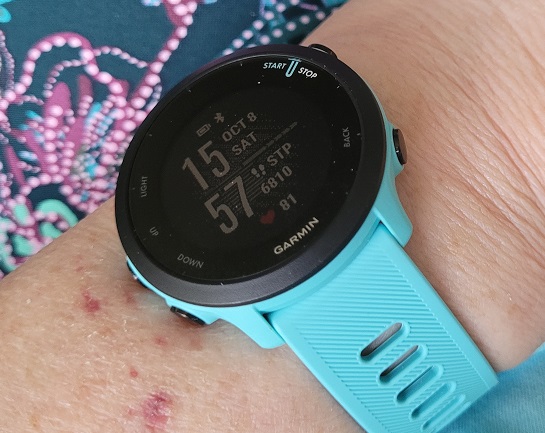
Earlier this year, I bought a Garmin Forerunner 55 sports watch. I got it on special, just for the record. Now, I was rather upset to discover they’d stolen MY idea of an internal battery, just renamed it Body Battery. (No, I don’t really think they stole my idea).

It was interesting indeed. Here was I not feeling too crash hot and my watch was telling me my body was very physically stressed even when I lying in bed asleep. Here is December 14 as an example of the type of day I was seeing.

Body Battery

The orange bars are physical stress (draining), the blue are rest (recharging). Out of a max of 100, my battery reached a high of 33 that day and dropped to a low of 13.

What, I wondered, was this trying to tell me? My doctors weren’t very interested. It’s not a medical device, after all. Well, they may not be interested, but I am.

The watch is very accurate with other measurements: kilometres walked, GPS, step count. But was it perhaps faulty in this respect?

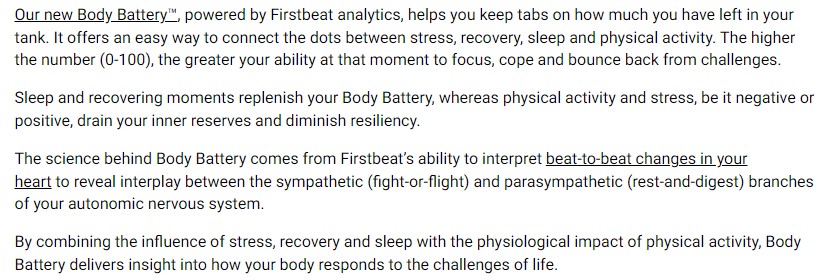
The first question I had was how is Garmin calculating this? Click the pic to read the full article

Calculation

I read several of the related publications, just chose the above to share here.

I was convinced my watch was telling me something. I even logged a support ticket with Garmin (still in progress as I write) but I have now decided the watch is onto something. That something MAY be inflammation.

Let’s move forward to the end of December, when I was having quite a bit of pain. After two rheumatologist visits and two GP visits between December 22 and January 3 and a steroid shot in one wrist AND (this is the kicker I think) starting on anti-inflammatory medication on Wednesday January 3, all of a sudden my body battery looks much more like I would expect it to look. Here is yesterday’s report! Compare the pair!

Yesterday I did stuff aside from walking. I did a big grocery shop, put all the groceries away, I worked in the afternoon and before lunch. I can match those orange periods on the graph with what I was doing during the day. I could not do that in December. Not only that, I reached a high of 85! 85! The low of 8 was at midnight.

Stunned I was! The only explanation I can come up with at this point is the anti-inflammatories. Started on Wednesday, took a couple of days to kick in. Plus, of course, I have started my new PsA medication and it will be hopefully starting to work behind the scenes as well.

This morning is looking very similar. By the time I woke up my battery was charged to 93!

Body Battery This Morning

Now, as I type this, I have used up some energy. I was out walking at 7:30 am this morning. I haven’t felt like doing THAT at 7:30 am for months. 2.5 kilometres, for anyone keeping tabs. As we know, over Christmas it was taking me until about 10 am to desolidify enough to walk.

Now, two days does not solve a mystery. I might be 100% incorrect in my deliberations. However, I’m sure you’ll agree it is very interesting. Is it not? I will be monitoring progress to see what happens from here on in.

Yes, I have updated my Garmin support ticket with this new information. I’m finding this quite intriguing!

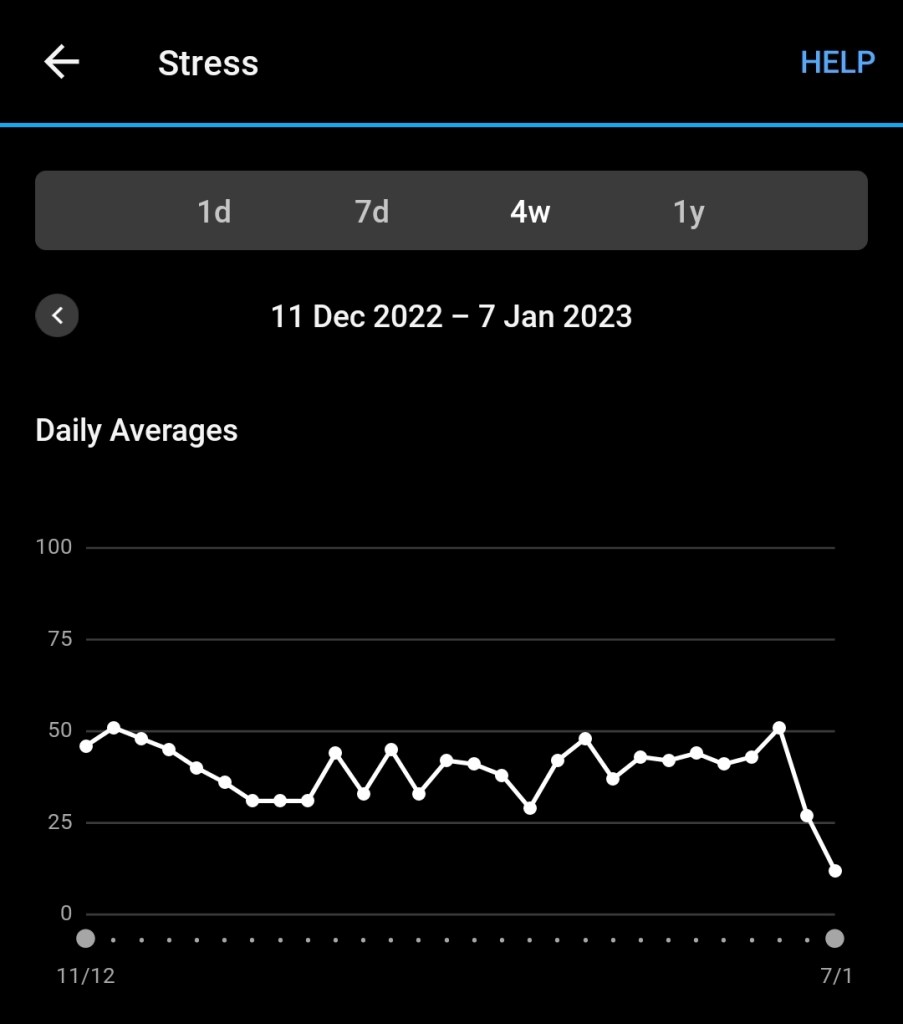
One more graph. Garmin also provide a graph of your average physical stress over the days. Look what has happened.

Stress Graph

Movement As Medicine

Let’s talk about specifics while I’m actually madly using movement as medicine in my own life. I use it all the time, obviously, or Limberation wouldn’t exist! Right NOW it is critical to just getting through my day.

I am in the process of changing medications. While my rheumatologist said “The medication’s stopped working”, now that I’m a few days down the track I tend to think it may not have quite stopped completely. Maybe a drop of 50%. Because I’m in a LOT more pain now than I was on Thursday when I saw him. Today is Monday, for reference. Thursday morning was the last dose of the old medication.

Why medications stop working for me is an as yet unsolved mystery, so for the point of today’s discussion, just accept it happens for me. We’ll investigate why another time.

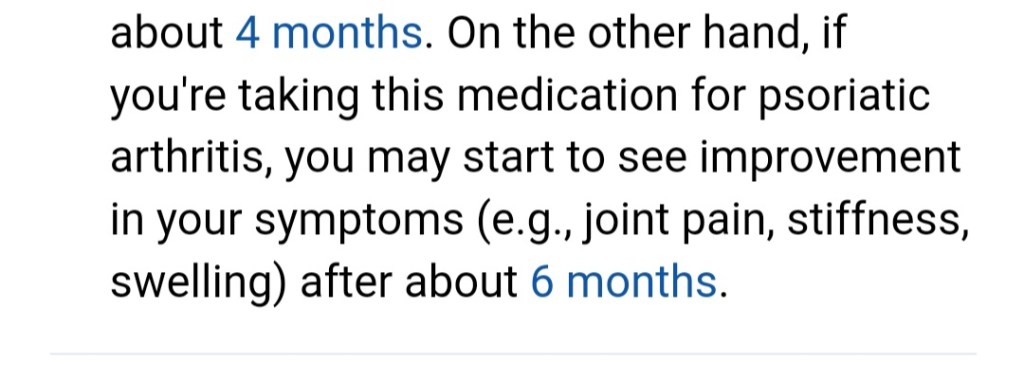
I was hoping the new medication would at least provide some improvement in the short term. Not so far (but it has only been five days). In an attempt to get a handle on when I might expect an improvement, I looked up the information.

Information re medication

Improvement after SIX MONTHS? I should say the documentation accompanying the medication and detailing two of the clinical trials provided more nuanced detail and I might see improvement by four weeks, so I’m hopeful! Even so, given that several areas of my body start getting painful at about 3 am, are REALLY painful by 7 am and that lasts until about 10 or 10:30 am depending on when I start moving (i.e., get out of bed), I have to get through the next weeks, whether they be four or 24. As my rheumatologist very sweetly squeezed me in on the last day of consulting prior to the Christmas break, we really didn’t have time for lengthy discussions, it was a fix-the-immediate-issue type consult. I will see him again in January and have the opportunity then to delve into the detail! I’m just grateful I was seen at such short notice! As he has me on Prednisolone (bridging) for six weeks, I’m figuring four to six weeks is the expectation for SOME degree of improvement.

The current list of sore bits?

  • Both shoulders (not too bad)
  • Both ankles
  • Soles of both feet
  • Posterior leg muscles, roughly around the back of the knee (could be gastrocnemius origin, not sure)
  • Right wrist (not bad)
  • Left wrist (EXCRUCIATING) – UPDATE: this is actually De Quervain tendonitis, diagnosed Dec 28.
  • Both hands, some fingers worse than others
  • The other day my neck was also in the mix, but it seems to have settled down – after some remedial exercises.

I think I’ve listed everything.

When I say the left wrist is excruciating, I mean when I load it (that is turn it, or try to lift a coffee mug) it feels like I’m being stabbed with a scalpel. When I once used that description of pain to my GP I saw the “you don’t know what that feels like” look on her face. I said, “I once stuck a pitchfork through my foot. Completely through. Into the ground on the other side.”

“Ah”, she replied, “You know what a puncture wound feels like.” Yes, sadly (and stupidly), I do.

In this particular case, it isn’t just the wrist itself, it is the tendons from the thumb, right where they pass the wrist joint. OUCH!

Anyway, back to movement! So my day goes like this. Wake up, in pain in all the various spots listed above. Clearly getting dressed and having breakfast are challenging. Getting that bra on….. you guys don’t know how lucky you are, trust me. I take my Prednisolone. Yes, ideally I should take it at night to counteract the development of inflammation overnight, however, if I do, I get NO sleep. So that’s not an option for me. I like my sleep! I need my sleep!

I potter about having breakfast (Pred has to be taken with food), gently moving everything until I can actually get dressed. By 10 or 10:30 I can walk. I mean walk outside, movement. This morning I monitored the improvements for the purposes of this article. By 300 metres the pain behind my knees had gone. By 500 metres my feet were feeling heaps better. By 1 km my ankles were improved. I have stuffed ankles anyway, the surgeon in charge of feet in my world wants to replace my ankles, they are mechanically so bad. So given they are likely a hot target for PsA inflammation, I’m not expecting them to resolve completely on a walk, but they are now much happier that when I left the house.

Walk

Having got the lower bits & pieces thawed out, I then tackle my hands. Warm, salty water in a bucket. Various finger movements, here are some.

I will also make fists. I hyerextend the fingers too, but do that out of the water.

By about 11:30 am I am actually a functional human being again. Pretty much. Am I completely pain free? No. Can I walk, use my hands? Yes.

Now I can use my hands, I can do remedial exercises for my shoulders. As I’ve detailed those at that link, I won’t repeat myself today.

I haven’t mentioned any pain medications have I? Well, no, because as I may or may not have mentioned before, the run of the mill pain meds we are allowed at home don’t really work for me most of the time. Endone we don’t even bother trying any more. I do take Panadol Osteo, it does help a little bit. This morning I didn’t bother with Tramadol as I wanted to compare to yesterday (when I did take it) and as I suspected, no difference. So I can now put Tramadol on the list of “May Work On Lucky Days” – or with some types of pain, but not all. Not working with what I’m dealing with at the moment, obviously. I do know about keeping severe pain under control, that it is harder to get back under control if you let it get too high on the scale. I’ve had a hysterectomy and a total knee replacement among other surgeries, I learnt stuff! I also know when a medication is not working.

For the record, I was born with these resistances (pain meds and sleeping meds, both). Most of my life it wasn’t a problem. I didn’t have pain and I slept like a log. Until I got sick. NOW I need the damn things to work, but the chances are slim! I also have wonky/broken pain sensors. Some, not all. I do wonder if that has anything to do with why pain relief doesn’t work with any reliability either. Pain to do with muscles, tendons, entheses I feel. Other stuff, like stomach ulcers, an infected tooth or abdominal adhesions – those pain sensors failed the quality checks during assembly.

My GP asked me had I always been that way. I said I have no idea – to ME I was normal. I didn’t know other people felt pain when I didn’t, plus I was rarely sick (other than the usual measles, mumps, chickenpox etc in pre-vaccine days). I did have meningitis at about 12. I did tell my GP that I remembered saying to people after the birth of my first child , “I’m not sure what all the fuss is about, it isn’t that bad.” The look of shock on her face was quite dramatic! I think that was the point she jumped on board with the pain management crew at the Barbara Walker Centre who first suggested I had faulty wiring.

Prior to my appendectomy, I went from absolutely no pain to agony in the space of about 30 minutes, BUT that really isn’t a reliable indication, as that can happen with appendicitis. No pain with my gallbladder either, BUT I had a porcelain gallbladder and often there is no pain with a porcelain gallbladder. So again, not conclusive evidence. Indicative, perhaps, as the surgeon did seem a little surprised that I had no pain given the state of the thing.

Without using Movement As Medicine I’d be in BIG trouble right now.

Are my legs, feet and ankles sore when I take those first 300 or so steps? Yes, I’m not going to lie to you, they are sore. I don’t start while they are still really painful, I do that thawing out first, pottering about. But no, I don’t leave the front door feeling normal.

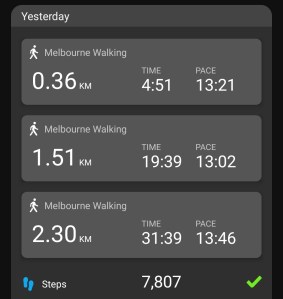
Do I have a good rest of the day? Yes, pretty much. Yesterday, I still reached my four kilometres and 7,500 steps targets. I’m slow, but I’m moving. These items list in reverse order, by the way. The 0.36 was at the end of the day, just to reach the targets. I was up earlier yesterday too, so thawed out earlier.

Taregts

My fingers and hands are still swollen and they actually feel swollen. But the soreness has gone for the day. I am NOT lifting weights at the moment. My assessment is (an example) the load on the wrists of holding the dumbbells for the bicep curl is not going to help the wrists. The biceps are fine! I could probably risk lower body and core stuff, but my body is fighting a battle with itself at the moment, so I’ll keep it to remedial level activities.

I will rinse and repeat the day just described until the new med starts to kick in. I will add activity intensity as I deem appropriate. For example, if I get the shoulders settled, I’ll hit the lap pool. The shoulders aren’t too bad, so I think I may be able to calm them down relatively quickly with focused attention.

Here’s the caveat. Make sure you talk to your doctor/(s) and/or physiotherapist before using Movement As Medicine. My purpose is to provide my experience as encouragement from a practical perspective. To illustrate the value of moving. Having said that, not all conditions are the same. Different patients have different comorbidities, different degrees of severity: a host of clinical considerations. Always consult YOUR health care providers.

The below is from an interview with Arizona-based chronic pain specialist David Tom, M.D.

Movement As Medicine

I have subscribed to this theory since late 2014 and it has served me well. Eight years and I’m still moving. Movement has helped me get through six medication changes (this new one is my seventh medication).

My final tip for the day? Get bright shoes! They lift your spirits!

Choosing Your Doctor/(s)

At the risk of the medical profession banning me for life, yes, I’m going to look at this topic. Let me say at the start I have a great medical team: my GP, my specialists, my surgeons and my allied health practitioners are all fantastic. If they weren’t, they wouldn’t be in my team. It is that simple. Of course, they aren’t “mine” as in, I don’t own exclusive rights to them. Even so, to me, they are “mine”. I do share them with other nice patients!

My condition, psoriatic arthritis, is not terminal: so while my life does not depend on my doctors, my quality of life certainly does. In my experience, it is important to feel you “click” with your doctor/(s). I think that is important to anyone managing a chronic condition. We aren’t popping in once a year to have our blood pressure and heart rate checked or for an annual blood test. We need to be able to communicate on an ongoing and regular basis, years in fact, with someone we trust and whom we feel trusts us. Our relationship with our long-term doctors is, in my view, critical to ensuring we achieve patient goals. There would be no point in my seeing doctors who were not as into Movement As Medicine as I am, for example. Continuity of care is also important. I don’t have to relate my history every time I go for an appointment, my practitioners know my history.

Now, doctors are just the same as the rest of us. They may relocate, they may take maternity leave, they may make a career change. I’ve had my GPs take maternity leave, I had an endocrinologist move into management, a psychologist give up private practice. Or we move – I changed endocrinologist, gastroenterologist and GP when I moved from one side of town to the other. Doctors retire – my rheumatologist is currently in the process and I have proactively moved to one of his colleagues to ensure a smooth transition of care. Even if you are happy with your current doctor/(s), there will no doubt be a time you have to change.

Patients need to think about what is important to them, aside from clinical expertise. If you feel you gel or click with your doctor, you are more likely to follow their advice and instructions.

What do I look for (other than clinical/surgical expertise)?

Top of the list is a sense of humour. One of the ways I deal with my disease is humour and I need my doctors to be on board with that. This would not work for everyone, I acknowledge that.

The doctors need to have moved on from their registrar days in hospitals and not expect their sick patients to look sick! That’s me on my invisible illness crusade again. It doesn’t matter how much pain I am in, if I can get that lippy on, I will have it on. Don’t look for a lack of lippy as an indication of my state of health.

Me after my total knee replacement surgery. My nails were painted by Day 2!

Don’t speak to me like I am a child. The doctor is trained in their field, I’m trained in mine, don’t think I’m less intelligent that you are! If the doctor can’t adequately answer my questions, that says more about the doctor than about me. I don’t care how “medically dumb” my question is, I expect a proper explanation because I’m not medically trained – if I was, I may not have asked the question. Gold star to my knee surgeon, by the way. He excelled!

Which brings me to arguing debating. Yes, I will debate issues with my doctors. Once we’ve agreed a strategy, I’m a very compliant patient, because I then have equal ownership of the decisions made. Let’s face it, I’m the foot soldier here. The doctors are the commanders back at headquarters, they aren’t in my home every day ensuring I take my medications, (try to) sleep right, eat right and exercise. They aren’t the ones doing the hard yards managing my health on a day-to-day basis, I am. Flip side note here: I was once a member of a support group and another patient said her rheumatologist was going to be cross with her. Why, she was asked. Because she hadn’t filled the prescription the rheumatologist had given her three months ago. I don’t know how doctors deal with situations like that, I don’t think I’d be good at it! SO I take my hat off to those doctors that manage those situations smoothly.

The ability to admit they don’t know something. I don’t expect any medical professional to know everything (there is SO MUCH to know), but I do expect them to be open enough to say, “I don’t know, I’ll find out” or “I don’t know, ask your [other] specialist”. This is also about being curious. Your doctor needs to be the curious type. Those of us categorised as “complex comorbid” are not text book cases. Symptoms may be caused by any one of a number of conditions. I recently did the specialist merry-go-round to find the cause of an issue. From GP to gastroenterologist to rheumatologist to endocrinologist. Also, research takes about 15 years to become embedded in practice. Curiosity can work in our (the patients’) favour.

Although this is a bit of a long shot (I was lucky), it can definitely help if the doctor or specialist has an interest in the particular condition you have. Or has it themselves, which just about ensures a specific interest. Again, doctors are people too – they aren’t all text book “healthy”. They may have an interest in a specific condition because a family member or friend has that condition or simply because it interests them. We all have specific interest in our lives: yesterday was Melbourne Cup Day – I am not the slightest bit interested, but a girlfriend will have been there in all her finest frockery. I went to the gym and lifted heavy things. Why does one person become a virologist and another a microbiologist? Something about each attracts that specific person. My hope is they will be more up-to-date with treatment developments if they have that specific interest.

I do like to see they look after their own health. They exercise, don’t smoke, wear a mask (re Covid-19) and hopefully get enough sleep. Sleep can be difficult when hospitals ring anaesthetists at 3 am in the morning when a patient’s pain is uncontrolled, I know. I wonder how many calls each night some receive. To my way of thinking, if a doctor doesn’t follow the advice they give to patients, why should the patient follow that advice? Of course, as noted above, some doctors have chronic conditions themselves so they may not look like the embodiment of Superman or Superwoman and that’s fine.

Have I ever had a problem with a doctor? Yes, I have. I once ended up with two Merina IUDs in my body and was not at all well as a result. The story is a bit long for this article, but the experience taught me that patients have every right to question and to go to another practitioner if deemed appropriate. Which is exactly what I did in that case.

There are times when we have no choice. A friend had surgery that was only available from one surgeon in Australia at the time. Whether he liked the surgeon or not was not a consideration – if he wanted the surgery, that’s who my friend had to go to.

Yes, cost is a factor as well. Clearly I am not talking about attending out-patient clinics in public hospitals where there is no choice of practitioner and it is possible the patient sees a different doctor each time they attend an appointment. I am an avid supporter of public health, but there are ways we could try to improve it especially in relation to chronic illness patients. Seeing doctors in private practice means you need to ensure you really understand how the safety net threshold works and that you are registered correctly as a family or couple if applicable.

One’s relationship with one’s doctors in not quite the same as with other service providers. A plumber comes in, fixes the drain and leaves. Job done. One’s relationship with one’s health care providers is more personal than that. The impact on my life could be considerable, so I need to feel I have the right doctors for me.

One problem is this. I’d love to take my GP out for dinner, but my understanding is that is ethically inappropriate, sadly. I also have an awful feeling we’d get into trouble – and I suspect if she reads this I am in trouble. I have sent a previous GP flowers because she had gone above and beyond on a particular occasion and I wanted to show my appreciation. Flowers are OK.