“How Can I Afford to Exercise?”

This question has been passed to me from a health care worker and is a very valid question. Many people with chronic conditions are on a limited budget. They may be working reduced hours, be on the Disability Support Pension (or worse, have been forced onto JobSeeker) or Age Pension. Disclosure: I am an age pensioner, so I have lived experience of the budgetary constraints! Like me, many will not have qualified for the NDIS. I’ve written before about the The Costs of Chronic Illness, many of which no-one, least of all governments, seem to think about! If we can’t afford to take care of ourselves, the costs of our healthcare rise.

There is definitely an argument for governments, via the health system, to make exercise more affordable for the chronically ill, but what can we do now?

Please note there are many links in this article to past articles. That keeps this article shorter than it might otherwise be. Click through to read the details!

Doctors, I find, are often (not always) good at telling patients to get exercise, but that is where the advice stops! How is left up to the patient!

Most of us can’t afford a private physiotherapist or exercise physiologist on a weekly basis. I have both myself, but unless I need specific support for a specific problem, I don’t see them as it bites the budget. I wish I could see my exercise physiologist on a weekly basis! This was one of the reasons I initially undertook my Fitness Coach education – to help people like me.

So WHAT can we do to keep costs controlled? Then I will look at WHEN we should do the exercise!

Find a gym that offers concessions: I am a member of my local council aquatic centre. This has a fully equipped gym, great hydrotherapy pool, 25 metre indoor pool, 50 metre outdoor pool, spas and a sauna. Everything I need in one place. Due to my PCC (Pensioner Concession Card) I receive a 40% discount on the membership fee. I pay fortnightly so I can suspend my membership for four weeks a year for free (e.g. hospitalisation, surgery, etc). No lock in contract either – watch out for those! Places like this are harder to find in regional areas, unfortunately.

Memberships are generally much cheaper than paying casual rates per visit. Finding a facility that offers all the services you need, as mine does, is a bonus. If you are working reduced hours, you may qualify for a concession card even if you are not technically unemployed or on a pension. Check your eligibility. The Seniors Card also attracts membership discounts.

Aside from weights, a gym gives you access to indoor rowing machines, stationary bikes and treadmills. All very useful equipment.

Have equipment at home: therabands or resistance bands come in various strengths and are available from physiotherapists and stronger ones are available at sporting goods stores. I also have a swiss ball and my daughter lent me an aerobic step when I had my knee surgery. Many of us have space considerations therefore having equipment at home has limitations. It isn’t just space: I own 2 kg and 5 kg dumbbells but realistically that doesn’t allow me to Pace UP my strength training. I need the gym for that as I have no space to house a full dumbbell set, nor can I afford one! Suggest to family members a good Christmas Present would be [whatever it is you need].
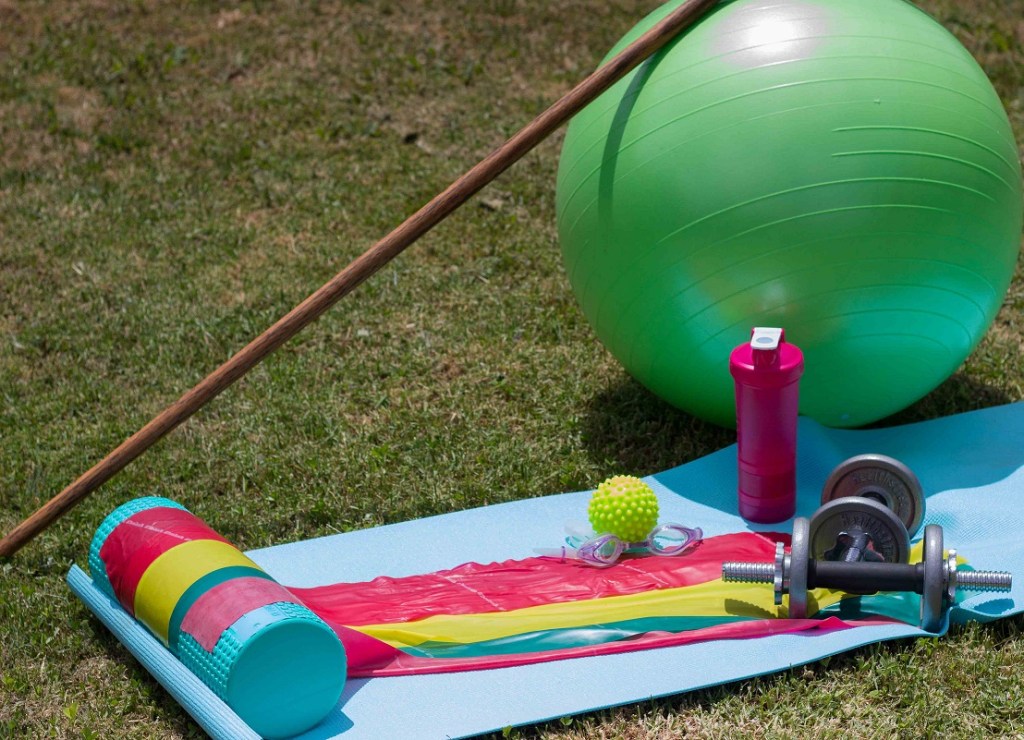
Home Equipment
Christmas Present from family – was very useful during TKR rehab!

Floor exercises at home: many exercises can be done at home without weights, sufficient for our therapeutic needs. Squats, glute bridges, planks, push ups (against the wall is fine) as a few examples. However, getting down onto the floor and back up again is not possible for all of us. I did glute bridges on my dining room table when preparing for my total knee replacement. After my knee surgery I found a way to slide off a lounge chair onto the floor using my arms, then used my arms to lift myself back up after I’d done my rehab exercises. I strongly recommend paying for at least one formal training session to ensure you have correct technique – you do NOT want to damage anything through incorrect technique. See your GP about a Health Care Plan to have five physiotherapist or exercise physiologist visits covered by Medicare – bulk billing is rare though, so make sure you are on top of your Medicare Safety Net details.

Walking: never underestimate the benefits of walking as exercise. Best of all, walking is FREE! Well, free after you’ve allowed for the cost of decent walking shoes – important with most medical conditions! It helps if you can find a local park or walking track that makes walking a pleasant experience. The featured photo above is of Gardiners Creek, a lovely spot! Some parks are implementing exercise/fitness equipment in a corner of the park, so keep an eye out for such in your locality. However, please take note of my “when” cautions at the end of this article before rushing off to walk your way to a healthier you.

Central Park
Fitness Equipment – free in the park

These public fitness equipment spots generally do not allow for a balanced workout. For example, there is a leg press in that photo but no leg curl for the hamstrings.

Get a step counter of some sort. I recently upgraded from a Vivofit generation 1 to a Garmin Forerunner 55 (bought on special). It also counts my swimming laps. You need to be able to monitor your progress properly. Christmas stocking request! Nothing more motivating than seeing your progress graphically AND wanting to maintain/improve it. Below is a comparison of the last eight weeks. Bear in mind I moved home and retired in August. I was pretty exhausted to be honest, plus there was a health “glitch”. Therefore August/September situation was messy on the steps front. Even with that excuse, I like the graph on the right MUCH better! It is good to actually see your progress.

Compare the months

Garmin Connect on your phone lets you see everything at a glance. The app is free (just as well, because the watches aren’t!). If you already have an Apple watch, check out what you may already have available.

Before any reader goes “Uh ha! We caught you! That’s more that 10%.” Yes, it is more than 10% comparing those two 4 week periods, but not overall! Plus I was still going to the gym and swimming, just the steps and walking took a tumble. I also changed my goal structure after I retired, but that is a whole other discussion for another day!

I will walk to the supermarket or pharmacy and record that as a walk. Just over 1 km. Same back. Walk to my favourite coffee shop. 1.30 km trip. Not possible for all, I know, but think about what activities you can turn into an exercise event in a similar way.

Swimming: see gym membership above. If you live near a beach, even better! Swim for free!

Hydrotherapy: wonderful if you can have access to a hydrotherapy pool with a gym membership as I do. Definitely not enough of these around, especially in regional areas. I also do squats and lunges in the pool. I have specific equipment to help me achieve my goals. Bought before I retired, but perhaps another Christmas stocking option!

Hydrotherapy equipment drying after use

Cycling/Running: both great options if you are able to. Good running shoes are expensive. Buying (and maintaining) a bike and related equipment is even more expensive. Gym membership gives you access to stationary bikes. Stationary bikes can be better when starting out as you don’t accidentally overdo it – you can stop when you feel that change in your body (see Pacing for Beginners) rather than find yourself too far from home and suffering later from over exertion. There is NOTHING to be gained from riding 35 kms today and being unable to do anything for the next three days. Consistency is key.

Motivation: I personally struggle to find motivation to do exercises at home. I’m much better going to the gym. I was fantastic at the daily rehab after knee surgery, but that had measurements and specific goals involved. We are all different, some find being diligent at home easy. I don’t. Unless I’m trying to fix something, like rehab a temporarily grumpy shoulder. Joining walking groups is a great idea, but in practice not suitable for all chronically ill people. For example, a group may walk at a much faster pace than we can safely manage with our condition/(s), walk further or walk at times that don’t suit our condition/(s) (e.g. morning stiffness/pain). I’d love to join the local swimming group, but I need to be able to swim 2 kms without stopping – I’m not there yet. Fitness classes can be demoralising if we can’t keep up. I recommend strength training is more beneficial anyway! We need to select exercise modes that suit us in order to maintain our motivation, especially if we are paying for a membership.

Covid-19 Considerations: no matter where we go at the moment, remember to be Covid safe. We already have underlying conditions, we don’t need Covid-19 on top. But then neither do we want to let our underlying conditions run riot because we are protecting ourselves from Covid-19. I wear a mask into the gym. Depending how many people are there I may well keep it on while training. I may warm-up outside rather than on the treadmill. I’ll wear my mask in the hydrotherapy pool and the spa. For lap swimming I take the mask off just before I put my cap and goggles on.

Medical Clearance: Let me repeat something I often say on this web site: ensure you have your doctor’s approval to undertake exercise and ask if there are any limitations. In most cases, musculoskeletal conditions will have no restrictions other than “listen to your body”. Other medical conditions may have certain cautions. Get a clearance. I do notice men can be more gung ho about it, so please see your GP!

I emphasise it does take time to learn to listen to your body.

Now to the WHEN!

I’ll use walking as an example. My daily target is 7,500 steps a day. I know that if I do very little incidental steps, I need to walk 4 kms to reach that 7,500 steps target. I do not walk 4 kms in one go. Now I am retired from the workforce I can walk whenever it suits me. When I was working I would aim for 1.33 kms before work, lunchtime and after work. Now I generally do 2 kms in one walk and then two separate walks of 1 km each. Many of us can do (say) 4 kms per day easily with respite between the walks, but 4 kms in one burst would drain that internal battery.

Some people may think this takes too much time. Not really. I walk 1 km in about 11.5 minutes. Exercise physiologists tell me each activity over 10 minutes is good. All I have to do is find 11.5 minutes four times a day. That is manageable. In 2014 I started by walking around the block four times a day. Some people have walked around their clotheslines to get started. Where any of us start is not a competition. Maximising your health over time is the objective.

Obviously splitting workouts like that is not really sensible for strength training or swimming – I’m not going to go to the gym four times a day to split up my weight training! Of course, this is where pacing up comes in. Start small, build up slowly.

As mentioned above re cycling, it is critical to follow the pacing principles at all times, even with walking. Where you start with any movement/exercise activity will depend on your current state of health and mobility. We are all different. Cost is not the only consideration here. Depending on where you are starting from, it may be wise to build up on free exercise, then only consider a membership of a gym once you are in a position to utilise that membership effectively. Alternatively, paying a regular membership may actually be motivation to use the facilities: you decide what works for you!

We Don’t All Look Sick! Invisible Illness

Many people who are classified as chronically ill, myself included, don’t look sick or ill. Healthy people can find this a bit of a conundrum. We can be accused of “faking it” or being a hypochondriac. Even worse, we can be criticised for doing the very things we must do to manage our various conditions. With my condition, psoriatic arthritis, I must exercise. This just seems to be a red rag to a bull for the doubters because their understanding of “sick” doesn’t include things like the leg press or lat pull down in the gym!

I wonder how many chronically ill people are actually dissuaded from doing the very things they should do because of this attitude of doubt they encounter from others. That is a study for an enterprising young exercise physiologist and a psychologist to undertake! I’m just posing the question!

In 2018 I wrote “You Look So Healthy!” which was a look at how our emotions can react to being complimented for looking “so good for a sick person”. I also looked at society’s overall acceptance of chronic illness in my more recent article, “Will Society Adapt? When? How?“.

Please be aware not all conditions that MAY be invisible are invisible for everyone. To take psoriatic arthritis as an example, it is invisible in my case SO FAR (and I hope to keep it that way). Other psoriatic arthritis patients will have visible indications of their condition. It may be deformed joints or the need for mobility aids. In fact, psoriatic arthritis is a condition that may wax and wane – so I could be using a walking stick today, but not tomorrow.

People often look for a “gotcha” – and that is very annoying. Having to constantly explain that being chronically ill does NOT mean we have to be in hospital with a cannula in our hand, that yes we can walk 4 kilometres a day but we are still clinically sick is very, very tiring. As I have said before, the reaction I get from the public if I go out with a walking stick is very different to the reaction I get without it. In some respects this is fair enough as without the walking stick there is no indication to anyone that I am not perfectly healthy. However, if I tell someone I need a seat on the tram, I don’t expect to be put through the Spanish Inquisition!

Today I’m looking at the specific question of why, given such a large percentage of the population has one if not more chronic conditions (comorbidity is common), society is not more aware of invisible illness. To use myself as an example, why do people find it difficult to understand that I can do the leg press at the gym, but I can’t clean my shower recess without falling in a heap? For those wondering, it is due to damage in my lumbar spine – which you can’t see. It is invisible.

I sometimes get the strong impression I am not supposed to paint my nails, wear lipstick, or wear my extravagantly floral (happy) leggings. I am supposed to “look unwell”. Why? I think I speak for most of us when I say we go to considerable lengths to NOT look unwell! Doing so makes us happier.

I remember going to my GP once, a while ago now. I was in a flare. My shoulders and wrists were, essentially, unusable. I couldn’t put a bra on (so wore the most bulky windcheater I own to hide the fact). I managed to pull on some tracksuit pants – leggings weren’t happening. Lipstick certainly wasn’t happening. I called a taxi as I didn’t feel safe to drive. “Oh, you are the worst I’ve ever seen you”, she said. True, she had never seen me in such a condition. Had it been my knees or hips or ankles, she would not have seen me in that state: it was only because the joints I use to “look good” were “feeling bad”. Would my GP have recognised how sick I was, though, if I still “looked good”? While only she can answer that, I have been a patient of hers for quite some time now – I think she gets it. But not everyone does.

I would have had NO trouble convincing anyone I was sick that day! But that is not how I want to live my life. It isn’t how I want to look everyday. I don’t want to have to look sick for you to believe I have a chronic condition and trust my requests for certain adjustments.

I don’t want to live my life justifying why I DON’T look like that every day! A friend of mine has MS and he has a card, the size of a credit card, issued by the MS Society confirming his health status. Like me, he doesn’t look ill either, most of the time, to the uninitiated. Maybe a card would be appropriate for more of us.

Above I mentioned walking 4 kilometres. Let me assure you that 4 kilometres is very carefully planned out. I don’t walk out the door and just walk 4 kilometres in one hit. I do hope to pace up to doing that again, but at the moment I’m on the comeback trail. Sometimes, no matter how well we manage our conditions, we have setbacks. We have to pace up again to get back to where we were, provided we can.

I cite myself as having an invisible illness NOW – in ten years it may not be so invisible.

If you are standing in a group of ten randomly selected people, statistically at least four of them will have a chronic condition, maybe more than one chronic condition. There may be absolutely no visible indication. Some readers may have read my rant about public transport – if not, hit that link and read up.

All I ask is don’t assume that a person who looks 100% healthy is actually healthy. Many of the population is not – and we shouldn’t have to explain it every day.

chronic conditions care courage consistency coaching

Use It (Consistently), or Lose It

Modern medicines do many things. Some cure conditions. Many do not (yet) cure, but help in other ways: medications may slow disease progression or manage condition expression (e.g. control/reduce inflammation).

Medication alone is not a silver bullet – it often isn’t enough on its own to retain or regain functional movement and quality of life.

I’m going to share my own practical experience as an illustration. Shoulders are only the example here – the concept is the important bit. Interestingly I had a conversation with my eighty-something year old neighbour this morning who concurs! He told me he has FINALLY learnt to do his rehabilitation exercises religiously, every day. But Jack (not his real name) no longer works: this is where my consistency can suffer!

As per my earlier article, I Sat in My Car and I Cried, 2021 was a bad year for me. I went through a period where everything hurt. Consequently, as I was battling so many bits of my body, my shoulder care slipped. That’s on me, my fault.

My shoulders had first played up in 2016 and with the help of a great physiotherapist and lots of CONSISTENT exercises I’d rehabilitated them. With my usual swimming and weight training, the shoulders had stayed good without the need for specific exercises daily. However, during 2021 because the rest of my body went into meltdown, I was limited in my swimming and weight training. The shoulders progressively worsened to the point I had an ultrasound-guided steroid shot in each shoulder in late October 2021. There was at the time fluid in both shoulders. Not good. I should mention at this point the shoulders may not be exclusively psoriatic arthritis, there is likely some osteoarthritis going on in there too, plus the constant irritation of mouse and keyboard work. Yes, I have a fantastic vertical mouse, but that is more for the wrist than the shoulder. The right shoulder (mouse shoulder) is worse than the left.

It wasn’t until after my new medication started working in January 2022 that I was capable of being consistent with my exercises again. But how consistent was I being? As it turns out, not very.

The last couple of weeks are good examples. Saturday I head to the gym and yes, my shoulders hurt for the first couple of reps, but I do the usual upper body routine: lat pull-downs, chest press, seated row, bicep curls etc. By the time I leave the gym I have no shoulder pain. Movement Is Medicine (point 3 in that article). Sunday I head off to the hydrotherapy pool and do more gentle exercises, some involving the shoulders. As of last week I’ve added a few swimming laps (slowly increasing as shoulders toughen up). Monday, back to the gym, but less upper body work as I did the workout on Saturday. By Monday afternoon, my shoulders are singing!

Then comes Tuesday. My first work day of the week. I’m busy. I make sure I get my step count in. No gym today. My shoulders, feeling fine, do not remind me to do my rehab exercises and I slip. Bad me.

Wednesday I might feel a twinge or two when I get up and think to myself, “Robyn, make sure you do your exercises today, you know what happened last week!” Do I? Maybe, maybe not. Depends how exhausted I am at the end of the work day. Note to self: do them before breakfast, you idiot.

By Friday I’m back where I started, with sore shoulders. Again, I kick myself (figuratively speaking).

According to my myotherapist, I am pronating my shoulders. Not surprising as a desk jockey, we have to be so careful and it gets harder as we get older. To counteract the pronation, I bought myself a PostureMedic which I wear under my clothes, not over as shown on the marketing materials! Ran it past my myotherapist for his approval. I don’t wear it all the time, as while it encourages the wearer to hold their shoulders correctly, wearing it isn’t strengthening the muscles required to hold the shoulders in position naturally. I use it as a prevention tool as I first start work to help me develop/maintain correct sitting posture at the desk when I am deeply engrossed in work and can forget about my body.

If you have ever had your shoulders taped by a physiotherapist, it is a bit like that, but something you can put on and take off yourself without the issue of wet tape on your back after a shower!

My goal this week is to be CONSISTENT! To follow my own advice to other people! To do my exercises every day and not lose the gains I make over Saturday, Sunday, Monday.

Modern medications are fantastic, but they don’t do everything. Often, there is no way of medications repairing past damage, for example. If there were, I wouldn’t have needed a total knee replacement! I need to take the time and put in the effort to get my shoulder muscles working properly again. Yes, age is also a factor. In three months I will be three years away from three score and ten – what used to be considered the nominal span of a human life.

I hope by sharing my failures at being CONSISTENT I may have encouraged you to be more consistent than I have managed recently.

Movement IS Medicine.

A Tale of Two Days

I had a typical chronic illness experience this week. I’m writing this article particularly for family, friends and colleagues of patients, to increase understanding in the community.

Edited to add: After publishing this I decided to add a personal thought. Other chronic illness patients may or may not agree with me, so check first! We are not looking for sympathy. We definitely aren’t looking to be told to try extra Vitamin C, D or K. We don’t want, “But have you tried….” because trust me when I say this, most of us have agreed our treatment plans WITH OUR MEDICAL PROFESSIONALS.

So what do we want? Just acceptance! Accept what we say at face value, don’t doubt us. We aren’t making it up. It is what it is and many of us are very used to it and just get on with life as best we can. We don’t want a fuss. I’m not saying we don’t welcome kind thoughts or offers of assistance. Yes, you can certainly make me a nice cup of coffee or tea, that would be lovely, thank you. But the most important support you can offer is acceptance and understanding without doubting what we say and without making a fuss as if you expect us to keel over in the next hour. This may not be your normal, but it is our normal.

We hear and talk a lot about chronic pain in relation to chronic illness, but as we know from my last article, I’m pretty much pain free on my new medication. That is very pleasing. Pain is not the only debilitating issue we face.

Wednesday night I did not sleep at all well. I had an intense two hour meeting and worked an extra hour on Wednesday – did that contribute to the bad sleep? No idea. Woke up Thursday morning feeling shit. There is no other word for it. While I do try to stay polite in my articles, the lovely medical word I like, malaise, didn’t quite cover it. Unwell didn’t cover it. Clinically, my experience would likely have been classified as malaise, but that is such a nice sounding word it didn’t cover how I would have described the feeling. I want to stress, no pain. Pain is NOT our only problem.

I doubted I could actually work, but we had a 9:30 meeting scheduled so I dressed, braved the world. When I say I braved the world, let’s not get too ambitious here! I work from home, so braving the world entailed throwing my hair in a bun, putting on some clothes and some lipstick and sitting in front of my laptop camera for a Teams meeting! I did warn my colleagues I felt crap and doubted I’d make it through the day but would work as long as I could. Stomach pains then arrived, along with a couple of trips to the bathroom – I think you get the picture.

However, by 1 pm I felt relatively normal and completed my work day (quite productively, as it turned out) although I was a little hyper, which made no sense either. Logged off at 4 pm, sat down in an armchair and a wave of nausea engulfed me. My stomach felt funny, just funny. I was a little dizzy. The unwellness was back with a vengeance. I had a 5 pm appointment with a girlfriend for iced coffee and cake. There was no way I was going to be able to drive or have cake. I cancelled. Dug deep in my medication supply and swallowed anti-nausea medication and took a Somac (Pantoprazole). By 6:30 pm I felt marginally better. Went to bed reasonably early (for me, that is).

Slept like a log! Best night of sleep for the last two years, I think. Woke up Friday morning all cylinders firing! Went for a 1 kilometre walk before work. Worked my usual hours without issue. Waited for the temperature to drop (the weather temperature, not mine, mine was fine) in the evening and walked another 1.3 kilometres at just after 7 pm, before the rain arrived.

This morning (Saturday) I am giving my body it’s usual Saturday morning recovery-from-the-work-week time and I will head to the gym this afternoon for a weight training session.

So what on earth happened Thursday? I have NO idea. I hadn’t eaten anything different, I hadn’t been out partying, I hadn’t overly exerted myself physically on the Wednesday. I suspect the bad sleep wasn’t the cause, but a symptom – of course I can’t prove that.

These episodes, while not painful, are very restrictive and affect quality of life. I’ve been trying to think of a way to describe the situation that healthy people may relate to. You see, most people have experienced an episode of pain in their life: a toothache, a twisted ankle, recovered from surgery, headaches, a broken bone, a sports injury, something. Although healthy people might struggle to really understand chronic pain, most do understand pain itself at some level and know it exists in different degrees of severity. Most people who have not experienced malaise have no similar experience to inform their understanding of what the patient is going through. We look fine, no bandages, stitches, crutches – so what’s wrong with us?

The closest I can come up with is imagine you have a case of influenza but without the temperature, runny nose and headache. You just feel shit. Throw in a bit of lightheadedness and nausea (but no throwing up) for good measure. Don’t confused malaise with fatigue or lethargy, although they can sometimes arrive hand-in-hand.

Healthy people (e.g. family, friends, colleagues) can find this difficult to comprehend. It arrives out of nowhere, lasts an indeterminate time, may fluctuate and is extremely annoying and quite debilitating. I don’t like cancelling coffee dates with friends. The patient literally may not be able to do anything. I couldn’t on Thursday afternoon/evening, I just sat until I went to bed. Feeling extremely annoyed, but there was little I could do about the situation. It may not happen again for six months. It might happen again tomorrow. We never know.

If someone you know has these episodes, be gentle and supportive, even if you don’t understand. Trust me, we don’t like it either.

So, About the Safety Nets Thresholds

Introduction

Some years ago in Australia it was possible to claim a certain amount of out-of-pocket medical expenses on one’s tax return at the end of the year.

A few years ago, this changed. It was replaced with a system of higher rebates once a certain level of out-of-pocket expenses had been reached for the calendar year. This is beneficial, as the patients don’t have to wait for that money to be received once a year at tax time.

I have discerned some confusion about how this all works, so this article is an attempt to put “how it all works” in simple terms.

The one aspect I think is MOST important is registering as a family or couple, especially if you have a person in your family with a chronic or underlying condition. Watch out for that heading below!

Please note if you are reading this article after 2022, you may need to locate current links. The links given herein are current as at the time of writing, for 2022.

PBS and Medicare Thresholds

The Pharmaceutical Benefits Scheme (PBS) and Medicare Benefits Schedule (MBS) are managed differently and have different safety nets thresholds. It is important that both are understood.

Medicare is managed centrally and the details and your current status is easily accessed in your Medicare app if you have it installed on your phone or via MyGov/Medicare.

Pharmaceutical thresholds are tracked by your pharmacist, so if you get prescriptions from different pharmacies on a regular basis, you could be missing out.

Medicare Safety Nets Thresholds

The Medicare Safety Net Thresholds are set every year for the calendar year. Once you reach the threshold applicable to you, you get a higher rebate. What can this mean in dollars? Please note the below example is across two different years, so the rebates shown may have moved slightly. Also, different item numbers may attract the same consultation fee but have different rebates based on the item number. For example, a psychology consultation fee may also be charged at $210, but as it is a different item number than a GP consultation, the rebate will be different.

Given the above caveat, the below is sufficient for illustration purposes and the examples are actual transactions of mine.

StatusConsultation FeeRebateOut-of-pocket
Before I reach my threshold (from start 2022)210.0075.75134.25
After I reach my threshold (from end 2021)210.00183.0526.95

As you can see, after I reach my threshold, my out-of-pocket is reduced by $107.30 (for this consultation fee for this MBS item number).

https://www.servicesaustralia.gov.au/what-are-medicare-safety-nets-thresholds?context=22001

Note all of these refer to “out of hospital” services. If you receive a service in a private hospital as an inpatient, the out-of-pocket costs will not count towards reaching your threshold (although the graphic above doesn’t state that), nor will you receive the higher rebate for any services you receive as an inpatient. I know this from personal experience!

Remember imaging and pathology fall under this scope.

Verified & Unverified Costs

In most cases these days, you pay for a consultation at the time of the consultation and the practitioner’s staff submit your Medicare claim for you. In that case the cost is a verified cost. However, if this does not happen, be aware there will be extra steps.

Verified costs are when you pay your doctor’s fee before you make a claim from us. When this happens, your gap amount and out of pocket costs count towards your thresholds. 

Unverified costs are when you don’t pay your doctor’s fee before you claim from us. When this happens, your gap amount and out of pocket costs don’t count towards your thresholds.

https://www.servicesaustralia.gov.au/verified-and-unverified-costs?context=22001

Once you pay the doctor the balance and provide that receipt to Medicare, then the gap payment will be considered verified. Make sure you do that!

Registering as a Family or Couple

Why is this important? Let’s assume you are an Aged Pension couple. If you are not registered as a couple, you each, individually, have to reach that magic $717.90 out-of-pocket expenditure to receive the maximum increased rebates. That is, together you need to reach a total of $1,435.80 before you both get increased rebates. One of you may receive increased rebates before the other, if one of you has higher medical costs.

If you are registered as a couple, then you both contribute to a single threshold: $717.90.

Being on the same Medicare card does NOT mean you are registered as a couple or a family. I suspect this is a result of the transition from the old tax deduction method to the thresholds. You need to actually register.

If you’re part of a family or couple, you can register as a family to combine your costs. This means you’re more likely to reach the thresholds sooner. Even if all family members are on the same Medicare card, you’ll still need to register.

https://www.servicesaustralia.gov.au/how-to-register-for-medicare-safety-nets?context=22001

You can see if you are, perhaps, a family of five, especially if a family member has high medical costs, registering as a family for the Safety Net is a very sensible move. There is a BIG difference between reaching $2,249.80 per year for each of you, or for all of you combined.

Edited: This advice is predicated on the fact the couple or family are officially a couple or family for other purposes, such as the age pension.

Pharmaceutical Benefits Scheme Safety Net

Please note that the PBS Safety Net is a little more complex than the MBS. The thresholds for 2022 are $1,542.10 for General patients and $326.40 for Concessional patients. Note that if you have private scripts, these do not count towards the threshold. Private scripts are those where the patient doesn’t qualify for the Government Subsidy, but is still able to be prescribed the medication – this could, for example, be for “off-label” use. That link also has good “The Real Cost of Medicines” examples illustrating how it works.

The scheme requires pharmacists, on request by patients, to record the supply of PBS and RPBS items on prescription record forms. When a patient reaches the Safety Net threshold within a calendar year, they qualify to receive PBS or RPBS items at a cheaper price or free of charge for the rest of that year. Any applicable special patient contributions, brand premiums or therapeutic group premiums must still be met by the patient.

The Safety Net threshold is reached by accumulating eligible patient contributions for PBS prescriptions supplied through community pharmacies and private hospitals and for out-patient medication supplied by public hospitals.

Pharmaceutical benefits (including authority items) can only be counted towards the Safety Net threshold when prescribed and supplied according to PBS conditions. A medicine supplied by a pharmacist not approved to supply pharmaceutical benefits cannot count towards the Safety Net.

https://www.pbs.gov.au/info/healthpro/explanatory-notes/section1/Section_1_5_Explanatory_Notes

I strongly recommend if you or a family member has high medication costs, you ensure you are availing yourself of the benefits.

Summary

The confusion I have noticed among members of the general public is I suspect partly due to the transition from the tax deduction days. I don’t remember how well the “new system” was publicised at the time.

I recommend couples and families ensure they are registered because if someone suddenly does become unwell, the last thing anyone thinks of AT THAT TIME is registering with Medicare. With the risk of Long Covid currently, best to be prepared.

If you do have high pharmaceutical costs, please check with a pharmacist. I never hit the PBS Safety Net so I do not know nearly as much about how it works.

I’m Not Lazy

Neither are YOU lazy. The title above is stolen, with permission, from a social media contact’s tweet.

We’re not lazy, nor are we responsible for other people’s expectations of what THEY think we should or shouldn’t be able to do. Sidenote: often those expectations are based on our appearance. Refer to You Look So Healthy! for more on that.

There are four other articles you may like to browse as background material to this article:

One of the challenges we face is helping people understand the whole energy availability thing many of us struggle with. In the conversation related to the above tweet, J told me she had mowed the lawns, done the edging, walked the dog and cooked dinner. J has the same disease I do, psoriatic arthritis (PsA). While I don’t know or understand the specific expressions of many other chronic conditions, this is one I do understand. J couldn’t see me, but if she could have, my eyes nearly popped out of their sockets.

Other conditions can be very similar, but I will stick with the disease I know for illustrative purposes today.

On a great note, for PsA management, J had certainly been moving. Movement is Medicine! However, J had probably used up more spoons or internal battery than she had available. All that in one day would cost her later, as she well knows from experience.

Society conditions us, well before we get sick, as we are growing up: doing our share, work ethic, earn our way. We then place expectations on ourselves. We don’t want to be sick, we don’t want to let others down by not doing our bit. In the first few years, of course, in the back of our minds we think it is temporary. To understand a bit more on that, you may like to read Will Society Adapt? When? How? Even we ourselves have to adapt to our new normal.

PsA is a very odd disease. At its worst for me, I can wake up in the morning with painful feet, ankles, knees, wrists, fingers; maybe even throw shoulders and neck in on a particularly bad day. I may have to use crutches to get around first thing in the morning. I’ll be unable to turn a tap on. Can’t lift the electric jug, struggle to open the coffee jar. Put on a bra? Are you kidding? Pull on tracksuit pants? Yeah, right. That sort of thing. About 11:30 am I’ll be fine. Virtually pain free. My body will have de-solidified. I’ll head out for a walk, go to the gym and do a weight training session. Sadly 160 kg leg presses aren’t happening any more, but maybe again one day…….. I am a completely different physical specimen at 4 pm than I am at 7 am. I saw my Plan B GP on Tuesday (Plan A was away), who hadn’t seen me for probably a year. She said “You look great!” This was 6:30 pm. I said to her, “You didn’t see me at 7 am!”

This can be VERY difficult for our friends, colleagues and family to understand. You need rest but you also need to go to the gym? That doesn’t make sense! Actually it does make sense and the reasons why are discussed in more detail in the above linked articles, so I won’t repeat myself.

We know, we can see it in their eyes. The doubt. The lack of comprehension of the situation.

We know people think we are just being lazy (at best) or hypochondriacs (at worst). J is right, it is VERY exhausting to be constantly explaining it to people, yet we know if we don’t explain it, if we don’t share the knowledge, social understanding and acceptance will never happen. We use analogies: spoons, internal batteries, even daisy petals. Over time our nearest and dearest do start to understand. If they want to.

If we live by the rules of pacing our activities and energy consumption, many of us can achieve a fantastic very nice quality of life, given our disease. The problem is, to OTHER people our rules can make us look lazy in their eyes – or at least that is how we can feel.

I work six hours a day. I have just entered my eighth year of having PsA, so I’ve had time and practice to build my personal pacing skills. Even so, I still feel guilty some days that I’m not “doing my fair share” at work. I have to lecture myself along the lines of this is what I MUST do or I won’t be able to work at all. I did try full-time for a while in 2019/2020 – it was WAY too much. Recently, we had a systems issue at work. That day I worked ten hours – I was petrified I was going to crash before we solved the problem. Thankfully, I didn’t, but those feelings and fears are what we live with every day. We don’t need to feel others are judging us because we MUST do less than they do in order to regain and retain quality of life and independence.

No, we do not have to vacuum the whole house in one day. A room a day would do!

No, we do not have to mow the whole lawn in one day. J, are you listening?

Spreading out those sort of tasks DOES NOT mean we are lazy. It means we are protecting our bodies, our internal battery and our quality of life.

Today I was going to go grocery shopping. But today is also weight training day. The grocery shopping can wait until tomorrow. Both on the same day would mean I wouldn’t be able to do what I have planned for tomorrow. Grocery shopping will fit with my plans for tomorrow as the overall intensity tomorrow is less.

We are not lazy. I am not lazy. Don’t let yourself be guilted into doing things that break your pacing rules, whatever they may be for you. The goal is to balance activity and energy so you achieve consistency in your state of health.

Flaring

For the uninitiated, flares are what we chronic condition people call the times our condition (or conditions) decides to remind us it exists, usually in no uncertain terms.

Barb, who, like me, is a complex comorbid patient including psoriatic arthritis, sums up flares succinctly!

The unjoys! The phrase “Oh the joys!” is in common usage, the implication being something is not actually so joyful. But I love this new word. For me, it hits a home run.

I had one yesterday. While the experience is fresh in my mind, I’m writing about it. We tend to get used to them, they become just part of our new way of life, while healthy people can find the flares of others confronting.

If you are friend, family or colleague of a chronic condition person, or you are new to this chronic world, hopefully I provide some insight to “what happens”. Everyone is different, what I describe is specific to me, my conditions and my current circumstances, but should give readers a feel for flares generally. Flares can be long or short: once my right wrist flared for about eight hours, then was fine. No rhyme nor reason.

Yesterday’s flare was different. For a start, it was whole body, not just one joint.

I now realise it started on Wednesday. I was driving to the office and my upper arms were sore when dressing and driving. Sore upper arms usually means shoulder inflammation. Nothing too bad, but I did take panadol osteo to see me through the day. Driving home from the office that night I felt nauseous and sleepy and nearly drove through a red light. Not good.

Thursday was a little worse, more areas were sore. I was WFH that day, so I managed. Even my total knee replacement scar felt tight, stretched and tingly. This was a new thing. The joints at the base of my thumbs were sore. My right (unoperated) knee was painful. My right hip was grumpy. You don’t need the whole list!

I woke up Friday morning in a full flare. Not only did I have many sore bits, I had no energy. I had to work, because…. deadlines. At least I was working from home though. No meetings scheduled. I certainly would not have gone into the office, but I felt I could manage the most important tasks in solitude at home. I resorted to panadol osteo and a stronger pain med to get me through the day – I hoped.

Yesterday is the first time ever I have worked in my dressing gown. I am the sort that puts on the lippy and mascara every day, working from home or not. For me to not even get out of my dressing gown is an indication of how crap I was feeling. Healthy people reading this may be horrified at this admission – chronic people will be nodding their heads and thinking, “Oh, yes, know that feeling well.” I did 1,172 steps for the day, between my office and my kitchen mostly.

It is very hard to explain how awful it actually feels. I liken it to possibly feeling as if you have run a marathon – at least that is how I envisage a marathon runner may feel at the finish line. It is only the start of the day, but you feel done already. Like, literally, DONE! That’s before any pain is taken into account. Or maybe the old “run over by a truck” phrase is applicable.

I did manage to get through the work day, almost – I finished slightly early. I doubt my productivity was any way close to normal, but I got some important deadlines met. I will probably work a few hours this weekend to catch up on other tasks. If at all possible DO NOT DO THIS! If you are flaring, REST. I’m setting a bad example here, I know that – but my example also underlines the fact sometimes we are caught between the devil and the deep blue sea.

After I finished work I sat in an armchair and my lumber spine decided to be excruciating. It had, I’ll admit, been building as the day wore on, now it was awful. No idea why – my lumbar spine hasn’t been a problem since 2017 (except for changing the bed linen, that irritates it). Pain medication was required, most definitely. Then, I got stomach pains. My eyes were dry and irritable. Like, what next?

This morning I woke up feeling absolutely fine! Made myself a lovely cinnamon rolled oats and pink lady apple breakfast, have been for a 1.6 kilometre walk, had a coffee at my local café. After lunch I went to the gym for a strength training session. The only slightly sore bits are the joint at the base of my right little finger and only if I hyperextend it, plus my soon-to-be-operated on toes are a bit off (but that’s understandable). I have energy, I feel perfectly fine.

The flare is over, just like that. Gone.

What causes flares when we are on a stable medication that is working and we are doing all the right things (eating properly and sleeping, hydrating, exercise)?

I will never forget my rheumatologist saying to me in late 2014, “Get the stress out of your life.” Great advice, but easier said than done. While the evidence is pretty conclusive that stress exacerbates many conditions and causes flares, we still have to live life! Earn money to pay the bills.

If I stand back and look at what has been happening in my life during the last few weeks there are several factors that alone may not be a problem, but the culmination of the stress of each has resulted in this flare. If you are flaring more than usual, take a look at everything that is going on in your life in the time period preceding the flare. In my case, right at the moment:

  • Pending surgery, with a late change of surgeon
  • Late change of the actual surgery procedure (extra stuff)
  • Teaching a relief staff member to do my role while still doing my role
  • Usual work deadlines
  • Fitting extra pre-op tests into my schedule
  • Mountain of pre-op paperwork
  • Lack of exercise due to work hours and therefore internal battery depletion
  • 42 minute phone call to Medicare – even things like that add to the stress load
  • I’d let my dietary protein drop while distracted with the above concerns

There is stress related to each of the above. Any one item alone is probably not an issue: add them all up and the body goes “What are you doing to me????”

Realistically we can’t avoid these life stressors. We can’t necessarily spread them out over time to minimise the impact on us, sometimes they just all come together. I haven’t really flared for years. You might ask what about the knee surgery, did I flare then? No, but the list was smaller then. No late change of surgeon, no late change of proposed procedure, I wasn’t working at the time so no work-related pressures. I was getting exercise. Sure, I was unemployed and THAT alone is hugely stressful, but I was able to mentally put that on the top shelf out of sight while I concentrated on the knee. I knew the knee rectification was important in order to be able to get a job – I prioritised.

There is no way I could have avoided the culmination of the above stressors, it is just the way life has played out over the last week. I saw the new surgeon on Thursday, had to digest his unexpected news about what needed to be done, fit in an MRI on the Saturday, phone consult and decision on Tuesday, flare started Wednesday, Friday full conflagration.

Surprised I feel so fantastic today after feeling SO bad yesterday. It really is like getting into a brand new car: today I am driving a brand new car! Yet that is what flares can be like and why it can be hard for healthy people to understand or, worst still, easy for assumptions to be made about “it is all in your mind”. No, it isn’t: it is what happens physically.

If you are friend, family or colleague of a chronic person, including healthy looking chronic people, please be compassionate. Be supportive. We don’t like these flares, we don’t have them to inconvenience others!

If you are a chronic condition person, please share any advice or your experiences in the comments.

We Need Personalised Numbers!

2,000 calories. 10,000 steps. These numbers float around and almost become related: subconsciously there can be a belief that if we do 10,000 steps a day we’ll be fine eating 2,000 calories a day! Will we?

2,000 calories a day is as much a myth as is the 10,000 steps a day. While there is always the caveat that the 2,000 is an average recommendation for the average person, etc etc, it is the 2,000 number that sticks in people’s minds.

Based on these rather wide, and self-reported, ranges, some pretty loose rounding happened, and the number 2,000 was settled on for a standard. In other words, not only was the calorie standard not derived based on prevalent scientific equations that estimate energy needs based on age, height, weight and physical activity levels, but the levels were not even validated to ensure that the self-reported ranges were actually accurate.

US News
From Samsung Health app

The 10,000 steps originally came from a marketing campaign.

The magic number “10,000” dates back to a marketing campaign conducted shortly before the start of the 1964 Tokyo Olympic Games. A company began selling a pedometer called the Manpo-kei: “man” meaning 10,000, “po” meaning steps and “kei” meaning meter. It was hugely successful and the number seems to have stuck.

BBC .
Garmin Connect app

Readers who know me on social media know I am very big on getting my movement every day. This website originated from my personal dedication to Movement IS Medicine. So am I against pedometers? Not at all, I highly recommend pedometers. Just forget about the 10,000 steps a day.

Let’s look at each of these aspects of our lives separately. First, the calorie conundrum.

2,000 Calories?

My favourite illustration is the car fuel tank versus the human body. My car’s fuel tank capacity is 60 litres. No matter how hard I try, I can’t put more than 60 litres of petrol in that tank. My body? Ohhhh, I can consume as much fuel as I like. I would just keep expanding to store it all!

I have several factors at play:

  • I’m over 65 – age reduces our basal metabolic rate
  • I’m short
  • I have a chronic condition which limits my fuel burn
  • I’m on medications – medications can affect metabolism.

It would take me an hour of weight lifting in the gym on top of my three walks a day and 7,500 total steps to burn slightly over 2,000 calories a day. My usual burn would be 1,800 on a good activity day. On that basis, if I consumed 2,000 calories a day I’d be storing 200 calories a day. A rule of thumb is one kilogram of fat on the body is 7,000 calories, so I’ll let you do the maths on that. Yes, I lift weights and I walk, but not at the intensity required to be building too much lean muscle with that extra 200 calories a day!

In the image above from my Samsung Health app 1,352 calories a day is recommended for me given my age, weight, height and gender. It doesn’t know about my medical conditions or my medications – if it did, it might recommend less! That is 648 calories less that the 2,000 number that gets thrown around with abandon.

My nutritionist recommended 1,400 a day for me, just for comparison.

Everyone is different and we need to tailor our intake for our particular circumstances and output (burn). We also need to be very careful about what we eat as we have less calories to “fit in” the needed nutrients. For example, I aim for 1.5 grams of protein per kilo of body weight per day. The extra protein chews into my calorie allowance.

Those of us with chronic conditions that have a boom/bust aspect do not have the luxury of “burning it off tomorrow” either. We can’t “do extra” or we end up with a flat battery. It is all interwoven.

10,000 Steps?

I aim for 7,500 personally, at this time. A pedometer is a good way of measuring how much we are moving. It is not the number itself that is critical, it is the consistency. Not moving leads to de-conditioning which is not what we want as it has negative impacts on our bodies.

de-conditioning

A pedometer is also useful when it comes to calculating our pacing up. It is an indication of what we have done and therefore helps us calculate what our 10% increase target is. It doesn’t matter if the number is 2,000, 3,000 or 8,000. It is the relatively and consistency that matters.

I talk about steps as part of my movement regime because it is what I and many other people use. There are, of course, also many chronic condition patients who use other movement modalities. The underlying premise remains the same.

Tracking and Recording

I track and record because let’s face it, even healthy people forget they had a muffin at morning tea. Add cognitive impairment on top of that and it is easy to forget what we ate during the day. I’d be hopeless if I didn’t keep track. With only 1,400 calories to play with, I need to make sure I don’t accidentally eat 2,000!

The same with activity/movement. It is easy to think we moved more than we have and over time we find we’ve paced down unintentionally instead of UP. Our pain levels may increase as a result of less movement and more weight. Not what we want at all.

Personalised numbers are needed. Know our BMR, know our limits, work out our personal parameters and targets based on our individual circumstances and bodies: age, gender, height, weight, medications, conditions.

Personal Energy Use

Early in my chronic illness life, I wrote an introductory article, Pacing for Beginners. More recently, I wrote about Pacing THRU, Pacing UP, Pacing DOWN.

Pacing, balancing my life, has become even more critical since starting a full-time job. The earlier articles talk about the spoon theory and the battery analogy. Today I’m going to stick with the battery analogy as we all understand what happens when our mobile phone battery dies. That’s it. The screen is dead. You can’t make a call. The only option you have is to recharge the battery.

I find energy difficult to write about. I can’t quantify it like I can quantify calories or steps or weights. Energy seems elusive, hard to pin down. Even though I am using the battery analogy, I don’t have a charge meter on my arm. I can’t tell how much battery I have left at any given point in time. So if it seems like I’m pondering as I write, it is because I am pondering as I write.

Many of us with chronic conditions are a bit like a mobile phone. The battery has a limited capacity. I’ve written about fatigue/lethargy before too, in When was the Last Time You Yawned? Working full-time hours again, I have had to revisit my condition management plan to ensure I avoid the dreaded Boom/Bust Cycle. So far, I’ve managed, although my weight training has taken a bit of a back step, sadly.

The difference between me and my phone is if my phone goes flat, I can plug it into power, turn it on and make a call. If my battery goes flat, that is it. Coffee is not going to help. A sugar hit is not going to help. In fact, either might make the situation worse. Imagine if that phone battery could actually go negative and had to be charged back up to zero before use, even when connected to power. THAT is how we can be (not how we can feel, how we can BE) if we are not careful, if we break the rules.

While I was working part-time, I had everything worked out beautifully for me. I got the exercise I needed, the sleep I needed, I did my job well. I never let myself get a flat battery.

While I was not working in the early part of 2020 my plan was to pace up my exercise to build physical resilience in readiness for a new job. With the success of my new treatment, I could do this. There were some interruptions! A knee put me in hospital, then Covid-19 lockdowns followed by a total knee replacement meant things were a bit stop-start, but I was way ahead of where I had been at, say, the end of 2016.

Working full-time has changed how I can arrange my time and also shone a light on the fact the boom/bust cycle is still very much a risk. There have been times at the end of the work day where I quite simply feel my brain shut down. It goes from 90 miles an hour to a dead stop. Nothing I can do about it. The battery is dead. It isn’t just about physical activity, this battery also runs our brain.

It is challenging for people who have no prior experience of these sorts of conditions to understand what happens. After all, many of us, myself included, LOOK fine! It took my daughter some time to come to grips with it, but she now asks “Do you have enough spoons, Mum?” when suggesting something.

I’ve become better at declining social invitations – no, not on an evening before a work day, or no, not two events on one day.

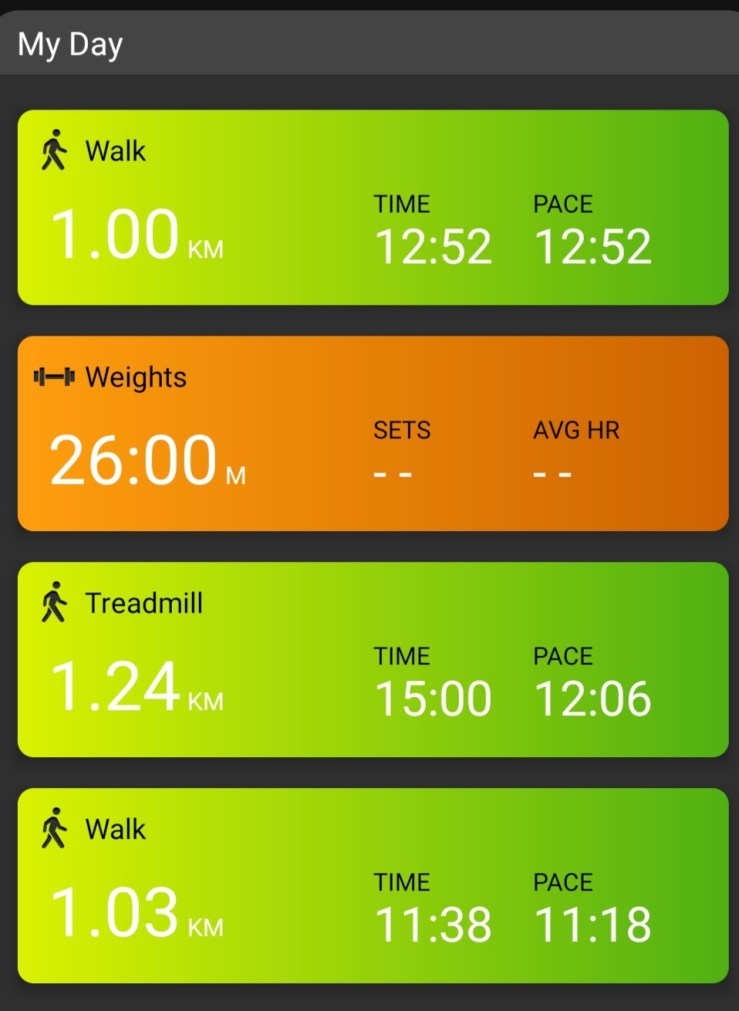
Every activity we do uses battery power. Showering, drying our hair, driving, working, exercising, cooking. In my experience some things use more battery power depending on the time of day: driving is a classic example. Driving for one hour in the morning is not nearly as tiring as driving for one hour in the evening after a day at work. It is almost as if once the battery gets low, it depletes faster. We have to be aware of all these things. I don’t want to cause a fatal car accident because I lose concentration because I haven’t paid heed to my battery level. Look at the pace column of my walks in the image above. the first walk of the day is the fastest, the last is the slowest. This is a constant pattern.

Early in my journey, I would have been unable to do a weight training session and grocery shopping on the same day. That would have used way too much of my battery. Even now, I shower in the evenings. Why? Because I can do it at a slower pace in the evenings and I am not using up vital battery life I need for the work day.

A good night’s sleep should recharge us, you say? We wish that were true. In many cases it is true – unless we have drained too much – then we end up in that negative charge scenario. Not good. However, disrupted sleep is often a symptom experienced by those with chronic conditions. Imagine trying to charge your flat phone, but the charger plug keeps falling out of the phone overnight. In the morning your phone battery is still at only 50%. That can be us.

Strength can fluctuate as well. I happily did 32 kilogram chest press sets one day with every intention of increasing next visit. Next visit I struggled with 25 kilograms. Why? No idea. By no idea, I mean no rational “healthy” explanation. Just that day my body said, “No, not today”.

Endurance is linked to our battery too. Some days I can walk two kilometres easily in one walk – other days I have to stick to three separate one kilometre walks. I’ll feel exactly the same at the start of any walk – then sometimes the body just says, “No, not today”. Part of this is linked to my not having the time available at the moment to consistently Pace UP. Between work and weather I have been limited to grabbing my walks in a somewhat patchy manner which breaks all the rules of pacing. Consistency is key. I’m not getting consistency. I suspect similar applies to the weights.

It is very hard to explain to people what this whole energy thing is like. How we constantly have to be aware of how much battery we’ve used. Healthy people would not, for example, think of having a shower as using energy, or should I say using any great amount of energy. I can assure you, many of the chronic illness community will attest to having to rest after a shower.

In my last article I raved, quite rightly, about the medication I am on. I also stated it hadn’t completely solved the energy/lethargy/fatigue aspect, or the “brain fog”. Despite my writing about energy today, these aspects are still much improved from where I was three years ago. To give some sense of measurement, three years ago I was working 24 hours a week and Saturday morning would always be a recovery morning – I’d do nothing until at least noon. Now I am working 38 or more hours a week and I’m actively doing something by 10 am on Saturdays. I might be at the gym, grocery shopping, doing laundry: I’m active. So a major improvement. And some quantification, which makes me happy!

However, I’ve had to cut my second weight session a week because the energy required to drive to the gym, do weights, drive back and then shower is more than I can manage at the end of a work day. I rarely write any more because usually by the end of the work day my brain has said, “No, not today”. I started this article on December 31, it is now January 16 and I still feel this is very scrappy writing. On the other hand it is a very scrappy topic: as I said I can’t quantify it very well. My thoughts about it come and go: after all, we learn, over time, to live with it. It becomes our new normal. At the same time we recognise that our healthy friends, family and co-workers can be baffled by something they have no experience of and it is not visible.

When I wake up in the morning, assuming I haven’t overdone it the day before, I feel perfectly “normal” just as I did before I became a chronic condition patient. The main difference is at the end of the day I will NOT feel as I did at the end of a day back then. Furthermore, depending how much “charge” I use during the day, I could hit that flat battery state earlier in the day. Other patients will not be as fortunate as I am, I am aware of that. So readers, just because I say I can do something, DO NOT, please do not, assume your mother, father, sibling, friend or co-worker can. They may be “better” or “worse” that I. I am simply n=1 – I’m not a study, I’m just one example trying to explain what it can be like!

As I write, at the beginning of 2021, I am very concerned for the long haul Covid-19 patients, many of whom cite fatigue as an ongoing issue. While the studies of this phenomenon may shed scientific light on ME/CFS, we will also have more chronic patients. My thoughts on society and chronic conditions are expressed in Society and Chronic Health Conditions. As communities, we have challenges ahead.

Engaging the Correct Muscles

You did it! You went to a physiotherapist or exercise physiologist (EP) or personal trainer (PT) and you now have a resistance training programme! Congratulations, you have taken another step in managing your chronic condition.

Even though I am qualified, I still seek the assistance of other professionals when I deem it appropriate. I did recently, with my osteoarthritic knee.

One of the exercises I have to do currently is the TRX supported squats shown in the above photo. As I was doing them alone I realised, “Hang on a minute, I’m using my arms to pull myself up!” This, of course is not the idea at all with squats – the target muscles to work are the lower body! Yes, in this case I am using the TRX to support, but I still need those lower body muscles to do at least some of the work!

While we are under the watchful eye of our physio, EP or PT they are watching closely and monitor that we are engaging the correct muscles. Technique isn’t just about holding correct form (e.g. a straight back), it is also about using the right muscles.

Once we are on our own, not being monitored, we have to ensure we are feeling the right muscles working. Sometimes that is harder than others. During a leg extension exercise it is a little harder to cheat, but those TRX squats? Quite easy to cheat. Especially for those of us with chronic conditions trying to rebuild our physical strength and resilience.

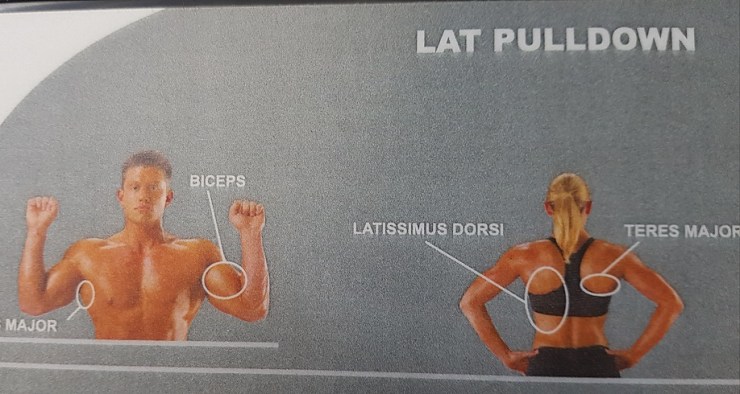
When you are in the gym by yourself working your program, check the pictures on the item of equipment (if you are using equipment), there should be some like this.

Concentrate on feeling those muscles working.

Where there is no pictorial reminders or guidance, there is usually a gym instructor on duty who won’t mind checking your technique for a moment or two if you ask.

During your physio, EP or PT consultation, make sure you are clear on exactly which muscles you should be engaging when doing each exercise and make sure you concentrate on feeling them working when you are on your own.

We want our time spent exercising to have therapeutic value, after all!

Bonus Reading for Psoriatic Arthritis patients:

A resistance exercise program improves functional capacity of patients with psoriatic arthritis: a randomized controlled trial