Strength Training – Getting Started (Part II)

If you have not done so already, read Part I before reading this article. Also pay close attention to the caveat therein.

Please bear in mind it is impossible for me to cover everything in one or two articles. My aim is to give you ideas and tips about how to get started.

Choosing Your Trainer

If you have an exercise physiologist – problem solved! They can develop a program for you and will know all the stuff I’m (hopefully) putting in laymen’s terms in this article! But not all of us do have exercise physiologists. Like any profession, you have to find the right one for you. I’m very happy with mine, but I have pointed out to one (in a hospital environment) that what I was being asked to do was not suitable given my overall situation at the time. Communication is, as with so many things, key. Recently I met a personal trainer who has become a osteopath as he wanted to increase his knowledge. This would be another ideal situation, of course!

From here on, I am writing as if you do not have an exercise physiologist.

As I described in Part I, different trainers have different areas of expertise, the same as doctors. No doctor graduates from medical school as a rheumatologist. Fitness coaches/personal trainers don’t finish their certification with a specialist knowledge of chronic illness patients. We need to find a trainer with either further education in this field or considerable experience – or willing/wanting to learn.

What questions should we ask? That is going to vary from person to person, depending on your particular condition/(s) AND the stage of progression of your condition/(s). I can give you some ideas, but you will need to think about your own specific situation and what might be the best questions to ask in your situation. What you are looking for is the trainer’s willingness to and hopefully knowledge about adapting exercises to suit your situation.

One question I would ask is do they recommend the chest press be done with free weights on a bench, or on a chest press machine. Yes, we already know I’d MUCH prefer to be doing the chest press with free weights – but I don’t for safety reasons as explained in Part I. I’d be looking for a trainer who was aware of the risk mitigation.

Another may be simply asking what do they know about your medical condition/(s). Hopefully you know enough to know if their answer is correct! If they don’t, are they willing to research. Effectively, your trainer becomes part of your “treatment team” and while you don’t need another doctor, you need them to understand the basics of things like flares and inflammation.

Side arm raises are an exercise where the angle can be changed from the standard lateral raise. Or the elbow can be bent slightly. These modifications depend on individual circumstances – I adjust my technique, you may not need to. This is a classic example of why the questions you ask need to be tailored to your situation.

The big one is the old “no pain, no gain” mantra. For a healthy person there is some truth to this – you might feel like you’ve lifted weights a day or two after you’ve lifted weights especially if you are lifting to failure. None of us will be doing that! If we feel discomfort doing an exercise it could be for a number of reasons:

  • Could be because we haven’t used that muscle or muscle group for a while
  • Could be because there is currently some inflammation there
  • Could be because over time we have “protected” that area and it has become weaker than it should be

The list is rather endless but we must stick to the pacing principles of Chronic Pain Management – feel a change, stop! NO “pushing through”. As I pointed out above, it may be a solution to change the angle, or drop the kilograms you are lifting, or do less repetitions (or drop kilograms and increase reps – the possibilities are many). The bottom line is you need a trainer who is well aware of these adjustments and who will NOT encourage you to continue at ANY level of discomfort.

Program Options

What sort of program you do will depend on your condition(/s), your background with strength training (if any), your level of overall fitness and your energy levels. While yes, you want to improve, you also have other things to do in your life such as cooking, laundry, driving and you need to ensure you don’t use all your energy on any one activity. Some chronic illnesses impact our energy levels quite severely, others not so much.

Be guided by the trainer – that’s why you are paying them after all – but be guided by yourself. If you feel the program design is too much for you when first starting out (e.g. do you feel wiped out the next day) then cut it back, add exercises back in slowly.

You may start with something like (I just plucked these out of the air for illustrative purposes):

  • Warmup
  • Leg press
  • Chest press
  • Seated row
  • Leg extension
  • Bicep curls

That’s not a heavy load BUT it is enough to see how your body reacts. If you feel fine, add a couple more exercises in.

Remember, the more exercises you do per session, the more careful you may have to be about increasing the weights because more exercises means using more energy. Increasing kilograms means using more energy. You don’t want to use too much energy all in one go. Avoid the Boom/Bust cycle!

Also, see the “How Often” section. You can split the workload!

Starting Kilograms

Recently I took a much younger friend, Tanya, to the gym with me. Tanya had expressed an interest in building her strength but was a bit wary of hitting a gym full of body building champions (my words, not hers). My gym is nothing like that so I invited Tanya along. Essentially she is healthy, not a chronic illness patient. She had recently noticed that physical work had resolved some shoulder pain she had been experiencing and that had driven her to think more strength training would be a good idea.

We did a warmup on the treadmills then headed for the leg press. I am mortified by my own (now) measly (by my expectations of myself) 125 kg leg press, and innocent me assumed given Tanya’s relative youth and health status, she’d easily lift that. I was wrong. We needed to drop the kilos. I have lifted weights most of my adult life, I have a history. Tanya doesn’t. So even though I’m sad I can’t lift what I once did, Tanya’s legs had no such experience! On one machine I had to set the weight to no weight at all. I will say Tanya is now more inspired than she already was to build her strength!

And she posted a lovely compliment: “Can this woman lift some serious weight, yes she can! Put me to shame!” I didn’t put her to shame at all really. I suspect it was a simple case of my friend underestimating my abilities due to my age (compared to her age) and medical conditions! Tanya is 16 years younger than I am. I probably overestimated her abilities due to her youth and recent physical work.

The lesson here is your starting weights could be anything. DO NOT STRUGGLE. Yes, you will see healthy people lifting to failure (keep increasing the weight until they literally fail to lift that weight). WE are NOT going to EVER do that, unless you are lucky enough to go into remission!

Start with a weight that feels comfortable for you for that exercise. You might start by doing 8 reps a set instead of 10. Increase the reps each session, then increase the weight and drop back the reps at the new weight. As I mentioned in Part I, I tend to build up to 12 reps a set before I increase the weight. At the new weight I’ll do 8 or 10 reps depending on the exercise.

If your trainer says, “That looks too easy for you, let’s increase”, that’s fine to TRY, but if you feel any discomfort or you struggle, drop back. Pacing rules rule!

How Often

When I started back I did strength training twice a week. I then increased to every third day. Now I’m doing three times a week and I very much doubt I’ll go beyond that, simply because I want to ensure I don’t overdo it. It also depends on what else you are doing. I walk and swim. You might cycle or run. Some readers will still be working, may have families you are caring for: any number of other aspects of life that require energy. And let’s not forget those darn medical appointments you still have to fit in – they take energy too.

Initially, I dropped my step goal on the days I did weights. I no longer do that, but it is an approach that works in the early days. It is all about balancing your energy use while you build more energy reserves.

Now I’m going to paint a general picture. I’m not saying this next idea is what you should do, I’m saying this is an example of what you MAY do. The trainer and you decide on a program. Be aware it doesn’t have to be done all on the same day. You can split the exercises. Spread the exercises over two days. You may do upper body one day, lower body the next. Or you may find a bit of both is better. For example, my wrists have been problematic from time to time. Most upper body strength training exercises involve use of the wrists in one way or another. Consequently, at those times, I do not do all my upper body on one day. That may aggravate my wrists, not something I’m keen on.

We have to be a bit more flexible (no pun intended) on how we approach strength training, especially in the early stages.

Other Adjustments

I’ve seen stroke survivors in the gym exercising one side of their body. I’ve been there in a moon boot doing upper body only. Other times I’ve done lower body only because my shoulders were flaring. I’ve walked in on crutches and only done upper body. We need to be prepared to be flexible in our approach. Sure, I’m working on increasing my weights, but there’s been days when my body just says, “no, not today” and I have to drop my weight (on whatever exercise) for that specific day.

Don’t get hung up about increasing constantly. That’s not what this is about, we aren’t aiming to compete at the Olympics, we just want to maintain our independence (see the articles at the bottom of Part I).

Don’t feel defeated if today you can’t lift what you lifted three days ago. We have chronic illnesses that often seem to have minds of their own and while we are in charge of managing those conditions, part of managing them is listening to our bodies.

I wear a mask. Yes, I’ve been asked, “Are you going to lift weights in a mask?” Yes, I am. I am immunosuppressed and have underlying inflammatory conditions. I DO NOT need Covid! I am not lifting the sort of kilos that would have me gasping for breath. I will say I can only manage about 500 to 700 metres on the treadmill with a mask, but that’s all I need for warmup.

Protein

Check how much dietary protein you are consuming. Many of us don’t eat enough protein and if we add strength training to our “To Do” list we need to ensure we are getting enough. I am not a nutritionist so I suggest you talk to your GP or a nutritionist. I have cited this article before, specifically related to inflammatory diseases (and inactivity).

Effects of inflammation and/or inactivity on the need for dietary protein – PubMed

I found this interesting as I realised at one point my protein intake was not reaching even the recommended levels for a healthy person AND my pain had increased. I asked a physiotherapist was he aware of any research re pain and lack of protein. He wasn’t. I discovered I felt better when I upped my protein intake. I then went searching for any research on the topic of inflammatory conditions and dietary protein. The above article is one of several I found and the one I cite.

Remember, if you eat a 180 gram steak, you are not eating a 180 grams of protein! A beef eye fillet is about 22% protein, per CalorieKing.

Note for Older Australians

If you have a My Aged Care Plan you MAY be eligible to have your gym membership paid for through your plan. Your program would need to be developed by an exercise physiologist (verification requires paperwork!) or similar allied health professional.

In Closing

I hope this has been helpful. If you have any questions, drop them in the comments and I will respond.

If there is a topic you would like me to address, let me know!

Build that strength!

My favorite walking spot

Active Rest Days

Movement As Medicine is a balancing act. Sometimes we have to adjust our weights, our speed, our range of motion or other aspects of our exercise regime due to our conditions misbehaving unexpectedly. In this article, I’m not looking at those situations: this is about when our conditions are behaving! It is important to keep moving every day: it is also sensible to have active rest days. Active rest days are not specifically a chronic illness tool, it is a standard fitness coaching recommendation. It can be useful for us too!

I am using my stats to illustrate. I don’t run or cycle, but the concept is the same, just apply the underlying logic to whatever your exercise preference is.

If I’m moving, how am I resting, you ask? Funny you should ask, that’s just what I am about to explain.

I have several personal objectives at the moment:

  • Improve my VO2 Max
  • Increase my walking speed
  • Maintain my daily step goal streak (sitting at 72 days as I type)
  • Increase my weights

Doing the above every day relentlessly would NOT be practical. Pacing is critical at the best of times! While pacing is about improving (if possible), it is also about making sure we don’t boom/bust. Active rest day are days we do keep moving, but we are not trying to break any records. When just starting out, of course, no-one is breaking records, pacing rules everything we do (not just exercise). However, once we reach a more stable state with our conditions and providing we take due care and do not overdo things, we can have some objectives we could not have managed in previous years.

I don’t lift weights on an active rest day. I don’t try to increase my walking speed. I will still hit my step goal for the day. I’ll just do it slower and possibly in smaller chunks.

My daily step goal is 7,500 steps. I also have a goal of formally walking 4 kilometres a day. Why both? I’m retired (so not working) and I live in a very small apartment so I don’t get many incidental steps. I can walk 4 kilometres in less than 7,500 steps (5,600 steps to be precise). Other days I might be running errands and clock up some of the 7,500 steps pottering around the pharmacy etc, but not have achieved 4 kilometres in formal walks. On weight lifting days, I’ll clock up steps at the gym. Those days, because I’ve used energy to weight lift, I am happy to not achieve 4 kilometres as long as I still get 7,500 steps. None of that explains active rest days, but it paints the picture of where I am at.

Over time I’ve improved my walking pace from around 13 minutes a kilometre to somewhere between 10:30 to 11:30 minutes, depending on the day – I walk faster in cooler weather!

On an active rest day I’ll drop that speed back to around 12:00 to 12:30 minutes per kilometre.

I’ll also take shorter walks. On a “workout” walking day, I’ll aim for a distance between 2.5 to 3 km in my main walk (depending on where I am actually walking). I will take a shorter walk later. On an active rest day I’ll walk three or four times, about two hours apart. So I’m slower and have lowered the intensity. I’m still moving so nothing seizes up, but I’m doing it more gently. I’m actively resting.

I recently increased my weight lifting sessions from every third day to three times a week. I lift weights Monday, Thursday and Saturday, keeping Tuesday and Wednesday free for other commitments like medical appointments, walks or lunch with friends and other normal things. Even with my weights sessions, I make Saturday a lighter workout than Thursday and Monday, simply because I don’t want to risk overdoing the heavier weights such as leg press and chest press, especially as I’ve recently upped the overall regime. There is flexibility here too. In six months time I may decide to make Saturday a little more intense, but I’m seeing how my body holds up first!

In case readers are wondering, “If she is pacing UP, why is she not trying to increase her step count per day or the 4 kilometres?” Fair question. We can’t increase everything at once. At one point, when I first reintroduced weights into my exercise plans, I used to drop my step count goal on weights days. Gradually I’m got to the point I no longer need to do that. Also, studies have shown that 7,500 steps a day is fine – for healthy people. So I’m in no hurry to try to hit 10,000 (it was a marketing thing) steps. As for the 4 kilometres – some days I do walk more, but 4 kilometres is my target. If I exceed it, great, but I don’t make exceeding it a goal at this time. Increasing my speed is my current goal.

The featured photo is of my favourite walking spot, taken from one of the bridges that crosses the creek. This is where I do walks of 3 kilometres or more. Listening to the birds.

Be Careful Who You Believe!

I had a very concerning conversation on social media across yesterday and today. I made a post (see below) and the reply poster (I’ll call him RP from here on) told me my exercise regime was wrong, according to his doctor. Not only that, what he told me to do was COMPLETELY incorrect for my situation. What concerns me is people new to chronic illness life may be persuaded by him to follow his advice which may be COMPLETELY contraindicated for those people. Everyone is different!

To put some context around the conversation that took place, on December 29 I had an infected cyst removed from my back by a plastic surgeon. Because it was infected I was given strict instructions NOT to get the dressing wet or to sweat. It is not a waterproof dressing, due to the fact the cyst was infected. We are in Australia, in summer: we can sweat walking to our letterbox. So I have had to take that into consideration in the last couple of weeks.

Secondly, I am clinically heat intolerant. In the past I have ended up in the Emergency Department due to my heat intolerance. I prefer to avoid that.

To top it off, we have been in the middle of a heat wave. Looking at the RP’s social media profile, I think he may not be used to temperatures around the 40o Celsius mark. Trust me, not the sort of temperatures it is safe for me to be out and about in.

Most of my followers were aware of all the above when I made the following post, so I didn’t go into specific detail.

YAY! After the heat inhiiting my working, II finally got my daily goal again! Next 2 days will be OK, then we are back in the 30+ range again. (includes two pics from Garmin

The reply I received?

“Walking? That’s more of a stroll! Let’s start with 5 km a day!”

He had not, I think, clicked into the actual image (full image above title) to see I had in fact walked 4.1 km in total.

My reply:

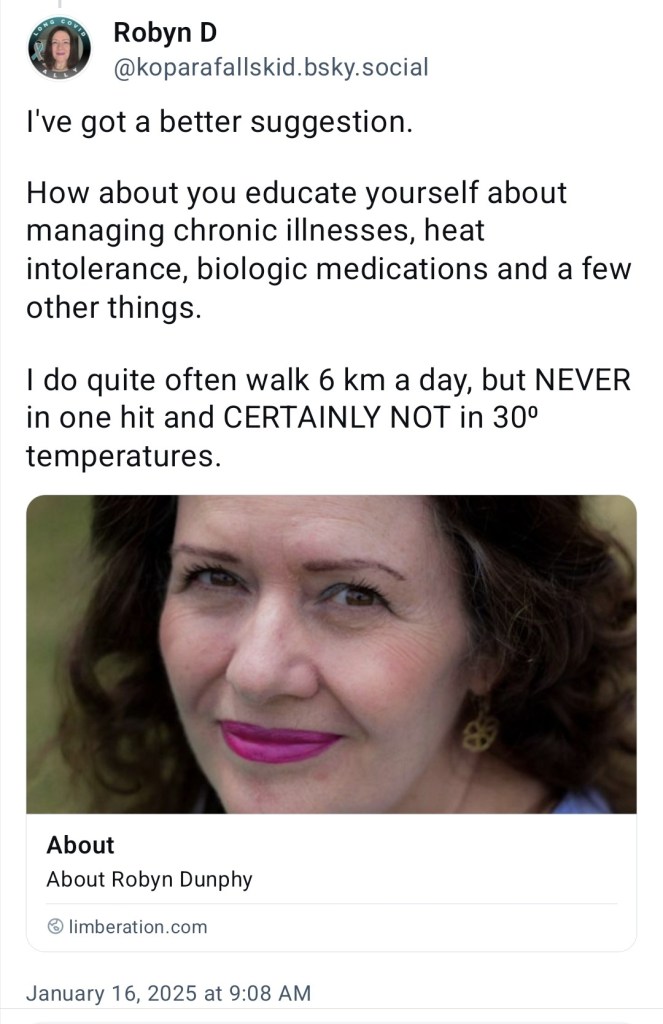
've got a better suggestion.

How about you educate yourself about managing chronic illnesses, heat intolerance, biologic medications and a few other things.

I do quite often walk 6 km a day, but NEVER in one hit and CERTAINLY NOT inn 30 degree temperatures. (Included link to my About page)

At that point I thought that would be the end of the discussion. But no! This morning I woke up to a stern lecture.

RP’s reply to me:

“I don’t have to, my doctor has recommended that I go for regular walks for various health reasons. And he didn’t mean 10 minutes around the corner, but 30-60 minutes a day! So I can only recommend that you educate yourself!”

He then added, “BTW: At every weather!”

I have redacted his ID in the image below.

Image of text quoted above.

I am actually qualified to give exercise advice, which he would have discovered if he had bothered to actually look at my About page.

I replied:

No, RP, you are not correct is assuming what is recommended for YOU is suitable for ALL patients. If you do that, you risk causing someone damage.

l am qualified, thank you very much, to give the advice I give. You are not. So please pay attention and learn some things you clearly do not know.

I do exercise for a hour a day, just not all in one hit, which would lead to the Boom/Bust cycle, something you clearly know nothing about.

Again, I am qualified in this field. You are not. I also have 10 years lived experience. Into my 11th year now. It is not safe for you to give incorrect advice to other patients based on something your doctor told you for your medical situation. Please do not do that!

So his doctor has recommended he walk for 30 to 60 minutes a day. Great. FOR HIM! He clearly knows nothing about the Boom/Bust Cycle, Pacing, chronic pain management and a host of other things. But he sees fit to tell me, in my 11th years of managing my chronic illnesses and qualified in exercise and having attended a chronic pain management program, that his doctor’s advice applies to ME? Furthermore, he tells me to educate myself?

Importantly, not many doctors are also qualified exercise practitioners. That is why we have Exercise Physiologists, Physiotherapists, Fitness Coaches and Personal Trainers. Exercise Physiology is a four year degree: not many doctors will have added that onto their already lengthy medical degree and training.

Of course, in attacking me, he chose the wrong person. I know what I am doing. My medical specialists are in total agreement with me. I was qualified to hit back.

What worries me is people new to chronic illness life, or their family or friends, may believe this random uneducated person on the internet and do themselves some serious damage in the process. Always make sure you receive advice from QUALIFIED practitioners who ALSO know YOUR specific medical situation. RP’s doctor knows NOTHING about me, but RP thinks his advice somehow magically applies to me. I wouldn’t give RP advice unless I had done a complete assessment consultation and he had medical clearance in writing.

Reference Articles (some are already linked above):

Beat the Boom/Bust Cycle
Pacing for Beginners
Pacing THRU, Pacing UP, Pacing DOWN
Let’s Revisit Pacing
Exercising in Summer When You Are Heat Sensitive

Rattle Ya Bones Day!

Rattle Ya Bones Day is coming! What is Rattle Ya Bones Day, you ask? I’m so glad you asked, because that’s what I want to tell you about!

Rattle Ya Bones Day is a National Day of Awareness for all muscle, bone and joint conditions. It’s held every year on October 31.

Let’s look at some statistics around musculoskeletal conditions.

  • 1 in 3 people have one or more musculoskeletal conditions (That’s about 7 million of us, give or take)
  • Musculoskeletal conditions aren’t just conditions of old age. Babies, children, and young adults are affected as well
  • 93% of people told us that their lives were negatively impacted by their condition
  • 58% of people are of prime working age (25-64)
  • Musculoskeletal conditions are the most common cause of early retirement (yes, that includes me!)
  • Musculoskeletal conditions cost the economy $55 billion each year.

Given 1 in 3 people have one or more musculoskeletal conditions it is highly likely even if YOU do not, a member of your family, a friend or co-worker has a musculoskeletal condition. Regular readers know I do: psoriatic arthritis. I also have a bit of osteoarthritis and minor scoliosis of the spine. Rattle Ya Bones Day is very relevant to me!

Remember, quite often our conditions are invisible: I’ve written about that particular challenge before, in “We Don’t All Look Sick! Invisible Illness“. This is a photo of me I used in that article – I don’t (I hope) LOOK sick, but yes, I am.

Me! Looking not sick, I hope!

This year’s message is “Get informed and Get supported”.

Learn more about conditions like arthritis, back pain and others, to help you and those you love live well.

On the evening of October 31, MSK will present the Koadlow Community Lecture, Back Up: Why back pain treatments aren’t working and the new science offering hope.

The 2023 Koadlow Community Lecture will be presented by Liam Mannix, a multi-award-winning national science reporter for the The Age and the Sydney Morning Herald. Liam is one of the many who live with back pain, and he takes his own experience as a starting point for his recently published and highly praised book of the same title.

If you are interested, click here to find out more!

Support Musculoskeletal Australia’s work: Please donate today. Your support plays a crucial role in enabling MSK to provide free resources aimed at improving the quality of life for people impacted by muscle, bone, and joint conditions. By donating, you become an agent of change, ensuring that those facing these challenges receive the support and resources they deserve. Together, we can make a lasting impact and create a brighter future for everyone affected by muscle, bone, and joint conditions.

Together, we can raise awareness, share information, and foster a more compassionate and informed society regarding muscle, bone, and joint conditions. Join us on Rattle Ya Bones Day 31 October as we strive to make a positive impact and create a place where everyone has access to the support and resources they need.

Musculoskeletal Australia also has an on-line shop where you can buy items that may make your life or the life of a friend, family member or colleague just that little bit easier. Highly recommend visiting! The kitchen page is particularly useful for me, with dodgy hands.

Need More Information?

Perhaps your organisation may be interested in supporting Musculoskeletal Australia and/or Rattle Ya Bones Day? Your organisation’s support will help create awareness around the wide variety of musculoskeletal conditions and the impact they have on people’s lives. Contact us (that link is to MSK, not me personally 😊) to learn more.

Get informed. Get Supported. Rattle Ya Bones Day

Disclosure: I am a member of the Consumer Advisory Committee of Musculoskeletal Australia.

Walking Graph

Why Is There A Dip In My Stats?

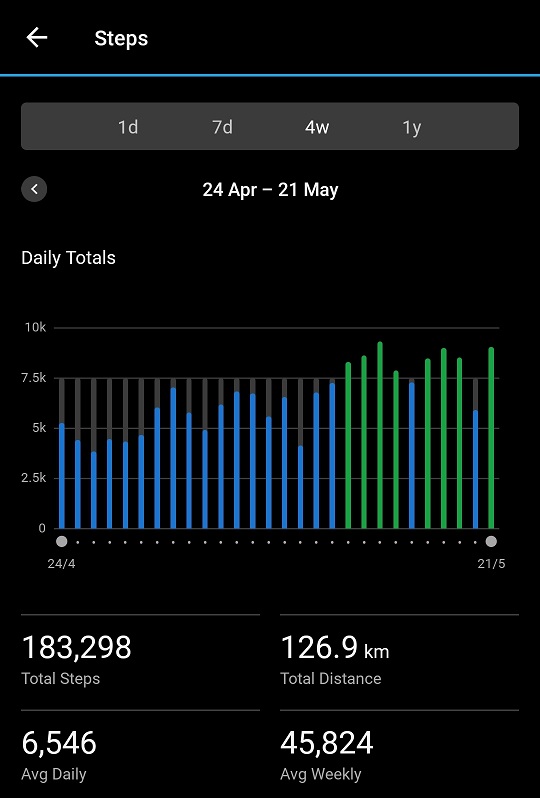
Above is a snapshot of my walks for the last four weeks. In my last article I wrote I was improving. Yet we see there was dip yesterday. Why is this so? You’ll be pleased to know it is a deliberate dip. A very deliberate dip, in fact. Recently I wrote Let’s Revisit Pacing. If you are new to my work I strongly suggest you click that link and read that first as this is, essentially, a sequel. A real life example.

Improvement has allowed me to get to the point I am walking 4 kilometres each day: but that was all I was doing! At least that was my primary use of energy over and above actually fueling the bodily functions that keep us alive: pumping blood, breathing, digesting food etc.

Yesterday I did two activities that require energy, that chew through our internal battery charge. I had a shower and I did grocery shopping. This wasn’t a “nip down to the shops and grab a pint of milk” trip, this was a monthly stock up. When I got back to my apartment it was four trips between my apartment and the car to bring everything inside. Then the effort of putting it all away.

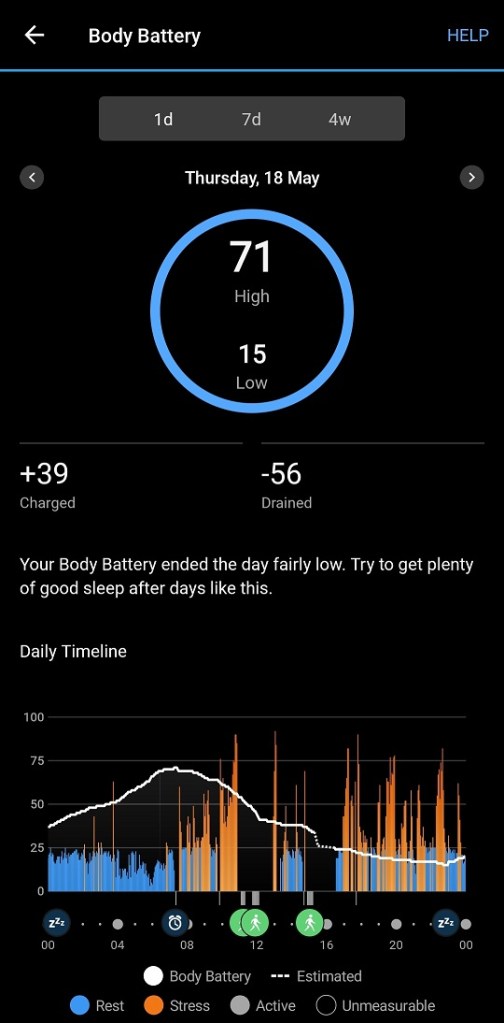
When I initially wrote about what I call our internal battery, I stated I didn’t have a charge meter on my arm! I do now: my Garmin watch. Here it is for yesterday (Saturday) compared with Thursday. For whatever reason, I hadn’t charged my battery as well overnight Friday night, so I was already a little low on fuel Saturday morning. I will state I am not sure how accurate this is for chronically ill people – I’m working on watching it carefully – but it is certainly an indicator. Blue is charging your internal battery, orange is using it up.

Another point to note is that most of the step counters will not register steps, or register steps accurately, if you are pushing a shopping trolley (or similar activity). Very annoying, as I think I walked about 1,000 steps just around the supermarket. Consequently there is also a dip in my steps for yesterday, even though I was moving. For those wondering the blue bars below are where I did not achieve my daily goal of 7,500 steps. Green bars are goal achieved!

Why not 10,000 steps you ask? Ahhh, well, yes, I have that covered too! Read We Need Personalised Numbers to understand the 10,000 figure is a myth.

Healthy people reading this will most likely understand shopping uses energy. They might raise an eyebrow over the shower taking energy. Trust me, for most of us chronically ill patients, a shower consumes energy. Many of us need a rest afterwards. I don’t usually, but I do at the moment.

What I did yesterday was adjusted my activities so that I did not Boom/Bust. I don’t need to burn through my internal battery one day then be wiped out for the following two or three days. Having a goal of 4 kilomtres a day is great, but at this stage of my “comeback” I am not risking any post exertional malaise (PEM). If I have to do something, like the grocery shopping, I will adjust my walking goal. Hopefully. in a few months I won’t need to: I’ll be back to my “normal”. Right at the moment, I’m not taking that risk. When I do head back to the gym for strength training, initially I will drop my walking goal for that day.

Using Movement As Medicine is not a simple “just get out there and walk”. It requires careful planning and monitoring. I hate “bust” days and monitor myself very carefully to avoid those days. Over time, following the pacing principles, I can do more. Pacing is the golden rule here! Today I walked 5 kilometres. I’ve been working up to it and I did nothing else that used energy today (other than writing this, of course).

I don’t always win!

I get told many of my audience see me as an inspiration. This is a lovely compliment and I really appreciate it. The recognition actually helps keep me motivated to keep doing movement as medicine to manage my own medical condition/(s).

Having said that, not everything goes according to plan. I think it is appropriate I share the dippy things I do as well as the things that go well!

Today was a dippy day. I had a plan for the day. Around 10 am have two sets of bloods done. For the curious among you, one set was for thyroid function as I recently started Thyroxine. Some years ago I swallowed radioactive iodine and as a consequence, sooner or later I was going to go hypoactive. I was lucky, I got a few years before that happened! The time has come. The second test was to meet the PBS regulatory requirements for the authority necessary to continue a biologic treatment for my psoriatic arthritis.

At 10:30 I had a GP appointment scheduled. Then my plan was off to the gym for weights. Saturday was weights, Sunday was swimming, yesterday (Monday) was an active rest day (walked 4 kms and hit goal of 7,500 steps). So back to weights today. Then I realised that was not a great plan as I was having blood tests – and that means no lifting heavy things afterwards. Hmmmm. OK, compromise, I’ll do just lower body stuff, I thought to myself. Yes, if you are wondering, I wear a mask when doing weights.

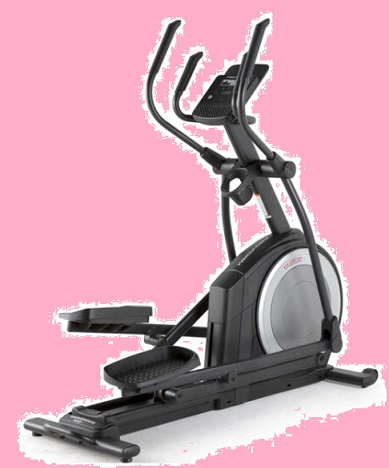
Warmed up on the treadmill. Did leg press, leg extensions, back extensions, hamstring curls, single leg push back. Couldn’t do the seated row, of course, or get on the rowing machine. Did not feel as if I’d done enough and wasn’t keen on getting back on the treadmill. Stationary bike? Nuh, not today. The elliptical machines were standing there looking rather unloved so I decided, not having been on an elliptical machine for WELL OVER 10 YEARS (and I was never a fan of them in the first place), I decided I’d just do five minutes to “top up” my workout.

At the 1 minute 30 second mark (this is me we are talking about, I time EVERYTHING for pacing purposes) my quads were telling me they were not at all impressed with this sudden change to their routine. At this point I thought, “OK, three minutes will do this time”.

At two minutes I hit the stop button. Of course, what has happened NOW is I have decided I must pace up on the elliptical machine, haven’t I? I have no desire to become an Olympic candidate by any means, I’ll be happy with five minutes!

After my recent experience with the screwing of 48 screws with a manual screwdriver, where I subsequently needed to resort to Prednisolone (brief, one day only needed – phew) and a wrist brace, I wasn’t about to overdo the elliptical machine (after a more than 10 year sabbatical). I’d learnt my lesson. Now, why I never applied the pacing logic to screwing things, I have no idea. I know better: excitement at building stuff overrode my thought processes! It happens! But really, *rolls eyes at self* I know full well my wrists are involved in my psoriatic arthritis. I have a special mouse, for that very reason!

I also fitted in my second ‘flu vaccine for the year – one of the joys of being immunosuppressed. Just thought I should finish on a positive note!

Never forget to pace.

I Have Retired. Should You?

I’ve been very quiet on Limberation because I’ve been extremely busy. I’ve retired and moved. BIG life change it is too!

My plan was to keep working until I was 70. My body has been saying, “Maybe not”. Not that I am in constant pain, I’m not. And I want to stay that way. Regular readers will have noticed my articles about energy use and pacing. Two very important aspects to managing my condition and retaining my mobility, function and independence.

By April of this year I had reached the point where I was seriously considering how long I could keep working. It seemed I didn’t have enough energy to work AND exercise enough: #MovementIsMedicine. Of course, simply getting older plays a part in this as well and there is not a lot I can do about the passage of time.

When my name came up on the right list for retirement housing (yes, I had been planning ahead, I was on waiting lists) I made the decision. Retirement was the way to go. The decision involved a lot of work though – energy I really was struggling to find. Writing was definitely put on the backburner. Working through phasing me out of my position in a job I love. Organising the actual move – and the move date got moved twice, just to complicate matters. The move also meant downsizing and that was work. I am typing this on my dining table, not my very large corner desk with a return on each side that I used to have! Packing took more energy. To top it off I got a temperature that hung around for six weeks and towards the end of that six weeks, a tooth infection. The temperature involved a lot of blood tests, some CT scans and several doctors visits. More energy needed. We now think the temperature and the tooth were connected, but initially I didn’t have any tooth pain, therefore we didn’t realise.

It wasn’t just me either. My brother-in-law was diagnosed with an aggressive cancer, my nephew needed stents and my daughter and her husband got Covid-19. There was an attempted identity theft/fraud on an account of mine which had to be sorted as well – I caught it as it was happening, so no losses. Everything was happening at once.

Back to why I retired. I used to be able to walk before work, walk at lunch time and walk after work. I was struggling to find the energy to get dressed before work, let alone walk before work. This wasn’t good for the management of my psoriatic arthritis. I wasn’t being consistent in my exercise either. My weight training had dropped to once a week – I was not happy about that. As a result I was experiencing an increasing number of minor flares and I didn’t want any major flares! I had already cut my working hours from 30 hours per week to 24 hours per week, but the days I worked I was still struggling to do the movement I need, therefore I was losing the consistency.

It seemed if I did the exercise and physical therapy I need to do, I was too tired to work, and if I worked, I was too tired to maintain my exercise regime. Maintaining my health as best as I possibly can is critical to quality of life. I love working, but it reached the point where I could no longer have my cake and eat it too.

Should those of us with chronic conditions make this decision earlier if we can? It is a huge decision. There are the financial implications of course. There may be housing implications as well. The age pension age keeps getting further and further away……. The disability pension (for younger patients) is almost unattainable these days. Women around my age may not have a lot of super (if any) due to the particular decades we worked through, there was no paid maternity leave for many of us and so on.

Yet more and more of the population live with chronic conditions of some sort. We have to make hard decisions about how we manage our lives. I became eligible for the age pension the year before I finally bit the bullet and retired. I am still working as a casual for my employer but minimal hours.

I believe I have made the right decision for my health. Without health, other aspects of our life may suffer: relationships, work, mental health to name just three. Do we try to “keep going” too long, or longer than we should? I’m thinking not just of now, but in ten years time. I want to give myself the best chance of minimising deterioration NOW so I can maintain quality of life in my seventies and eighties. We need to look ahead, not just at tomorrow or next week. Our modern medications, as fantastic as they are, don’t solve everything.

What am I going to do with all this “spare” time? Naturally, I’ve set myself some physical goals: swimming, weight training, walking goals. I will pace up to those goals. Find more unusual flowers!

I will write more. I will get back to my parking permit project. I will finish unpacking, cull my shoe collection.

Paint my nails! Of course!

This first week of full retirement has been psychologically challenging. I hadn’t had time to really prepare myself for the change of lifestyle and then there it was, happening. My advice would be if you can plan ahead, do so.

So that is it. I am retired. A different phase of life.

Bring it on!

(Mostly) No Pain is FANTASTIC!

A few of my recent articles have been quite serious, so it is time to celebrate progress! After starting my new medication on January 14, 2022 I am happy to report I’m functional again! Friday I started Week 7 of my new medication and I very pleased with progress. Let’s hope it keeps working!

Readers may recall my list of painful bits from I Sat in My Care and I Cried. It was a pretty long list.

What was painful?

  • Shoulders
  • Ankles
  • All Toes
  • Left hip
  • Elbows
  • Wrists
  • Most fingers
  • Hands
  • Knees (yes, even the operated knee felt swollen, but not painful, the right was painful)
  • Neck
  • TMJ (jaw joint)
  • Left Achilles Tendon
  • I also had some plantar fasciitis

Today I can happily report all of that list has resolved except the shoulders and the plantar fasciitis. While I was on Prednisolone and the new medication together, the shoulders and the plantar fasciitis were barely noticeable, but as I tapered off the Prednisolone both reappeared. The plantar fasciitis is minor, only noticeable when I first get out of bed in the morning and hopefully will continue to improve the longer I am on the new medication.

The shoulders I am not so sure about. At my age and with prior injuries, I suspect the root cause of the shoulders may not be psoriatic arthritis (although it is undoubtedly not helping). The right shoulder is the worst of the two and that is the shoulder that has in the past suffered a torn rotator cuff. I’m doing lots of remedial exercises which will hopefully improve the situation (I’ll admit to letting those lapse while I was battling everything else). It is time to focus.

Other than that it is great to be able to do all these things again, pain free:

  • Fasten my bra (shoulders are at least allowing that)
  • Hold my full coffee cup in one hand (wrists)
  • Get out of bed without mobility aids (crutches or walking stick)
  • Sit down and stand up without immense difficulty (quads & glutes weren’t firing)
  • Be able to clench my fists (no, I’m not planning on using my fists!)
  • Turn taps on and off without pain (fingers & wrists)
  • WALK!!!!! (mainly ankles, although right knee & left hip had spasmodically interrupted)

That is not an exhaustive list, of course, but hopefully sufficiently illustrative! Functionally, I am almost back to (my version of) normal. I’ve been to the gym and done some hydrotherapy.

The only downside seems to be lethargy. I am quite tired. This may be temporary and may be due to my body adjusting to the new medication, the (tapered) cessation of Prednisolone and quite simply normal life things such as work-related stress. In order to give my body the best chance I have negotiated with my employer to drop my working hours to 24 hours per week. Initially this is for a temporary period of six months and then we will reassess.

The tiredness could possibly be my thyroid firing back up, although based on my last ultrasound we doubt that. Even so, that fact I do have an unhealthy thyroid cannot be overlooked. I’m due for monitoring checks again in April. I was, I gather, a little unusual as a radioactive iodine recipient. Many patients’ thyroid function becomes hypoactive after the treatment but mine never (not yet anyway) did. Both hypoactive (underactive) and hyperactive (overactive) thyroid conditions can result in tiredness/lethargy. Mine, theoretically, could go either way!

I am very concerned about the lack of strength training I have done over recent months as retaining muscle strength really is very important with this and many other arthritic conditions. However, I can’t rush back, I need to pace up again. That is part of the reason for reducing my working hours.

The shoulders, particularly the right one, may be being exacerbated by typing and mouse use. This is something that will also be reduced by reducing my working hours. Of course my bank account is NOT going to like less income, but that is simply a fact of life for those of us with chronic conditions: we have to make our bodies a higher priority than our finances, otherwise we end up with no finances at all as we lose the ability to work.

Overall, pretty darn happy! Of course, there are no guarantees. I’ll just enjoy the improvements while I have them! This gives me space to concentrate on rehabilitating the grumpy shoulders. I’m seeing my myotherapist regularly at the moment to assist.

Concurrent objective is to rid myself of the weight gain from the Prednisolone – there’s always something!

If you are interested in the fascia of the body, this is a great video! This is related to my seeking myotherapy treatment at the moment. More on this another day.

I’m Not Lazy

Neither are YOU lazy. The title above is stolen, with permission, from a social media contact’s tweet.

We’re not lazy, nor are we responsible for other people’s expectations of what THEY think we should or shouldn’t be able to do. Sidenote: often those expectations are based on our appearance. Refer to You Look So Healthy! for more on that.

There are four other articles you may like to browse as background material to this article:

One of the challenges we face is helping people understand the whole energy availability thing many of us struggle with. In the conversation related to the above tweet, J told me she had mowed the lawns, done the edging, walked the dog and cooked dinner. J has the same disease I do, psoriatic arthritis (PsA). While I don’t know or understand the specific expressions of many other chronic conditions, this is one I do understand. J couldn’t see me, but if she could have, my eyes nearly popped out of their sockets.

Other conditions can be very similar, but I will stick with the disease I know for illustrative purposes today.

On a great note, for PsA management, J had certainly been moving. Movement is Medicine! However, J had probably used up more spoons or internal battery than she had available. All that in one day would cost her later, as she well knows from experience.

Society conditions us, well before we get sick, as we are growing up: doing our share, work ethic, earn our way. We then place expectations on ourselves. We don’t want to be sick, we don’t want to let others down by not doing our bit. In the first few years, of course, in the back of our minds we think it is temporary. To understand a bit more on that, you may like to read Will Society Adapt? When? How? Even we ourselves have to adapt to our new normal.

PsA is a very odd disease. At its worst for me, I can wake up in the morning with painful feet, ankles, knees, wrists, fingers; maybe even throw shoulders and neck in on a particularly bad day. I may have to use crutches to get around first thing in the morning. I’ll be unable to turn a tap on. Can’t lift the electric jug, struggle to open the coffee jar. Put on a bra? Are you kidding? Pull on tracksuit pants? Yeah, right. That sort of thing. About 11:30 am I’ll be fine. Virtually pain free. My body will have de-solidified. I’ll head out for a walk, go to the gym and do a weight training session. Sadly 160 kg leg presses aren’t happening any more, but maybe again one day…….. I am a completely different physical specimen at 4 pm than I am at 7 am. I saw my Plan B GP on Tuesday (Plan A was away), who hadn’t seen me for probably a year. She said “You look great!” This was 6:30 pm. I said to her, “You didn’t see me at 7 am!”

This can be VERY difficult for our friends, colleagues and family to understand. You need rest but you also need to go to the gym? That doesn’t make sense! Actually it does make sense and the reasons why are discussed in more detail in the above linked articles, so I won’t repeat myself.

We know, we can see it in their eyes. The doubt. The lack of comprehension of the situation.

We know people think we are just being lazy (at best) or hypochondriacs (at worst). J is right, it is VERY exhausting to be constantly explaining it to people, yet we know if we don’t explain it, if we don’t share the knowledge, social understanding and acceptance will never happen. We use analogies: spoons, internal batteries, even daisy petals. Over time our nearest and dearest do start to understand. If they want to.

If we live by the rules of pacing our activities and energy consumption, many of us can achieve a fantastic very nice quality of life, given our disease. The problem is, to OTHER people our rules can make us look lazy in their eyes – or at least that is how we can feel.

I work six hours a day. I have just entered my eighth year of having PsA, so I’ve had time and practice to build my personal pacing skills. Even so, I still feel guilty some days that I’m not “doing my fair share” at work. I have to lecture myself along the lines of this is what I MUST do or I won’t be able to work at all. I did try full-time for a while in 2019/2020 – it was WAY too much. Recently, we had a systems issue at work. That day I worked ten hours – I was petrified I was going to crash before we solved the problem. Thankfully, I didn’t, but those feelings and fears are what we live with every day. We don’t need to feel others are judging us because we MUST do less than they do in order to regain and retain quality of life and independence.

No, we do not have to vacuum the whole house in one day. A room a day would do!

No, we do not have to mow the whole lawn in one day. J, are you listening?

Spreading out those sort of tasks DOES NOT mean we are lazy. It means we are protecting our bodies, our internal battery and our quality of life.

Today I was going to go grocery shopping. But today is also weight training day. The grocery shopping can wait until tomorrow. Both on the same day would mean I wouldn’t be able to do what I have planned for tomorrow. Grocery shopping will fit with my plans for tomorrow as the overall intensity tomorrow is less.

We are not lazy. I am not lazy. Don’t let yourself be guilted into doing things that break your pacing rules, whatever they may be for you. The goal is to balance activity and energy so you achieve consistency in your state of health.

Personal Energy Use

Early in my chronic illness life, I wrote an introductory article, Pacing for Beginners. More recently, I wrote about Pacing THRU, Pacing UP, Pacing DOWN.

Pacing, balancing my life, has become even more critical since starting a full-time job. The earlier articles talk about the spoon theory and the battery analogy. Today I’m going to stick with the battery analogy as we all understand what happens when our mobile phone battery dies. That’s it. The screen is dead. You can’t make a call. The only option you have is to recharge the battery.

I find energy difficult to write about. I can’t quantify it like I can quantify calories or steps or weights. Energy seems elusive, hard to pin down. Even though I am using the battery analogy, I don’t have a charge meter on my arm. I can’t tell how much battery I have left at any given point in time. So if it seems like I’m pondering as I write, it is because I am pondering as I write.

Many of us with chronic conditions are a bit like a mobile phone. The battery has a limited capacity. I’ve written about fatigue/lethargy before too, in When was the Last Time You Yawned? Working full-time hours again, I have had to revisit my condition management plan to ensure I avoid the dreaded Boom/Bust Cycle. So far, I’ve managed, although my weight training has taken a bit of a back step, sadly.

The difference between me and my phone is if my phone goes flat, I can plug it into power, turn it on and make a call. If my battery goes flat, that is it. Coffee is not going to help. A sugar hit is not going to help. In fact, either might make the situation worse. Imagine if that phone battery could actually go negative and had to be charged back up to zero before use, even when connected to power. THAT is how we can be (not how we can feel, how we can BE) if we are not careful, if we break the rules.

While I was working part-time, I had everything worked out beautifully for me. I got the exercise I needed, the sleep I needed, I did my job well. I never let myself get a flat battery.

While I was not working in the early part of 2020 my plan was to pace up my exercise to build physical resilience in readiness for a new job. With the success of my new treatment, I could do this. There were some interruptions! A knee put me in hospital, then Covid-19 lockdowns followed by a total knee replacement meant things were a bit stop-start, but I was way ahead of where I had been at, say, the end of 2016.

Working full-time has changed how I can arrange my time and also shone a light on the fact the boom/bust cycle is still very much a risk. There have been times at the end of the work day where I quite simply feel my brain shut down. It goes from 90 miles an hour to a dead stop. Nothing I can do about it. The battery is dead. It isn’t just about physical activity, this battery also runs our brain.

It is challenging for people who have no prior experience of these sorts of conditions to understand what happens. After all, many of us, myself included, LOOK fine! It took my daughter some time to come to grips with it, but she now asks “Do you have enough spoons, Mum?” when suggesting something.

I’ve become better at declining social invitations – no, not on an evening before a work day, or no, not two events on one day.

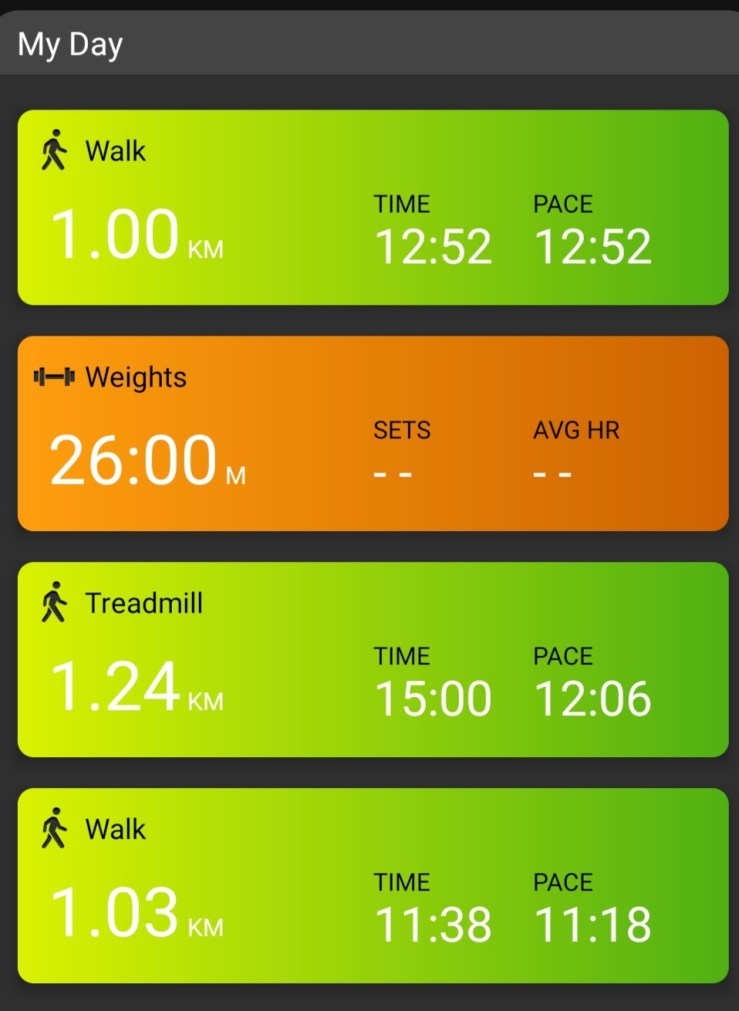
Every activity we do uses battery power. Showering, drying our hair, driving, working, exercising, cooking. In my experience some things use more battery power depending on the time of day: driving is a classic example. Driving for one hour in the morning is not nearly as tiring as driving for one hour in the evening after a day at work. It is almost as if once the battery gets low, it depletes faster. We have to be aware of all these things. I don’t want to cause a fatal car accident because I lose concentration because I haven’t paid heed to my battery level. Look at the pace column of my walks in the image above. the first walk of the day is the fastest, the last is the slowest. This is a constant pattern.

Early in my journey, I would have been unable to do a weight training session and grocery shopping on the same day. That would have used way too much of my battery. Even now, I shower in the evenings. Why? Because I can do it at a slower pace in the evenings and I am not using up vital battery life I need for the work day.

A good night’s sleep should recharge us, you say? We wish that were true. In many cases it is true – unless we have drained too much – then we end up in that negative charge scenario. Not good. However, disrupted sleep is often a symptom experienced by those with chronic conditions. Imagine trying to charge your flat phone, but the charger plug keeps falling out of the phone overnight. In the morning your phone battery is still at only 50%. That can be us.

Strength can fluctuate as well. I happily did 32 kilogram chest press sets one day with every intention of increasing next visit. Next visit I struggled with 25 kilograms. Why? No idea. By no idea, I mean no rational “healthy” explanation. Just that day my body said, “No, not today”.

Endurance is linked to our battery too. Some days I can walk two kilometres easily in one walk – other days I have to stick to three separate one kilometre walks. I’ll feel exactly the same at the start of any walk – then sometimes the body just says, “No, not today”. Part of this is linked to my not having the time available at the moment to consistently Pace UP. Between work and weather I have been limited to grabbing my walks in a somewhat patchy manner which breaks all the rules of pacing. Consistency is key. I’m not getting consistency. I suspect similar applies to the weights.

It is very hard to explain to people what this whole energy thing is like. How we constantly have to be aware of how much battery we’ve used. Healthy people would not, for example, think of having a shower as using energy, or should I say using any great amount of energy. I can assure you, many of the chronic illness community will attest to having to rest after a shower.

In my last article I raved, quite rightly, about the medication I am on. I also stated it hadn’t completely solved the energy/lethargy/fatigue aspect, or the “brain fog”. Despite my writing about energy today, these aspects are still much improved from where I was three years ago. To give some sense of measurement, three years ago I was working 24 hours a week and Saturday morning would always be a recovery morning – I’d do nothing until at least noon. Now I am working 38 or more hours a week and I’m actively doing something by 10 am on Saturdays. I might be at the gym, grocery shopping, doing laundry: I’m active. So a major improvement. And some quantification, which makes me happy!

However, I’ve had to cut my second weight session a week because the energy required to drive to the gym, do weights, drive back and then shower is more than I can manage at the end of a work day. I rarely write any more because usually by the end of the work day my brain has said, “No, not today”. I started this article on December 31, it is now January 16 and I still feel this is very scrappy writing. On the other hand it is a very scrappy topic: as I said I can’t quantify it very well. My thoughts about it come and go: after all, we learn, over time, to live with it. It becomes our new normal. At the same time we recognise that our healthy friends, family and co-workers can be baffled by something they have no experience of and it is not visible.

When I wake up in the morning, assuming I haven’t overdone it the day before, I feel perfectly “normal” just as I did before I became a chronic condition patient. The main difference is at the end of the day I will NOT feel as I did at the end of a day back then. Furthermore, depending how much “charge” I use during the day, I could hit that flat battery state earlier in the day. Other patients will not be as fortunate as I am, I am aware of that. So readers, just because I say I can do something, DO NOT, please do not, assume your mother, father, sibling, friend or co-worker can. They may be “better” or “worse” that I. I am simply n=1 – I’m not a study, I’m just one example trying to explain what it can be like!

As I write, at the beginning of 2021, I am very concerned for the long haul Covid-19 patients, many of whom cite fatigue as an ongoing issue. While the studies of this phenomenon may shed scientific light on ME/CFS, we will also have more chronic patients. My thoughts on society and chronic conditions are expressed in Society and Chronic Health Conditions. As communities, we have challenges ahead.